Which AI image generator is best for realistic, anime and illustration prompts? This page cannot honestly rank models, and the reason matters for how you run your own comparison. All eight generation records behind this article come from a single model, Krea2 Turbo. There is no second model to compare it against. What the records do show is how one model behaves when the same prompt recipe is pushed toward three visual languages: photographic, anime and flat-color illustration. Below is what is visible in those images, where they break, and a fair way to test several models yourself.
One model, three style families
The prompts were written as a scene description plus a style phrase, for example "cinematic realism", "polished modern anime poster style" or "vintage-modern travel illustration style". Krea2 Turbo produced a recognizably different image language for each. That is a limited claim: one generation per prompt, no repeats, so it says nothing about reliability.
Photographic: texture and light
a realistic lifestyle portrait of a woman seated near the front window of a narrow urban cafe, dark wool coat over a cream knit top, one hand around a ceramic cup, relaxed but alert expression, soft natural pose, overcast daylight diffused through glass, subtle street reflections, concrete wall and warm wood textures behind her, cinematic realism, Sony A7R V look, 50mm f/1.8 depth of field, natural skin texture, believable eye detail, clean hands, layered mid-gray and espresso color palette, editorial composition, high texture fidelity, realistic lighting falloff, no exaggerated beauty retouching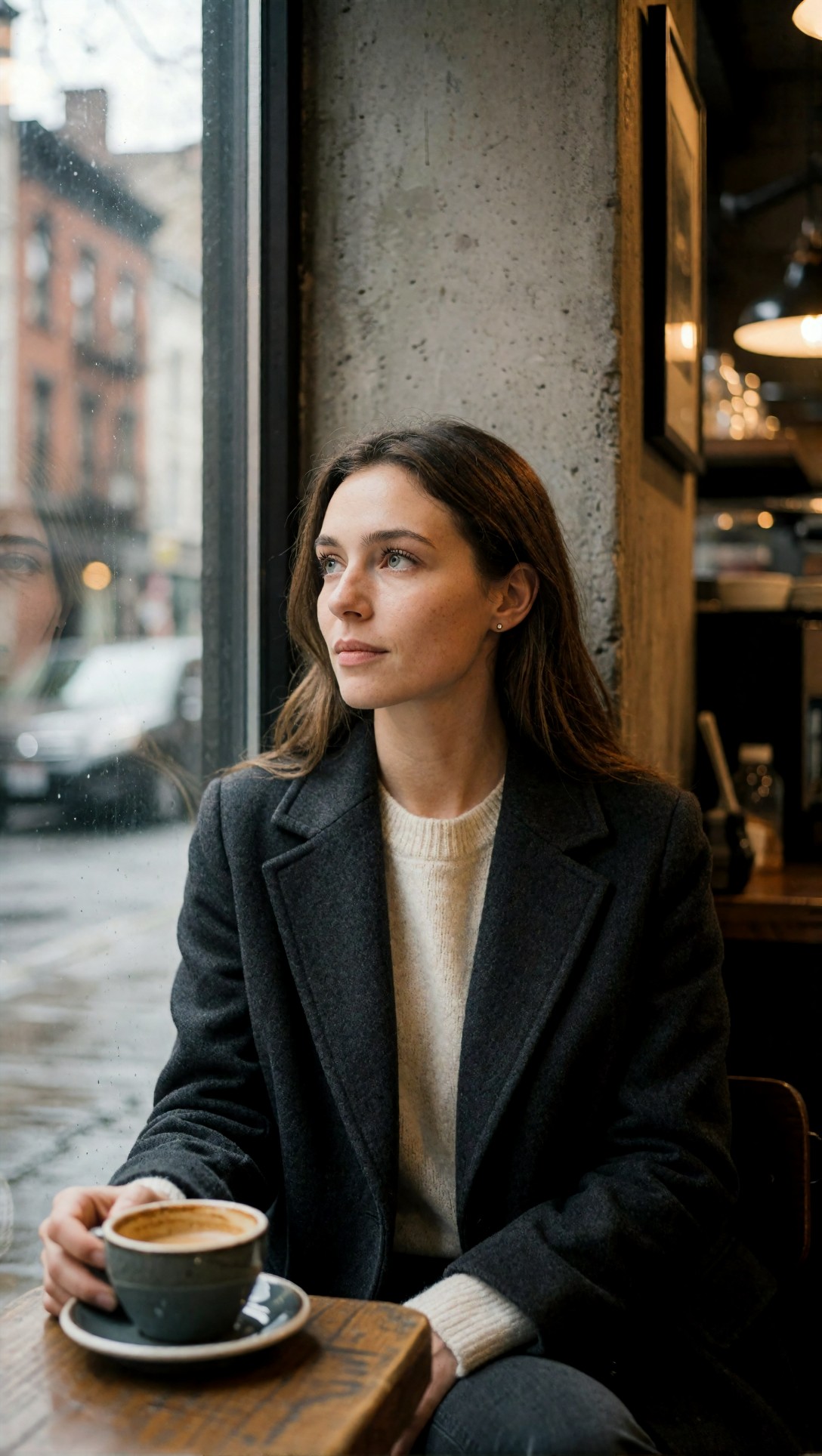
The coat shows a felted wool surface and a clean lapel fold, the sweater has a soft knit texture, and the face has light freckles rather than uniform smoothing. The hand around the cup has readable fingers. The window glass carries rain spots with a blurred street behind it. One oddity: at the left edge of the glass there is a partial face-like reflection that the prompt did not ask for. It is plausible as a reflection but easy to overlook.
Anime: line, flat shadow, graphic color
anime key visual of a high school student standing on a rooftop at sunset, navy school blazer over white shirt, loose ribbon tie, pleated skirt moving in the wind, one hand holding the fence, thoughtful sideways gaze, warm sunset backlight creating a soft rim around the hair, distant city skyline and pastel clouds, clean cel shading, controlled linework, expressive eyes, balanced composition, polished modern anime poster style, gentle orange and blue palette, crisp silhouette separation, subtle atmospheric depth, elegant but not overly glossy rendering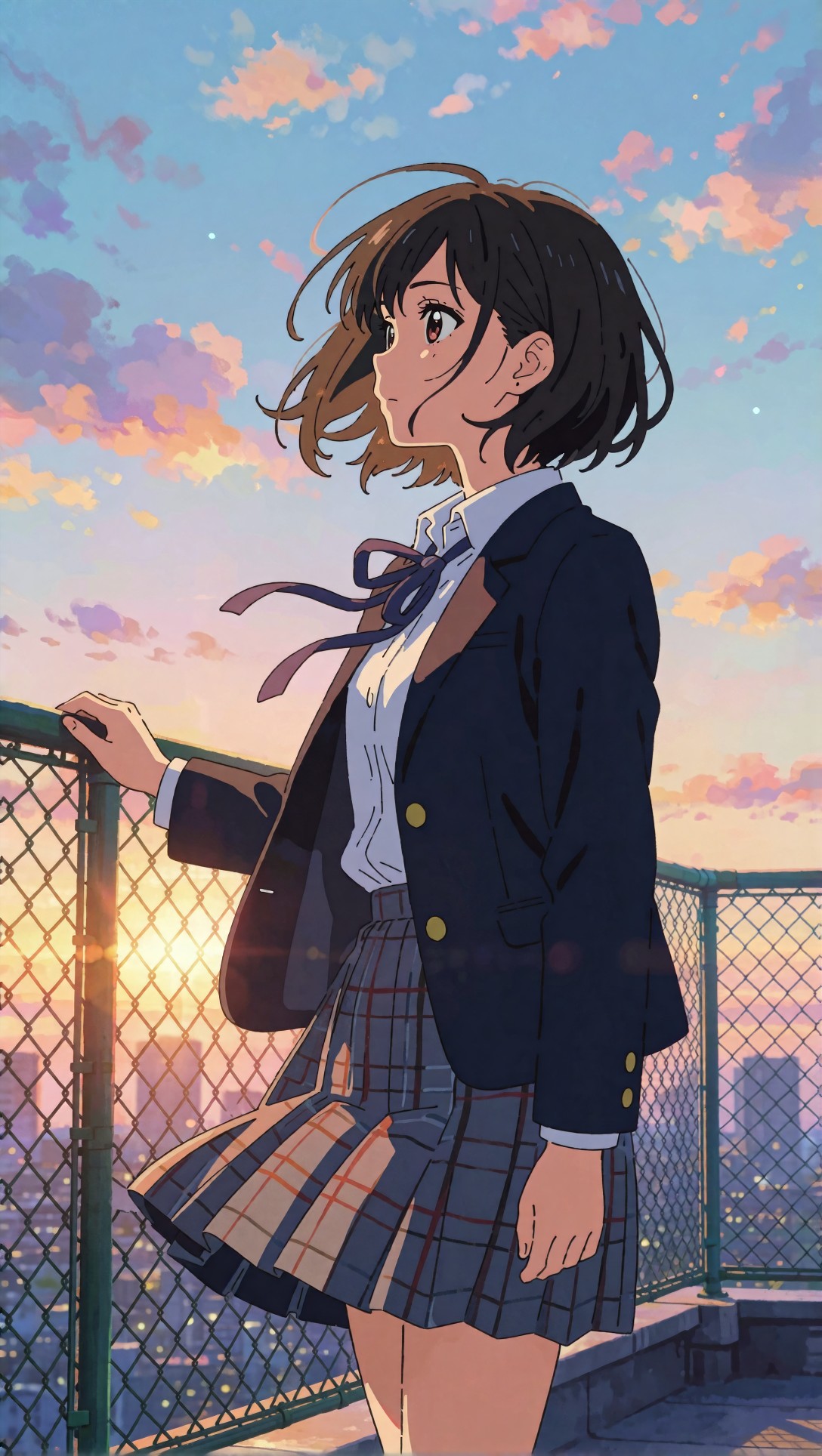
This one follows the brief closely: the ribbon and hair move in the same wind direction, the chain-link fence is drawn consistently, and the sunset sits behind the fence as a glow. Clothing is where it gets loose. The plaid on the skirt changes scale and direction between the folds, and the blazer has an unexplained brown patch along the lapel. Read these as examples of anime-style clothing detail breaking down, not as proof that anime prompts always do.
dynamic anime scene of a young courier paused on a compact motorbike on an elevated highway at night, short silver jacket with reflective strips, dark cargo pants, visor helmet lifted, determined expression, one foot on the ground, futuristic city towers behind with layered neon signage and magenta-blue haze, wet road reflections, dramatic perspective, high-energy anime action frame, strong silhouette, clean cel shading, controlled motion cues, readable mechanical design, sharp composition, rich contrast without realism creep, expressive but anatomically stable hands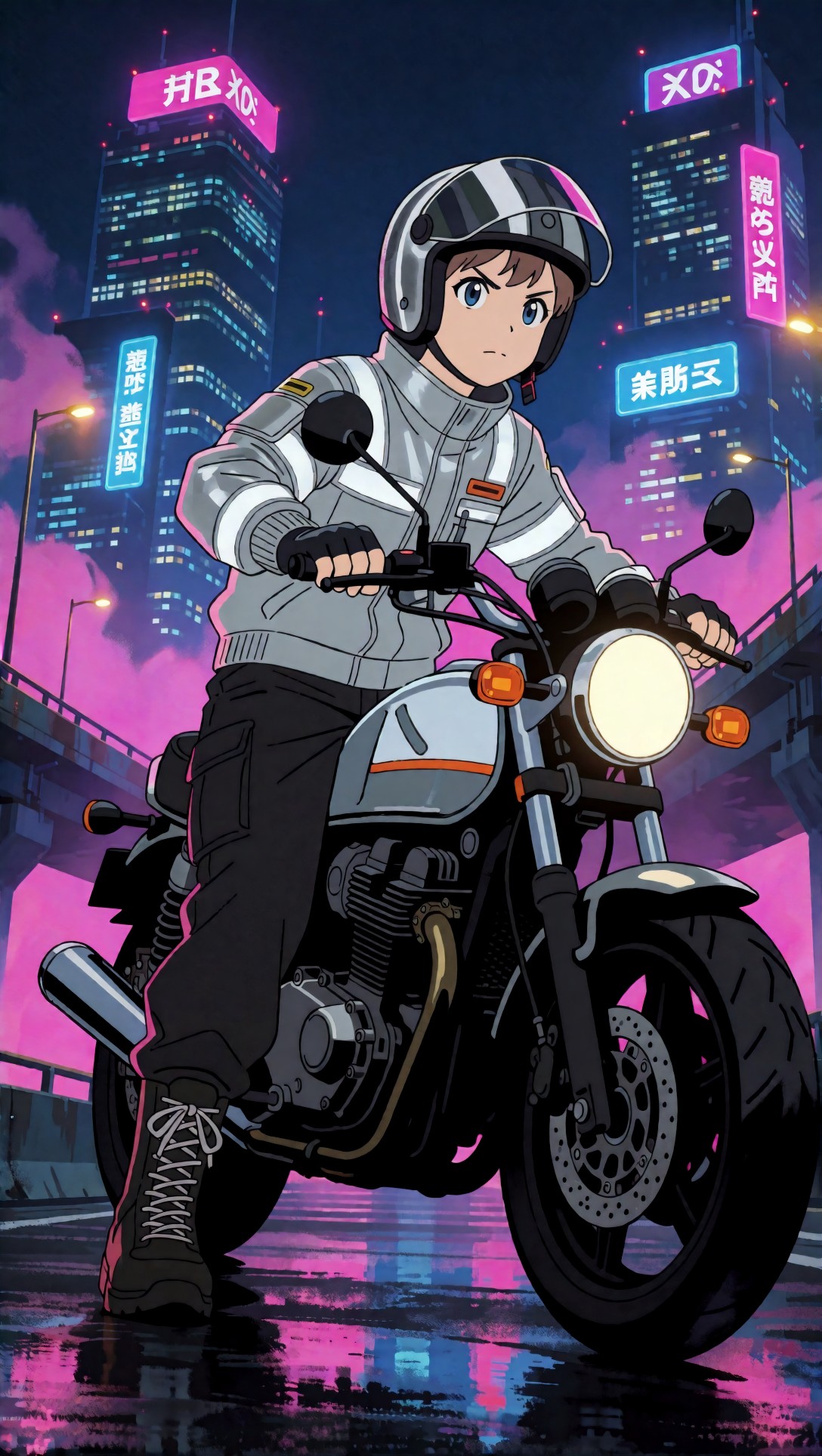
The mechanical design is the strong point: engine block, exhaust, brake disc, fork and mirrors are all present and connected. The gloved hands on the grips are readable, and one laced boot is planted on the ground as requested. The neon signs are not: their characters are pseudo-lettering that does not spell anything, which is typical of small text in generated images. The prompt said "visor helmet lifted", and the helmet's visor area looks down or dark in the result, so that instruction was not clearly met.
Illustration: palette and shape grouping
contemporary editorial illustration of a florist arranging wrapped bouquets in a covered morning market, linen apron over a muted green dress, paper textures, flower buckets arranged in repeating shapes, focused expression, hands mid-action tying ribbon around stems, soft pink, sage, cream, and terracotta palette, layered depth, elegant compositional rhythm, subtle grain, stylized but believable anatomy, refined edges, magazine-quality visual storytelling, Hasselblad-inspired framing, premium commercial polish without photoreal rendering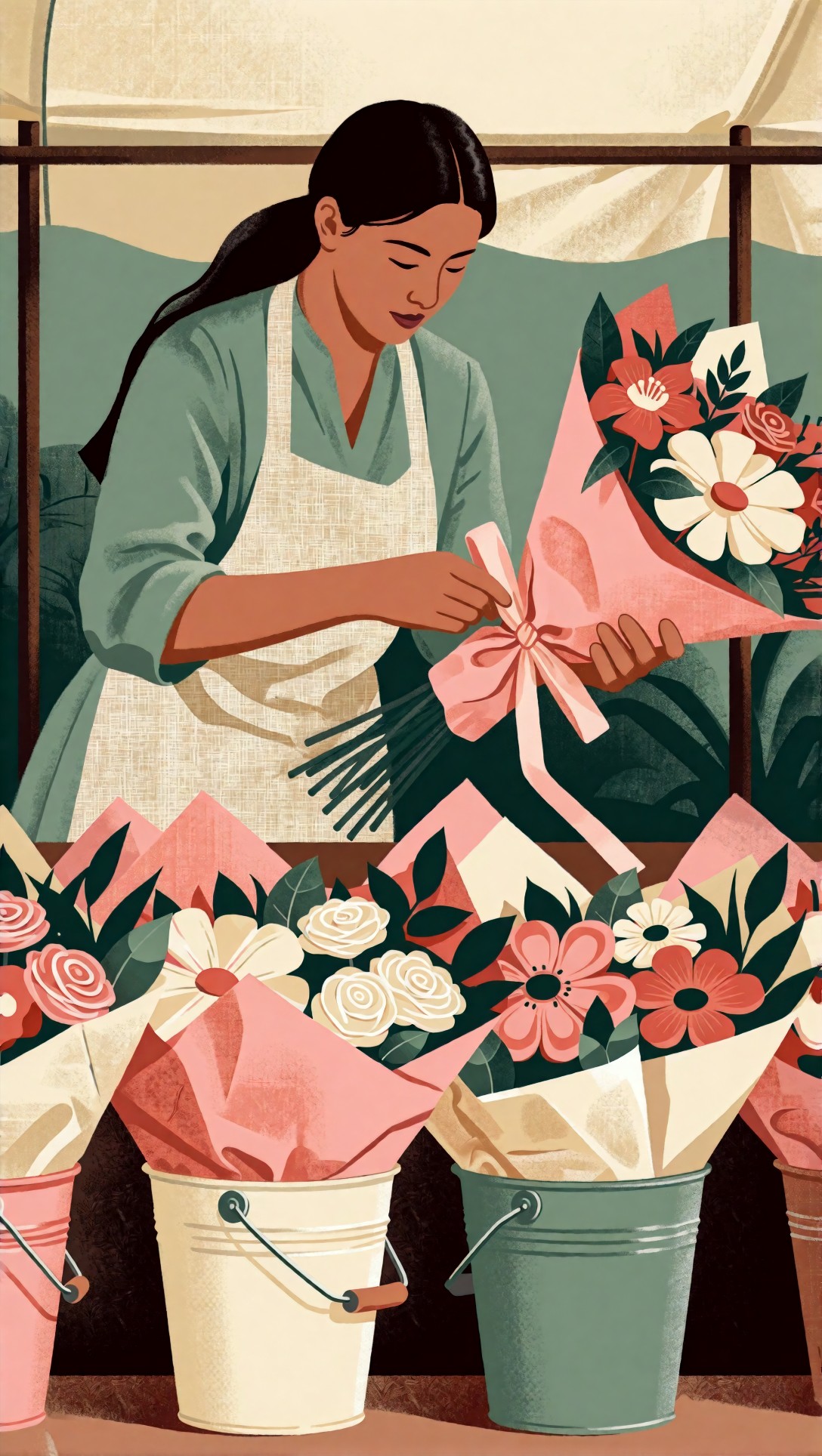
The palette stays inside the pink, sage, cream and terracotta range the prompt named, the buckets repeat as a rhythm across the foreground, and the apron has a linen-like grain. Both hands are involved in the ribbon and read clearly. Flowers are simplified to generic blossoms rather than identifiable species. Note that the prompt contained "Hasselblad-inspired framing" and no camera name appeared in this image.
travel illustration of a woman standing on a sunlit terrace above a Mediterranean harbor, wide straw hat, cream shirt dress, leather sandals, hand resting on a whitewashed wall, turquoise water below, fishing boats, terracotta roofs, bougainvillea spilling over stone steps, vintage-modern travel illustration style, simplified but elegant forms, poster-like composition, restrained grain, high color separation, warm cream and cobalt palette, airy atmosphere, readable figure silhouette, balanced foreground and background depth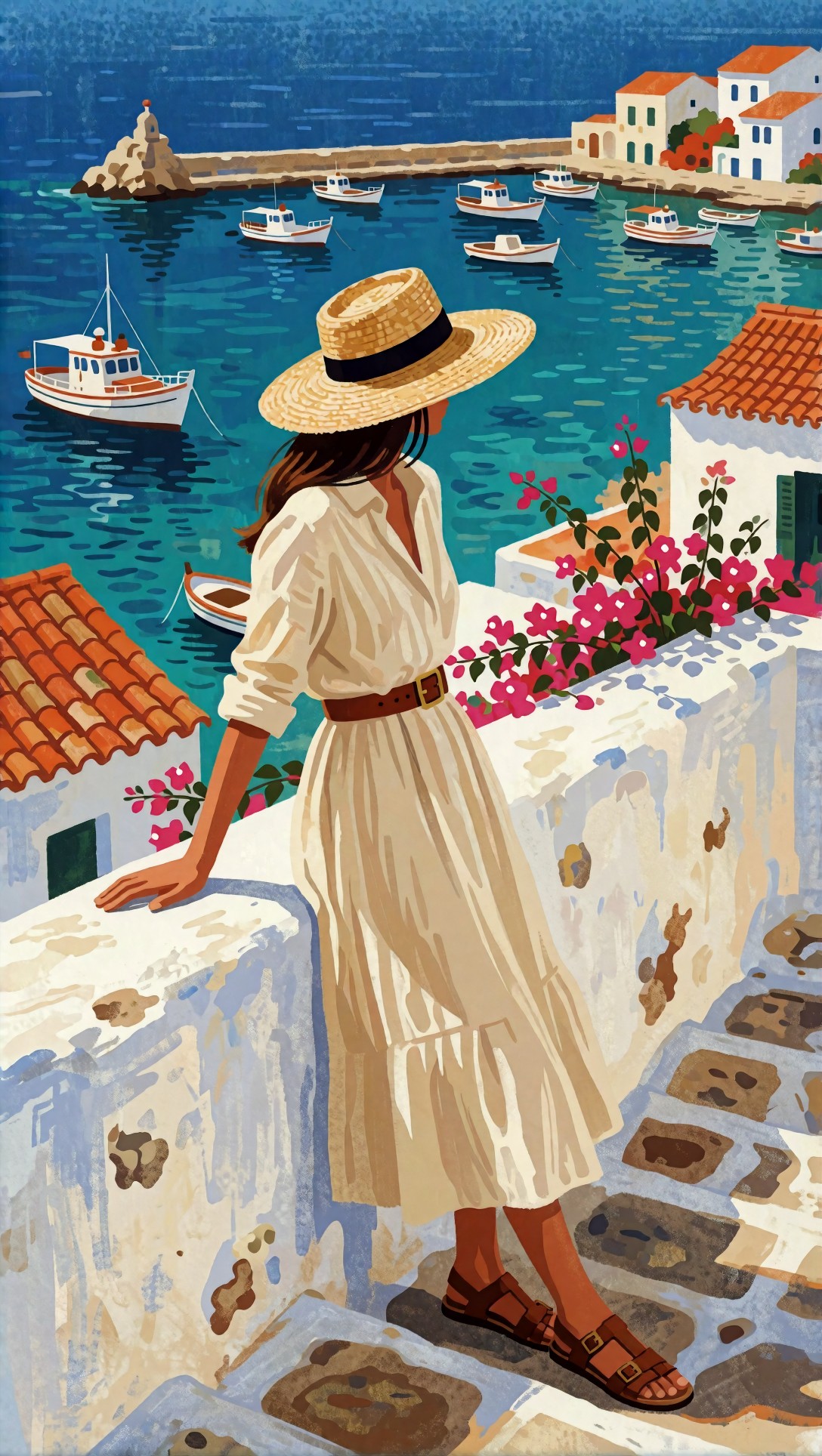
Here the harbor layers stay separate from the foreground: water, boats and a breakwater at the back, terracotta roofs at the sides, the figure and wall in front. The brush-texture treatment of the wall and dress gives it a printed-poster look rather than a clip-art one. The hand on the wall is simplified but correct.
Where the same model struggled: product realism and text
The watch prompt is the one place in this set where the model was asked for photographic precision on a small, detailed object.
luxury campaign image of a premium steel wristwatch being placed on a dark stone tabletop by a carefully posed hand, controlled specular highlights across the bezel, deep charcoal and silver palette, minimal reflective props, crisp dial markings, visible brushed metal texture, elegant macro composition, Phase One XF IQ4 look, 120mm macro precision, high-end beauty advertising style, premium studio restraint, clean negative space, realistic hand anatomy, subtle shadow falloff, sharp product edges without harsh clipping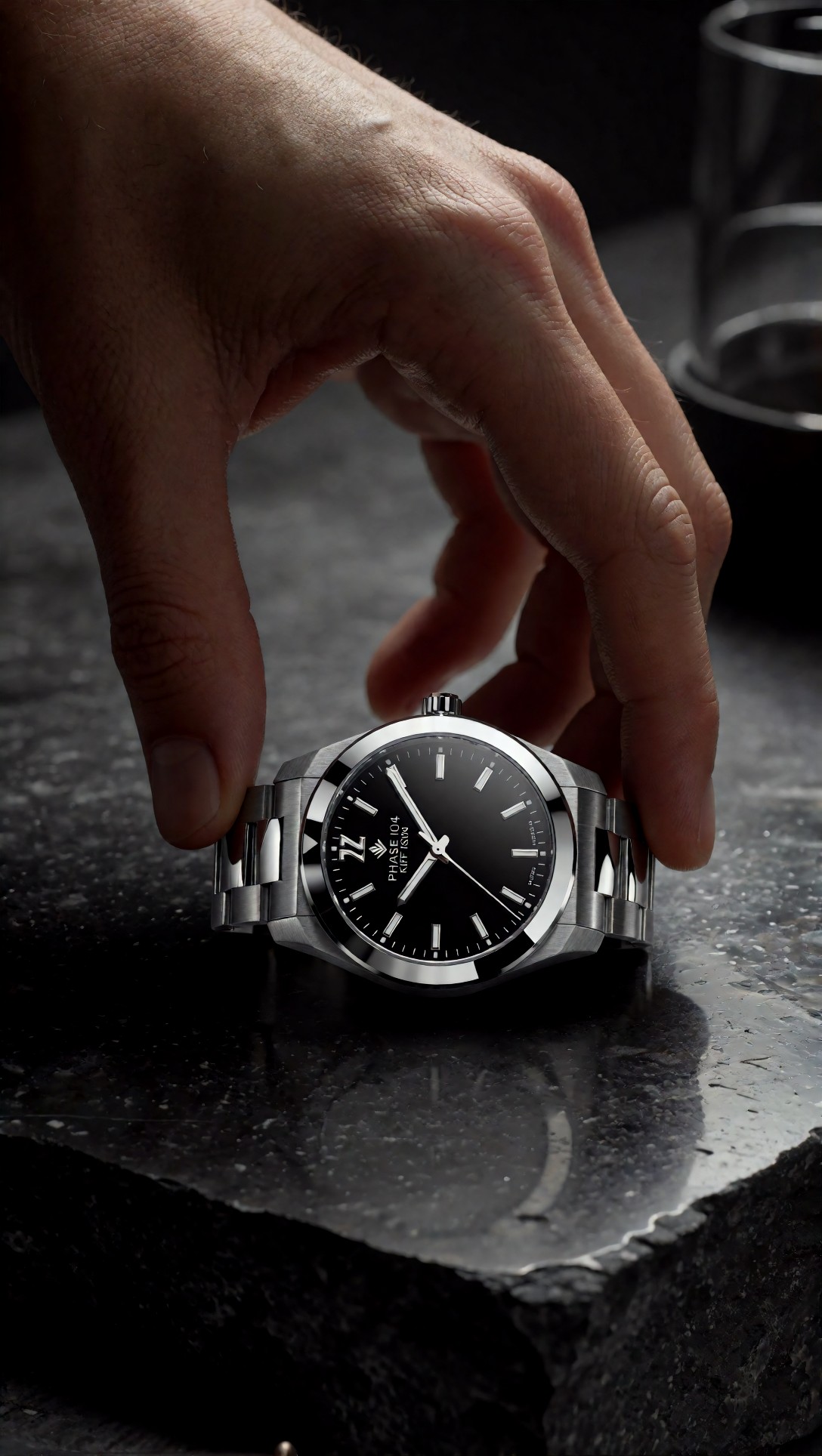
The skin of the hand, the brushed steel and the stone surface are convincing. The dial is not: it reads "PHASE 104" with garbled letters beneath, so the camera name from the prompt ("Phase One XF IQ4 look") was turned into printed text on the product. The practical reading is narrow but real: when a prompt includes a camera brand and the scene has a surface that can hold writing, the brand can show up as text. If that happens, remove the brand and describe the optical effect instead, such as shallow depth of field. That workaround is a suggestion, not something tested here.
Running a comparison that can actually rank models
A fair model comparison needs the same prompt, on each model, with several seeds each. The original version of this article described "photoreal models", "anime-tuned models" and "illustration models" and declared winners, but the generation records do not contain any model other than Krea2 Turbo, so those rankings could not be checked and have been removed. If you want to test models yourself:
- Use one prompt per style family and change only the model. The three prompts above (cafe, rooftop, florist) work as starting points because they are fully quoted here.
- Generate more than one image per prompt per model; one image only shows what is possible, not what is typical.
- Judge the same things in every model: hands and fingers, clothing structure, background logic, whether text-like shapes appear, and whether the style stays in its lane.
- Keep brand names of cameras out of the prompt for any scene with labels or signs until you have checked what they do.
For drafting and adjusting prompts of this kind, see [Prompt Lab](/promptlab/en), and to try them on your own, use the [image generator](/create/en).
FAQ
Is Krea2 Turbo good at all three styles? In these eight single-generation examples it produced a distinct, coherent look for each family. Eight images cannot establish how often it does so.
Should I use different prompt wording for anime versus realistic? The prompts here did: camera and lens phrases for photographic scenes, and terms like cel shading, linework and poster composition for anime and illustration. Whether each of those phrases matters was not isolated, because nothing was varied one at a time.
> What this article is based on. Model: Krea2 Turbo (records list `krea2_turbo`), eight images generated on 2026-07-11. I opened and inspected all eight; six are shown. No other model appears in the records, so no model ranking is given. Seeds, steps and other settings were not recorded.