The short answer: the four sample images in this article cannot tell you how good Baidu's ERNIE Turbo Image is, because they were not generated by it. The generation records list the model as Krea2 Turbo for every one of them. The prompts only mention ERNIE by name, and that turns out to be the first lesson: a prompt that says "prove that model X is strong at Chinese" does not test model X. It asks whatever model receives it to draw a picture about X. What the images do show, honestly, is what a current turbo-class image model does with Chinese signage, product labels and comparison screens, and that is useful as a yardstick when you test ERNIE yourself.
What this page can and cannot tell you
The original version of this article described ERNIE Turbo Image in general terms: Baidu's text-to-image system, tied to its ERNIE model family, marketed for fast generation, Chinese-language prompts and business use. I have no generation records, API output or benchmark for ERNIE Turbo Image, so none of those claims is verified here. Treat them as Baidu's positioning, not as findings. Specifically, I am not making claims about its speed, resolution, pricing, availability outside China, or how it compares with Midjourney, DALL-E or Stable Diffusion.
What I do have is four images made on 2026-07-07 with Krea2 Turbo, each from a prompt written for an ERNIE review. I opened all four at full size. Each is 1536x2736 pixels, a tall portrait format. Below, I describe only what is visible.
Chinese signage in a street scene
The first prompt asked for a rainy evening street in Chengdu. This is the exact prompt from the generation record (Krea2 Turbo):
A visually rich editorial image showing a rainy evening street in Chengdu with traditional shop signs in Chinese characters, red lanterns, food stalls with steam rising, pedestrians carrying umbrellas, wet stone pavement reflecting neon, subtle modern digital billboards, and layered storefront textures. Compose the scene with strong depth, foreground reflections, midground human activity, and background architecture blending old and new China. Use a balanced red, teal, and warm amber palette, realistic signage spacing, authentic street clutter, and natural crowd motion. The image should prove strong Chinese-language cultural understanding, local atmosphere, and accurate environment generation for a Baidu ERNIE Turbo Image review.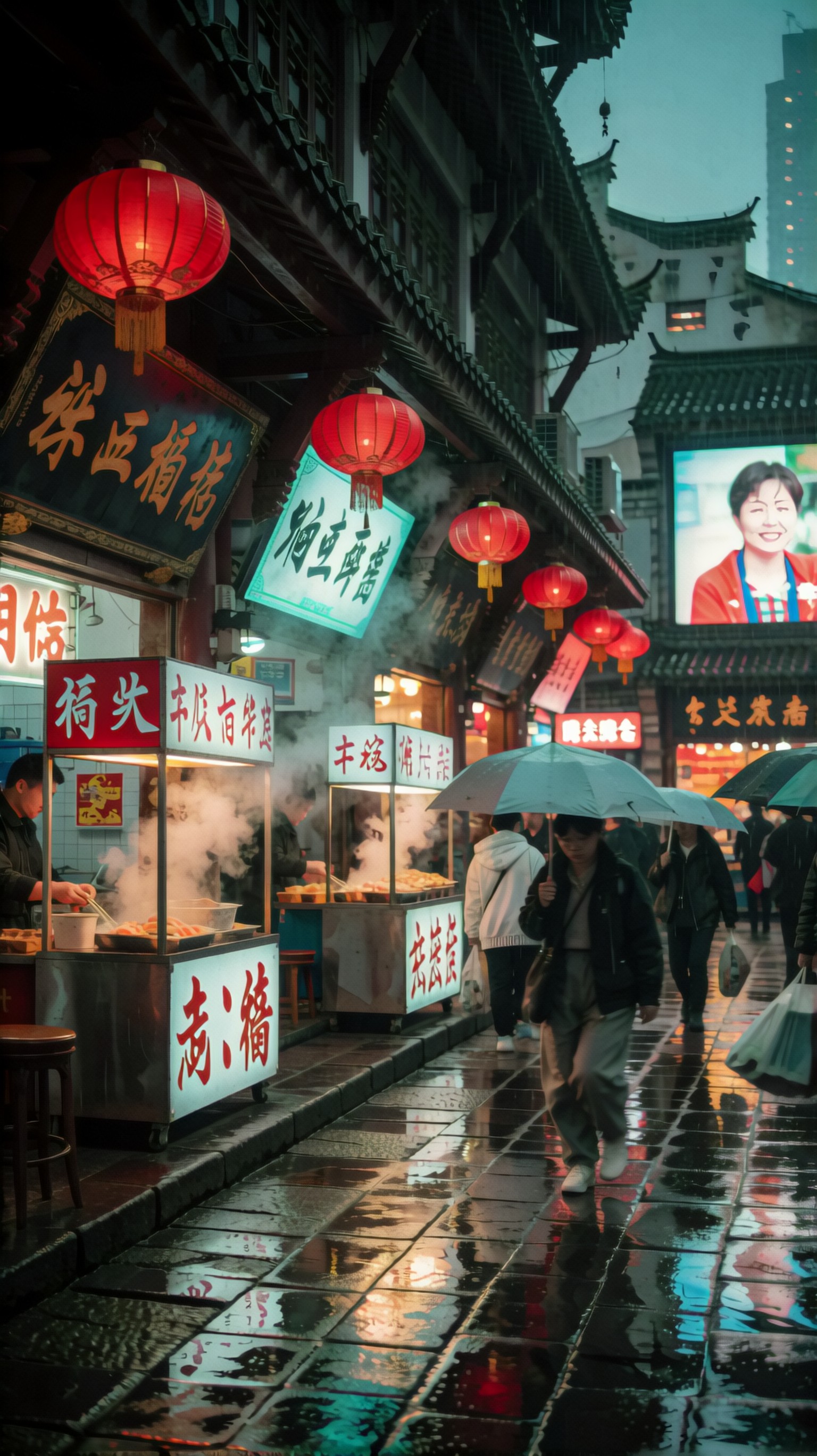
The atmosphere is convincing: red lanterns, tiled eaves, rising steam, a person with an umbrella, and wet paving that reflects the signs in red, teal and amber. The composition follows the prompt closely. The signage is where it gets weaker. The characters on the stall signs and hanging boards have the look of Chinese calligraphy, but as far as I can tell they do not spell recognizable words, and several glyphs look like blends of real characters. A reader who cannot read Chinese will find the image authentic; a reader who can will likely see the problem at once. For a Chengdu-themed scene, that is the main caveat.
A product label with a brand name leaking in
The second prompt asked for a premium tea beverage campaign with a glass bottle and Chinese typography:
An editorial-style commercial image of a premium tea beverage campaign created as if for an e-commerce brand in China, featuring a glass bottle with detailed label design in Chinese typography, splashing tea leaves, floating citrus slices, condensation droplets, glossy pedestal surfaces, and neatly arranged packaging variations in the background. Frame the hero product off-center with negative space for article text, crisp edges, high material detail, controlled reflections, and a fresh green-gold palette. Include subtle props that suggest AI-assisted design iteration, such as multiple packaging mockups on panels in the background. The image should prove how ERNIE Turbo Image can support enterprise marketing visuals, product storytelling, and fast commercial asset generation.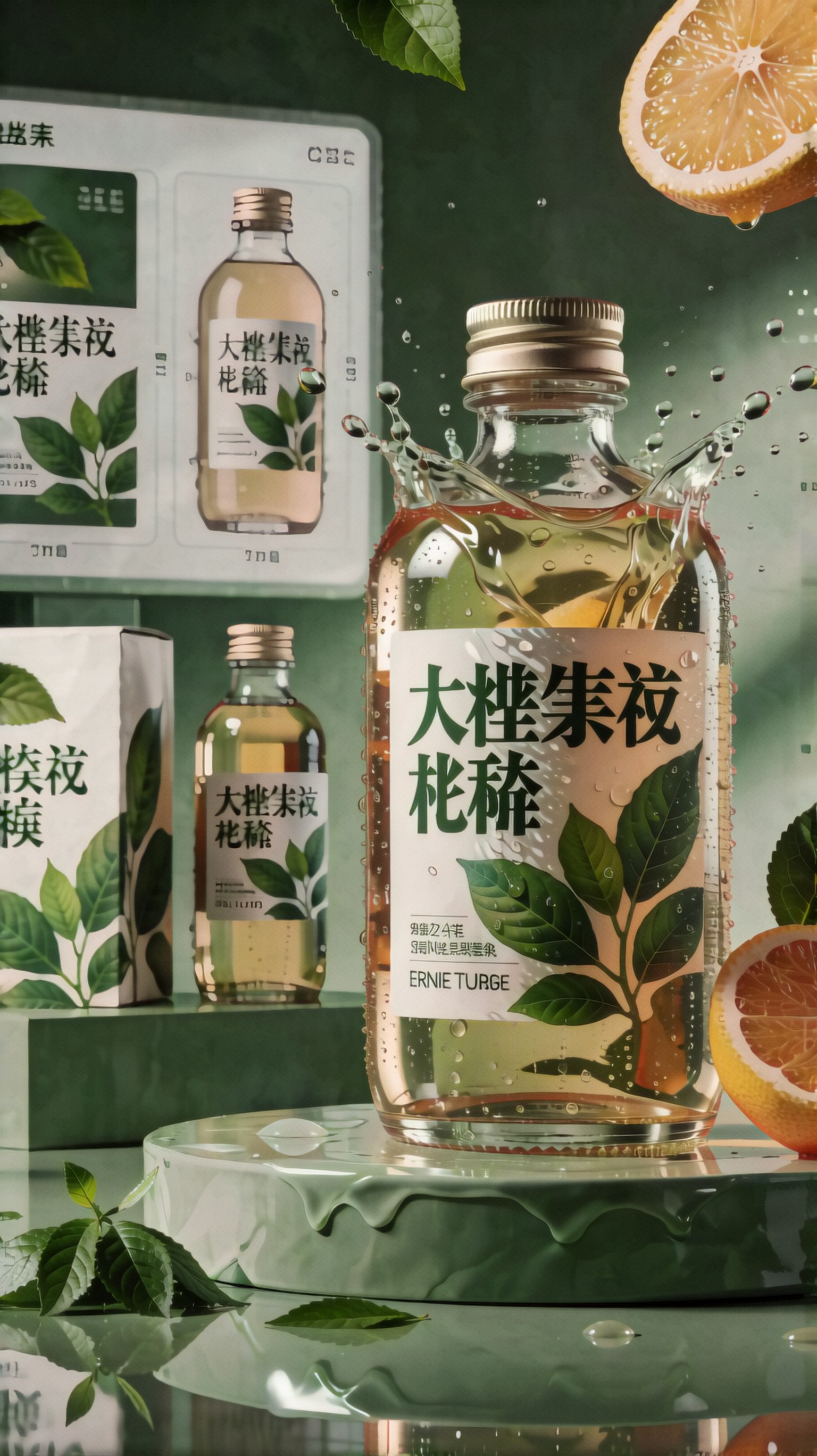
As a product photo, it works well: the splash, condensation droplets, citrus halves, glossy pedestal and repeated packaging in the background are all present and coherent. The label is the failure. The large characters look like real Chinese typography, but the smaller characters beneath them are visibly malformed, and the English line at the bottom reads "ERNIE TURGE". The prompt ended with "ERNIE Turbo Image", and the model printed a corrupted version of it on the bottle. The same behavior is well known with camera names and brand names in prompts: if a surface can carry text, words from the prompt can end up on it. The practical consequence is that a product shot like this still needs the label replaced in a design tool before it could be used commercially.
A comparison screen that is not a comparison
The third prompt asked for a designer's desk with a four-panel monitor comparison in which "the ERNIE-focused panel" is visibly stronger at Chinese signage:
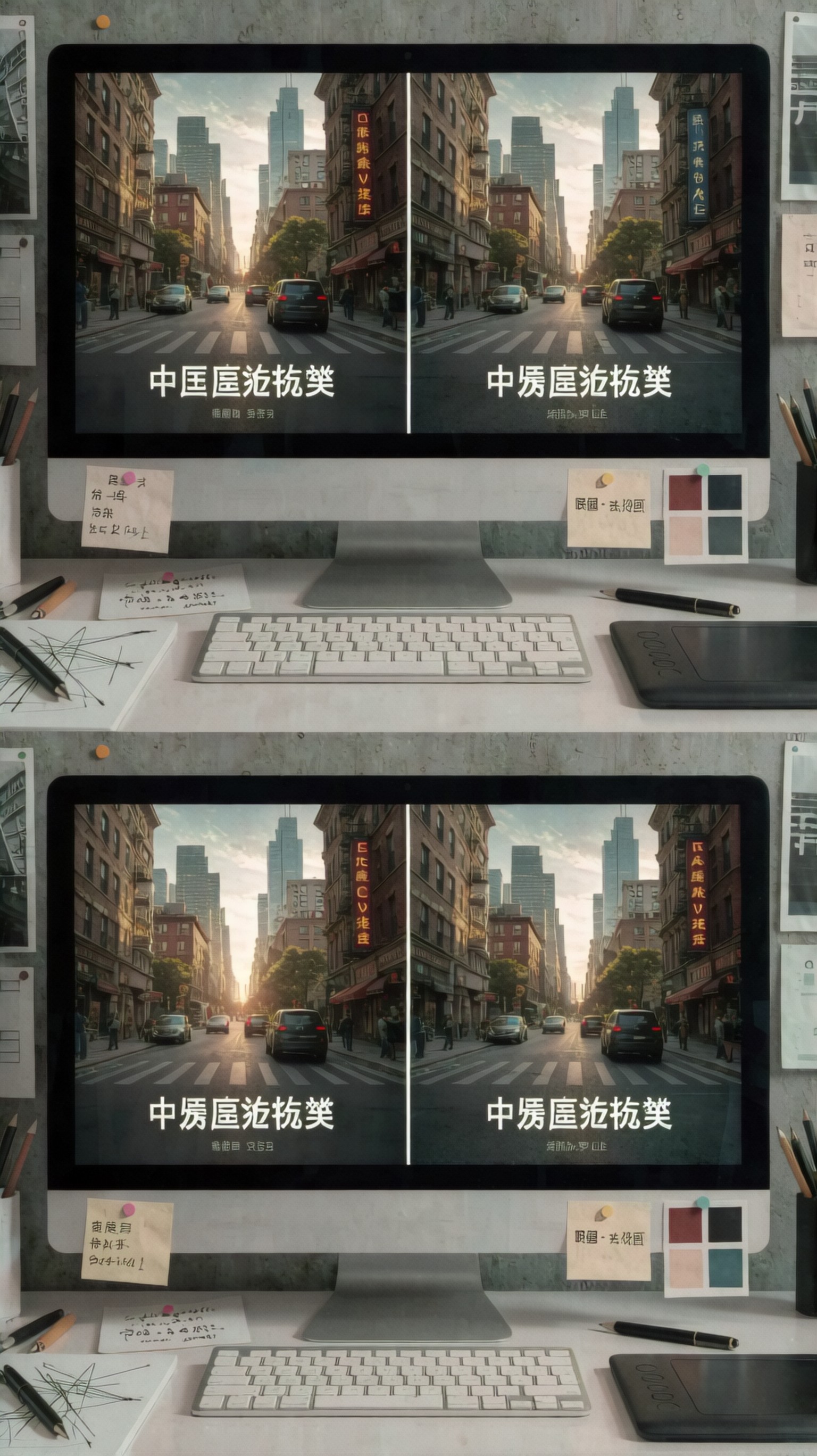
The result is a good example of why such images are not evidence. The picture shows the same desk twice, stacked vertically, each monitor split into two nearly identical street photos. The two halves differ slightly in the vertical sign on the right-hand building, and the white captions under each photo look like Chinese characters but are slightly different from one another and unreadable as a phrase. Nothing in it shows one model being more accurate than another. It is an illustration of a comparison, not a comparison. The sticky notes and paper scraps carry pseudo-writing as well.
A workflow scene with nonsense handwriting
The fourth prompt asked for a creator reviewing many generated images in a dual-monitor setup:
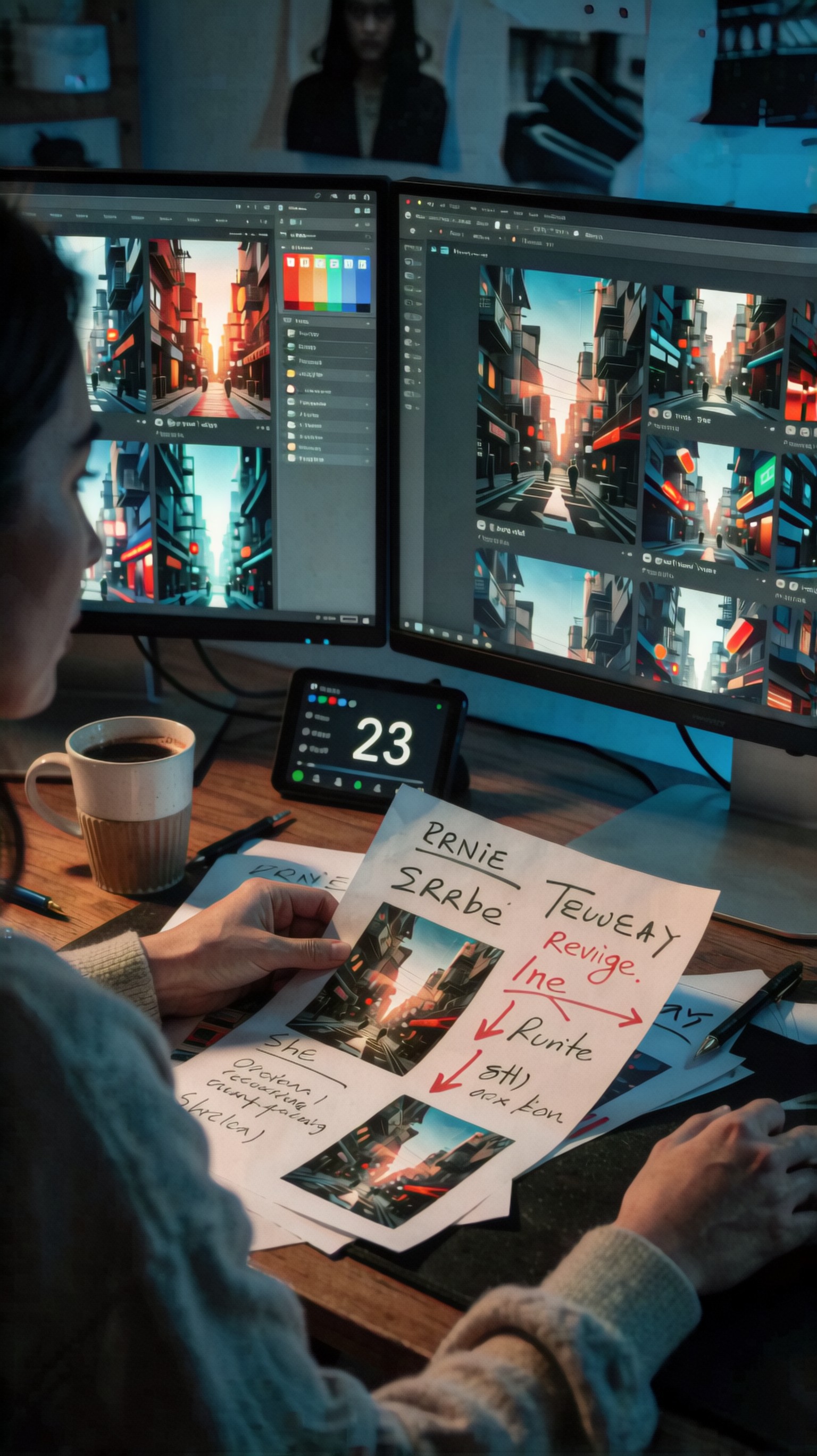
The scene is visually strong, with blue-and-orange lighting, a shallow depth of field, the knit sweater and a ceramic mug. The monitors show grids of street images, and the timer displays "23". As in the other images, the handwritten page fails as text: the headline looks like a mangled "ERNIE" followed by other non-words in red and black. The image says nothing about how fast ERNIE Turbo Image renders, even though the prompt asked it to "prove" that.
Testing ERNIE Turbo Image yourself
If you can reach ERNIE Turbo Image, the four images suggest a short way to check it on your own terms. These are suggestions, not results, and the prompt below is an unverified proposal rather than something I ran.
Proposed prompt (unverified):
A rainy evening street in Chengdu, red lanterns, a food stall with a white light-box sign that reads exactly "火锅" in clear Chinese characters, wet stone pavement, eye-level 35mm photoThen check the following:
- Give it a short, exact string of a few characters and see whether those characters come back correct. That is a far clearer test of Chinese-language ability than a long atmospheric prompt.
- Keep the model's own name out of the prompt, since the tea bottle shows how that name can be printed into the image.
- Zoom to 100 percent on signs, labels and handwriting. All four images above look fine at thumbnail size.
- Run the same prompt on two models, one prompt per image, and compare files rather than asking for a comparison picture.
- If speed matters to you, time the generations yourself. I have no timing data for any model here.
If you want to draft prompts first, the [Prompt Lab](/promptlab/en) can help, and you can try a prompt on the site's own models in the [image generator](/create/en). If a result needs resolution before you inspect small text, the [Upscaler](/upscaler/en) is one option.
FAQ
Are these images made by ERNIE Turbo Image? No. The generation records list Krea2 Turbo as the model for all four.
Can ERNIE Turbo Image render Chinese text correctly? This article cannot say. Baidu positions it around Chinese-language prompts, but I have no outputs from it to confirm how accurate its text is.
Why do the Chinese characters look right but read wrong? From these four images, the model reproduces the general shape and rhythm of characters without reliably producing correct ones. Generated text is a widely reported weakness of image models, and it is most visible in small signs and labels.
> What this article is based on. Model: Krea2 Turbo, four images generated on 2026-07-07, each 1536x2736. I opened and inspected all four. No ERNIE Turbo Image output, settings or timing was available, so every statement about ERNIE is general background, not a test result.