Best K Fashion Outfit Prompts for Full-Body Looks, Layering, and Accessories 한국어 요약
이 페이지는 ZView Space의 영어 원문을 한국어 검색 사용자도 이해할 수 있도록 정리한 SEO 요약입니다. 핵심은 단순한 얼굴 중심 이미지가 아니라 패션 에디토리얼, 룩북, 아웃핏, 프롬프트 테스트, 이미지 생성 워크플로우를 실제로 어떻게 구성할지입니다.
핵심 요약
- 원문 주제: Best K Fashion Outfit Prompts for Full-Body Looks, Layering, and Accessories
- 목적: AI 이미지 생성에서 outfit, silhouette, fabric, pose, location, camera framing을 더 명확하게 설계합니다.
- 활용 범위: Z-Image Turbo, Krea2 Turbo, Qwen Image, Anima, SeedVR2 같은 이미지 생성 및 업스케일 워크플로우에 적용할 수 있습니다.
- SEO 관점: 제목, 설명, 이미지 alt, 프롬프트 예시가 실제 검색 의도와 맞아야 색인 가능성이 높아집니다.
한국어 사용자를 위한 체크포인트
1. 프롬프트가 얼굴 묘사에만 머물지 않고 전체 스타일과 의상 구성을 설명하는지 확인합니다. 2. 패션 이미지라면 상의, 하의, 아우터, 신발, 액세서리, 소재감, 촬영 장소를 분리해서 씁니다. 3. 생성 결과는 바로 게시하지 말고 디테일, 손, 의상 형태, 배경 일관성, 이미지 품질을 비교합니다. 4. 글 본문에는 실제 테스트 기준과 실패를 줄이는 방법이 들어가야 검색엔진에서 얇은 콘텐츠로 보일 가능성이 줄어듭니다.
원문 미리보기
Finding a reliable k fashion outfit prompt is harder than it looks. Most image models can produce a vaguely Korean streetwear mood in one shot, but they often fail on the things that matter in a usable fashion image: full body framing, readable layering, balan
---
Finding a reliable k fashion outfit prompt is harder than it looks. Most image models can produce a vaguely Korean streetwear mood in one shot, but they often fail on the things that matter in a usable fashion image: full-body framing, readable layering, balanced accessories, and clothing proportions that make sense from head to toe.
In this test, I focused on prompts that could hold together as actual styling directions rather than mood-only descriptions. The goal was not just to get attractive images, but to produce outputs that read clearly as Korean fashion trends, Korean street fashion, Korean minimalist fashion, and K-pop airport fashion without collapsing into generic portrait photography.
What I tested
I tested full-body and near full-body prompt structures designed for editorial, lookbook, and street-style outputs. The variables I pushed hardest were:
- silhouette clarity
- outerwear layering
- skirt and trouser proportion accuracy
- bag, cap, glasses, and jewelry placement
- shoe visibility
- background control for lookbook photography
- pose complexity versus garment readability
The strongest result came from prompts with five consistent ingredients:
1. a specific styling system, not just "Korean fashion" 2. explicit full-body composition language 3. a location that supports the outfit story 4. accessory instructions embedded in the wardrobe sentence 5. a quality check phrase around textile detail and silhouette
Why AI models miss the outfit even when the mood looks right
The practical problem is that many prompts ask for a style label, but not a garment hierarchy. When you write only "K fashion outfit" or "Korean street fashion model," the model usually prioritizes face, hair, and broad aesthetic cues. The image may feel trendy, but the coat may merge into the skirt, the bag strap may disappear, and the shoes may be cropped out.
That problem gets worse with layering. In this test, once I asked for a blazer over knitwear, plus a long coat, plus a mini bag and boots, weaker prompts often produced one of three failures:
- fused garments with no visible separation between layers
- duplicate accessories, especially earrings or bags
- half-body framing even when the prompt implied a full look
Another issue is that "Korean fashion trends" covers too many directions. Korean minimalist fashion, Korean street fashion, and K-pop airport fashion use very different silhouette logic. If the prompt mixes them without priorities, the output often defaults to a safe commercial portrait with one trendy jacket.
The workflow that gave the most reliable images
The best-performing workflow was simple but strict:
1. Start with the outfit system
Instead of beginning with mood words, begin with garments and proportion. For example:
- oversized wool coat over cropped knit and pleated mini skirt
- straight wide-leg trousers with tucked shirt and clean leather belt
- bomber jacket over hoodie with cargo skirt and sneakers
This made the model decide the silhouette earlier.
2. Force framing language
For a usable k fashion outfit image, I had much better results when I explicitly asked for:
- full-body fashion photo
- head-to-toe visible
- shoes fully in frame
- standing pose with readable silhouette
Without that, even strong fashion models drifted toward waist-up imagery.
3. Tie accessories to function
In this test, accessories became more stable when described as part of the styling system rather than as extra decoration. For example, "structured shoulder bag tucked under arm" worked better than simply "bag." "Thin silver layered necklaces over crewneck knit" was more consistent than "jewelry accessories."
4. Keep backgrounds supportive, not dominant
For lookbook photography, a quiet urban wall, airport terminal corridor, studio seamless, or editorial showroom worked better than busy night markets or neon streets. Loud backgrounds often stole attention from textile detail.
5. Use inspection language while prompting
Phrases like "clear fabric separation," "visible layering edges," and "clean full-body composition" noticeably improved output discipline. They do not guarantee perfect anatomy, but they reduce mushy styling.
The prompt ingredients that mattered most
Before the examples, it helps to explain why these ingredients were chosen.
- Genre controls whether the model behaves like a portrait engine or a fashion layout engine.
- Camera and lens shape proportion. A 35mm full-body street look feels very different from an 85mm compressed editorial.
- Lighting affects textile readability. Overcast and studio soft light preserved blacks, knits, pleats, and leather better than dramatic low light.
- Location tells the model what kind of outfit logic to follow. Airport, studio, alley, showroom, and rooftop each pushed the styling in different directions.
- Style prevents drift. "Korean magazine editorial" and "clean commercial lookbook" usually held the outfit better than vague descriptors like "trendy fashion."
Prompt tests with inspection notes
Test 1: Clean Korean minimalist fashion with full-body stability
This first test checks whether the model can render a restrained Korean minimalist fashion look without turning it into a plain catalog image. I used a clean studio setup because it reveals whether the silhouette works on its own.
Topic: Korean minimalist full-body outfit with tailored layering
Genre: Fashion Lookbook
Camera: Canon EOS R5
Lens: 50mm f/4
Lighting: Large softbox key light with soft fill
Location: neutral studio seamless in warm gray
Style: clean commercial lookbook
Final Prompt: full-body Korean minimalist fashion lookbook image, young woman wearing a long charcoal wool coat over a cream fine-knit top and high-waisted wide-leg black trousers, slim leather belt, small structured black shoulder bag, simple silver earrings, clean white sneakers, standing straight with one foot slightly forward, calm neutral expression, head-to-toe visible, shoes fully in frame, clear separation between coat, knit, and trousers, premium wool and knit texture, warm gray seamless background, modern Korean retail editorial mood, Canon EOS R5 realism, 50mm f/4 balanced proportions, softbox lighting with gentle shadows, crisp garment edges, refined muted palette, high clothing detail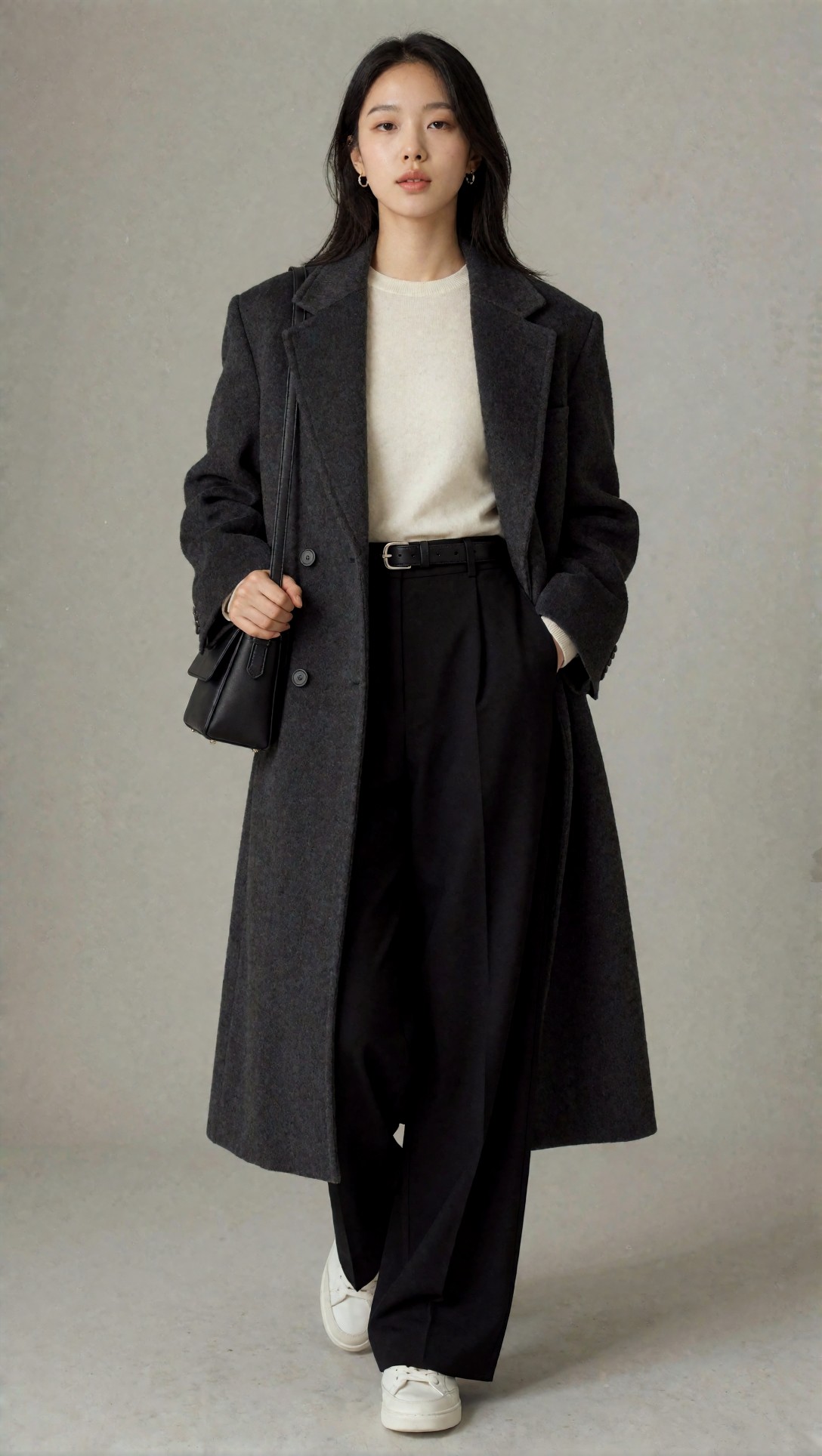
Inspect whether the coat hem, trouser break, and bag strap remain distinct. The strongest outputs from this setup kept the silhouette quiet but readable, which is exactly what minimalist fashion prompts need.
Test 2: Korean street fashion with loose layering and visible sneakers
This test is meant to check if the model can preserve layering in a more casual street-style setup. Sneakers often get cropped or distorted, so the prompt forces a grounded stance and shoe visibility.
Topic: Korean street fashion layered casual outfit
Genre: Street Style Photography
Camera: Sony A7R V
Lens: 35mm f/2.8
Lighting: overcast diffusion
Location: Seoul side street with concrete wall, small cafe signage, and crosswalk edge
Style: Korean street style editorial
Final Prompt: full-body Korean street fashion photo on a quiet Seoul side street, model wearing an oversized navy bomber jacket over a heather gray hoodie, white longline tee peeking below the hoodie, olive cargo midi skirt, ribbed socks, vintage white sneakers, baseball cap, crossbody mini bag, relaxed walking pose with natural stride, slightly serious expression, all accessories visible, shoes fully in frame, clear layered hems and realistic fabric folds, soft overcast daylight, urban Korean street atmosphere, Sony A7R V detail, 35mm environmental framing, authentic street-style composition, muted blue gray and olive palette, lookbook photography focus on outfit proportion and texture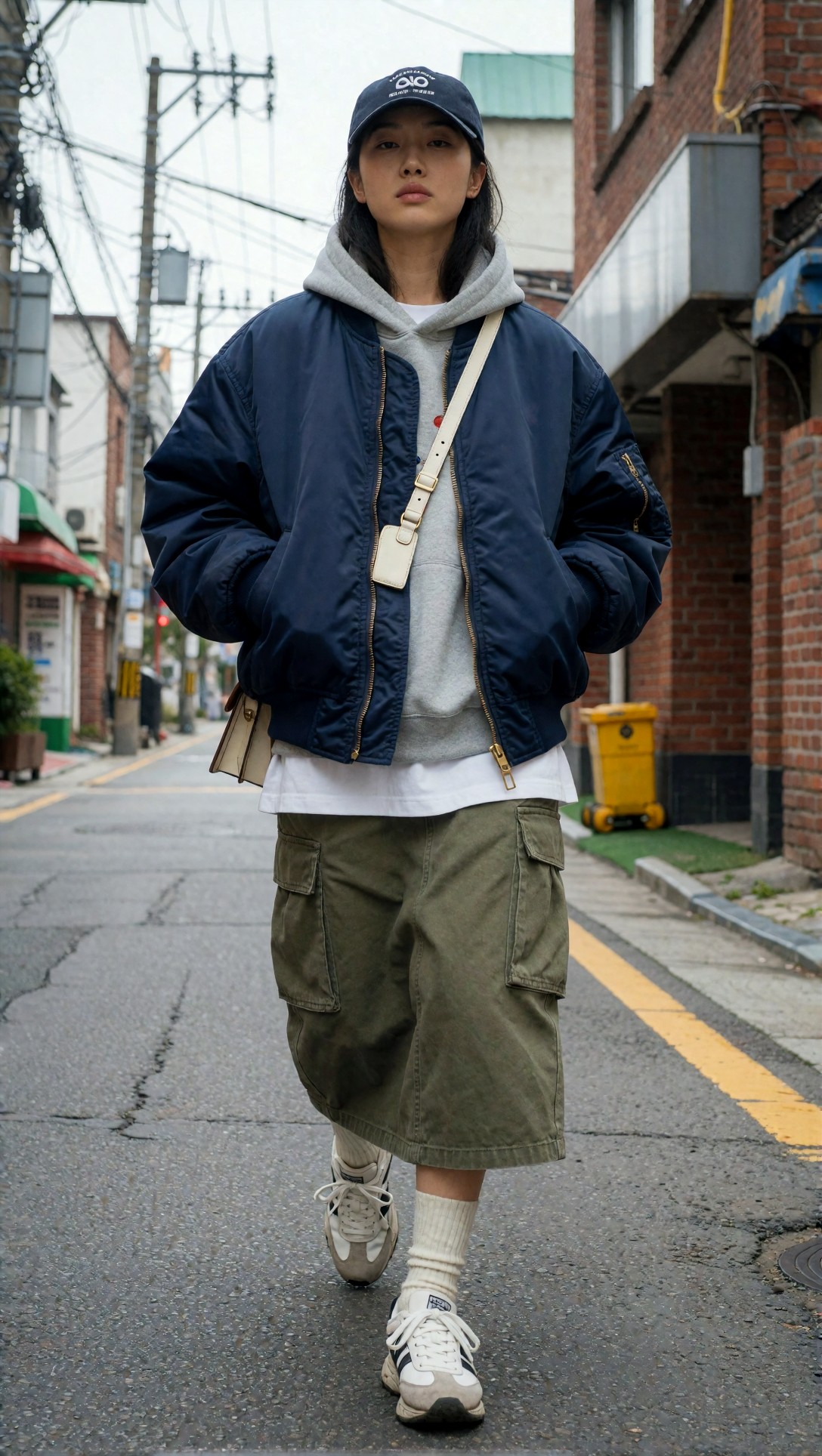
Check the hoodie hem, tee layer, and bomber volume. A common failure is the skirt blending into the jacket or the sneakers turning into generic blobs, so that is the first thing I would inspect.
Test 3: K-pop airport fashion with luggage and accessory control
Airport fashion is useful because it tests practical styling with props. In this setup, the weak point was often hand placement on the suitcase handle, but the outfit logic was easier for the model to understand than nightclub or concert prompts.
Topic: K-pop airport fashion outfit with travel accessories
Genre: Lifestyle Fashion Editorial
Camera: Nikon Z8
Lens: 85mm f/2
Lighting: bright terminal ambient light with soft directional window light
Location: modern airport departure corridor
Style: polished celebrity airport style
Final Prompt: full-body K-pop airport fashion editorial image, stylish young Korean celebrity in a beige trench coat over a cropped black cardigan and white crewneck tee, straight-leg blue denim, sleek black loafers, oversized sunglasses, delicate gold hoops, luxury carry-on suitcase, black leather tote on shoulder, walking through a bright airport corridor, composed expression, confident natural stride, head-to-toe visible, clothing layers clearly separated, visible trench belt and bag straps, premium travel styling, Nikon Z8 clarity, 85mm flattering compression, soft terminal light, neutral luxury palette, Korean celebrity airport fashion mood, editorial realism with clean polished detail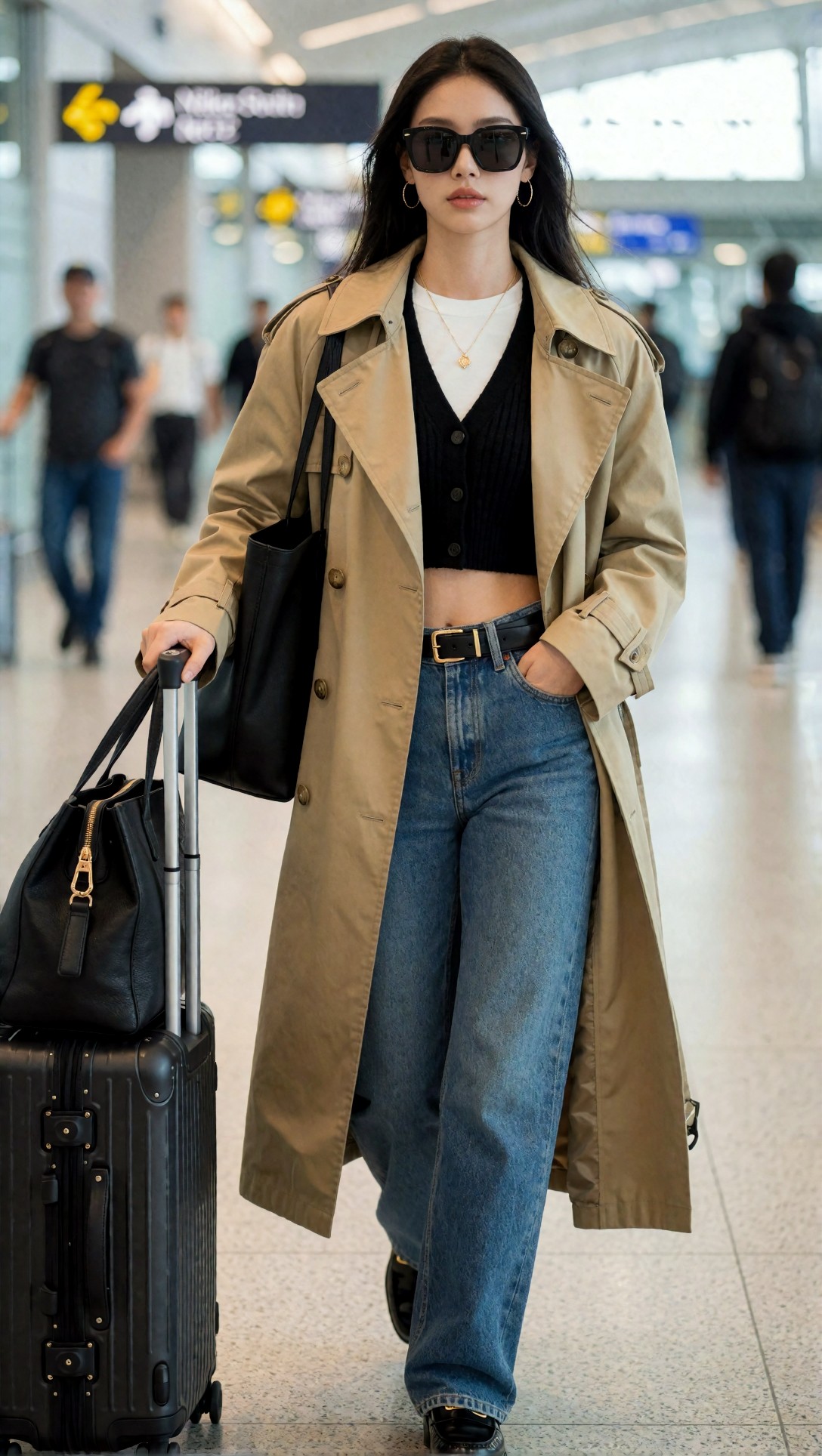
Inspect the luggage handle, tote strap, and sunglass shape. The best outputs here looked usable because the accessories supported the outfit story instead of floating as disconnected fashion props.
Test 4: Feminine layered look with skirt volume and boot clarity
This test is designed to stress lower-body styling. AI often mishandles the relationship between cardigan, skirt, socks, and boots, especially in full-body images.
Topic: Korean feminine layered fall outfit with skirt and boots
Genre: Fashion Editorial
Camera: Fujifilm GFX100S
Lens: 80mm f/1.7
Lighting: soft window light with gentle reflector fill
Location: quiet editorial cafe interior with wood chair and cream walls
Style: Korean magazine fashion spread
Final Prompt: full-body Korean fashion editorial inside a calm cafe, model wearing a soft oatmeal cardigan over a fitted ivory mock-neck top, charcoal pleated midi skirt, knee-high brown leather boots, thin belt, small quilted shoulder bag, ribbon hair accessory, seated then half-risen pose that still shows the full outfit, elegant thoughtful expression, visible pleat structure, distinct cardigan and top layering, boots fully visible, warm neutral interior, Fujifilm GFX100S medium-format detail, 80mm fashion compression, soft natural window light, refined Korean magazine styling, tactile knit and leather textures, balanced cream brown and charcoal palette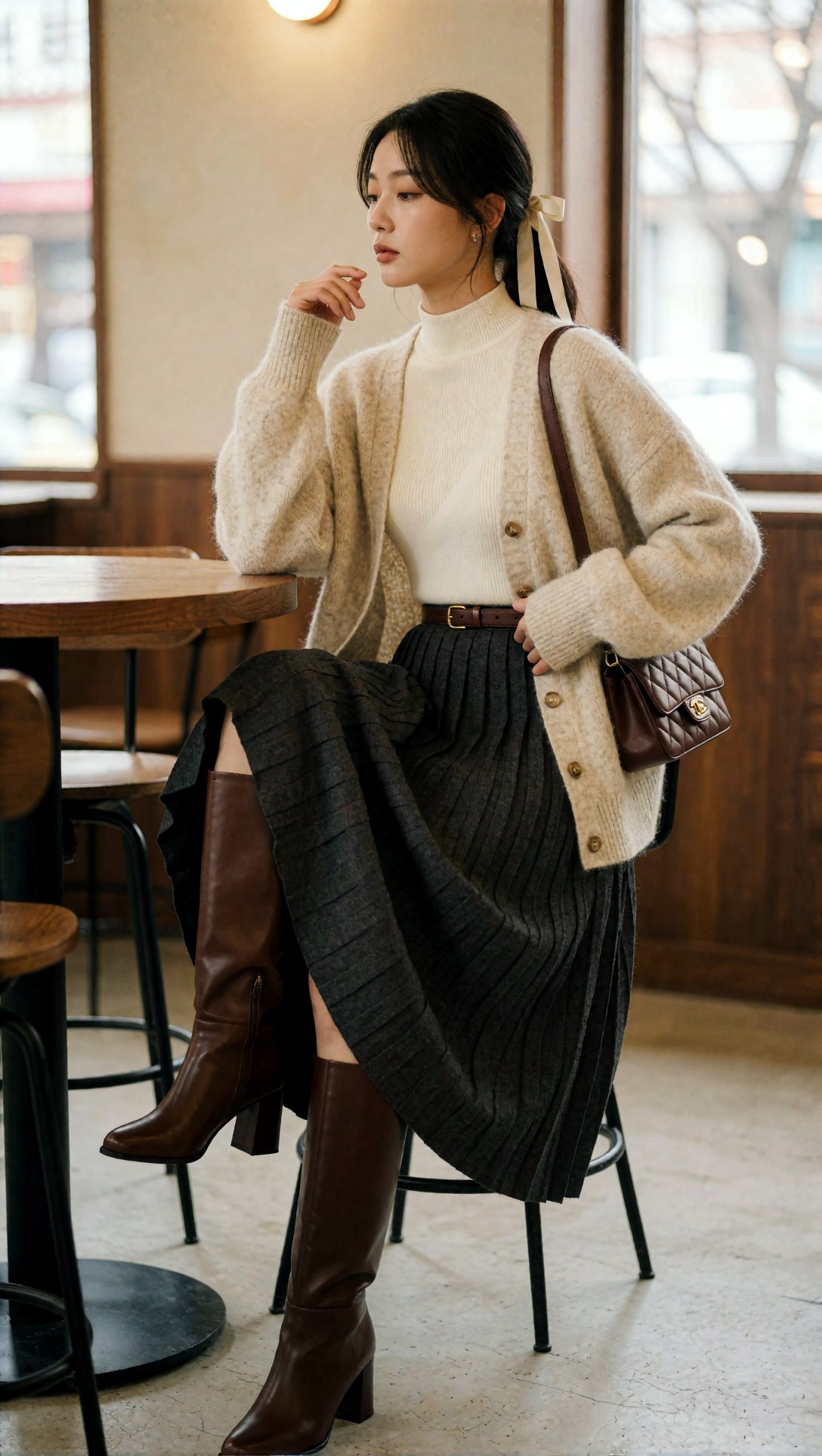
Look closely at pleat consistency and boot symmetry. If the skirt volume looks inflated or the boots merge into the floor, the prompt likely needs a simpler pose or stronger full-body wording.
Test 5: Monochrome Korean minimalist fashion for lookbook photography
This setup checks whether a monochrome palette can still hold texture contrast. It is useful when you want Korean minimalist fashion without losing detail in black and gray garments.
Topic: monochrome Korean minimalist outfit with texture contrast
Genre: Retail Lookbook Photography
Camera: Leica SL2-S
Lens: 65mm f/2
Lighting: overhead soft key with controlled side fill
Location: concrete showroom with matte gray walls
Style: premium Korean retail campaign
Final Prompt: full-body monochrome Korean minimalist fashion lookbook, model wearing a boxy black blazer over a charcoal ribbed knit tank, high-waisted slate wide-leg trousers, polished black leather flats, slim silver cuff, geometric mini handbag, hair neatly tied back, relaxed upright pose with one hand in pocket, direct gaze, head-to-toe framing, outfit fully visible, strong texture contrast between matte tailoring, ribbed knit, and smooth leather, concrete showroom background, Leica SL2-S realism, 65mm clean fashion proportions, premium Korean retail campaign direction, restrained luxury, cool gray and black palette, precise garment construction, crisp editorial composition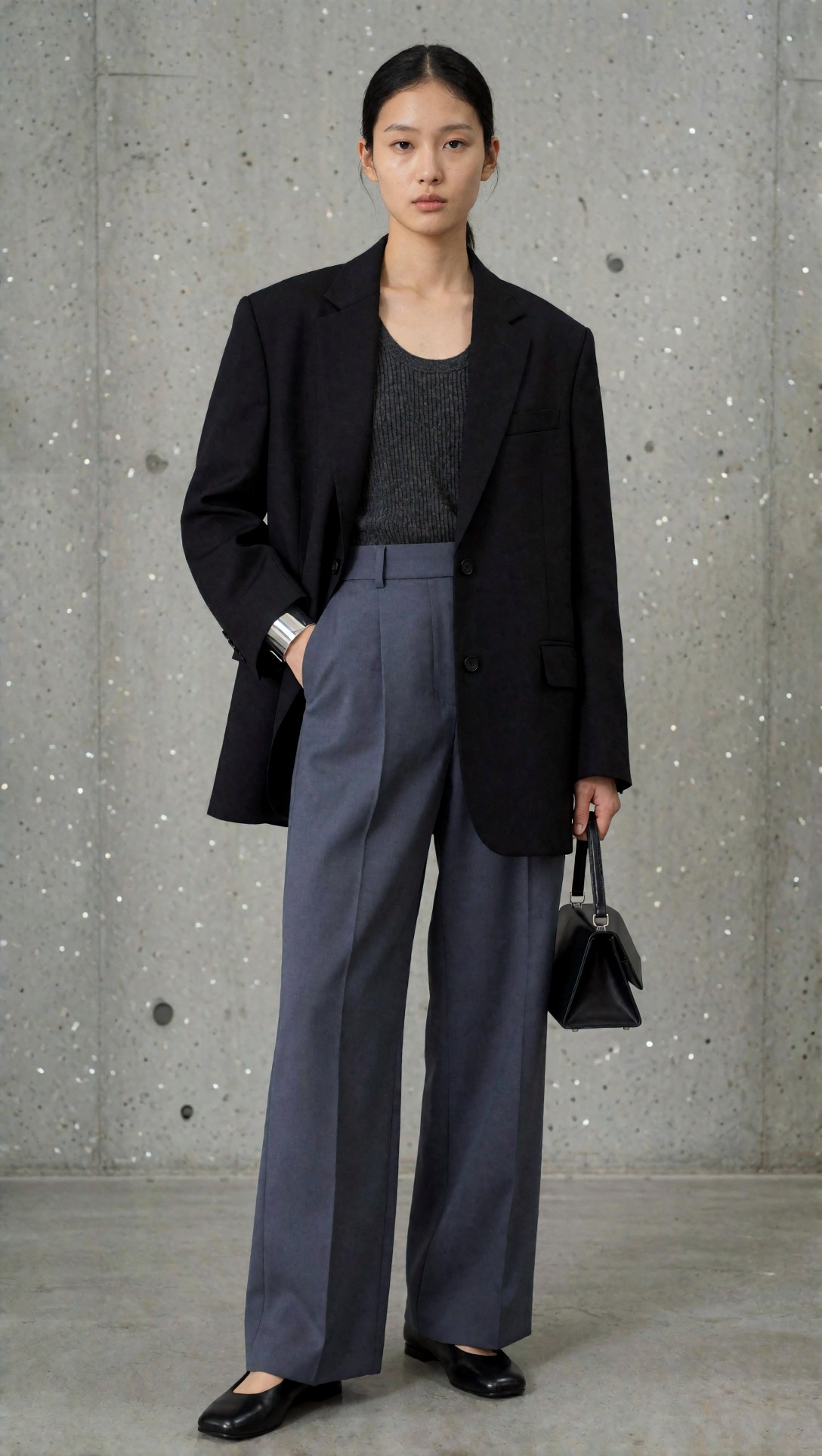
Inspect whether the blazer, tank, and trousers remain visually separate despite the limited color range. This was one of the strongest setups in the test because texture instructions compensated for the monochrome palette.
Test 6: Youthful Korean streetwear with layered accessories
This test checks accessory density. It deliberately includes cap, headphones, bag, and jewelry to see when the model starts dropping items or duplicating them.
Topic: youthful Korean streetwear outfit with multiple accessories
Genre: Street Fashion Campaign
Camera: Panasonic Lumix S1R
Lens: 28mm f/3.5
Lighting: late afternoon open shade
Location: rooftop parking deck in Seoul
Style: energetic youth fashion campaign
Final Prompt: full-body Korean streetwear campaign image on a Seoul rooftop parking deck, model wearing an oversized cream varsity jacket over a striped knit polo and black pleated shorts, tall white sports socks, retro running sneakers, canvas messenger bag, navy cap, silver chain necklace, on-ear headphones resting around the neck, playful confident pose with weight shifted to one leg, lively but controlled expression, head-to-toe visible, all accessories readable, clear short layering and proportion, late afternoon open shade, Panasonic Lumix S1R crisp detail, 28mm wide fashion energy without distortion, youthful Korean trend styling, bright neutral palette with navy and black accents, realistic fabric texture and clean accessory placement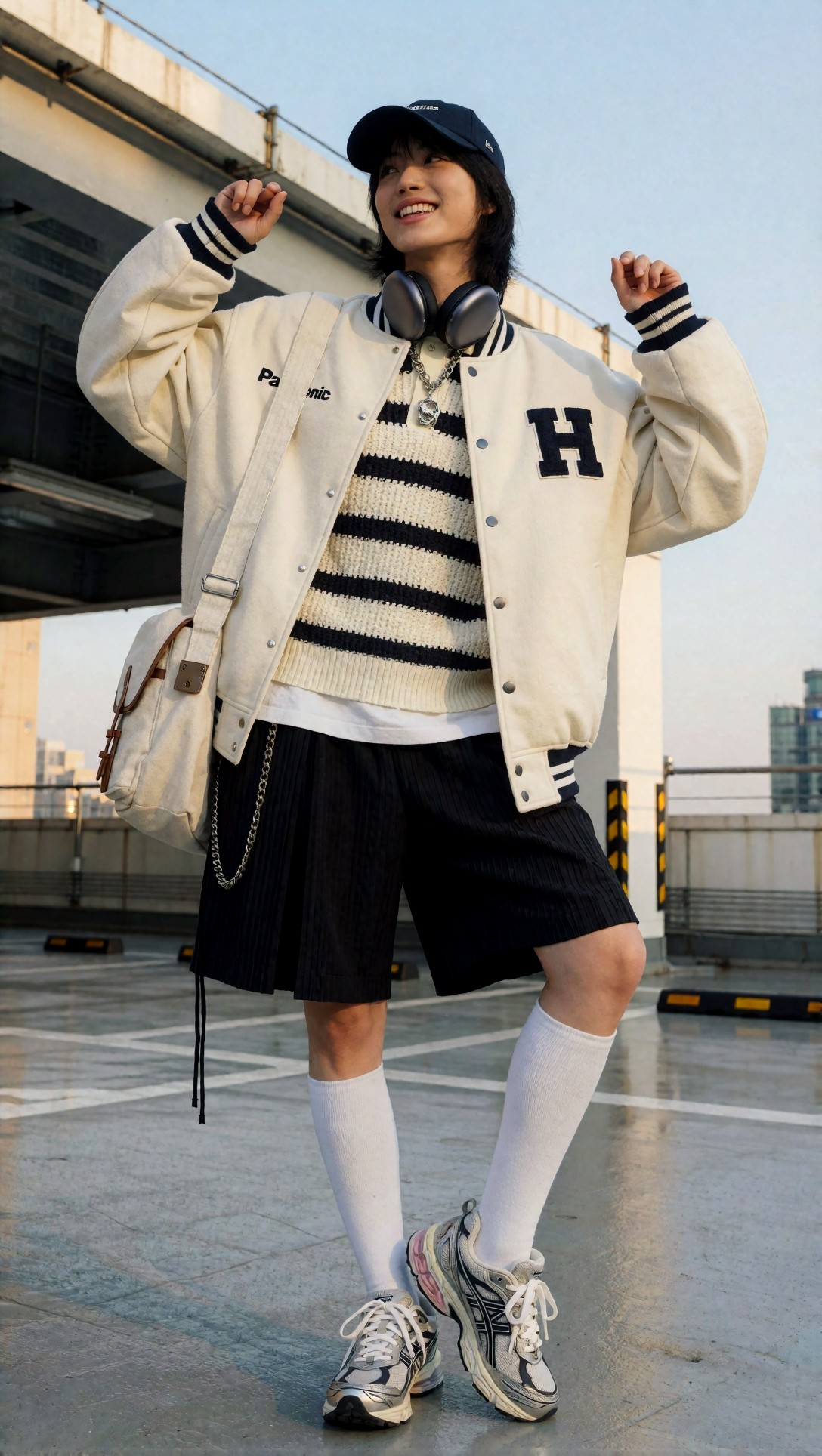
Check for duplicate headphones, merged cap hairlines, and distorted sneaker shapes. When this setup works, it creates the kind of Korean street fashion image that feels editorial rather than random.
Test 7: Smart casual menswear-inspired K fashion outfit
I included a menswear-leaning setup because many "K fashion outfit" searches are really looking for proportion ideas, not just one feminine styling direction. This prompt tests whether the model can maintain a long-line silhouette with controlled layering.
Topic: smart casual Korean fashion outfit with menswear-inspired layering
Genre: Fashion Campaign
Camera: Hasselblad X2D 100C
Lens: 55mm f/2.5
Lighting: soft cloudy daylight with subtle negative fill
Location: minimalist urban plaza with pale stone architecture
Style: luxury contemporary Korean editorial
Final Prompt: full-body smart casual Korean fashion image, androgynous model wearing a taupe single-breasted overcoat over a crisp white oversized shirt and fine black knit vest, cropped straight trousers, black leather derby shoes, narrow crossbody bag, understated watch, standing in a clean urban plaza, calm poised expression, long vertical silhouette, full head-to-toe composition, visible shoe shape, clear separation between coat, shirt hem, knit vest, and trousers, muted taupe white and black palette, Hasselblad X2D premium realism, 55mm natural fashion perspective, luxury contemporary Korean editorial style, refined architectural background, sharp textile detail and balanced composition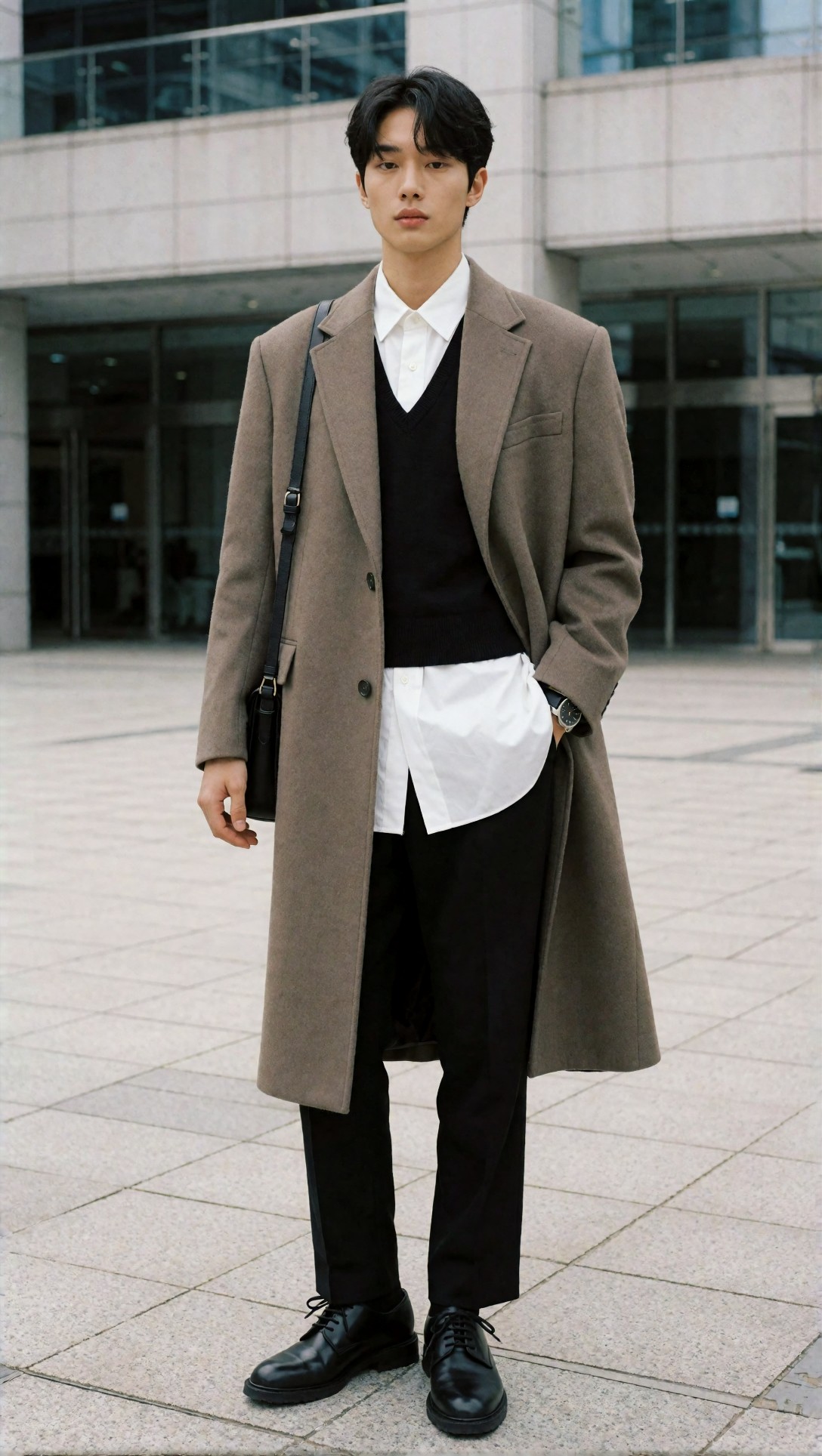
Inspect shirt hem length and coat structure. In weaker outputs, the vest sometimes disappears into the coat, so the layer order is the key evidence point here.
Test 8: Evening editorial look with accessories and controlled drama
This final test checks how far you can push atmosphere before outfit readability starts to break. I kept the lighting dramatic but not so dark that the garments disappear.
Topic: elevated evening Korean fashion outfit with layered accessories
Genre: Fashion Editorial Campaign
Camera: RED V-RAPTOR cinematic still
Lens: 50mm anamorphic look at T2.8
Lighting: neon rim light with soft frontal fill
Location: upscale hotel hallway with reflective stone floor
Style: cinematic Korean fashion editorial
Final Prompt: full-body evening Korean fashion editorial in an upscale hotel hallway, model wearing a fitted black turtleneck under a cropped textured tweed jacket, ivory satin slip skirt, pointed slingback heels, small metallic clutch, layered silver rings, statement ear cuff, sleek low bun, slow walking pose with composed expression, full outfit visible from head to toe, clear edge light around jacket and skirt, visible heel shape, luxury Korean editorial atmosphere, RED V-RAPTOR cinematic still realism, 50mm anamorphic mood, neon rim light balanced by soft frontal fill, elegant black ivory and silver palette, reflective stone floor, precise textile detail, controlled drama without losing garment clarity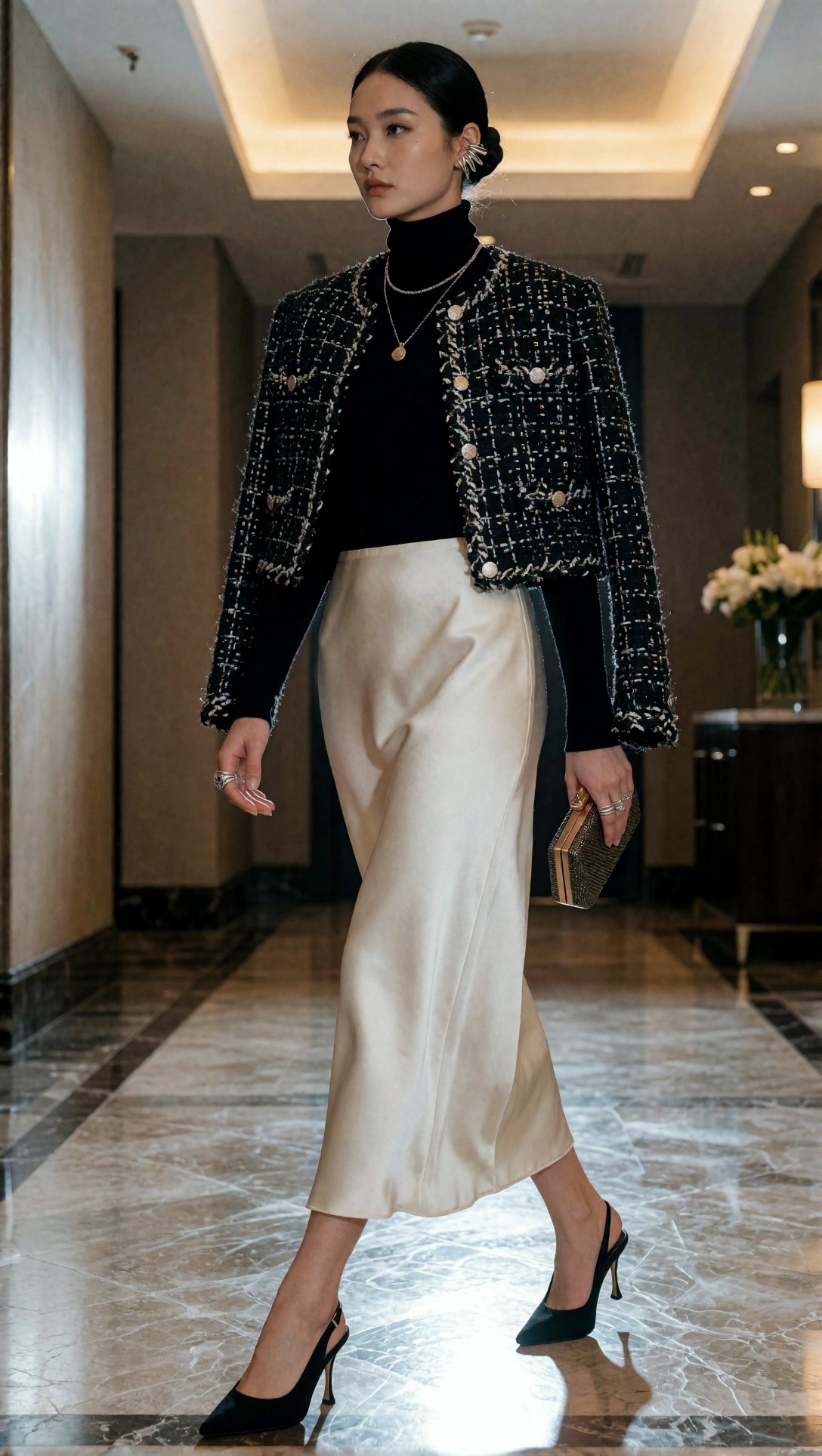
Inspect whether the satin skirt keeps believable folds and whether the metallic accessories remain singular and clean. The tradeoff here is obvious: stronger atmosphere gives better editorial mood, but it also raises the risk of losing subtle garment detail.
What worked best across the test
A few prompt patterns consistently outperformed the rest.
Strongest result: simple background plus explicit garment stack
The strongest result came from prompts that described the outfit in sequence from outerwear to base layer to lower half to shoes to accessories. That order reduced confusion. The model seemed to treat it like a styling blueprint.
Best use case for Korean street fashion
For Korean street fashion, 35mm or 28mm framing in overcast or open shade worked well because it preserved the full body and kept textiles readable. This was better than dramatic night scenes when the goal was outfit analysis rather than mood.
Best use case for Korean minimalist fashion
For Korean minimalist fashion, studio or showroom setups gave the cleanest output. If the purpose is lookbook photography, this is the most reliable option because it minimizes background competition and lets proportion lead.
Best use case for K-pop airport fashion
Airport prompts are useful when you want aspirational but practical styling. They naturally support coats, tote bags, luggage, sunglasses, and loafers or sneakers. They are also easier to prompt than runway scenes because the composition is more grounded.
Failure risks and common mistakes to avoid
Asking for too many trend labels at once
If you combine "Korean fashion trends, Korean street fashion, minimalist fashion, luxury airport fashion, Y2K, soft girl" in one prompt, the result usually gets muddy. Pick one dominant styling system and one secondary accent.
Forgetting to force full-body composition
This is the biggest practical mistake. Even fashion-tuned models still drift toward portrait crops. If shoes matter, say so directly.
Overloading accessories without placement
"Bag, necklace, rings, sunglasses, hat, scarf" is too loose. Place them in relation to the body or garment. The model performs better with instructions like "crossbody bag resting at hip" or "headphones around the neck."
Choosing lighting that hides black fabrics
Low-key cinematic setups can look expensive, but they often flatten black coats, knitwear, and trousers into one dark mass. If the outfit depends on subtle tailoring, use overcast, window light, or soft studio light first.
Complicated poses before the outfit is locked
In this test, dynamic poses often hurt garment clarity. If you need a reliable k fashion outfit generation, get the outfit right in a stable standing pose first, then add movement later.
A compact quality checklist
Use this checklist before keeping an image:
- Is the full body visible from head to shoes?
- Can you identify each layer separately?
- Do the accessories appear once and in the correct place?
- Are the shoes readable and anatomically plausible?
- Does the background support the outfit instead of distracting from it?
- Do fabric textures match the garment type?
- Does the silhouette fit the intended Korean fashion direction?
- If it is airport or street style, does the pose feel naturally wearable?
Practical recommendation: when to use each workflow
If your goal is lookbook photography, use a studio or showroom setup with a 50mm to 65mm lens description, soft lighting, and explicit full-body language.
If your goal is Korean street fashion inspiration, use an outdoor Seoul-style location, 28mm to 35mm framing, and fewer than four accessory instructions.
If your goal is K-pop airport fashion, include one travel prop, one luxury accessory, and one clear outerwear layer. Do not add more than two competing bags or the model may hallucinate straps.
If your goal is Korean minimalist fashion, keep the palette narrow and make texture contrast explicit. This matters more than adding trend keywords.
Final recommendation
If you want dependable k fashion outfit images, use this workflow when the outfit itself is the product: full-body framing, garment-first prompt order, accessory placement, and a background that does not compete with the styling. That combination produced the most reliable outputs in this test.
Who should use this workflow: creators building AI lookbooks, prompt designers testing Korean fashion trends, sellers mocking up apparel concepts, and editorial users who need readable layering and accessories rather than face-led beauty shots.
Who should avoid it: users chasing highly abstract mood images where silhouette accuracy does not matter, or anyone who wants fast one-line prompts without inspection and iteration.
The setting that matters most is not the camera name or even the location. It is the prompt detail that forces head-to-toe garment clarity: visible shoes, separated layers, and accessory placement tied to the body. Once that is locked, the style labels start to work. Without it, even a good Korean street fashion prompt tends to collapse into a generic portrait with fashionable noise.