Short answer: in the two sets of eight images below, a capsule wardrobe survived best when the picture was one person wearing it, full length, and broke down when a single frame had to hold several garments at once. Street and lookbook shots showed nearly every garment the prompt named. The flat lays, the multi-look grids and the shop windows did not. They invented printed text and logos, put people's legs into object-only layouts, and repeated the same outfit or the same bag across panels. Below, all sixteen images are checked garment by garment. This is not a benchmark: each image is one generation from one model (Krea2 Turbo), with no repeated runs, so read the patterns as observations, not rates.
Both sets started from the same idea: pick a neutral palette, then show that wardrobe through eight different photo formats. The first set (generated 2026-07-12) used charcoal, stone, ivory, black and chocolate in a Seoul-and-Paris styling. The second (generated 2026-07-16) used ivory, stone, black and tan in a Nordic summer styling. The two sets were originally separate articles and are merged here.
Start with one outfit and count the garments
A simple test for a lookbook prompt: list the garments it names, then check each one in the image. Set A's street shot, prompt exactly as recorded:
street-style full body fashion shot of a minimalist capsule wardrobe outfit, model walking confidently through Seongsu, long charcoal wool coat worn open over a fitted black rib knit top, high-waisted stone straight-leg trousers, pointed black ankle boots, structured chocolate shoulder bag, slim belt, delicate gold hoops, tasteful body-conscious silhouette with defined waist and long leg line, clean layered styling, full outfit visible head to toe, natural stride, neutral expression, soft overcast light, urban concrete textures, understated quiet luxury palette of charcoal stone black and chocolate, realistic fabric drape, editorial composition, garment fit and silhouette prioritized over face, crisp fashion magazine detail, sexy fashion mood, outfit-first fashion editorial, complete styling system, visible fabric texture, accessories, shoes, bag, scene context, natural pose or walking action, 35mm editorial photography, realistic street, runway, retail, or lookbook setting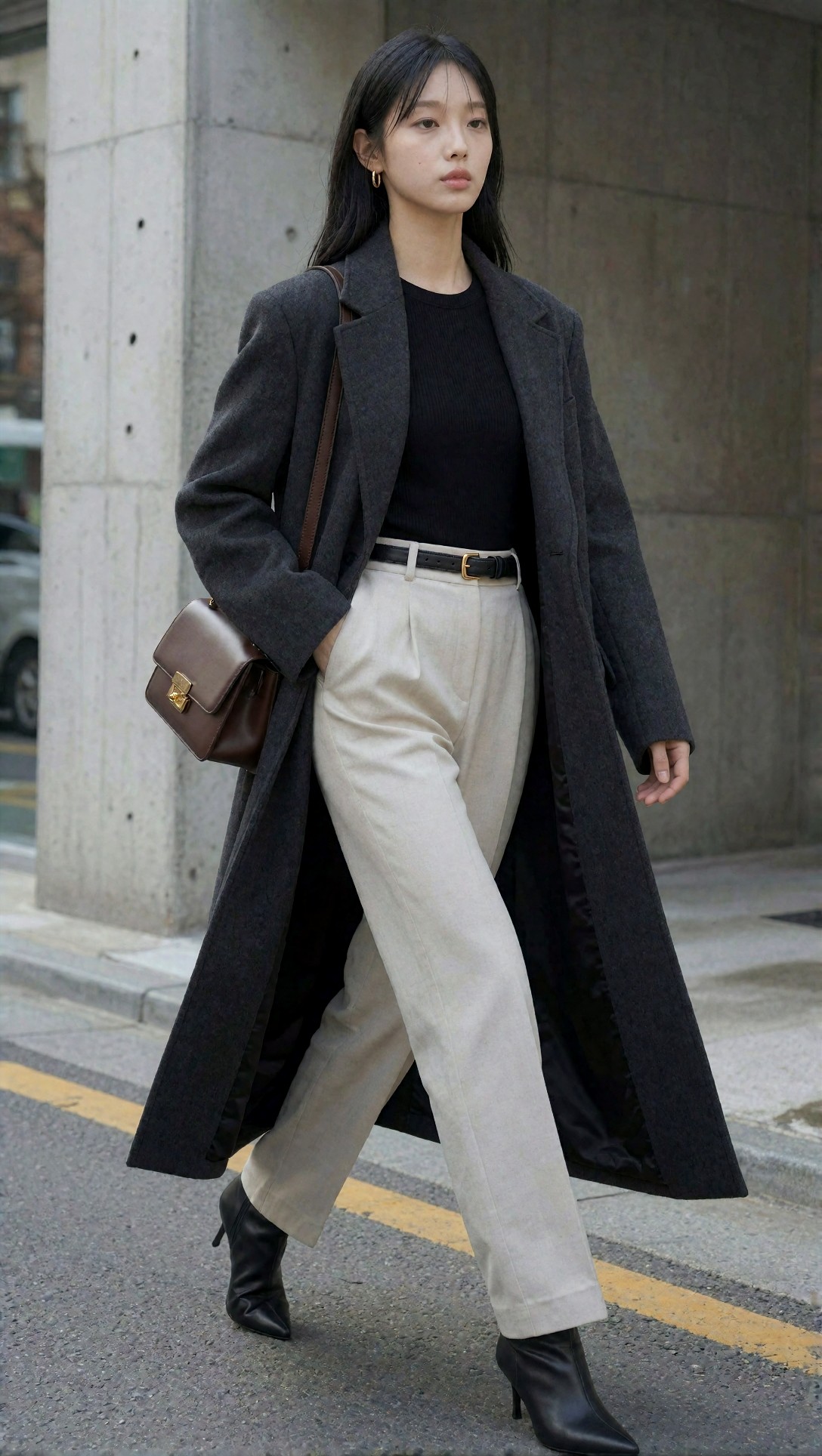
Everything the prompt named is there: the coat is open and shows its black lining, the rib knit is visible underneath, the trousers are high-waisted with a front pleat, the belt is black with a gold buckle, the boots are pointed with a heel, and the bag is a dark brown boxy shape with a gold clasp on a shoulder strap. The trousers come out light cream-grey rather than a clear "stone", and the coat hangs wide enough to keep the trouser shape readable. The walking stride looks natural. The prompt names Seongsu, but nothing in the picture identifies a place: it shows a bare concrete wall and a painted yellow line on the road. Treat place names as mood cues, not as guarantees.
Two notes on the records. The recorded prompt ends with a generic tail ("sexy fashion mood, outfit-first fashion editorial, complete styling system ...") that the original article did not show; Set B carries a similar tail with "trend led fashion mood". And the camera and lens lines the original articles printed above each prompt (for example "Canon EOS R5, 35mm f/2") are not in the recorded prompts, so no claim is made about them.
Set B's street shot follows the same logic with lighter pieces:
street-style full body fashion shot of a Scandinavian fashion capsule wardrobe outfit, complete head-to-toe visibility, relaxed boxy white poplin shirt worn open over a black rib tank, high-waisted stone wide-leg trousers with a clean break, black leather slide sandals, tan suede tote, slim silver cuff and small hoops, hair simple and natural, walking pose with slight motion, muted palette of ivory stone black and tan, soft overcast Nordic light, Copenhagen street context with restrained architecture ... (excerpt of the recorded prompt)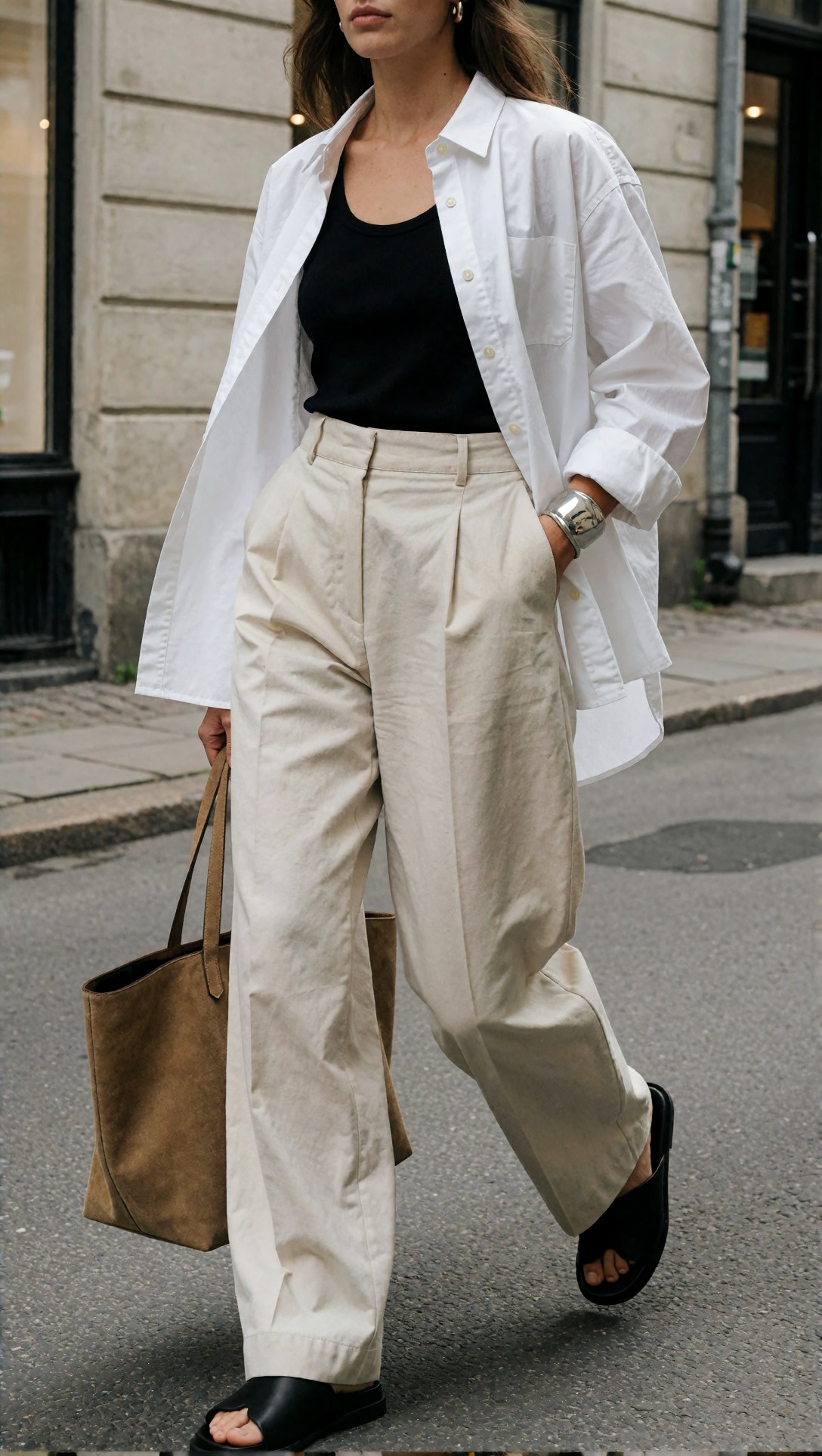
The shirt, tank, trousers, sandals, tote and silver cuff are all present, and the creased cream trousers and crisp white shirt are clearly different fabrics. But the prompt asked for "complete head-to-toe visibility", and the frame crops the face at the lips and cuts off the front sandal at the bottom edge. If a full-length frame matters for your use, that request on its own was not enough here. The prompt asked for a "slim silver cuff"; the cuff in the image is broad and chunky.
The same wardrobe in other poses: what stays and what drifts
Set A's blazer-and-satin look (image 2) kept every named piece: rolled blazer sleeves, a square-neck ivory tank, a champagne-beige satin skirt with soft highlights, pointed slingbacks, a gold cuff. The odd parts are the background, a cream backdrop with a studio light stand rather than the "Paris loft" the prompt describes, and two small black rectangles on the right edge near the stand. Its cropped-jacket look (image 3) shows the intended proportion contrast well, with a short taupe jacket ending above the hip over high-rise black trousers, but the face is cropped at the nose and the loafers are cut at the bottom edge, although the prompt asked for the silhouette "from shoulders to shoes".
Set B shows a different kind of drift. In the apartment look (image 2) the prompt asked for an oatmeal linen blazer with stone pleated trousers; the blazer and trousers came out as nearly the same cream linen, so they read as one matching suit. In image 3, a cream fine-gauge knit top tucked into an ivory skirt came out as two pieces of the same fuzzy cream knit and reads like a co-ord. That is two observations, not a rule, but in both cases two neighbouring garments shared a colour family and the prompt wrote no material contrast. The courtyard look (image 6) is where the prompt's specifics held best: linen blazer draped over the shoulders, white tank, mid-wash relaxed jeans that are not distressed, black double-strap sandals, suede tote, stacked silver cuffs.
Grids: four different outfits, one identical bag
Grids test "does this look like a system?" most directly, because repetition has nowhere to hide. Set A's prompt asked for four distinct looks:
catalog grid page showing four distinct capsule wardrobe outfit ideas in a cohesive minimalist system, look one long charcoal coat with black knit and stone trouser, look two oversized blazer with ivory tank and satin midi skirt, look three taupe cropped jacket with black wide-leg pant, look four white shirt layered over rib tank with dark denim and slingback heels, each figure shown head to toe in separate panel (excerpt of the recorded prompt)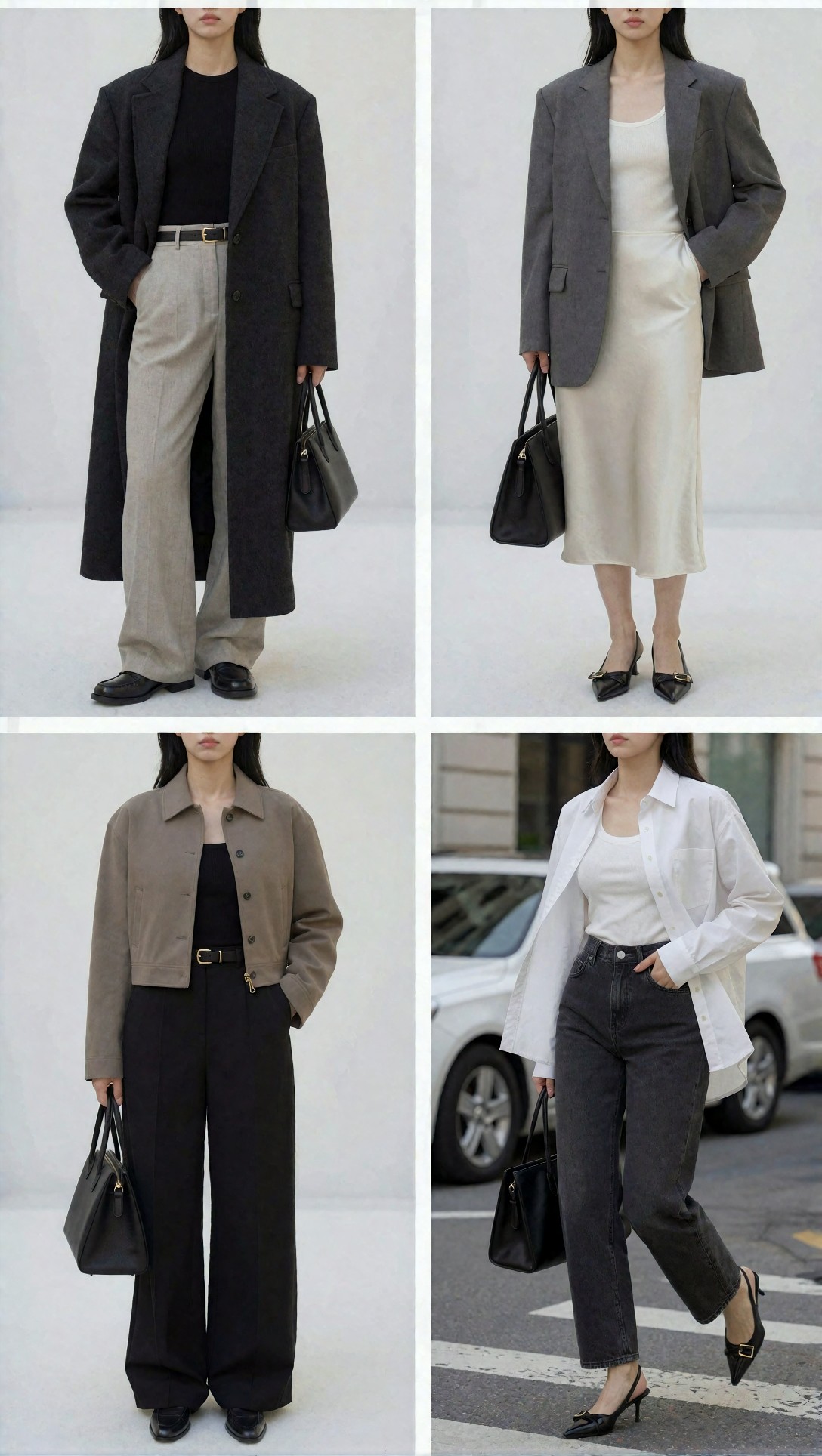
The four silhouettes are genuinely different (long over lean, boxy over fluid, cropped over wide, open shirt over straight jeans), and panel four even moves to a street crossing. But the same black structured tote appears in all four panels, all four figures have a hand in a pocket, and every panel crops the face at the nose or chin. The recorded prompt mentions bags only generically ("visible shoes bags and accessories"), so the single repeated tote is the model's own default. If you want variety in a set, name a different accessory in each look.
Set B's grid is a harder case. The prompt asked for "multiple coordinated outfit panels in one composition":
catalog grid page showing a Scandinavian fashion capsule wardrobe for summer, multiple coordinated outfit panels in one composition, each panel displaying a repeatable capsule combination using white poplin shirt, black rib tank, stone trousers, tailored black shorts, ivory midi skirt, oatmeal blazer, slide sandals, ballet flats, suede tote and silver jewelry, clean magazine layout feeling, restrained Scandinavian design language, soft neutral shadows, precise garment separation, luxury retail presentation, emphasis on wardrobe system rather than personality ... (excerpt of the recorded prompt)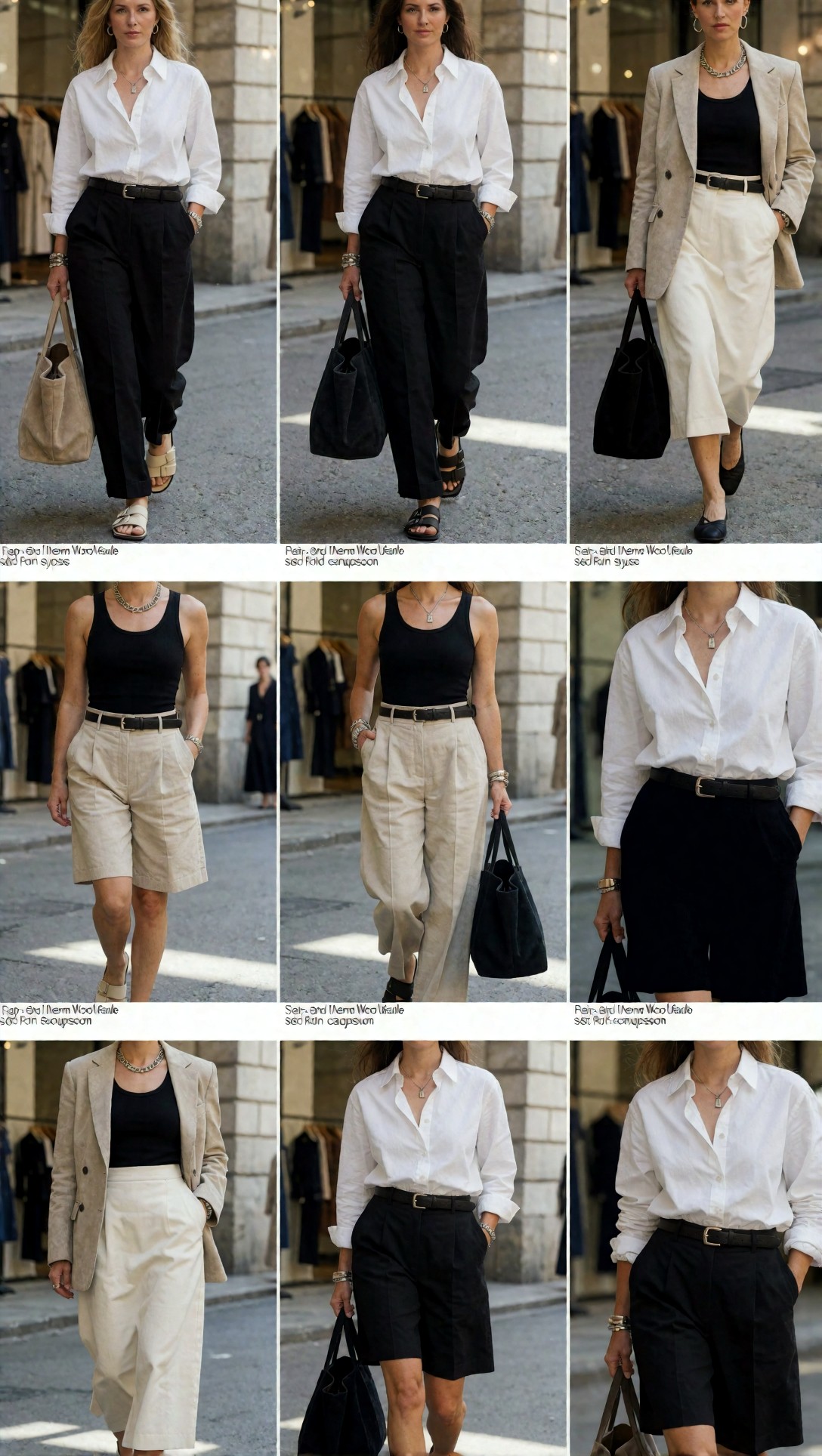
Nine panels came out, but they contain only about six distinct outfits: the white shirt with black shorts appears three times, the white shirt with black trousers twice, and the blazer with cream skirt twice. The panels appear to show different women (hair colour and apparent age differ), so the "same wardrobe" also changes wearer. And under each row there is a strip of caption text that the prompt never asked for; it is unreadable pseudo-text, something like "Rair and Item Wool Ueale", not real words. Fine for a mood board; for anything shop-like the text would have to go.
Flat lays and shop windows: where the model invents things
Object-only formats should be safer, since there is no anatomy to get wrong. Here they produced the most surprising errors. Set A's flat lay prompt listed thirteen items and asked for "pieces spaced cleanly" and "no clutter".
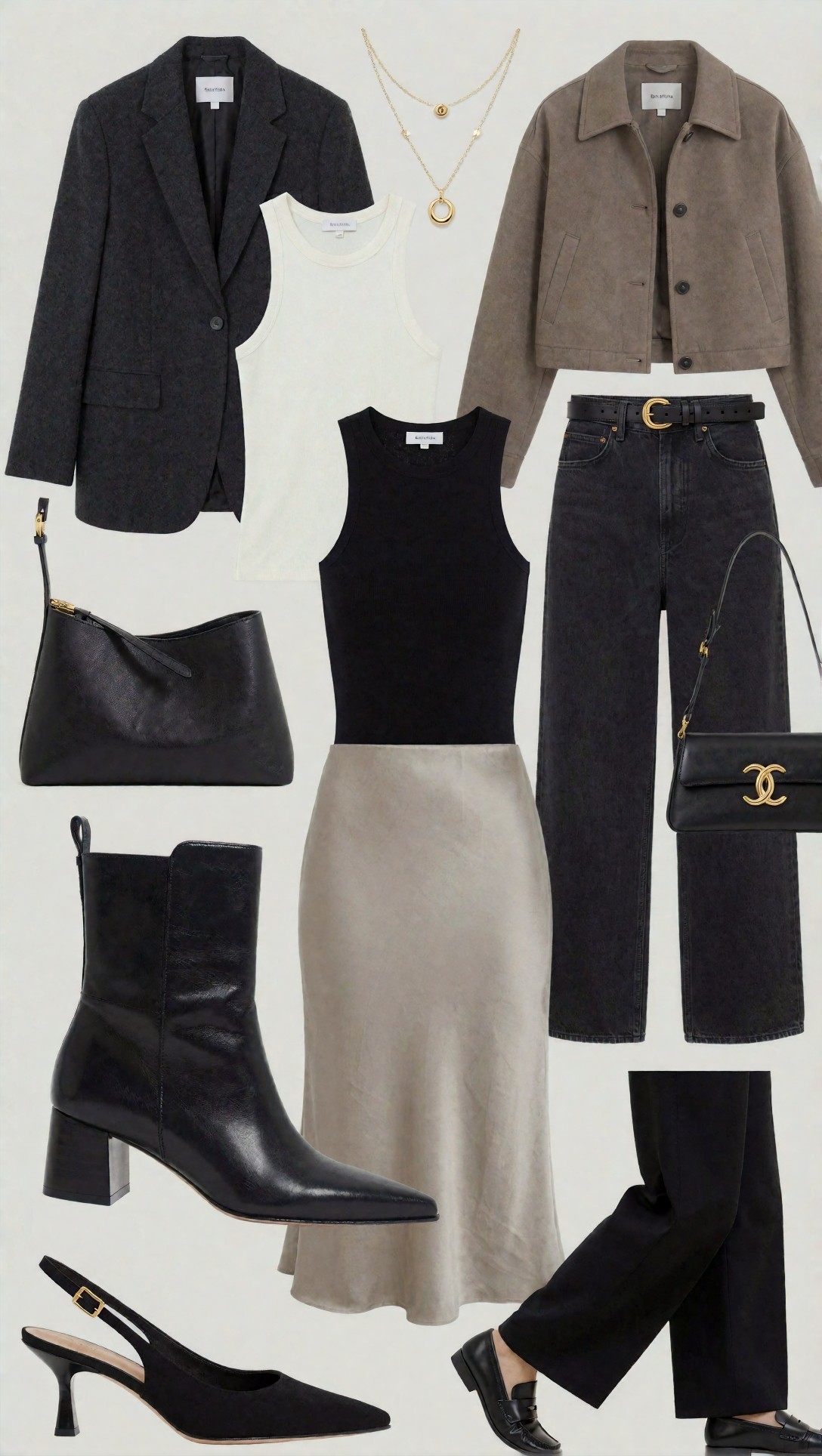
What is visible: every major garment is there and each has clear edges, but the pieces overlap instead of being spaced, the "black fine-knit top" is another tank, and the trousers and loafers are shown on a person's cropped legs at the bottom right. Small white tags on the blazer, tank and jacket collars carry unreadable text, and the shoulder bag carries an interlocking double-C style gold logo the prompt never requested. Set B's flat lay shows the same three issues on its own pieces: sandals on a person's feet at the bottom, unreadable tags, and a pleated cream skirt with stray dash-like marks where the prompt asked for a straight skirt. Its prompt allowed "a minimal fashion notebook and sunglasses"; the sunglasses appear, the notebook does not.
Storefront scenes show the same thing in a different way. Set A's window has three headless mannequins (charcoal coat with stone trousers; blazer with satin skirt; cropped taupe jacket with black wide trousers) with the shoes arranged below. The third mannequin is cut off at the right edge, a blurred passer-by smears into the frame, and the third pair of shoes is a hybrid, a loafer with a heel strap, which is not any of the shoes named in the prompt. Set B's window has a good full outfit on a single mannequin beside a hanging rail:
storefront display presenting a Scandinavian fashion capsule wardrobe for summer, minimalist boutique window with pale oak fixtures, rail of coordinated neutral garments, mannequin styled in white poplin shirt, black rib tank, stone wide-leg trousers, black sandals, tan tote, folded knitwear stacks, suede and leather accessories, restrained signage ... (excerpt of the recorded prompt)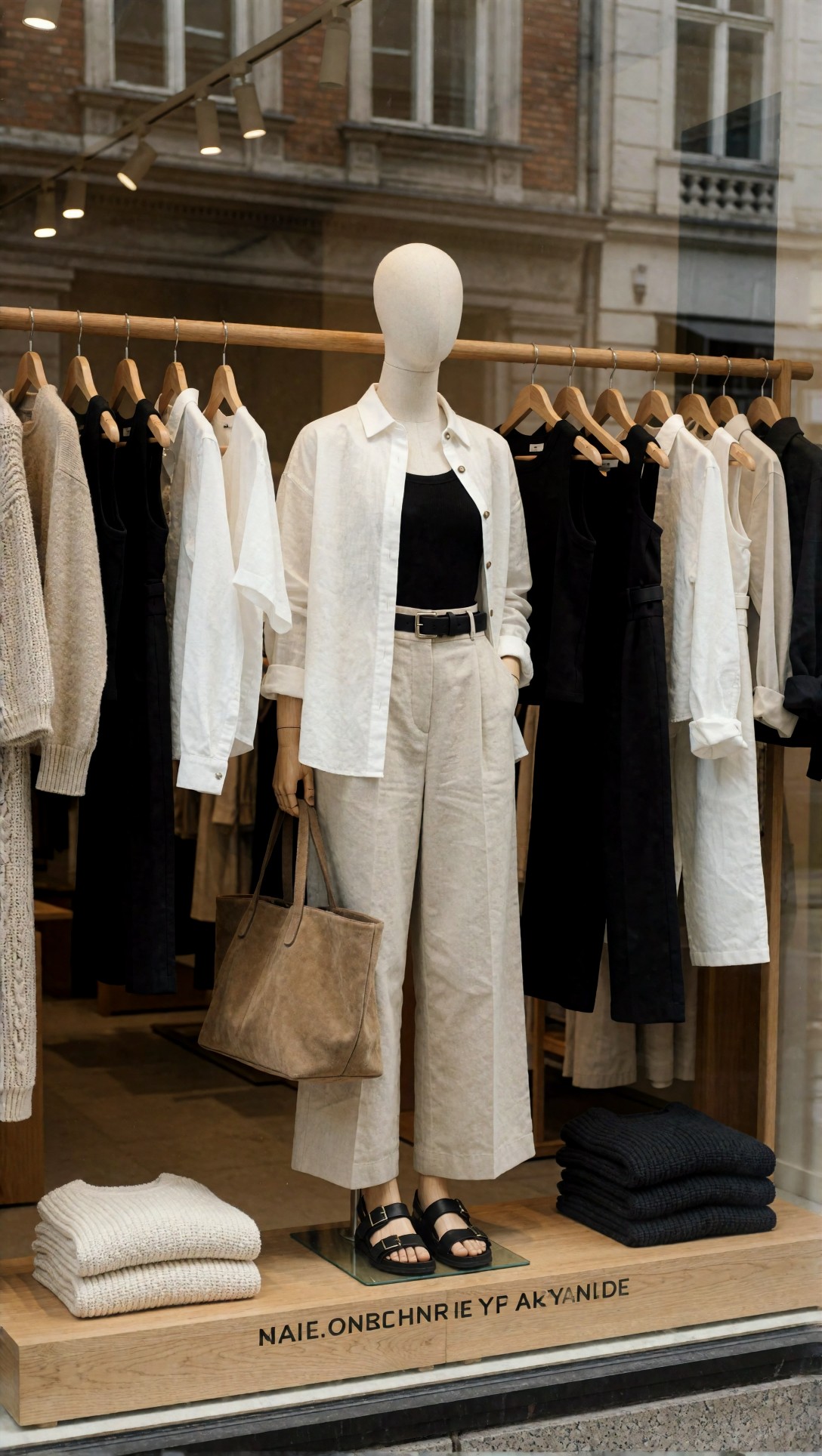
The outfit reads well, with folded knit stacks on both sides. But the prompt said "restrained signage", and the wooden plinth carries a line of black capital letters that spell nothing ("NAIE.ONBCHNRIE ..."). Across both sets, any surface that can carry writing (tags, captions, plinths, signage) got filled.
Where fabric contrast did work
Set A's detail macro is the clearest success for the prompt's "texture contrast between wool rib knit satin and leather": a charcoal wool blazer with visible fuzzy fibre, cream rib knit at the sleeve, a satin skirt with soft highlights that reads as satin rather than plastic, a black belt with gold buckle, and a gold cuff and chunky ring. It is cropped at the torso, so no face or shoes can go wrong. A close crop is an easier task for the model than a full outfit.
What to try next (unverified suggestions)
An untested suggestion that follows from the pattern above: build the capsule from full-length worn shots first, then add object-only frames with explicit exclusions. A flat-lay proposal, not yet generated:
Suggestion prompt (unverified): product flat lay, top-down, charcoal wool blazer, ivory rib tank, black fine-knit sweater, stone satin midi skirt, dark straight-leg jeans, black wide-leg trousers, pointed ankle boots, slingback heels, black loafers, each item fully in frame with space between items, no people, no body parts, no labels, no tags, no logos, no textFive checks would have caught the problems above: any text anywhere; body parts in an object-only layout; a cropped face or shoe when head-to-toe was requested; one accessory repeated across panels; two neighbouring garments sharing one fabric and colour. Drafting and rewriting prompts is easier in [Prompt Lab](/promptlab/en), and you can try them in the [image generator](/create/en). For the airport-travel side of the same minimalist wardrobe, see [Model Off Duty Airport Outfit Ideas](/articles/model-off-duty-airport-outfit/en), and [best AI image generators for fashion lookbooks](/articles/best-ai-image-generator-fashion-lookbooks/en) for a wider look.
FAQ
Do city names in the prompt (Seongsu, Copenhagen, Hongdae) change the image? They set a mood. In the street shots here, the pictures show a concrete wall and a stone-fronted street, but nothing that identifies the city, so do not rely on a place name for accuracy.
Are flat lays safer than model photos for a capsule wardrobe? Not in these two sets: both had unreadable tags and a person's legs in the frame, and Set A's added a logo-like mark on a bag.
Can I use these kinds of images as shopping-page visuals? The garments are not real products, and the unreadable text and logo-like marks seen here would have to be removed first. Treat them as concept and mood-board material.
> What this article is based on. Model: Krea2 Turbo for all 16 images. Set A was generated on 2026-07-12 and Set B on 2026-07-16. I opened and examined all 16 images (1088x1928 each); the recorded data contain prompts and model name only, with no seed, steps or settings. Camera and lens lines from the earlier articles are not in the records and are not used. Advice in the final section is a suggestion and has not been tested.