Denim outfits are easier to get right when you stop asking "what is American denim style right now?" and ask how three things behave on the body: the seams, the wash, and the layers. This article does not measure what Americans are wearing this year. I have no sales, search, or survey data for that, so "trending in America today" is not a claim here. What I do have is eight generated images of denim outfits (Z-Image, generated 2026-07-13), all of which I opened and looked at closely. They show how seams, wash differences, and layer order decide whether a denim outfit reads as clothing or as a blue blob.
Start with the seams, because they show whether a garment has structure
On a pair of jeans, the outseam, the hem stitching, the pocket corners, and the waistband are what tell you where the garment starts and stops. In these images, those details were rendered more convincingly than I expected.
In the first image, the jacket shows lighter topstitching along the yoke, the pocket flaps, and the cuffs, and a pale outseam line runs down the left leg of the jeans. The hem is stitched and ends above the white sneakers.
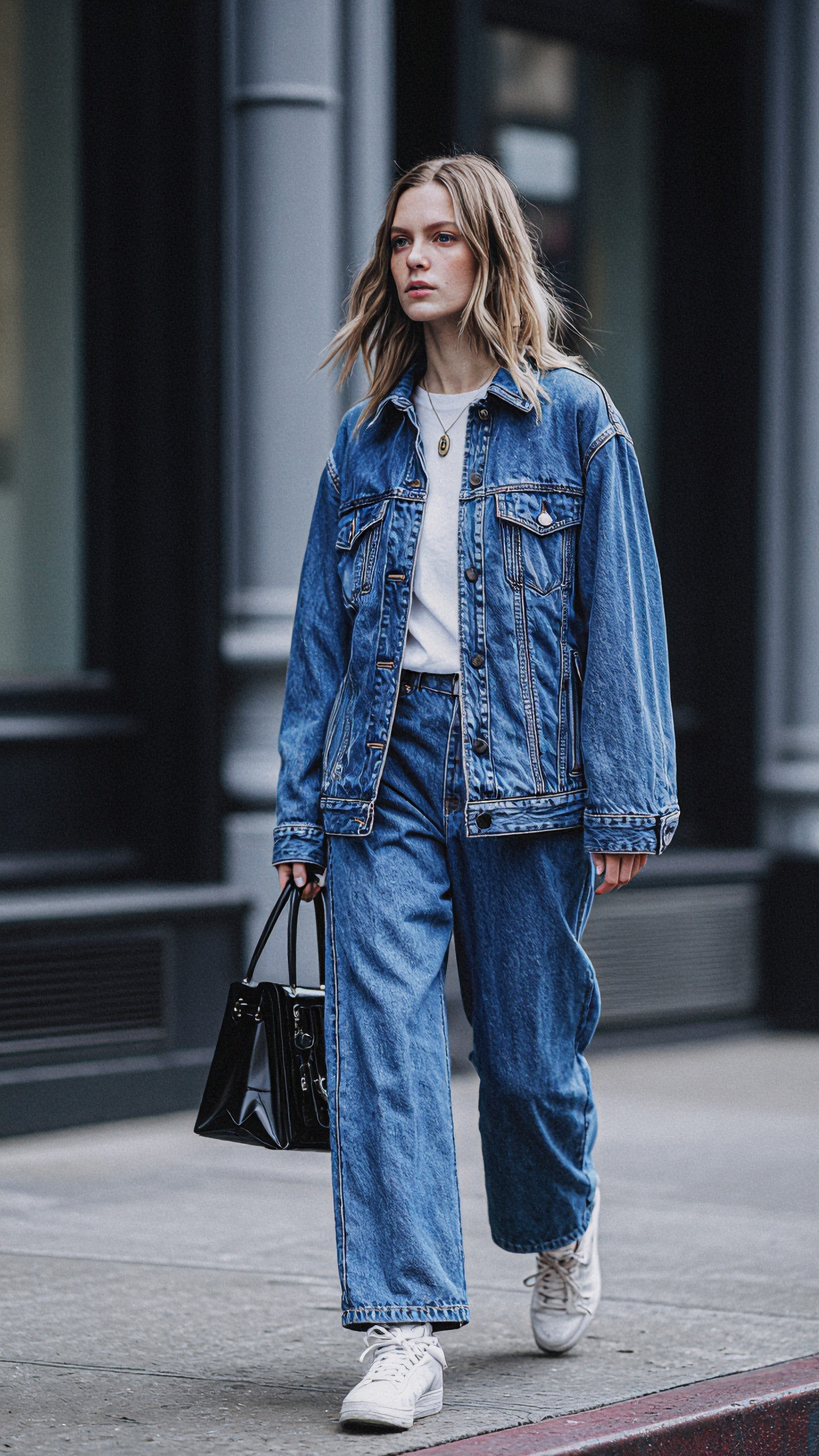
This was the broad prompt. Its full text, as recorded:
street-style full body fashion image of a current American denim outfit on a New York SoHo sidewalk, visible full look from head to toe, layered casual styling with denim as the main subject, modern streetwear attitude, full outfit readability, shoes, bag, accessories, realistic sidewalk context, overcast soft light, candid walking pose, cool neutral city palette, documentary fashion composition, Canon EOS R5 look, 35mm lens, emphasis on garment fit and silhouette rather than portrait beauty, trend led fashion mood, outfit-first fashion editorial, complete styling system, visible fabric texture, accessories, shoes, bag, scene context, natural pose or walking action, 35mm editorial photography, realistic street, runway, retail, or lookbook settingIt asks for "denim as the main subject" but names no wash, no cut, and no silhouette. The model chose a mid-blue oversized trucker jacket and mid-blue wide-leg jeans on its own. One flaw is visible: the right leg of the jeans bunches into an odd fold at the knee, and the two legs do not hang with the same width. That is a limit of this one image, and I can't say how often it would repeat.
The third image is a closer look at construction.
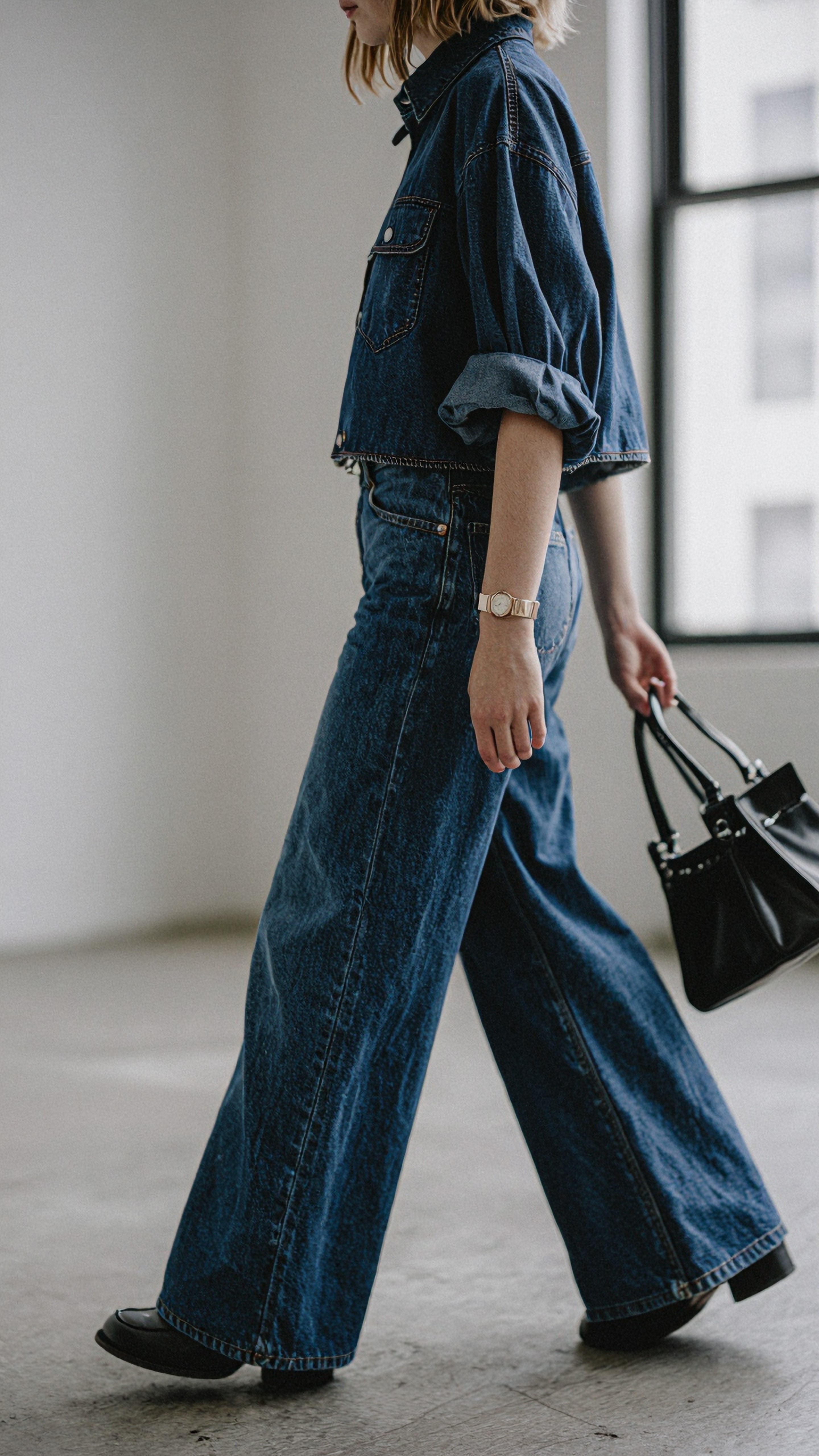
The cropped shirt has snap fronts, a chest pocket with a stitched outline, and a sleeve rolled back to show a lighter lining. The jeans show a clear outseam and a stitched hem that falls over black shoes. The framing cuts the head off at the mouth, which was not something the prompt asked for, so this is a usable clothing reference but not a usable portrait. The prompt:
three-quarter outfit editorial featuring a refined denim on denim look, cropped dark indigo denim shirt with visible topstitching, matching but slightly deeper indigo wide-leg jeans, sleek black loafers, slim leather tote, delicate gold watch, styling focused on clean lines and full outfit logic, model standing with relaxed editorial posture, Manhattan loft studio, soft window light shaping the denim texture, minimal set, quiet palette of indigo black cream and steel gray, Sony A7R V detail, 50mm fashion framing, premium fabric realism, strong garment separation, current US fashion trend mood, trend led fashion mood, outfit-first fashion editorial, complete styling system, visible fabric texture, accessories, shoes, bag, scene context, natural pose or walking action, 35mm editorial photography, realistic street, runway, retail, or lookbook settingWash consistency: one tone makes the layers disappear, a contrast makes them legible
The most useful comparison in the set is between the second image and the third.
The second prompt asked for "strong wash contrast between jacket and jeans":
street-style full body shot of a denim on denim outfit trending in America today, oversized medium-wash denim trucker jacket layered over a white rib tank, high-rise faded wide-leg jeans in a lighter wash, brown leather belt, pointed ankle boots, structured shoulder bag, small silver hoops, complete outfit visible head to toe, confident walking pose at a New York Lower East Side corner, late afternoon city light, texture-rich denim seams and pockets, strong wash contrast between jacket and jeans, modern American streetwear denim mood, Nikon Z8 realism, 40mm documentary framing, trend led fashion mood, outfit-first fashion editorial, complete styling system, visible fabric texture, accessories, shoes, bag, scene context, natural pose or walking action, 35mm editorial photography, realistic street, runway, retail, or lookbook setting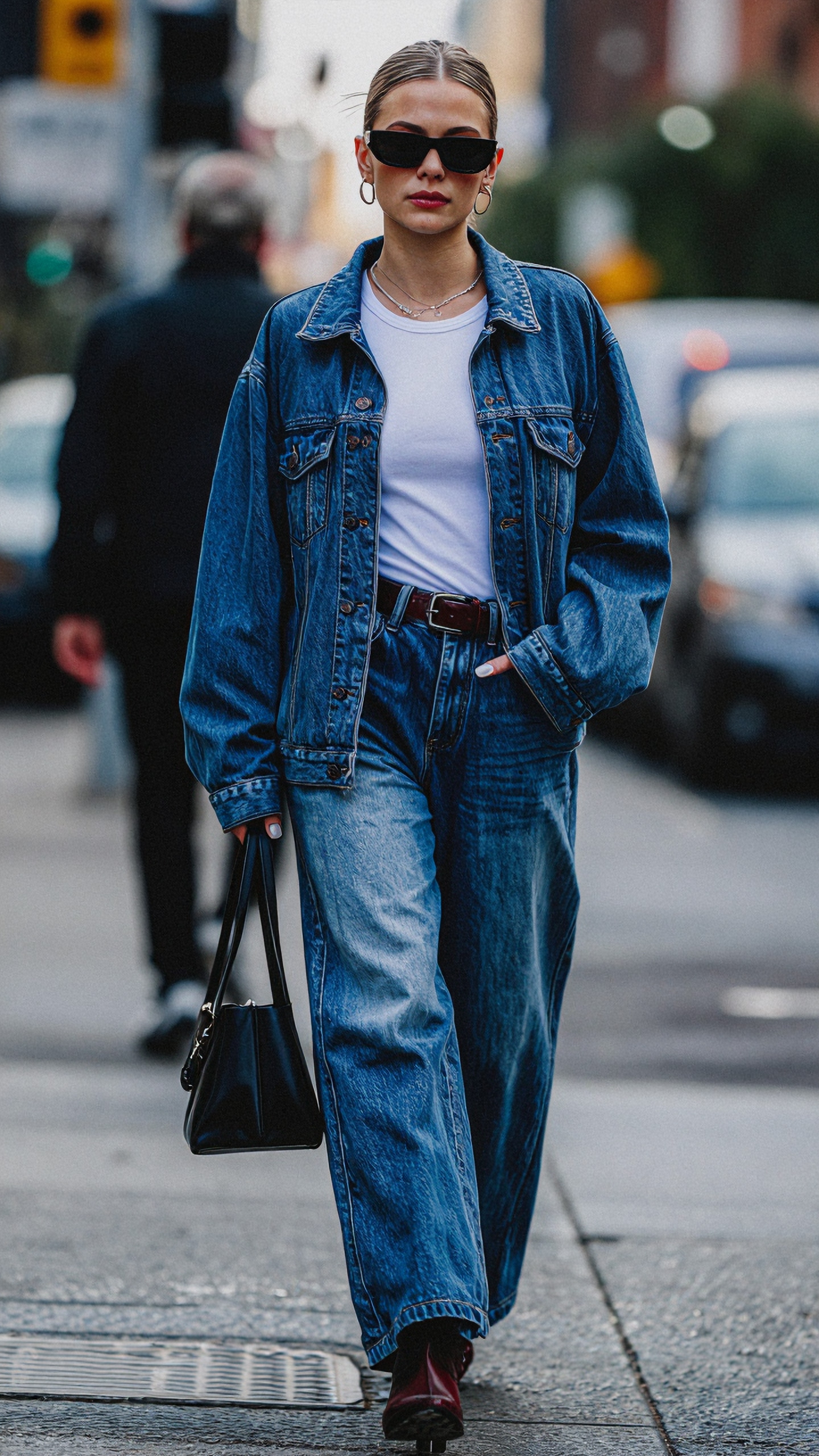
In the result, the jacket is a deep indigo and the jeans are a lighter, faded blue with visible whiskering and fading down the front of the thighs. The two garments separate at once, even though both are denim. A few things did not match the prompt: the belt and the boots are burgundy, not brown, and only one boot is visible under the hem, which pools slightly over it. Still, the wash difference did what it was asked to do.
The third image went the other way. The prompt asked for a shirt and jeans that "matched but slightly deeper indigo". In the image the two pieces are close in tone. What keeps them apart is not color but construction: the cropped hem of the shirt leaves a gap at the waist, the rolled sleeve introduces a lighter tone, and the shirt and jeans have different seam patterns. So when the washes match, shape and length have to do the separating.
The first image sits between these two. The jacket and jeans are both mid-blue with a similar mottled texture, and what divides them is the white tee showing at the center and the jacket hem landing at the hip. I read this as a general pattern in three images, not a rule: with near-matching washes, a neutral layer or a hem line keeps the outfit from merging.
The wash texture can look odd up close
In the fifth image the jeans have a mottled, slightly furry-looking fade over the whole leg.
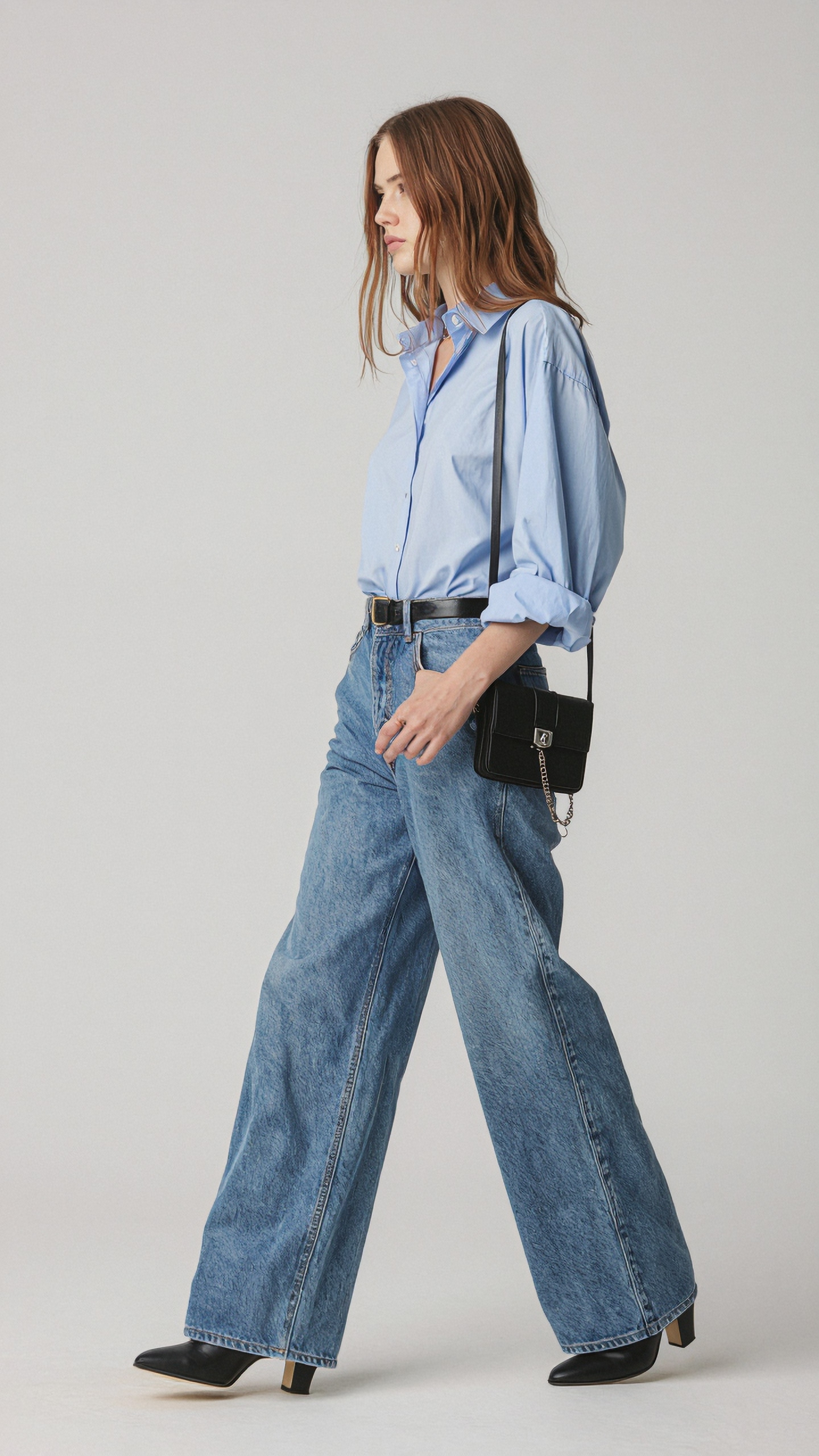
This reads as a stone-wash at thumbnail size, but it is a repeating pattern more than real fading, which would usually concentrate at the thighs, knees, and hems, as in the second image. Treat broad, even texture as something to zoom in on before you use the picture.
The prompt for this image, as recorded:
head-to-toe lookbook image showing a wide leg jeans outfit with current US fashion proportions, full body centered composition, medium-blue ultra-wide-leg jeans, crisp tucked-in poplin shirt with sleeves rolled once, slim black belt, heeled ankle boots, compact crossbody bag, minimal jewelry, clear negative space around the figure, off-white cyc studio, softbox lighting for honest denim texture and seam detail, modern catalog-meets-editorial styling, Canon EOS R3 clarity, accurate full silhouette, polished but not sterile, trend led fashion mood, outfit-first fashion editorial, complete styling system, visible fabric texture, accessories, shoes, bag, scene context, natural pose or walking action, 35mm editorial photography, realistic street, runway, retail, or lookbook settingIt asked for a "tucked-in poplin shirt". The shirt in the image blouses over the belt, and the belt is visible, so it is at most partly tucked. The long hem covers most of the boots, with the heels visible below it, and the outline of the wide leg is clear against the plain backdrop.
Layering logic: what goes over the denim, and what it hides
The clearest layering lesson came from the sixth image. A long cream coat was worn open over a black knit top and dark jeans.
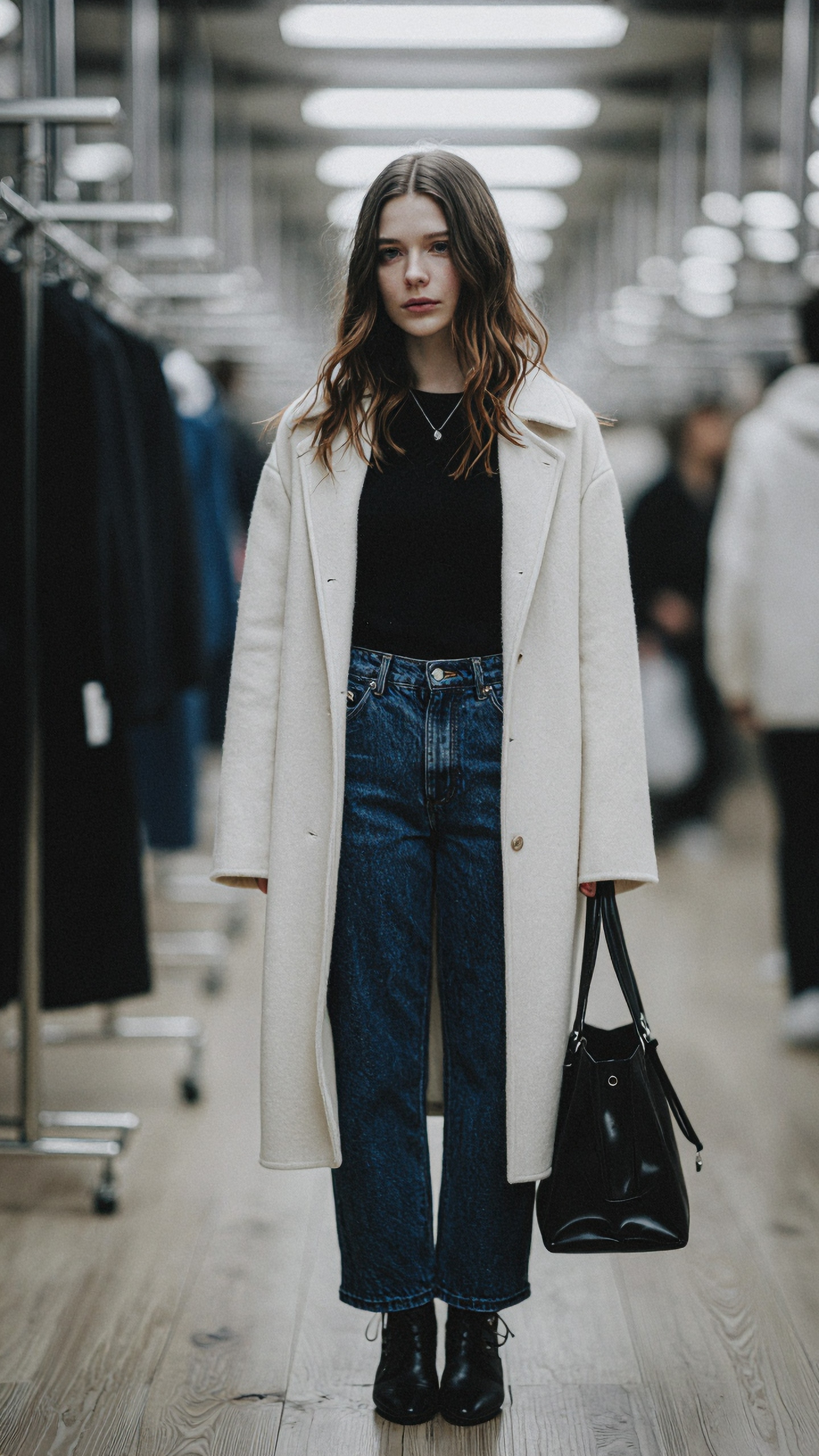
Here the coat hides the sides of the jeans, but the front waistband, button, and pockets remain visible, and the straight legs end above the boots with the hem stitching showing. The contrast between the cream coat, black top, and dark indigo jeans keeps each layer readable. The prompt:
three-quarter outfit editorial of a clean minimal denim outfit, straight-to-wide dark indigo jeans with crisp front line, fine black knit top, long cream wool coat worn open, black square-toe boots, structured leather tote, subtle silver jewelry, modern downtown American retail setting with pale oak floor and brushed steel fixtures, calm expression, styling focused on silhouette, texture, and clean layering, soft skylight, restrained luxury palette, Leica SL2-S realism, 50mm balanced framing, denim remains the visual anchor, trend led fashion mood, outfit-first fashion editorial, complete styling system, visible fabric texture, accessories, shoes, bag, scene context, natural pose or walking action, 35mm editorial photography, realistic street, runway, retail, or lookbook settingIt asked for square-toe boots; the boots in the image are black, lace-up ankle boots. The background is a rack-lined store aisle with blurred shoppers, and the jeans in the prompt were described as "straight-to-wide". The cut here is straight with a cropped hem. The prompt also says nothing about the lighting of the store beyond "soft skylight", and the overhead fixtures in the image are fluorescent tubes.
A layering order that works in the images where it worked: one pale or neutral layer next to the denim (white tee, cream coat, light blue shirt), an outer layer that ends at a different height than the jeans waistband (the jacket hem at the hip in the first image, the cropped shirt in the third), and dark footwear to close the line at the hem.
Where a flat lay breaks the logic
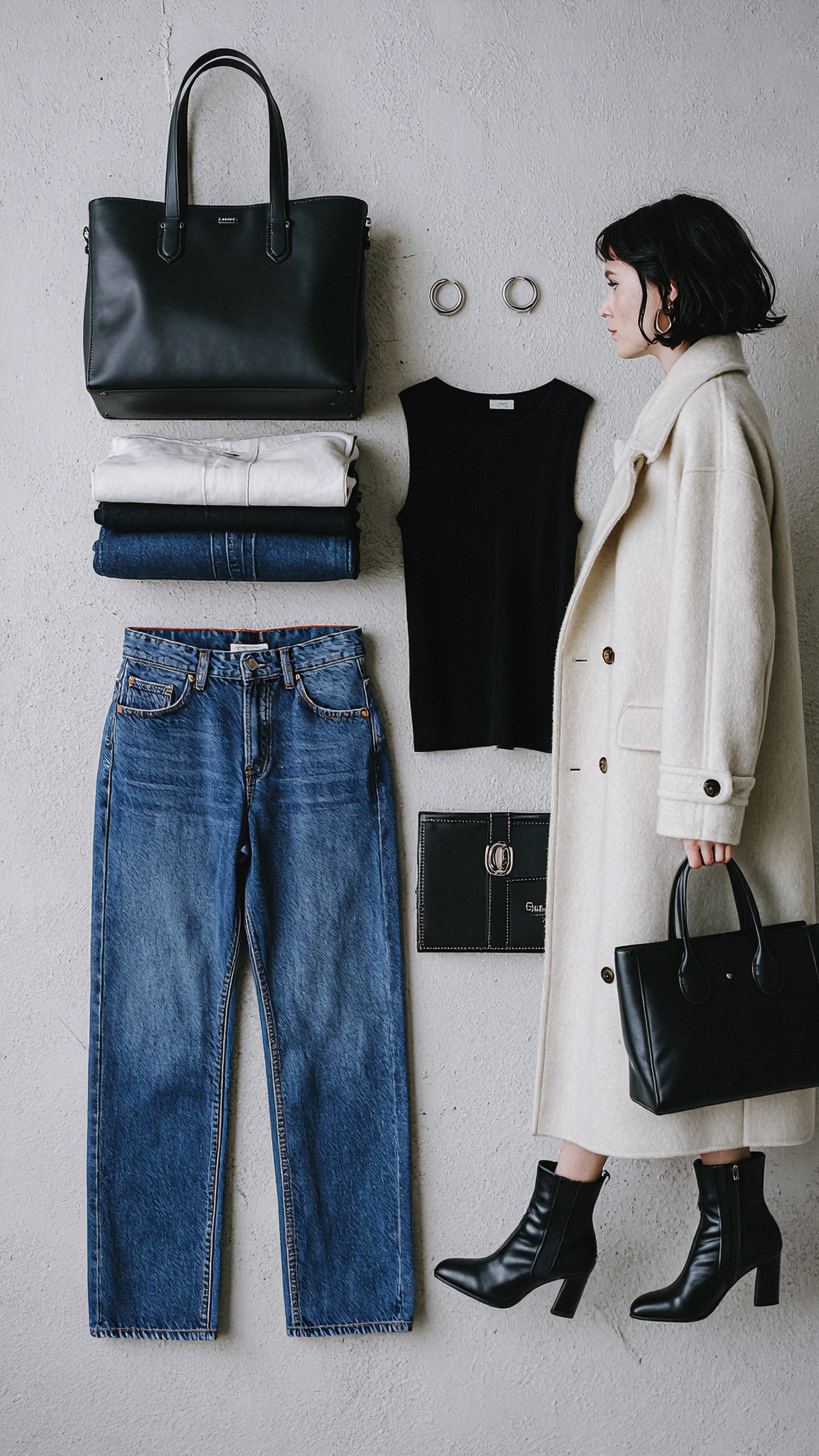
I also asked for a product flat lay of the same minimal outfit.
Prompt:
product flat lay of a clean minimal denim outfit trending in America today, dark straight-to-wide denim jeans, fine black knit tee, cream wool coat, black square-toe ankle boots, structured black leather tote, silver hoop earrings, slim belt, folded neatly with visible styling hierarchy on a neutral stone surface, overhead composition, premium retail editorial layout, fabric textures clear and tactile, restrained palette, Phase One detail, luxury merchandising feel, trend led fashion mood, outfit-first fashion editorial, complete styling system, visible fabric texture, accessories, shoes, bag, scene context, natural pose or walking action, 35mm editorial photography, realistic street, runway, retail, or lookbook settingThe result shows the garments laid out neatly on a grey concrete surface: dark jeans with visible pocket stitching and an orange inner waistband, a folded stack, a black tank, earrings, and a tote. But a woman in the cream coat and boots also appears at the right edge of the same frame, so the "flat lay" is half flat lay and half street figure. Small labels on the tote, the tank, and the clutch are garbled, unreadable marks. If you need a clean product-only board, this image would not serve as one. I did not run a second attempt, so I can't say whether the prompt can be tightened to prevent the figure.
What this tells you, and what it does not
- Seams and hem stitching were rendered consistently across the eight images. Fading was less consistent, and an even, furry texture can stand in for a real wash.
- A wash contrast of one visible step (deep indigo over faded light blue) made double denim readable. Matched washes needed a pale layer, a cropped hem, or a different garment shape.
- Text on labels and signs was garbled where it appeared (the flat lay, and the window lettering in the storefront image I also opened).
- None of these images says anything about what people currently wear. A single generated image per prompt cannot rank styles either, so I do not rank them.
For more on building wardrobes from a few reliable pieces, see the [capsule wardrobe outfit ideas article](/articles/capsule-wardrobe-outfit-ideas/en). To iterate on a denim prompt of your own, use the [Prompt Lab](/promptlab/en) and the [image generator](/create/en). If a hem or seam looks soft, the [Upscaler](/upscaler/en) is one option for a closer look.
Suggested follow-up prompts (unverified)
These were not generated; they are suggestions for checking the observations above.
full-length street photo of a woman in a dark indigo denim jacket and a light stonewashed wide-leg jeans, visible topstitching, fading at the thighs and knees, white tee, black ankle boots, overcast daylightFAQ
Can I wear double denim without it looking like a uniform? Fashion stylists commonly suggest varying the wash or the cut between top and bottom. The second image in this article shows that contrast working; it does not prove it for real garments.
Why does my generated jeans image look flat? In the images here, flatness appeared when the prompt named no wash and no layer structure. Naming a wash for each piece and one neutral layer gave clearer results.
Are wide-leg jeans the current trend? This article cannot say. Wide-leg jeans appear in five of the eight images because the prompts asked for them.
> What this article is based on. Model: Z-Image. Eight images generated on 2026-07-13, all opened and inspected; six are shown, two (a street crosswalk look and a three-mannequin storefront window) are not. The recorded generation data holds the prompts and the model name only. No trend, sales, or survey data was used, and any advice that is not tied to an image is general styling guidance.