Denim Trends Today: Testing Whether Baggy Jeans, Denim Maxi Skirts, or Double Denim Win US Outfit Searches 한국어 요약
이 페이지는 ZView Space의 영어 원문을 한국어 검색 사용자도 이해할 수 있도록 정리한 SEO 요약입니다. 핵심은 단순한 얼굴 중심 이미지가 아니라 패션 에디토리얼, 룩북, 아웃핏, 프롬프트 테스트, 이미지 생성 워크플로우를 실제로 어떻게 구성할지입니다.
핵심 요약
- 원문 주제: Denim Trends Today: Testing Whether Baggy Jeans, Denim Maxi Skirts, or Double Denim Win US Outfit Searches
- 목적: AI 이미지 생성에서 outfit, silhouette, fabric, pose, location, camera framing을 더 명확하게 설계합니다.
- 활용 범위: Z-Image Turbo, Krea2 Turbo, Qwen Image, Anima, SeedVR2 같은 이미지 생성 및 업스케일 워크플로우에 적용할 수 있습니다.
- SEO 관점: 제목, 설명, 이미지 alt, 프롬프트 예시가 실제 검색 의도와 맞아야 색인 가능성이 높아집니다.
한국어 사용자를 위한 체크포인트
1. 프롬프트가 얼굴 묘사에만 머물지 않고 전체 스타일과 의상 구성을 설명하는지 확인합니다. 2. 패션 이미지라면 상의, 하의, 아우터, 신발, 액세서리, 소재감, 촬영 장소를 분리해서 씁니다. 3. 생성 결과는 바로 게시하지 말고 디테일, 손, 의상 형태, 배경 일관성, 이미지 품질을 비교합니다. 4. 글 본문에는 실제 테스트 기준과 실패를 줄이는 방법이 들어가야 검색엔진에서 얇은 콘텐츠로 보일 가능성이 줄어듭니다.
원문 미리보기
This test looks at denim trends today through the lens of image generation, not trend forecasting in the abstract. I ran a comparison around three search led outfit directions that keep showing up in US styling queries: baggy jeans, denim maxi skirts, and doub
---
This test looks at denim trends today through the lens of image generation, not trend forecasting in the abstract. I ran a comparison around three search-led outfit directions that keep showing up in US styling queries: baggy jeans, denim maxi skirts, and double denim. The goal was simple: see which idea produces the strongest, most usable fashion images fastest, where the models fail, and what prompt ingredients actually improve outfit logic.
In practice, the winner depends on what you need the image to do. Baggy jeans gave the most immediate “American streetwear denim” signal. Denim maxi skirts produced the cleanest silhouette for lookbooks and catalog use. Double denim was the most editorial when it worked, but it also broke most often because models tend to merge washes, lose garment separation, or over-style the frame.
What to know first
- Baggy jeans trend prompts are the easiest route to strong US street-style images with minimal correction.
- Denim maxi skirt outfit prompts hold shape well in full-body frames and work best for clean retail, lookbook, and storefront scenes.
- Double denim trend prompts can look the most current, but they need explicit wash contrast and layer hierarchy.
- If you want fast concept validation, start in [Prompt Lab](/promptlab). If your texture looks waxy or mushy, send the best frame through the [Upscaler](/upscaler).
- For broad outfit iteration, I would not begin with close crops. Full-body framing exposed most of the styling failures quickly.
Test setup
I treated this as a fashion operator session rather than a single hero-image exercise.
What I tested:
- Three outfit directions: baggy jeans, denim maxi skirts, double denim
- US search intent: comparison-driven outfit inspiration, not runway fantasy
- Shot types: street-style full body, editorial three-quarter, head-to-toe lookbook, catalog grid, storefront display, runway/backstage, flat lay, detail macro
- What I inspected: silhouette readability, denim texture, wash separation, proportion, footwear logic, bag/accessory coherence, hand stability, hem behavior, and background consistency
Workflow notes:
- Full-body and three-quarter shots exposed proportion errors fastest
- Editorial prompts looked good sooner than retail prompts
- Product-style denim folds often needed clearer fabric language: rigid, washed, faded, raw hem, contrast stitching, heavyweight cotton denim
- The strongest review set came from keeping people secondary to the outfit system
First passes: what looked good immediately
Baggy jeans produced the clearest US streetwear signal
This was the easiest category to get right on the first generation. The models already understand oversized denim pooled over sneakers, cropped tops under boxy jackets, and New York sidewalk context. If someone searches for jeans outfit ideas usa or american streetwear denim, baggy jeans usually read as current with the least prompt effort.
The strongest results had three traits:
- visible shoe-to-hem interaction
- one oversized element balanced by a fitted or cropped top
- a real city context instead of a blank seamless backdrop
This first prompt was meant to test whether the model could lock onto modern baggy proportions without turning the jeans into shapeless wide-leg trousers.
Topic: Baggy jeans trend in New York streetwear
Genre: Street Style
Camera: Canon EOS R5
Lens: 35mm f/2
Lighting: Overcast diffusion
Location: Lower Manhattan sidewalk with crosswalk markings, storefront reflections, muted morning traffic
Style: American streetwear editorial
Final Prompt: street-style full body fashion shot of a trend-led denim outfit in New York, model secondary to styling, oversized faded blue baggy jeans with long inseam stacking slightly over vintage white sneakers, fitted white rib tank, cropped black leather jacket, slim belt, silver hoop earrings, structured shoulder bag, head-to-toe outfit clearly visible, casual walking pose, Lower Manhattan sidewalk context, storefront reflections, cool neutral palette, documentary 35mm framing, realistic heavyweight denim texture, visible seams and whiskering, modern American streetwear denim, editorial but believable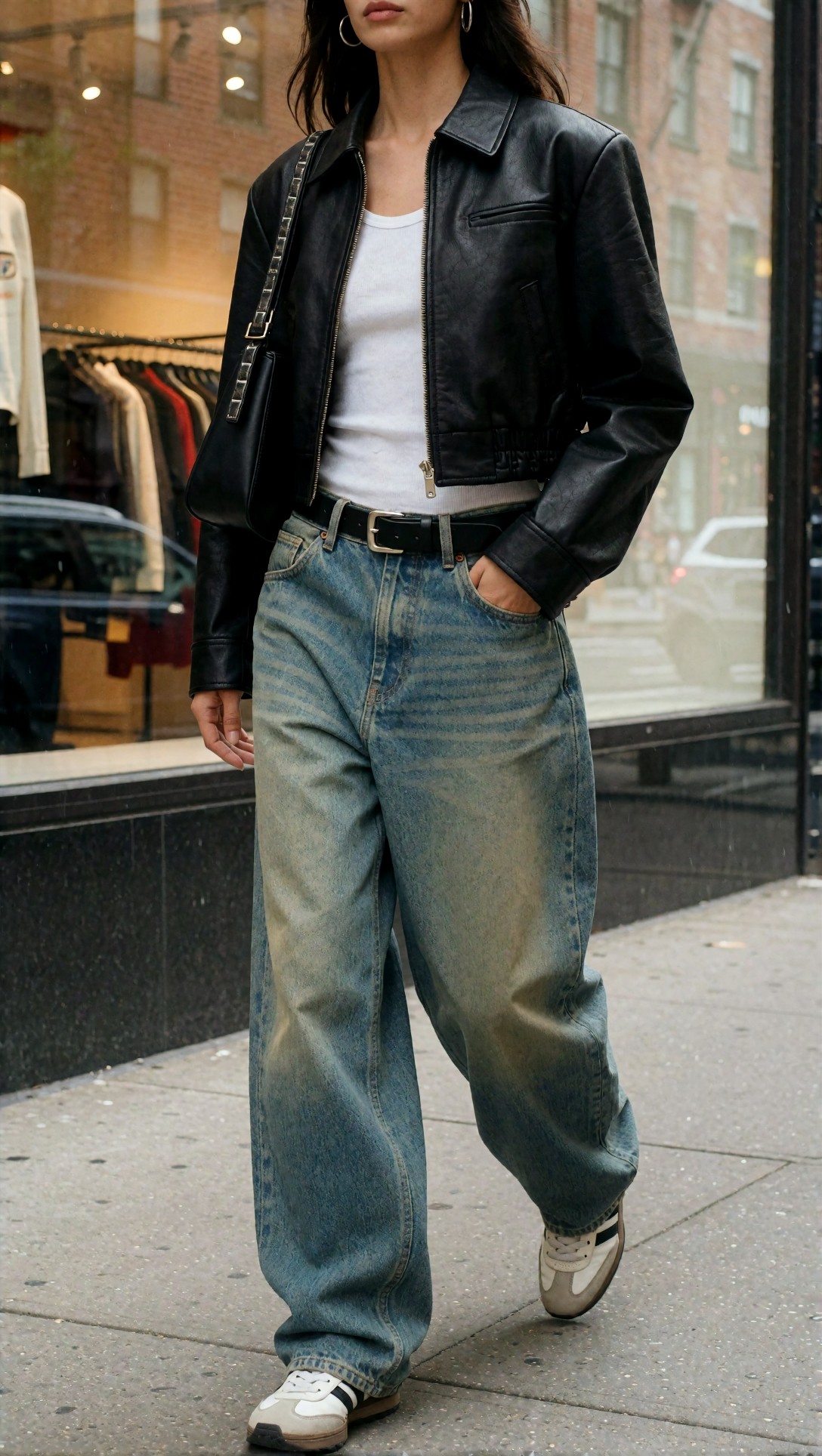
Inspect whether the hem stacks naturally over the sneakers and whether the jeans still have structure at the knee. The weak outputs usually flatten the waistband area or make the leg opening too symmetrical.
Denim maxi skirts held silhouette better than expected
The maxi skirt category was more stable than I expected, especially in lookbook and catalog shots. Search-driven users looking for a denim maxi skirt outfit are often comparing styling options, so clean shape mattered more than dramatic posing.
This setup was meant to test whether the model could preserve a straight or slightly A-line denim skirt without turning it into generic blue cotton.
Topic: Denim maxi skirt outfit for US trend search
Genre: Head-to-toe Lookbook
Camera: Sony A7R V
Lens: 50mm f/4
Lighting: Soft studio daylight simulation
Location: Minimal white loft studio with pale concrete floor and soft window spill
Style: Clean commercial fashion lookbook
Final Prompt: head-to-toe lookbook image focused on styling system, long medium-wash denim maxi skirt with front center seam and subtle back slit, tucked heather gray fitted tee, slim brown belt, suede ankle boots, compact tan shoulder bag, layered thin necklaces, full silhouette visible front-facing and relaxed, clean loft studio backdrop, balanced neutral palette with blue denim as anchor, crisp catalog-like composition, realistic cotton denim grain, visible stitching, modern denim trends today with practical wearable styling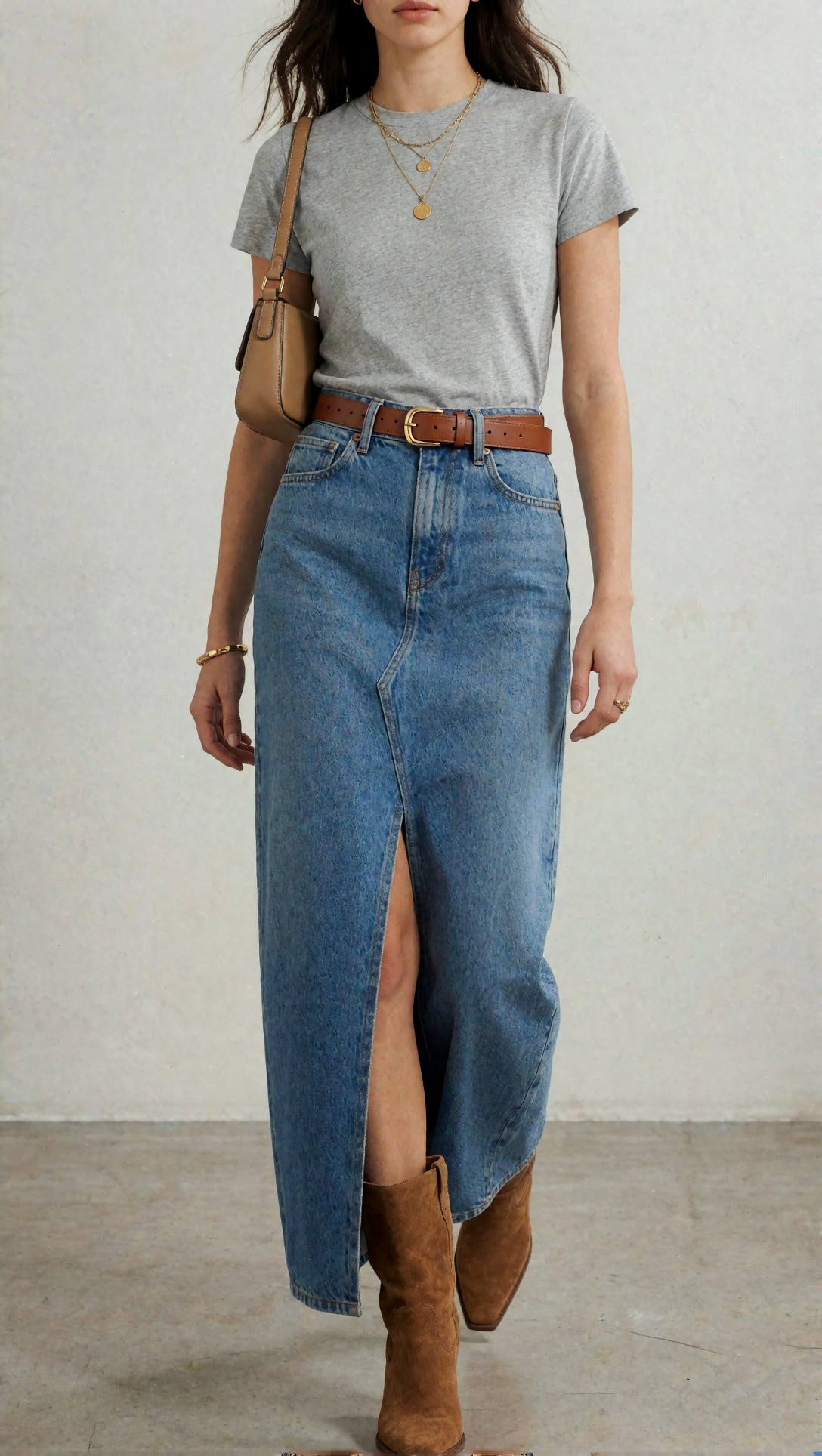
Check the seam placement and whether the slit is believable. Failures often show a skirt that behaves like jersey fabric or loses the weight needed to look like denim.
Where the outputs needed correction
Double denim looked current, but garment separation broke often
The most frequent failure in double denim trend tests was not anatomy. It was styling confusion. Jackets merged into shirts, washes matched too closely, and the image lost the intentional contrast that makes double denim look contemporary instead of costume-like.
The model needed direct instruction on:
- wash contrast between top and bottom
- layer order
- visible neckline or base layer
- hardware and seam breaks
This prompt was designed to force wash separation and check whether a darker top with lighter jeans reads more intentional.
Topic: Double denim trend with wash contrast
Genre: Fashion Editorial
Camera: Nikon Z8
Lens: 40mm f/2
Lighting: Late afternoon side light
Location: Brooklyn side street with brick wall, steel roll-up door, soft urban depth
Style: Contemporary editorial street fashion
Final Prompt: three-quarter outfit editorial showing a modern double denim trend, dark indigo cropped denim jacket layered over a white fitted tee, light vintage-wash straight baggy jeans, black loafers with white socks, structured black mini bag, visible silver buttons and contrast stitching, clear separation between jacket, inner top, and jeans, model standing angled against a Brooklyn brick wall, late afternoon side light, documentary fashion framing, realistic texture contrast between rigid indigo jacket and softer washed jeans, current US outfit styling, confident but not exaggerated pose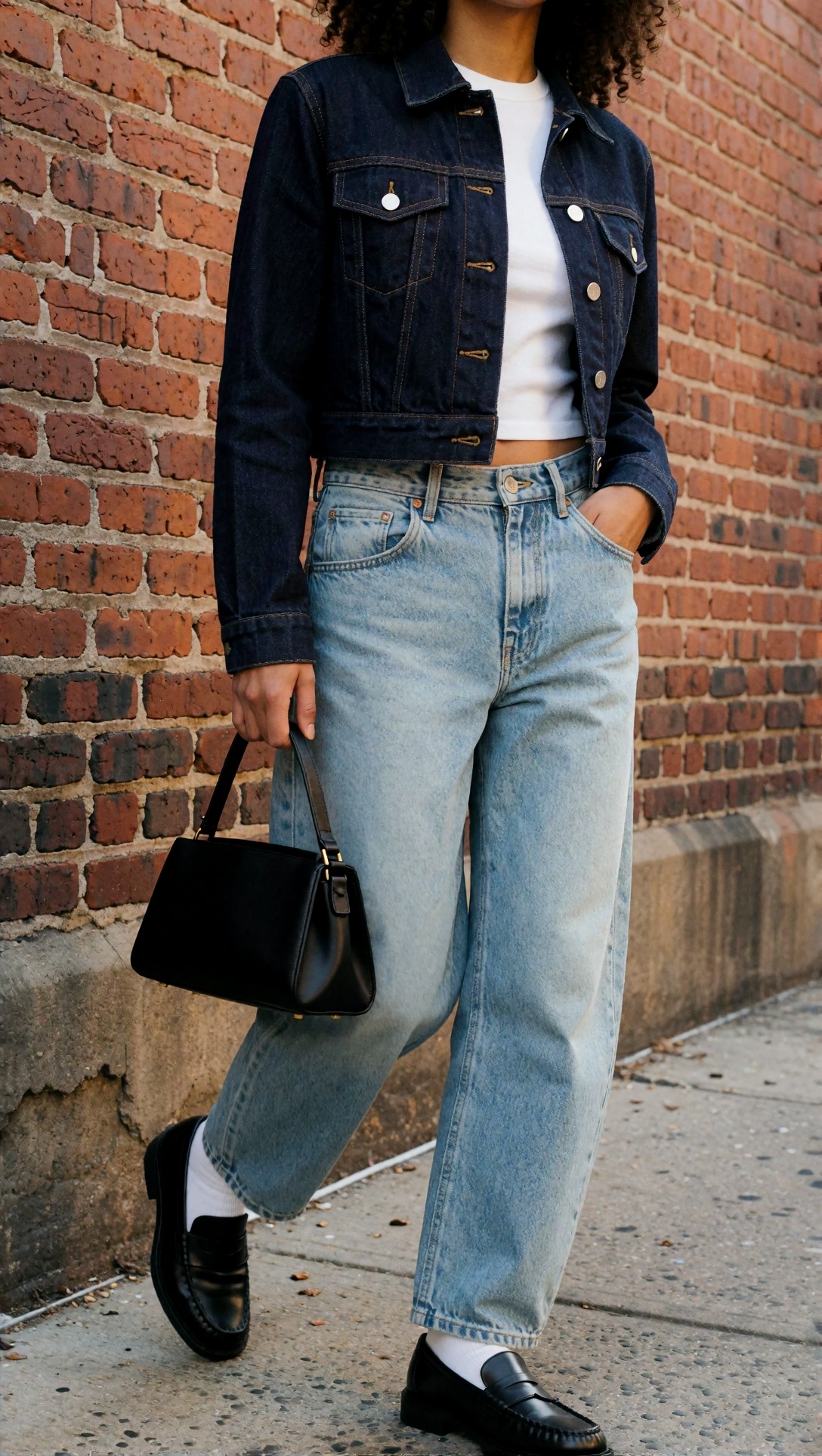
Inspect the jacket hem, inner shirt visibility, and whether the top and bottom are clearly different fabrics and washes. If they blur together, the trend signal weakens immediately.
Footwear logic was a major hidden failure
Across all three categories, the model often guessed the wrong shoes. That matters because in denim styling, shoe choice controls proportion. Baggy jeans with delicate sandals can make the image look trend-incoherent. Maxi skirts with oversized running shoes can visually shorten the look unless the prompt asks for it.
This next test was built to see whether the model could maintain maxi-skirt proportion with a stronger shoe anchor.
Topic: Denim maxi skirt outfit with stronger proportion control
Genre: Street Style
Camera: Fujifilm GFX100S
Lens: 45mm f/2.8
Lighting: Bright open shade
Location: SoHo sidewalk near cast-iron storefronts and café seating
Style: Modern urban fashion feature
Final Prompt: street-style full body image centered on a denim maxi skirt outfit, rigid dark blue ankle-length denim skirt with front slit, tucked striped knit top, cropped trench jacket, chunky black ankle boots, oversized sunglasses, leather tote, complete silhouette visible while crossing a SoHo sidewalk, clean urban lines, open shade lighting, visible garment layering and practical proportions, sharp denim texture, polished but wearable American city styling, fashion-editor framing with emphasis on hem-to-shoe relationship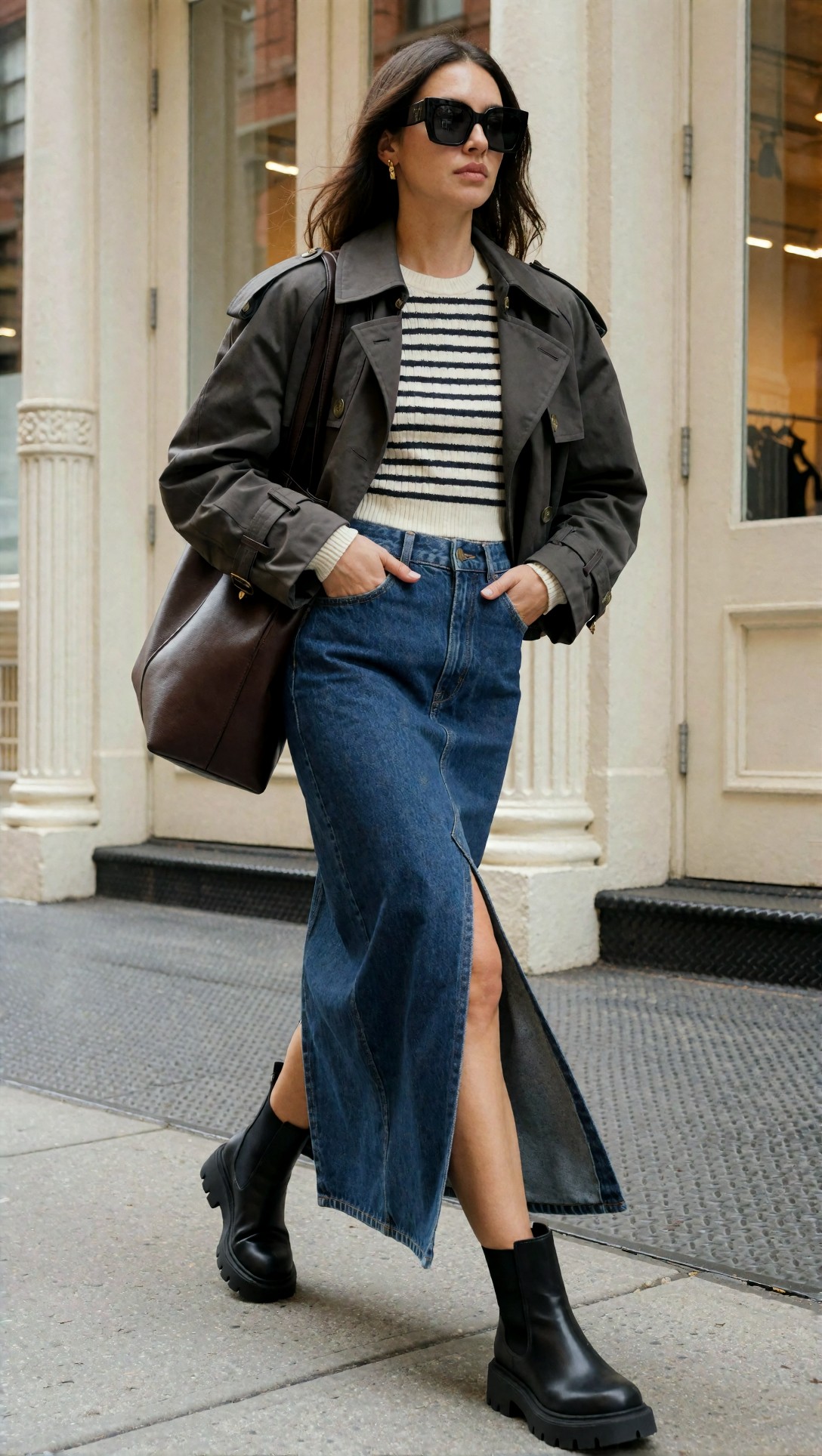
Look closely at the slit, the boot height, and the way the skirt falls over the leg. If the slit climbs too high or the hem floats unnaturally, the model is borrowing from generic fashion-dress patterns instead of denim behavior.
The prompt ingredients that actually changed the result
The biggest improvements did not come from adding more adjectives. They came from specifying the garment system like an editor or stylist would.
1) Name the wash, weight, and construction
“Denim” alone is too vague. Better outputs appeared when I specified:
- faded light wash
- dark indigo rigid denim
- medium-wash heavyweight cotton denim
- contrast stitching
- whiskering
- raw hem
- front slit
- center seam
2) State the silhouette relationship, not just the item
The model responds better to outfit logic than isolated garments.
Examples that helped:
- oversized jeans balanced by fitted tank
- cropped denim jacket over white tee and wide jeans
- straight maxi skirt with compact shoulder bag and ankle boots
3) Give the scene a real merchandising or street context
For denim outfit ideas, New York street, storefront window, or catalog loft context improved plausibility. Blank scenic prompts created attractive but less trend-specific images.
4) Use body framing that shows the whole outfit
If the point is search comparison, a full-body or three-quarter frame is more useful than portrait bias. For iterative generation, I would start with 35mm, 40mm, or 50mm framing before moving into 85mm details.
This prompt tested whether a more commercial catalog treatment could make baggy jeans look clearer for comparison-driven users.
Topic: Baggy jeans trend for catalog comparison
Genre: Catalog Grid Page
Camera: Phase One XF IQ4
Lens: 55mm f/5.6
Lighting: Even studio softbox lighting
Location: Neutral studio sweep designed for ecommerce and lookbook comparison
Style: Clean commercial denim catalog
Final Prompt: catalog grid page concept featuring one primary full-body model and two smaller side panels of the same outfit, oversized light-wash baggy jeans, fitted black baby tee, gray zip hoodie layered under a camel bomber jacket, white retro sneakers, black nylon shoulder bag, silver chain necklace, clear front and side outfit readability, neutral studio sweep, consistent commercial lighting, denim trends today presented as a comparison-friendly styling board, precise fabric texture, visible pockets, seams and leg volume, minimal distractions, US casual styling reference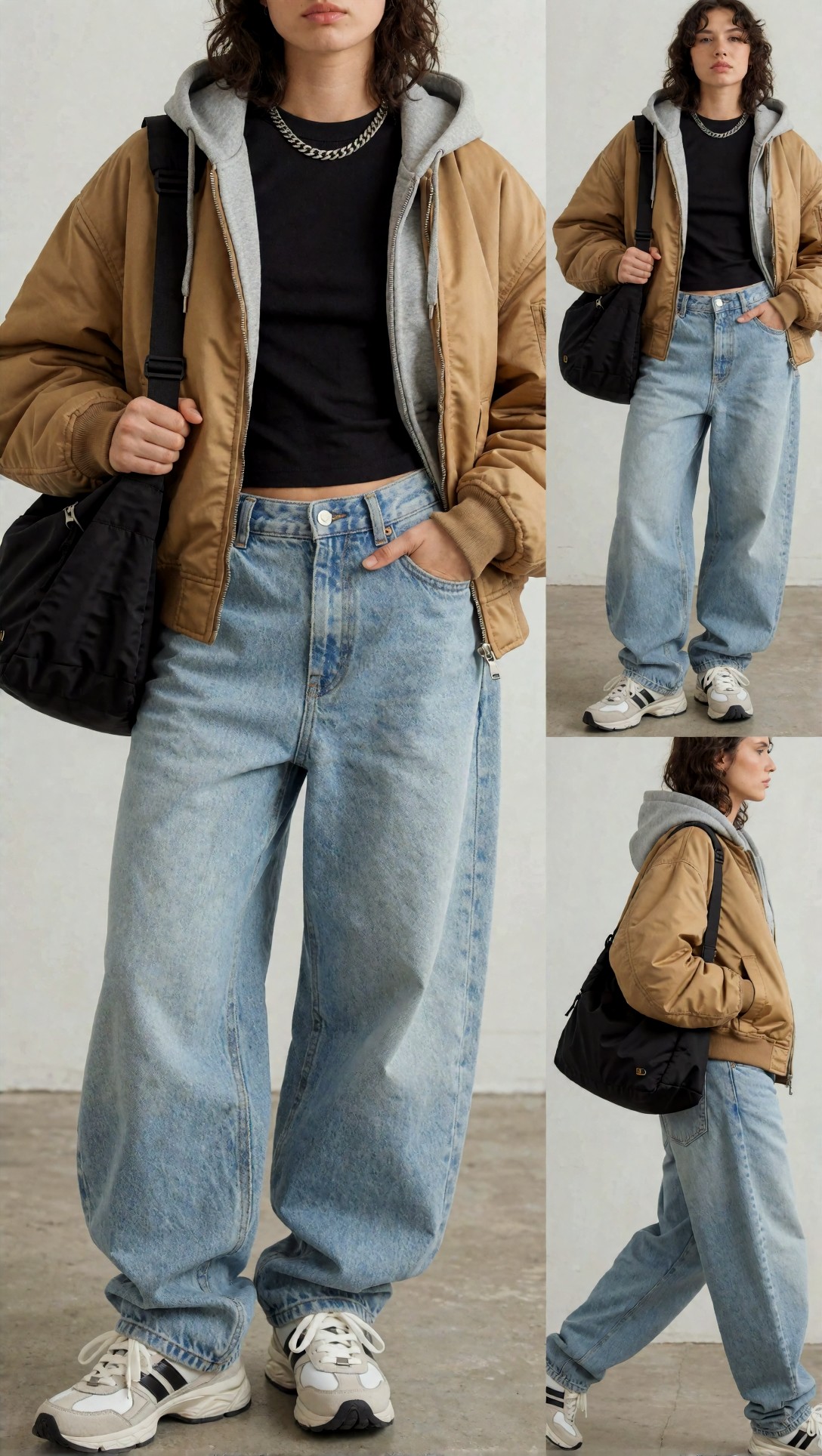
Inspect whether the panel consistency holds and whether the jeans volume remains believable across views. Multi-panel prompts often break if the model cannot keep wash and silhouette stable.
A comparison checklist: which denim direction wins for which use case?
| Trend direction | Strongest image use | What worked fastest | Common failure | Best fix | |---|---|---|---|---| | Baggy jeans | Street style, social editorial, US outfit inspo | Natural city styling, shoe interaction, relaxed proportion | Legs become too wide and shapeless | Add waistband fit, inseam stacking, specific sneaker type | | Denim maxi skirt | Lookbook, catalog, storefront, wearable outfit guides | Clear silhouette, easy layering, strong vertical line | Fabric looks too soft, slit becomes random | Specify rigid denim, seam placement, hem length, boot relationship | | Double denim | Editorial campaigns, trend stories, mood boards | High fashion signal, easy color story | Top and bottom merge, wash contrast lost | Force wash contrast, visible base layer, hardware and seam detail |
Prompt examples and image inspection notes
Testing a stronger double-denim editorial
I wanted to see whether adding a runway-adjacent fashion tone would improve confidence without losing wearability. This is where double denim can beat the other two visually, but only if the layers stay distinct.
Topic: Double denim trend in a polished US editorial look
Genre: Three-quarter Outfit Editorial
Camera: Leica SL2-S
Lens: 50mm f/2
Lighting: Soft directional studio light with subtle shadow edge
Location: Industrial loft set with concrete wall and brushed steel bench
Style: Minimal luxury fashion editorial
Final Prompt: three-quarter fashion editorial focused on a modern double denim outfit, light blue oversized denim shirt worn open over a fitted charcoal tank, deep indigo high-waist jeans with straight wide leg, pointed black boots, sculptural silver cuff, slim leather belt, compact black crossbody bag, complete outfit hierarchy visible, industrial loft backdrop, soft directional studio light creating seam definition and wash contrast, composed editorial stance, restrained color palette, premium denim texture, current and wearable rather than costume, clear layer separation for trend comparison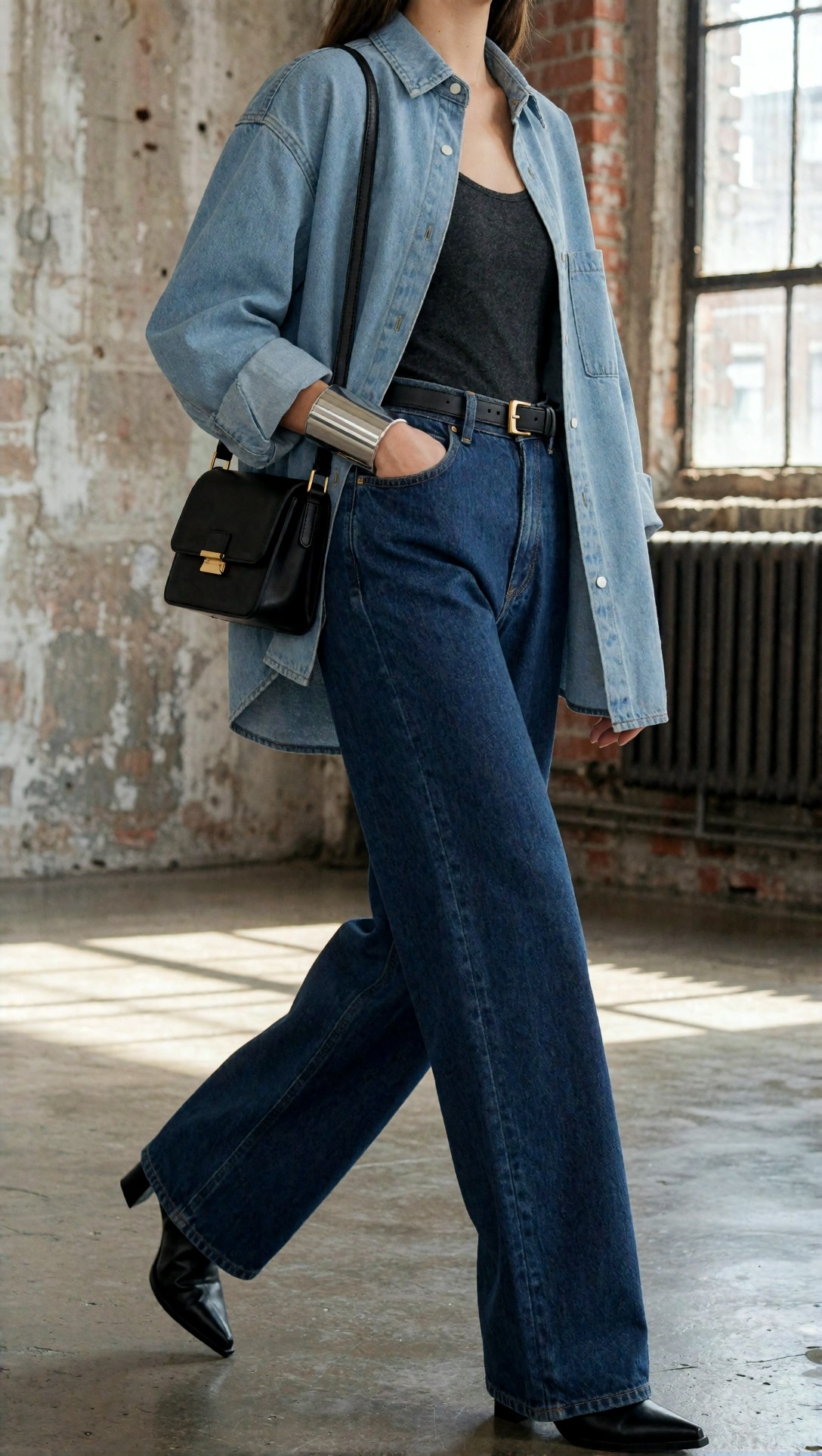
Inspect the shirt placket, tank visibility, and jean rise. If the shirt becomes a jacket without drape or the jeans lose structure at the hip, the look stops reading as intentional styling.
Testing whether baggy jeans can carry a more polished city look
Many searchers do not want pure skatewear energy. This prompt checked whether baggy jeans could still look elevated for broader denim outfit ideas.
Topic: Baggy jeans trend with polished city styling
Genre: Fashion Editorial
Camera: Canon EOS R3
Lens: 70mm f/3.2
Lighting: Early evening window glow mixed with indoor ambient light
Location: New York hotel lobby entrance with brass doors and stone floor
Style: Elevated metropolitan fashion story
Final Prompt: full-body fashion editorial featuring oversized medium-wash baggy jeans styled in a polished city way, cream fitted knit top, cropped navy blazer, brown leather belt, pointed slingback heels, structured caramel handbag, gold earrings, visible head-to-toe styling, poised walking motion through a New York hotel lobby entrance, brass and stone textures, refined neutral palette, realistic denim drape with slight stack at hem, editorial composition that balances relaxed jeans with tailored pieces, modern American denim outfit idea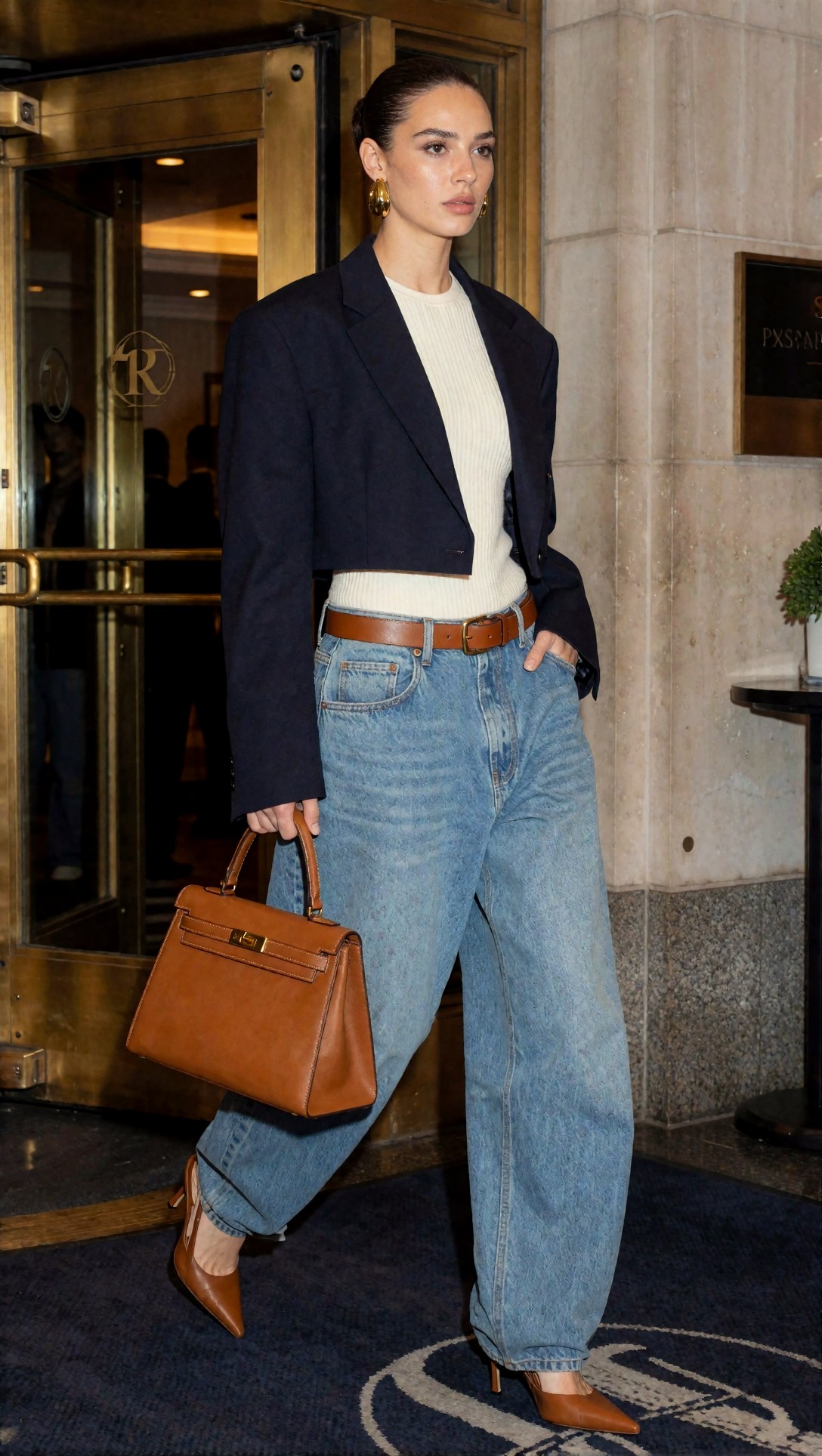
Check whether the blazer remains cropped and whether the jeans still feel oversized rather than simply loose. Heeled styling can cause the model to trim the width too much unless the prompt defends the volume.
Testing storefront merchandising for denim maxi skirts
A useful comparison image is not always a person. I tested a retail-first scene because many users searching trend terms are also evaluating what looks current on a rack or mannequin.
Topic: Denim maxi skirt trend in retail display
Genre: Storefront Display
Camera: Sony A1
Lens: 24-70mm at 38mm f/4
Lighting: Soft retail spotlights with window daylight mix
Location: Contemporary SoHo boutique window with pale wood fixtures and brushed metal rails
Style: Premium visual merchandising
Final Prompt: storefront display focused on denim trends today, mannequin styled in a dark-wash denim maxi skirt with front slit, fitted white poplin shirt tied at the waist, tan belt, ankle boots, small suede bag, adjacent rack with coordinated denim jackets and striped knits, boutique window in SoHo, premium visual merchandising composition, soft retail spotlights and daylight reflections, clear fabric texture, realistic skirt structure, trend-led but commercially believable display design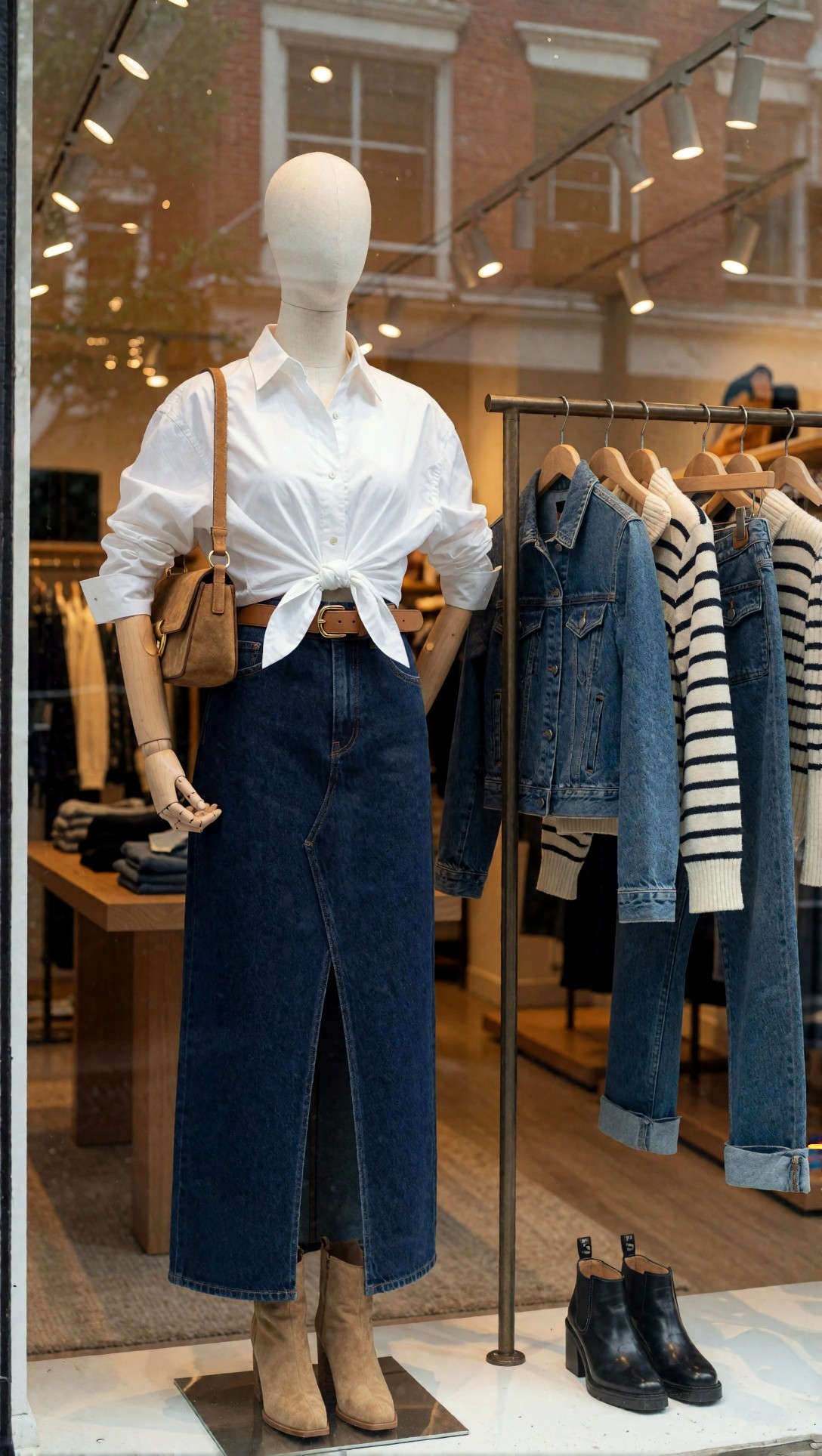
Inspect whether the mannequin proportions stay clean and whether the skirt still reads as denim under mixed lighting. The failure mode here is plastic-looking fabric or an over-decorated boutique scene.
Testing flat lay logic for search comparison boards
This prompt was meant to strip away pose problems and test if the styling system itself made sense. Flat lays are useful when you want to compare denim trends 2026 directions without body-rendering errors.
Topic: US denim outfit ideas flat lay comparison
Genre: Product Editorial
Camera: Hasselblad X2D 100C
Lens: 55mm f/4
Lighting: Overhead diffused softbox
Location: Editorial tabletop set in warm gray paper sweep
Style: Magazine shopping page
Final Prompt: product flat lay arranged like a magazine shopping page comparing denim trends today, one outfit built around oversized faded baggy jeans with white tank and retro sneakers, one around a dark denim maxi skirt with striped knit and ankle boots, one around a double denim look with indigo jacket and light-wash jeans, accessories neatly placed including belts, tote bag, sunglasses, silver jewelry, top-down composition, even overhead soft light, crisp fabric texture, visible stitching and wash differences, clean editorial organization for trend comparison
Inspect whether each outfit remains distinct and whether the washes are different enough to read at a glance. If the items blend into one blue mass, the comparison value is lost.
When I would switch models or settings
Switch when the denim texture turns plastic
If the image looks smooth and synthetic, prompt edits alone may not save it. Move to a model or checkpoint that handles garment texture better, then upscale selectively. On zview, I would compare variations in [Create](/create), save the strongest structural frame, then refine detail with the [Upscaler](/upscaler).
Switch when the full-body proportion keeps drifting
Baggy jeans and maxi skirts both fail when lower-body proportion is unstable. If three generations in a row distort hems, knees, or foot placement, change aspect ratio or move from dynamic street-style motion to a cleaner lookbook stance.
Switch when double denim loses garment hierarchy
Some models over-fuse same-family fabrics. If your jacket, shirt, and jeans keep blending together, use a model that handles layered fashion editorial better and simplify the background. The weak point is often not the clothing itself but too many competing textures in the scene.
This next prompt was designed as a controlled runway/backstage test, where lighting and styling are simpler and fabric hierarchy becomes easier to evaluate.
Topic: Double denim trend backstage evaluation
Genre: Runway/Backstage Moment
Camera: Nikon D850
Lens: 85mm f/2.2
Lighting: Backstage tungsten practicals with soft fill
Location: Fashion week backstage area with garment racks, clipboards, mirrors, and concrete floor
Style: Documentary runway coverage
Final Prompt: backstage fashion image with styling-first focus, model wearing a structured medium-indigo denim corset top layered under an oversized faded denim jacket, paired with dark straight-leg jeans, black heeled boots, stylist adjusting cuff near garment racks, mirrors and clipboards in background, documentary backstage composition, visible hierarchy between pieces, tungsten practicals with soft fill, realistic denim texture and hardware, current double denim trend presented as a real fashion-week prep moment rather than a glam portrait
Inspect whether the jacket, corset top, and jeans remain separate garments with different construction. Backstage scenes are useful because they reveal whether the outfit still works when the image is less polished.
Limitations and failure risks
Search trend energy does not automatically equal image clarity
The most search-visible outfit direction is not always the easiest to render well. Baggy jeans are popular because they are easy to recognize, but they also create hidden shape problems around knees, seat, and hem stacking.
“Trendy” prompts often over-accessorize
When I pushed too hard on trend language, the model added extra belts, random hardware, or noisy backgrounds. For denim trends today, less was usually better: one clear silhouette, one strong bag, one shoe decision.
Fashion-face bias can weaken the outfit
If the model starts prioritizing face, hair, or pose drama, the outfit comparison becomes less useful. That is why I kept most prompts anchored to shot type and full-body visibility.
This macro test was used to isolate whether the model could render denim construction detail before I committed to a larger editorial set.
Topic: Denim construction detail for trend validation
Genre: Garment Detail Macro
Camera: Sony A7 IV
Lens: 85mm f/2.8 macro
Lighting: Side-lit studio strip light
Location: Neutral textile test set with soft gray background
Style: Technical fashion detail study
Final Prompt: garment detail macro focused on modern denim construction, close study of dark indigo rigid denim jacket cuff layered over faded baggy jean waistband, visible copper hardware, belt loops, contrast stitching, pocket edge wear, subtle whiskering, side-lit studio strip light to reveal cotton grain and seam depth, clean gray backdrop, technical fashion detail image used to validate material realism for denim trends today
Inspect the stitching consistency, rivet shape, and grain of the fabric. If the material still looks synthetic here, the broader outfit shots will not hold up either.
Practical recommendations: which denim path is best for what?
Use baggy jeans when you need fast US relevance
If your goal is strong jeans outfit ideas usa imagery, baggy jeans are still the safest start. They communicate current American casual styling quickly and work across street scenes, lookbooks, and social editorial.
Best for:
- New York street-style prompts
- sneaker-led outfit boards
- broad youth-to-mainstream denim inspiration
Use denim maxi skirts when you need clean comparison images
For a user comparing silhouettes, maxi skirts are easier to evaluate visually. The shape is simple, the styling reads quickly, and the image often needs fewer corrections.
Best for:
- retail and storefront scenes
- wearable office-to-weekend outfit ideas
- catalog and ecommerce-adjacent creative
Use double denim when you want the strongest trend story
Double denim is the most editorial and often the most memorable in galleries like [Gallery](/gallery). But it is not the easiest route for clean comparison content unless you are explicit with wash contrast.
Best for:
- trend roundups
- campaign concepts
- fashion editorial spreads
- mood boards that need a high-fashion edge
FAQ
Are baggy jeans still the strongest denim trend in US outfit searches?
In image-generation terms, yes for general street-style relevance. They produce the fastest recognizable US outfit signal, especially with sneakers, cropped tops, and city context.
Is a denim maxi skirt still current for 2026 trend imagery?
Yes. In this test, maxi skirts looked especially strong for denim trends 2026 style boards because they hold a clean line and can be styled minimally without looking dated.
Why does double denim fail so often in AI images?
The main issue is garment separation. If the prompt does not specify different washes, an inner layer, and visible hardware, the model tends to collapse everything into one blue shape.
What is the best shot type for comparing denim outfit ideas?
Start with street-style full body or head-to-toe lookbook. Those two views expose silhouette, layering, and shoe logic better than close portrait crops.
Closing operator note
After running these comparisons, my practical read is this: for denim trends today, baggy jeans win on speed and search-style familiarity, denim maxi skirts win on clarity, and double denim wins when you need the most fashion-forward image and have time to correct it.
If you are building fast inspiration boards or testing prompts for search-intent visuals, start with baggy jeans or maxi skirts. If you want a more editorial result and can tolerate more failed generations, move into double denim with aggressive wash separation.
Who should use this workflow: creators making trend comparison images, fashion prompt testers, and merchandisers who need visible outfit logic. Who should avoid it: anyone trying to get a perfect hero campaign shot from one prompt without iteration. The setting and detail that mattered most in this session was simple: full-body framing plus explicit denim construction language. That combination improved useful output more than any generic “fashion editorial” wording.
For next passes, I would keep the same shot planning and test one variable at a time inside [Create](/create) or review more outfit structures in [Articles](/articles).