Editorial Fashion Trends Today: Prompting Fashion Week Looks Into Campaign-Ready Images 한국어 요약
이 페이지는 ZView Space의 영어 원문을 한국어 검색 사용자도 이해할 수 있도록 정리한 SEO 요약입니다. 핵심은 단순한 얼굴 중심 이미지가 아니라 패션 에디토리얼, 룩북, 아웃핏, 프롬프트 테스트, 이미지 생성 워크플로우를 실제로 어떻게 구성할지입니다.
핵심 요약
- 원문 주제: Editorial Fashion Trends Today: Prompting Fashion Week Looks Into Campaign-Ready Images
- 목적: AI 이미지 생성에서 outfit, silhouette, fabric, pose, location, camera framing을 더 명확하게 설계합니다.
- 활용 범위: Z-Image Turbo, Krea2 Turbo, Qwen Image, Anima, SeedVR2 같은 이미지 생성 및 업스케일 워크플로우에 적용할 수 있습니다.
- SEO 관점: 제목, 설명, 이미지 alt, 프롬프트 예시가 실제 검색 의도와 맞아야 색인 가능성이 높아집니다.
한국어 사용자를 위한 체크포인트
1. 프롬프트가 얼굴 묘사에만 머물지 않고 전체 스타일과 의상 구성을 설명하는지 확인합니다. 2. 패션 이미지라면 상의, 하의, 아우터, 신발, 액세서리, 소재감, 촬영 장소를 분리해서 씁니다. 3. 생성 결과는 바로 게시하지 말고 디테일, 손, 의상 형태, 배경 일관성, 이미지 품질을 비교합니다. 4. 글 본문에는 실제 테스트 기준과 실패를 줄이는 방법이 들어가야 검색엔진에서 얇은 콘텐츠로 보일 가능성이 줄어듭니다.
원문 미리보기
This test looks at editorial fashion trends today from the angle that matters for image generation: how to turn runway coded ideas, street style signals, and campaign references into prompts that actually produce usable fashion images. Instead of listing trend
---
This test looks at editorial fashion trends today from the angle that matters for image generation: how to turn runway-coded ideas, street-style signals, and campaign references into prompts that actually produce usable fashion images. Instead of listing trends in the abstract, I tested how current US fashion search themes translate into shot planning, garment visibility, lighting control, and scene direction.
The useful takeaway is simple: trend words alone do not produce strong fashion images. The strongest results came from prompts that treated the image like a real shot brief, with a named fashion shot type, visible outfit structure, a clear location, and one trend signal at a time.
What to know first
- Current fashion prompts work better when the styling system is the subject, not the model.
- "New York fashion week" and "fashion campaign photography" produce very different framing needs; mixing them without control usually weakens both.
- Full-body visibility is critical for editorial trend testing. 35mm, 40mm, and 50mm gave the most reliable silhouette read.
- The biggest failure point was trend pileup: metallics, tailoring, sport utility, sheer layers, and oversized bags in one prompt often collapsed into noise.
- If you want consistency across a set, build one baseline prompt first, then change only one variable at a time in [PromptLab](/promptlab).
Test setup
In this test, I evaluated prompt structures for trend-led fashion imagery across these scenarios:
- street-style full body
- three-quarter outfit editorial
- head-to-toe lookbook
- runway/backstage moment
- campaign-style retail set
- garment and accessory detail
- storefront display
- mood-board collage
I focused on common US fashion search intent around runway visual trends, fashion editorial shoots, New York fashion week references, and campaign-ready imagery. The goal was not to recreate one exact show, but to see which prompt ingredients best express trend direction while keeping garments readable.
For workflow, the most useful loop was:
1. draft in [Create](/create) 2. iterate shot language in [PromptLab](/promptlab) 3. inspect detail recovery with [Upscaler](/upscaler) 4. compare outputs against reference sets in [Gallery](/gallery)
What the prompt needs to accomplish
For this topic, the prompt has to do three jobs at once:
1. signal a current editorial fashion trend 2. keep the outfit legible from head to toe 3. place the styling inside a believable fashion context
That sounds obvious, but many prompts fail because they over-prioritize mood words. In this test, prompts that said only "editorial", "luxury", or "runway-inspired" often generated attractive images with weak garment logic. You could not clearly read the proportions, layers, bag scale, fabric finish, or why the outfit reflected current search-driven trends.
The strongest result usually came from one sentence hidden inside the prompt logic: what trend are we testing, and where would this image appear? A street-style trend image needs movement and sidewalk context. A campaign image needs stronger art direction and cleaner product hierarchy. A lookbook image needs body framing discipline.
The trend ingredients that actually moved the image
Subject: styling system first
For editorial fashion trends, the true subject is not "a fashionable person." It is the outfit architecture:
- oversized or sharpened tailoring
- visible layering order
- trousers versus skirt volume
- footwear proportion
- bag size and placement
- textile contrast such as matte wool, gloss leather, sheer organza, washed denim, brushed knit
When that structure was omitted, the model filled the gap with generic luxury cues.
This first prompt tests whether a street-style full body setup can carry a trend signal without losing garment separation.
Topic: editorial fashion trends today through New York street-style tailoring
Genre: Street Style
Camera: Canon EOS R5
Lens: 35mm f/2
Lighting: overcast diffusion
Location: SoHo sidewalk during fashion week, muted traffic, concrete storefronts, cold-season city atmosphere
Style: contemporary fashion week documentary editorial
Final Prompt: street-style full body fashion image focused on editorial fashion trends today, model walking through SoHo during fashion week, complete outfit clearly visible, charcoal oversized wool blazer layered over a fine ribbed cream turtleneck, long pleated graphite skirt over straight-leg tailored trousers, pointed black leather boots, structured oxblood shoulder bag, slim silver earrings, dark sunglasses, deliberate layered silhouette, fabric movement visible, documentary fashion framing, neutral city palette with rich accessory contrast, realistic sidewalk context, head-to-toe composition, Canon EOS R5 look, 35mm f/2, overcast diffusion, crisp garment texture, magazine-ready street-style shot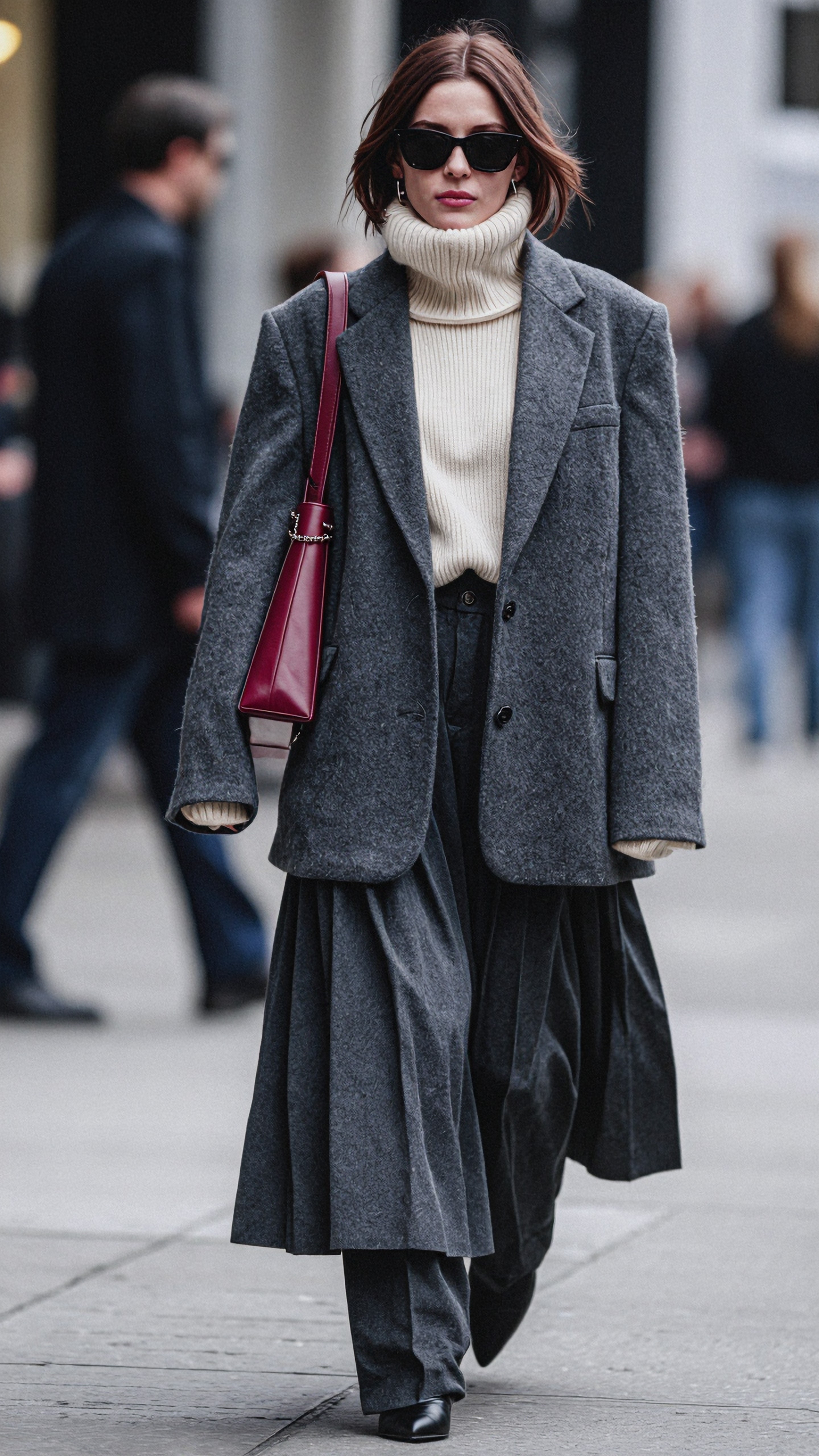
Inspect whether the outfit reads in layers from outerwear to footwear. The weak point to watch is lower-body confusion: skirts over trousers often merge unless the prompt clearly asks for visible garment separation.
Style: trend-led, but with one anchor
The current editorial search space in the US is full of overlapping signals: polished utility, corporate tailoring, off-duty runway minimalism, metallic evening accents, and retail-ready monochrome sets. In testing, one anchor trend per prompt gave the cleanest output.
This second prompt checks if a controlled editorial frame holds a softer trend message better than a busy street scene.
Topic: editorial fashion trends today with softened corporate tailoring
Genre: Fashion Editorial
Camera: Nikon Z8
Lens: 50mm f/2
Lighting: large window light with negative fill
Location: minimal Manhattan loft studio with pale concrete floor and off-white backdrop walls
Style: modern American magazine editorial
Final Prompt: three-quarter outfit editorial image built around editorial fashion trends today, model standing in a minimal Manhattan loft, styling-first composition, sculpted sand-colored double-breasted blazer with strong shoulder line, pale blue menswear shirt worn open at collar, elongated black knee-length shorts, sheer charcoal knee socks, square-toe loafers, oversized soft leather tote, restrained jewelry, controlled stance, serious editorial expression, focus on silhouette balance and proportion, quiet luxury palette, subtle tension between office tailoring and runway styling, Nikon Z8 rendering, 50mm f/2, clean magazine crop with visible outfit logic and textile detail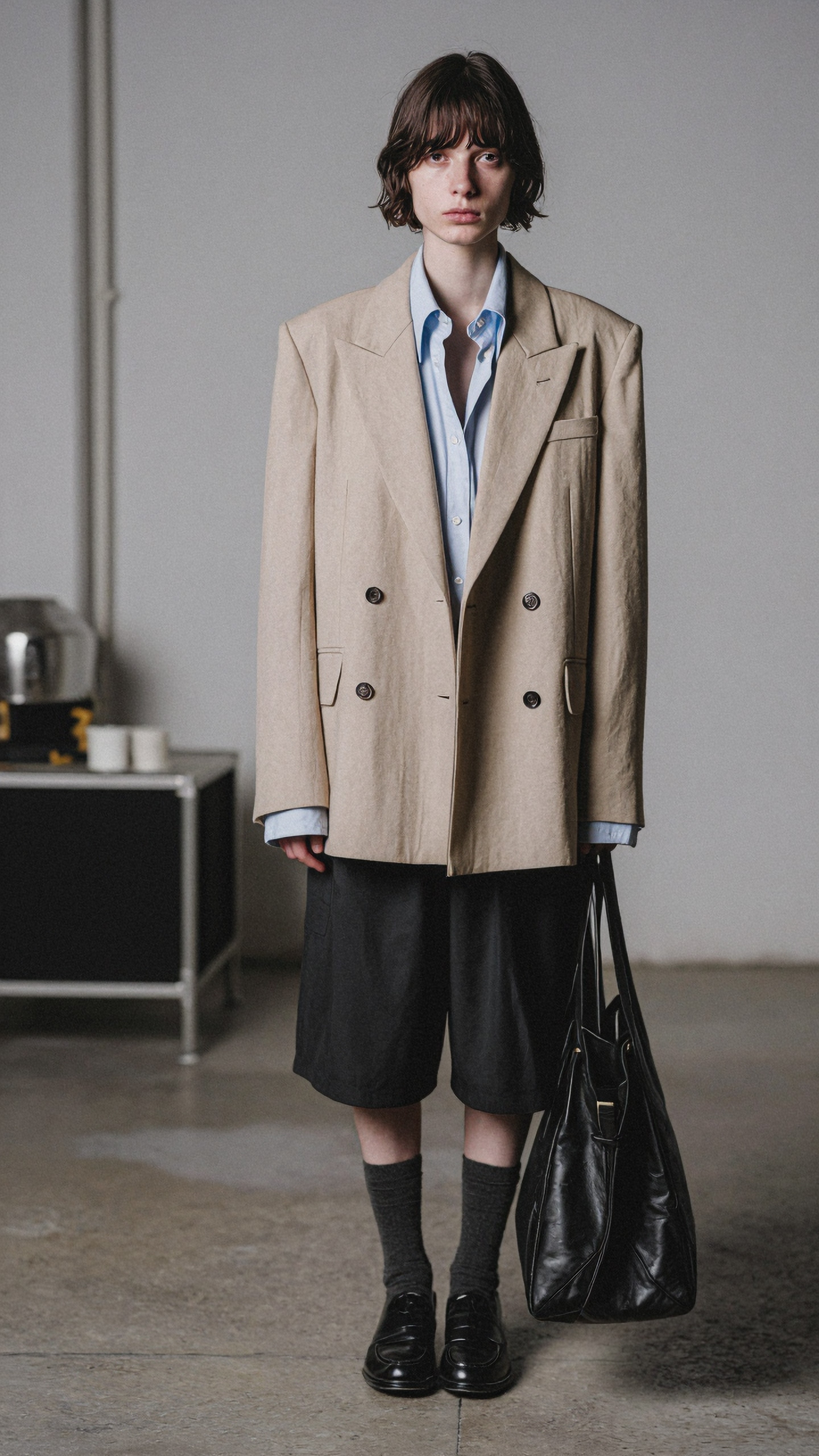
Check whether the shorts, socks, and loafers stay distinct. This setup usually improves shape control, but the tradeoff is less spontaneous energy than the street-style frame.
Baseline prompt: where the first pass usually fails
A baseline prompt should be plain enough to reveal the model's assumptions. Here is the kind of prompt I would use before refinement.
fashion editorial shoot showing editorial fashion trends today, full outfit, New York fashion week vibe, modern tailoring, luxury accessories, campaign style, realistic photo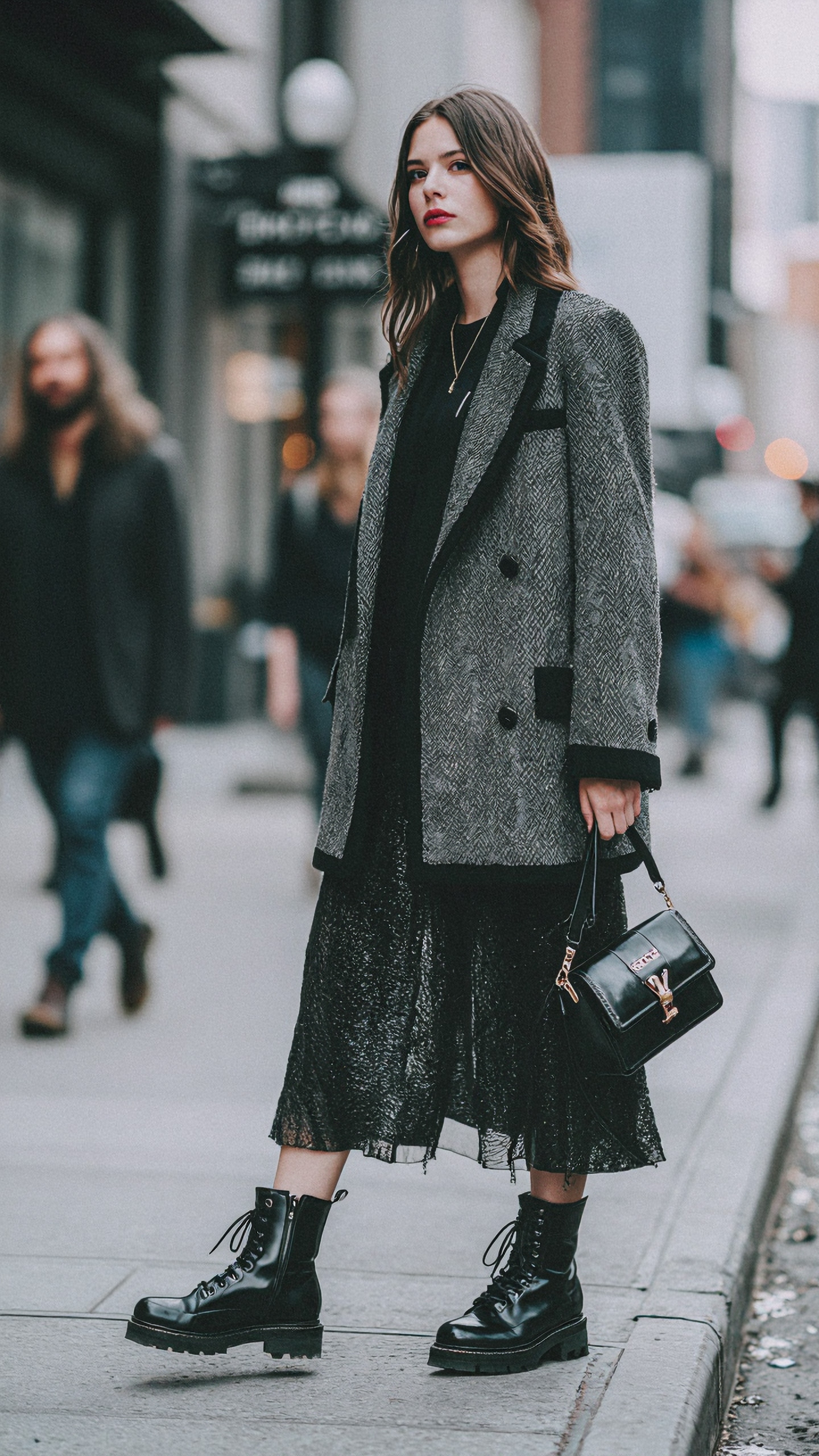
This baseline often produces three problems:
- vague outfit assembly
- inconsistent location cues
- image mood that feels expensive but not trend-specific
In this test, the baseline was usable only as a diagnosis tool. It told me the model understood "fashion" and "editorial" broadly, but not which exact trend behavior to prioritize.
First improvement: specify shot type before trend language
The biggest jump in quality came from naming the shot format first. Once the model knew whether it was generating a lookbook frame, runway capture, or campaign setup, trend details landed with less drift.
Why this works
Shot type controls composition pressure. A runway/backstage moment tolerates background clutter but needs motion and event cues. A head-to-toe lookbook frame needs symmetry and clean outfit readability. If you skip shot type, the model often mixes incompatible conventions.
This next prompt tests a head-to-toe lookbook approach for cleaner outfit comparison.
Topic: editorial fashion trends today expressed as monochrome layered lookbook styling
Genre: Fashion Lookbook
Camera: Sony A7R V
Lens: 40mm f/2.5
Lighting: softbox key plus white bounce fill
Location: clean studio cyc wall in New York, matte warm-gray floor, no set clutter
Style: premium retail lookbook
Final Prompt: head-to-toe lookbook image for editorial fashion trends today, full-body centered composition on a clean studio cyc wall, styling system is the focus, monochrome stone-gray layered outfit with cropped technical parka, fine-gauge knit top, long column skirt with front slit over slim tailored pants, tonal belt, leather gloves tucked into bag handle, sculptural sneakers, compact top-handle bag, precise hem lengths and visible fabric contrast, calm neutral expression, feet fully in frame, premium retail lookbook clarity, Sony A7R V, 40mm f/2.5, soft controlled studio light, clean shadows, exact garment edges, fashion buyer presentation quality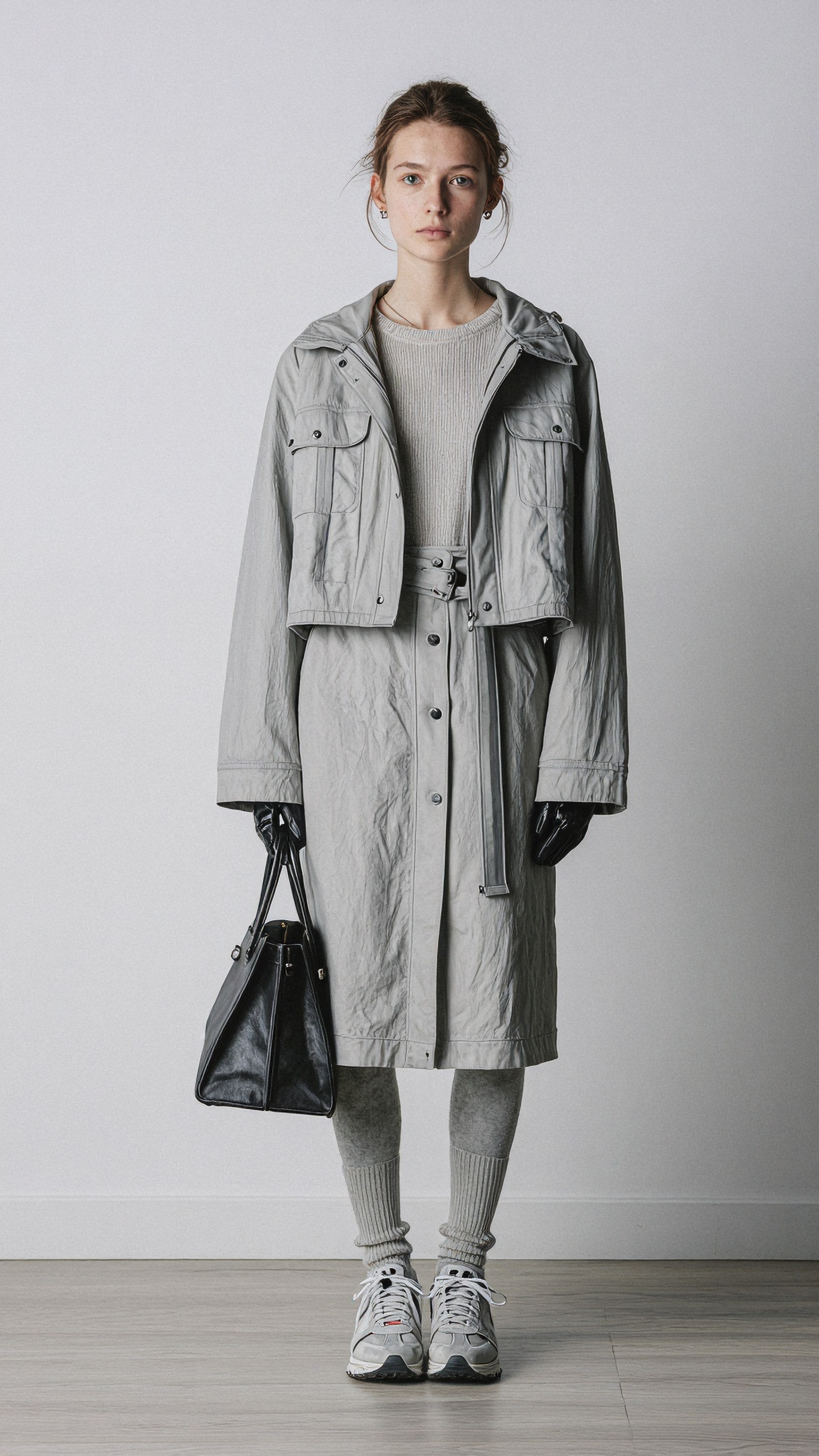
Inspect the hems, footwear visibility, and whether the bag competes with the outerwear. The strongest result here is usually consistency, though the image can feel less editorial unless you keep one directional styling move.
Refined prompt: adding campaign direction without losing the clothes
After locking shot type, the next useful change is to define what kind of campaign world the image belongs to. This gives context without forcing the model to guess between runway, ecommerce, and magazine logic.
This prompt tests whether a campaign set can hold current runway-coded metallic accents while keeping the clothes practical and readable.
Topic: editorial fashion trends today translated into a luxury fashion campaign set
Genre: Luxury Campaign
Camera: Fujifilm GFX100 II
Lens: 55mm f/1.7
Lighting: soft directional key with controlled silver bounce and gentle shadow falloff
Location: sculptural gallery-like campaign set in Brooklyn with brushed aluminum panels and pale stone blocks
Style: high-end American fashion campaign
Final Prompt: three-quarter outfit fashion campaign image focused on editorial fashion trends today, model posed against a sculptural Brooklyn set with brushed aluminum and pale stone elements, sharply tailored black longline coat worn open over liquid pewter satin top, wide-leg ivory trousers with clean crease, metallic heel boots, compact mirrored clutch, oversized cuff bracelet, styling balances runway metallic trend with wearable campaign polish, poised body angle, visible garment drape, cool gray and silver palette with black grounding, medium-format detail, luxury campaign composition, Fujifilm GFX100 II, 55mm f/1.7, soft directional key light, tactile fabric sheen, premium editorial control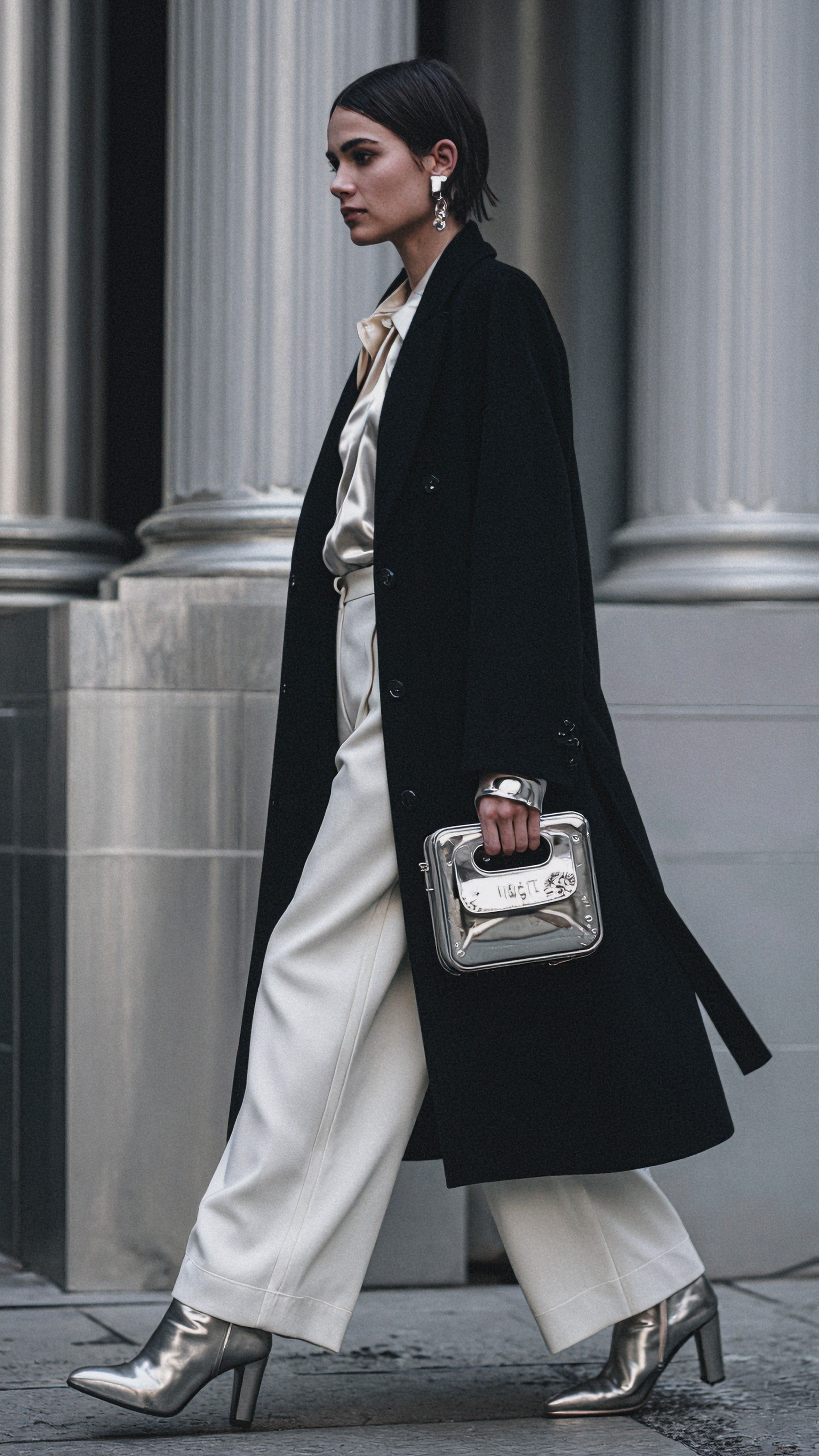
Inspect the satin and metallic surfaces carefully. The weak point is reflective material spill: if the sheen spreads too evenly, the image loses hierarchy and the coat can flatten into the background.
Breakdown: subject, style, camera, light, location
Subject choices for fashion editorial shoots
The trend subject should be expressed in clothing behavior, not just labels. In this test, the most reliable current signals were:
- elongated tailoring
- layered bottoms
- oversized work bags
- controlled metallic surfaces
- technical outerwear mixed with refined basics
- visible sock and shoe styling
This runway/backstage prompt checks whether the model can show trend motion and context without turning the frame into event noise.
Topic: runway visual trends with backstage tailoring and utility accessories
Genre: Runway Documentary
Camera: Leica SL2-S
Lens: 24-70mm at 45mm f/2.8
Lighting: mixed backstage fluorescents with bounced fill
Location: New York fashion week backstage corridor with garment racks, tape marks, stylists moving in soft blur
Style: fashion week reportage editorial
Final Prompt: runway and backstage fashion image reflecting editorial fashion trends today, full outfit visible in a backstage corridor during New York fashion week, model paused mid-step near garment racks, slate oversized trench over crisp white poplin shirt, narrow black tie, pleated micro-short layered over sheer tights and knee-high leather boots, giant soft carryall bag, backstage lanyard tucked into waistband, visible garment prep details, candid but composed, reportage energy, cool fluorescent backstage tones softened by fill light, Leica SL2-S realism, 45mm documentary framing, texture-rich fabrics, authentic fashion week movement without losing outfit readability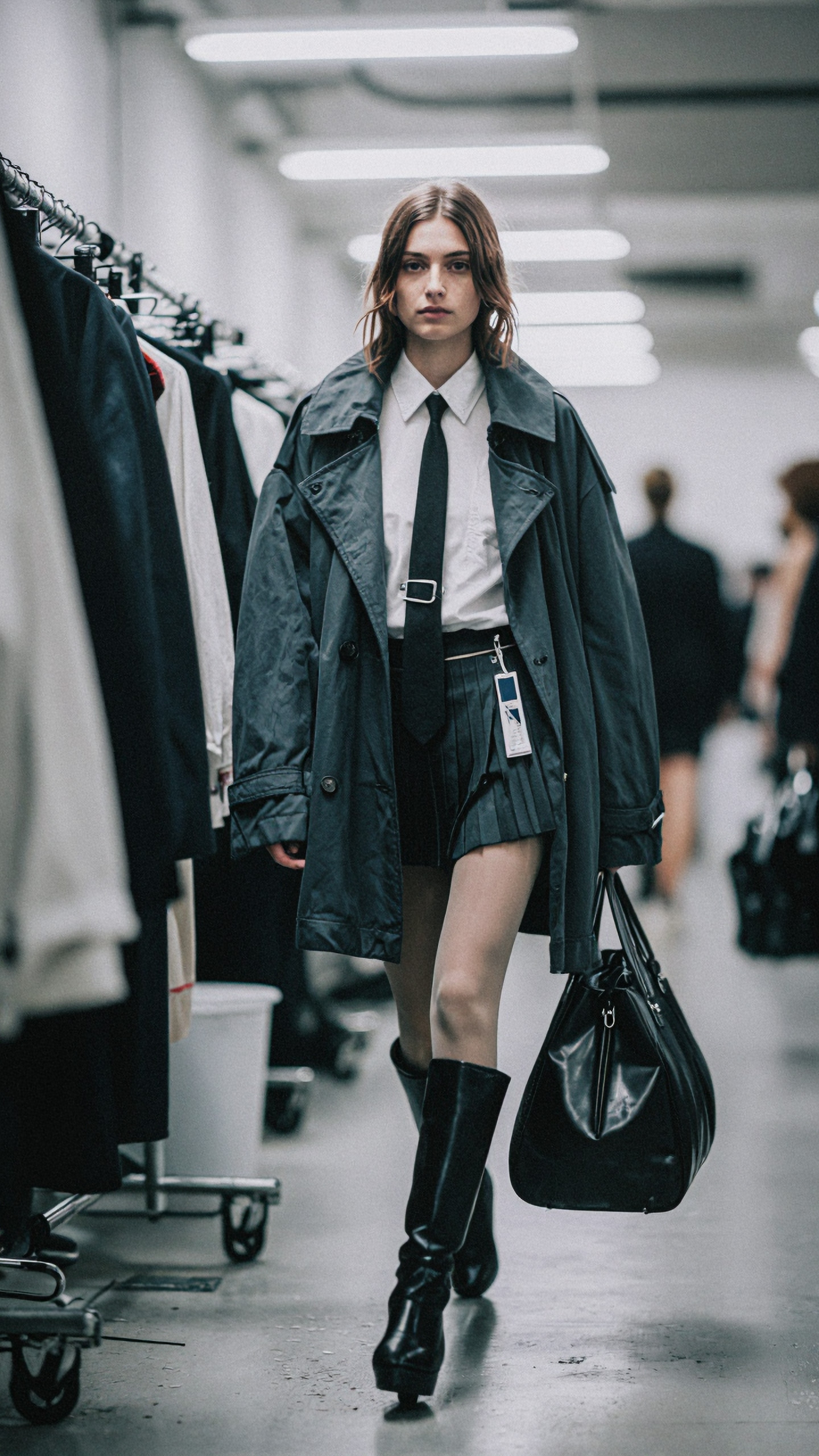
Check hand accuracy around the bag and tie area. Backstage prompts often create cluttered fingers, merged accessories, or duplicated straps when too many small objects are introduced.
Camera and lens choices that helped
For fashion trend imagery, I got the cleanest full-outfit read from 35mm to 50mm. Wider than that, limbs and bags started to distort unless the scene demanded documentary energy. For detail work, 85mm became useful, but only when the prompt was explicitly about one garment feature or accessory.
This next test isolates garment texture rather than silhouette.
Topic: garment detail macro from editorial fashion trends today
Genre: Product Editorial
Camera: Canon EOS R3
Lens: 85mm f/2
Lighting: narrow softbox key with side raking light
Location: studio detail table with matte charcoal surface and folded campaign tear sheets nearby
Style: luxury textile editorial detail
Final Prompt: garment detail macro image derived from editorial fashion trends today, close study of a sharply tailored charcoal blazer sleeve layered over a liquid metallic cuff and fine rib knit, visible topstitching, horn button texture, subtle fabric pilling on knit, tonal styling references from contemporary fashion campaign photography, elegant cropped composition, no face emphasis, tactile materials are the subject, side-raked studio light revealing weave and sheen, Canon EOS R3 look, 85mm f/2, crisp editorial macro detail, premium magazine insert aesthetic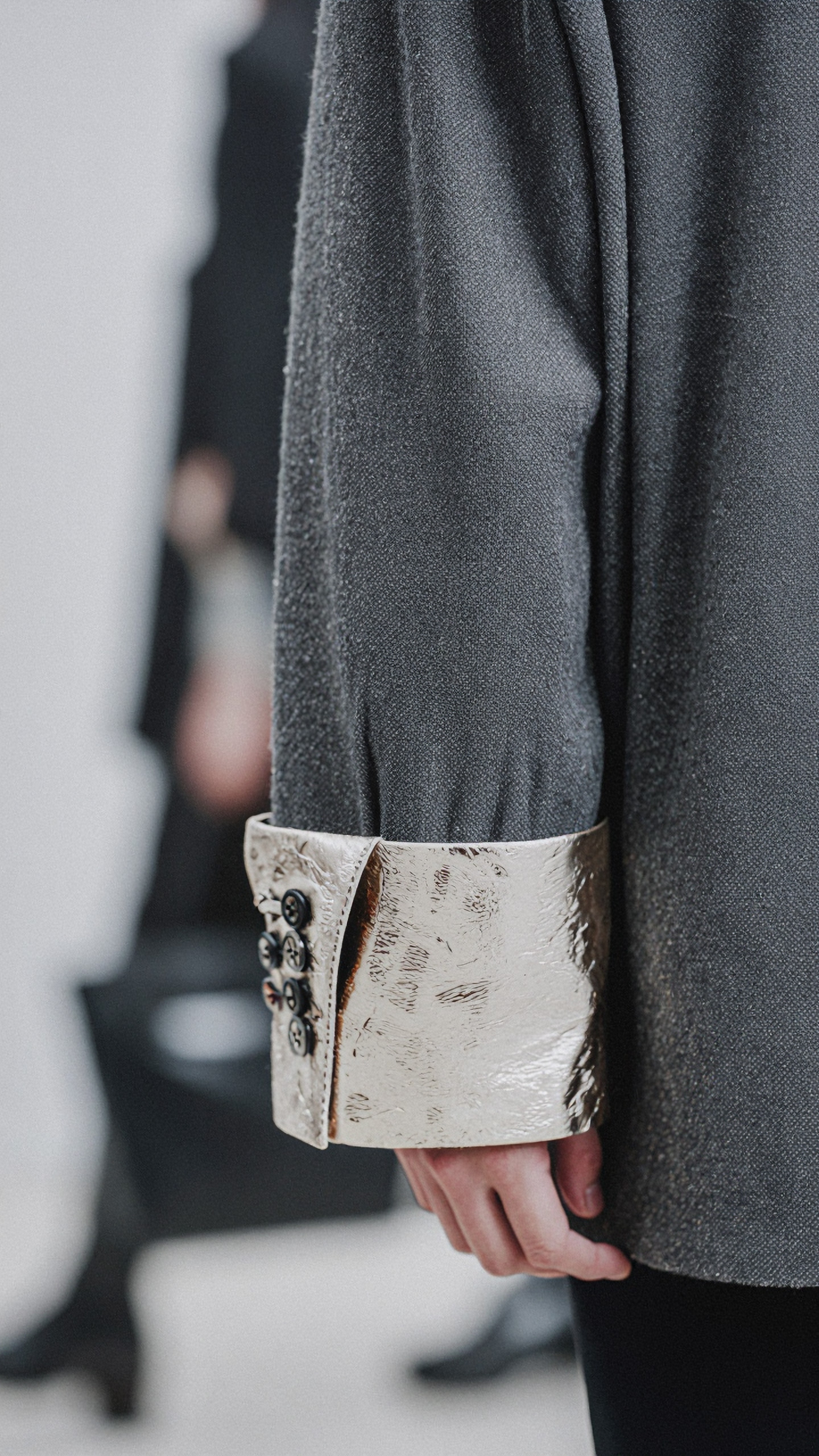
Inspect whether the weave, stitching, and metallic cuff remain distinct. This setup works when you need proof of trend texture, but it cannot replace a silhouette shot.
Lighting choices: editorial mood versus garment accuracy
Overcast street light was the safest for layered tailoring. Controlled studio light was best for lookbook and campaign work. Backstage mixed light helped realism, but it increased color inconsistency.
Practical comparison table
| Use case | Best shot type | Best lens range | Lighting choice | Strongest for | Main risk | |---|---|---:|---|---|---| | Street trend coverage | Street-style full body | 35mm–40mm | Overcast diffusion | silhouette, movement, city context | busy backgrounds | | Magazine editorial | Three-quarter outfit editorial | 50mm | Window light or soft directional key | proportion, styling clarity | lower spontaneity | | Retail-ready trend display | Head-to-toe lookbook | 40mm–50mm | Softbox key | clean garment separation | can feel too static | | Fashion week energy | Runway/backstage moment | 40mm–50mm | Mixed event light | authenticity, event context | clutter, hand errors | | Accessory or textile test | Detail macro | 85mm | Side-raked studio light | material realism | loses full outfit logic | | Store campaign concept | Storefront display | 35mm | Early morning natural light | merchandising, trend translation | reflection control |
Refined prompt examples by use case
A good trend workflow should not stop at one editorial portrait. The point is to see whether the styling idea survives across campaign, retail, and product views.
This storefront test checks whether runway visual trends can move into a shopping-facing image without becoming generic window dressing.
Topic: editorial fashion trends today adapted into storefront visual merchandising
Genre: Retail Editorial
Camera: Panasonic Lumix S1R
Lens: 35mm f/4
Lighting: early morning natural light with interior practical glow
Location: SoHo boutique storefront with large glass panes, brushed steel fixtures, pale oak platforms
Style: elevated fashion retail campaign
Final Prompt: storefront display image based on editorial fashion trends today, SoHo boutique window presenting full styled mannequins and hanging accessories, key look includes oversized camel blazer, silver knit layer, long black skirt over narrow trousers, pointed boots, large burgundy bag, secondary look in tonal gray technical outerwear, clean visual merchandising hierarchy, reflections controlled, premium downtown retail atmosphere, early morning quiet street, Panasonic Lumix S1R clarity, 35mm f/4, balanced interior and exterior light, fashion campaign meets store display realism, garments and accessories clearly legible from outside the glass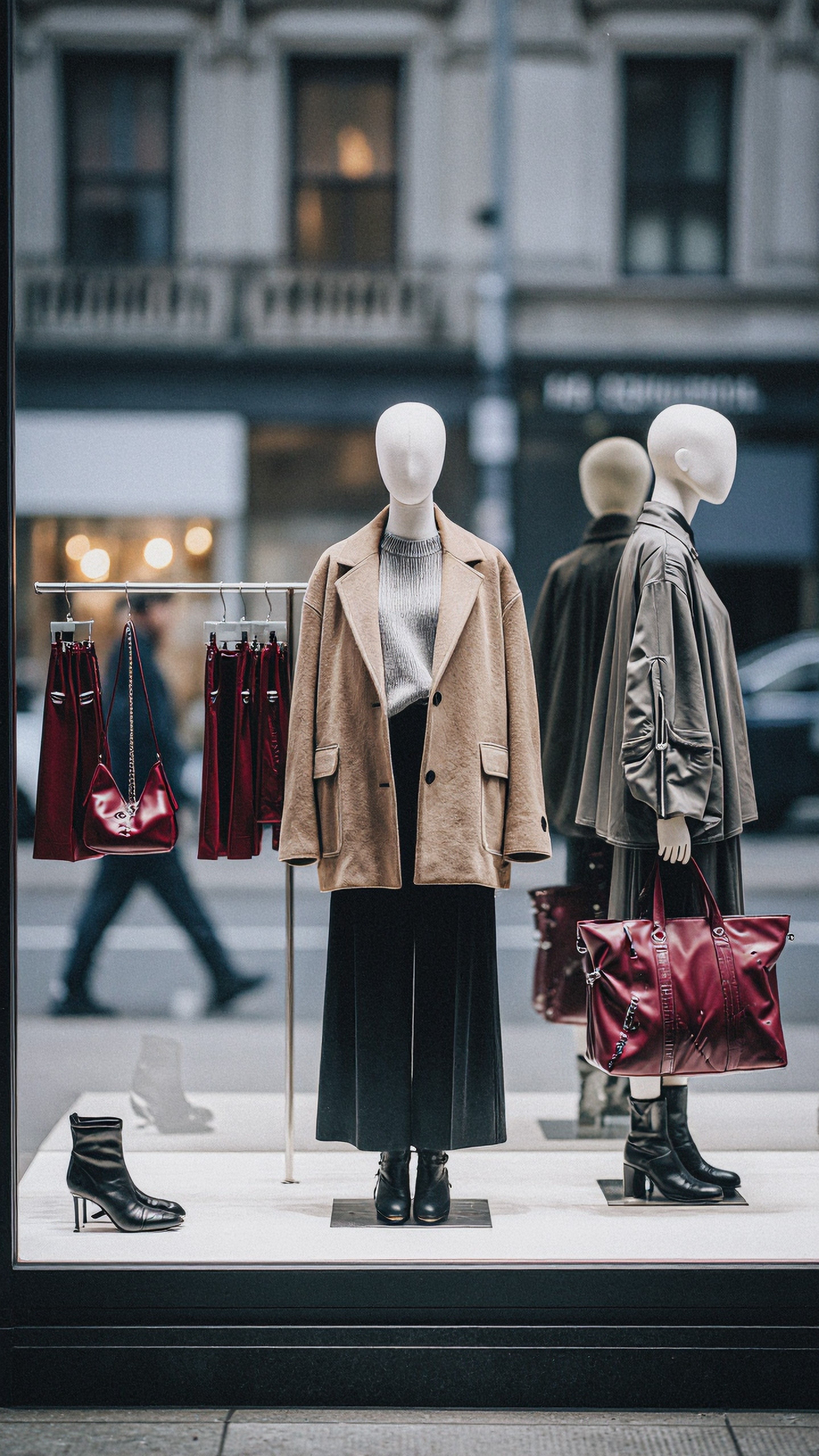
Inspect reflections on the glass and whether the mannequins preserve proportion. The common failure is either too much street reflection or mannequins turning into uncanny human figures.
This accessories prompt tests whether the trend survives in a tighter crop, especially with oversized bag styling that appears often in US searches.
Topic: editorial fashion trends today through oversized bag and shoe styling
Genre: Accessories Campaign
Camera: Hasselblad X2D 100C
Lens: 65mm f/2.8
Lighting: soft studio key with low silver reflector
Location: minimal stone plinth set with smoke-gray backdrop
Style: luxury accessories advertising
Final Prompt: accessories close-up campaign image reflecting editorial fashion trends today, lower torso to shoe crop, oversized oxblood leather shoulder bag tucked under a charcoal tailored coat, layered skirt-over-trouser hem visible, sharp pointed black boots, silver cuff bracelet, subtle movement in coat edge, focus on accessory scale and outfit proportion, cool luxury palette, tactile leather grain, polished but modern campaign styling, Hasselblad X2D 100C medium-format rendering, 65mm f/2.8, clean controlled light, premium accessories editorial composition
Inspect leather grain, strap logic, and boot shape. Watch for doubled straps or bag openings that make no physical sense.
Likely failure points in fashion campaign photography prompts
This was the most useful part of the test. Even strong prompts broke in repeatable ways.
1. Layer collapse
Skirt-over-trouser and long-coat layering is trendy, but image models often merge the hem lines. If the look depends on layered bottoms, state the separation directly.
2. Accessory duplication
Oversized bags, gloves, and cuffs can duplicate when placed near hands. If accessory clarity matters, reduce hand action and simplify pose.
3. Runway-event confusion
"New York fashion week" can push the model toward either catwalk images or sidewalk candids. If you want one, name it. Do not rely on the event phrase alone.
4. Metallic overexposure
Current campaign trends use reflective surfaces, but prompts that stack satin, chrome, mirrored props, and hard rim light often wash out texture.
5. Beauty drift
If the prompt under-specifies the outfit, the model shifts attention to face, hair, and makeup. That weakens fashion utility fast.
This next prompt intentionally pushes a mood-board format to see whether style lock survives across multiple references.
Topic: editorial fashion trends today summarized as a mood-board collage
Genre: Mood Board Collage
Camera: mixed editorial scan aesthetic
Lens: mixed crop simulation
Lighting: mixed magazine tear-sheet lighting
Location: digital fashion board with pinned swatches, runway snapshots, accessory crops, storefront references
Style: fashion editor concept board
Final Prompt: mood-board collage illustrating editorial fashion trends today, curated grid of runway-inspired tailoring, oversized bags, metallic fabric detail, monochrome layering, New York street-style snapshots, storefront merchandising references, garment close-ups, fabric swatches, campaign tears, cool neutral palette with oxblood accent, arranged like a fashion editor planning a campaign set, crisp paper textures, pinned notes, magazine layout energy, coherent trend story, premium design-board aesthetic
Inspect whether all tiles stay within one visual language. Mood-board prompts often drift into random collage unless the color palette and trend anchors are tightly named.
A practical checklist for stronger fashion editorial shoots
Before you run a trend prompt, check these:
- name the shot type first
- define the full outfit from outerwear to shoes
- include one trend anchor, not five
- choose a lens that fits outfit visibility
- say whether the image is for street style, runway, campaign, lookbook, or retail
- control metallic and sheer materials with specific lighting
- simplify hands if accessories matter
- ask for feet fully in frame when testing silhouette
What I would change next when a result is close but not usable
If the image is 70% right, I would not rewrite everything. Small controlled changes work better.
If the silhouette is unclear
Add: "head-to-toe composition, feet fully visible, visible separation between skirt and trousers, clean hem lines."
If the image looks expensive but generic
Add a trend behavior, not another luxury adjective. For example: "oversized work bag under arm" or "micro-short over sheer tights with knee-high boots."
If the campaign set overwhelms the outfit
Reduce prop complexity and narrow the palette to two neutrals plus one accent.
This final production prompt tests a cleaner campaign-to-product bridge using flat lay control.
Topic: editorial fashion trends today translated into a product flat lay story
Genre: Product Editorial
Camera: Sony A1
Lens: 50mm macro f/2.8
Lighting: top-down diffused soft light with subtle shadow shaping
Location: studio surface in warm gray felt with tear-sheet corner and metal tray accents
Style: luxury fashion ecommerce editorial hybrid
Final Prompt: product flat lay image translating editorial fashion trends today into a styled outfit story, carefully arranged oversized charcoal blazer, pale blue shirt, metallic knit top, long black skirt, narrow tailored trousers, pointed boots, oversized burgundy bag, silver cuff, dark sunglasses, visible layering order and accessory hierarchy, fashion editorial flat lay with campaign discipline, top-down composition, warm gray surface, tactile fabric texture, premium retail-meets-magazine styling, Sony A1 detail, 50mm macro f/2.8, clean diffused light, sharp edges and believable material contrast
Inspect whether the layering order is logical and the accessory scale feels intentional. Flat lays are excellent for styling clarity, but they can lose energy if spacing becomes too symmetrical.
Reusable prompt pattern for editorial fashion trends
This is the pattern that produced the most reliable results in this test:
[shot type] image focused on editorial fashion trends today, [full outfit logic], [specific trend anchor], [body framing], [pose or action], [lighting behavior], [real location with fashion context], [color palette], [fabric and accessory detail], [intended output style: street style / magazine editorial / lookbook / luxury campaign / retail display], [camera and lens look], [quality instruction prioritizing garment readability]A filled-in version might look like this:
street-style full body image focused on editorial fashion trends today, oversized charcoal blazer over cream knit, long pleated skirt layered over tailored trousers, pointed boots and oxblood shoulder bag, visible from head to toe, mid-walk on a SoHo sidewalk, overcast fashion week light, cool neutral palette, crisp wool and leather textures, documentary magazine street-style output, 35mm fashion framing, prioritize clear garment separation and readable silhouetteStrengths of this workflow
- It turns trend research into testable image directions.
- It works across editorial, lookbook, retail, and accessories.
- It reduces generic "fashion girl" outputs by forcing garment logic.
- It makes prompt debugging easier because each variable has a job.
Limitations and failure risks
- It is slower than writing one broad aesthetic prompt.
- Strong trend layering can still break on complex hems and accessories.
- Backstage and runway prompts remain the least stable because they combine motion, clutter, and styling density.
- Some models still prioritize face and pose unless outfit framing is stated very clearly.
Practical recommendations by use case
If you are building trend explainers or visual mood references for [Articles](/articles), start with lookbook and street-style prompts. They show the silhouette fastest.
If you need campaign-ready imagery, refine in two stages: first lock the outfit in a neutral studio or sidewalk scene, then move it into a designed set.
If you are testing merchandising or retail content, storefront and flat lay prompts are safer than trying to force every trend into a human subject.
If you only need textile proof, switch to macro detail early instead of overloading the full-body prompt.
FAQ
How do I prompt New York fashion week without getting random runway images?
Name the exact shot type: "street-style full body on SoHo sidewalk" or "backstage corridor documentary frame." The event phrase alone is too broad.
What is the best lens style for fashion editorial shoots in AI prompts?
For outfit visibility, 35mm to 50mm was the most reliable range in this test. Use 85mm mainly for garment or accessory detail.
Why do fashion campaign photography prompts lose the outfit details?
Because campaign language often pushes the model toward mood and set design. Counter that by listing the outfit structure and stating "styling system is the focus."
How many trends should go into one prompt?
Usually one main trend anchor plus one supporting detail. More than that often causes silhouette confusion or material noise.
What is the easiest format for testing US fashion trends quickly?
A head-to-toe lookbook shot. It is less exciting than street style, but much better for checking proportion, layers, and accessory logic.
Conclusion
This workflow is best for operators who need trend-led fashion images that explain why a look feels current, not just images that look expensive at a glance. It is especially useful for editorial planners, prompt builders, retail concept teams, and anyone comparing runway visual trends against campaign execution.
Avoid it if you want fast abstract mood images and do not care about garment accuracy. The method adds structure, and that structure matters.
If I had to keep one rule from this test, it would be this: start with shot type, then define the outfit, then add one trend anchor. That single prompt detail mattered more than any camera brand, lighting adjective, or luxury keyword.