If you are searching for Harajuku outfit ideas to generate with AI, the main challenge is not making the image colorful. It is making layered Tokyo street fashion look intentional, wearable, and playful instead of reading like cosplay clutter or a generic anime costume. In this test, I ran a set of fashion-first prompts built around silhouette, layering logic, accessories, and street context to see which prompt ingredients actually hold together.
The useful outcome: by the end, you should know how to prompt Harajuku fashion so the model shows full outfit structure clearly, keeps the styling eclectic without turning random, and preserves a confident, fashion-editorial mood.
Quick answer
- The strongest Harajuku outfit ideas prompts describe the outfit as a styling system: outer layer, inner layer, skirt or trouser shape, socks, shoes, bag, hair accessories, and palette.
- The weakest outputs happened when I used vague words like "Harajuku girl" or "Japanese streetwear" without naming garment relationships and shot type.
- Full-body street-style and lookbook prompts were the best for checking whether layers felt playful or costume-like.
- Limiting the palette to 3 to 4 anchored colors made the outfit look editorial. Too many unrelated novelty items pushed results into parody.
- If you want usable images fast, start in [Prompt Lab](/promptlab), then compare full-body outputs in [Gallery](/gallery) before refining.
Test setup: what was tested
I tested eight prompt structures across different fashion shot types:
- street-style full body
- three-quarter outfit editorial
- head-to-toe lookbook
- catalog grid page
- runway/backstage moment
- product flat lay
- storefront display
- accessories close-up
The test goal was simple: generate Harajuku fashion images that feel like modern Tokyo street fashion rather than theatrical costume dressing.
I judged outputs on:
1. layer clarity 2. silhouette coherence 3. accessory control 4. fabric and trim detail 5. whether the styling looked fashion-led instead of character-led 6. whether the sexy mood stayed tasteful and outfit-focused
Before you generate: preparation checklist
Before writing any prompt, set these controls first. This made a bigger difference than swapping models.
Preparation checklist for Harajuku fashion prompts
| Checkpoint | What to specify | Why it matters in this test | |---|---|---| | Shot type | full body, lookbook, detail, storefront | Prevents cropped outfits and missing shoes | | Layer plan | outerwear + top + bottom + legwear | Keeps the look styled instead of chaotic | | Palette | 3 to 4 colors max | Stops novelty overload | | Texture mix | sheer, denim, vinyl, knit, lace, mesh | Gives visual richness without adding random props | | Accessory count | 3 hero accessories | Too many accessories caused costume drift | | Street context | Harajuku side street, boutique frontage, crosswalk | Anchors the image in fashion reality | | Mood | confident, playful, sexy editorial | Helps avoid childlike or cartoonish styling |
My best results also included a camera and lens choice because it forced the model toward a believable editorial composition.
Step-by-step workflow for playful Harajuku outfit ideas
Step 1: Start with silhouette, not subculture labels
The weak point in early tests was relying on broad phrases like "Harajuku outfit" and expecting the model to infer structure. That usually produced one of two failures: either too much random layering, or a generic Y2K/anime hybrid with no outfit logic.
The stronger setup named the silhouette first: cropped jacket, fitted inner top, pleated mini, slouch socks, platform loafers, micro bag. That gave the model a styling skeleton.
This first prompt tests whether a full-body street-style image can show layered playfulness without the look turning into prop overload.
Topic: Harajuku layered street style with playful but controlled color blocking
Genre: Street Style
Camera: Canon EOS R5
Lens: 35mm f/2
Lighting: Overcast diffusion
Location: Harajuku side street with boutique signage, tiled sidewalk, passing bicycles
Style: Tokyo street fashion editorial
Final Prompt: street-style full body fashion image, complete head-to-toe Harajuku outfit built around a cropped patent moto jacket in bubblegum pink, fitted black mesh top layered over a pastel lilac bralette, high-waisted pleated mini skirt with mixed plaid panels, white slouch socks, black platform loafers, compact chain shoulder bag, charm keyrings, ribbon hair clips, stacked rings, confident playful pose with one leg forward, outfit clearly visible from head to shoes, colorful eclectic street styling, sexy but tasteful editorial mood, realistic garment layering, visible fabric contrast of vinyl, mesh, plaid, and cotton, modern Harajuku side street background, documentary fashion framing, Canon EOS R5 look, 35mm full-body composition, crisp texture detail, magazine-ready color balance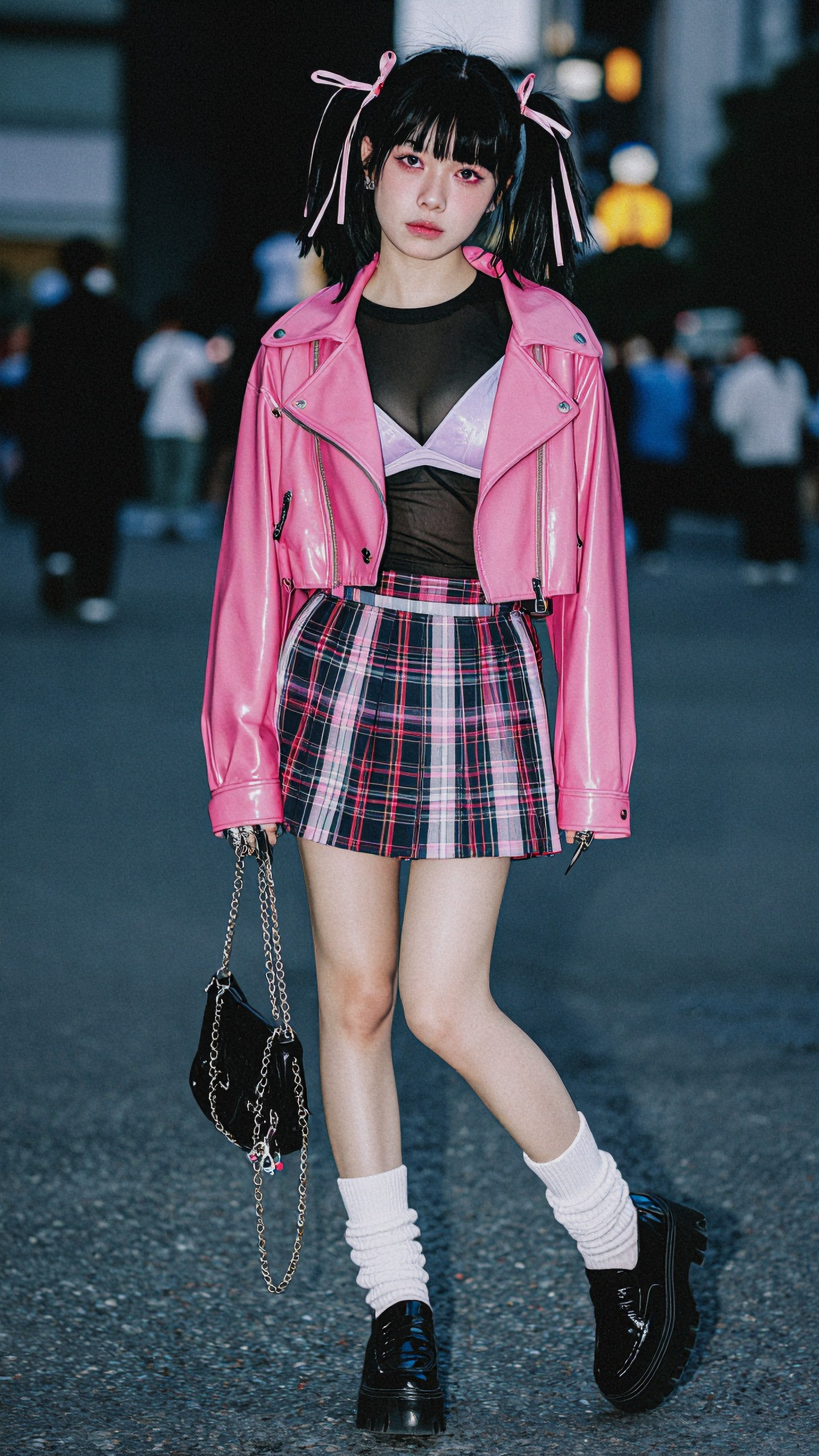
Inspect whether the jacket, top, skirt, socks, and shoes each stay readable. In the strongest results, the accessories support the silhouette; in weaker ones, hair clips and charms start multiplying and stealing focus.
Step 2: Lock the palette before adding extra accessories
In this test, color discipline mattered more than adding more "kawaii" objects. Once the prompt crossed beyond one dark anchor plus two bright tones and one light neutral, many generations became costume-like.
This prompt checks whether a three-quarter editorial crop can keep a sexy, body-conscious mood while still showing enough layering to read as Japanese streetwear.
Topic: Harajuku fashion with tight palette control and body-conscious layering
Genre: Fashion Editorial
Camera: Sony A7R V
Lens: 50mm f/2
Lighting: Soft daylight with silver bounce
Location: Concrete stairwell near Takeshita Street, urban retail backdrop
Style: Contemporary magazine editorial
Final Prompt: three-quarter outfit editorial portrait focused on Harajuku fashion styling, model wearing a fitted striped knit shrug over a satin corset-inspired cami, low-rise cargo mini with side straps, sheer polka-dot tights, lacquered platform ankle boots, narrow shoulder bag, silver chain belt, heart earrings, palette restricted to black, cherry red, soft pink, and chrome, confident sensual pose leaning against concrete stair rail, complete outfit structure still visible, colorful eclectic streetwear energy without costume exaggeration, texture-rich mix of knit, satin, nylon, and gloss leather, urban Tokyo context, Sony A7R V realism, 50mm editorial framing, clean magazine composition, stylish but believable Japanese street style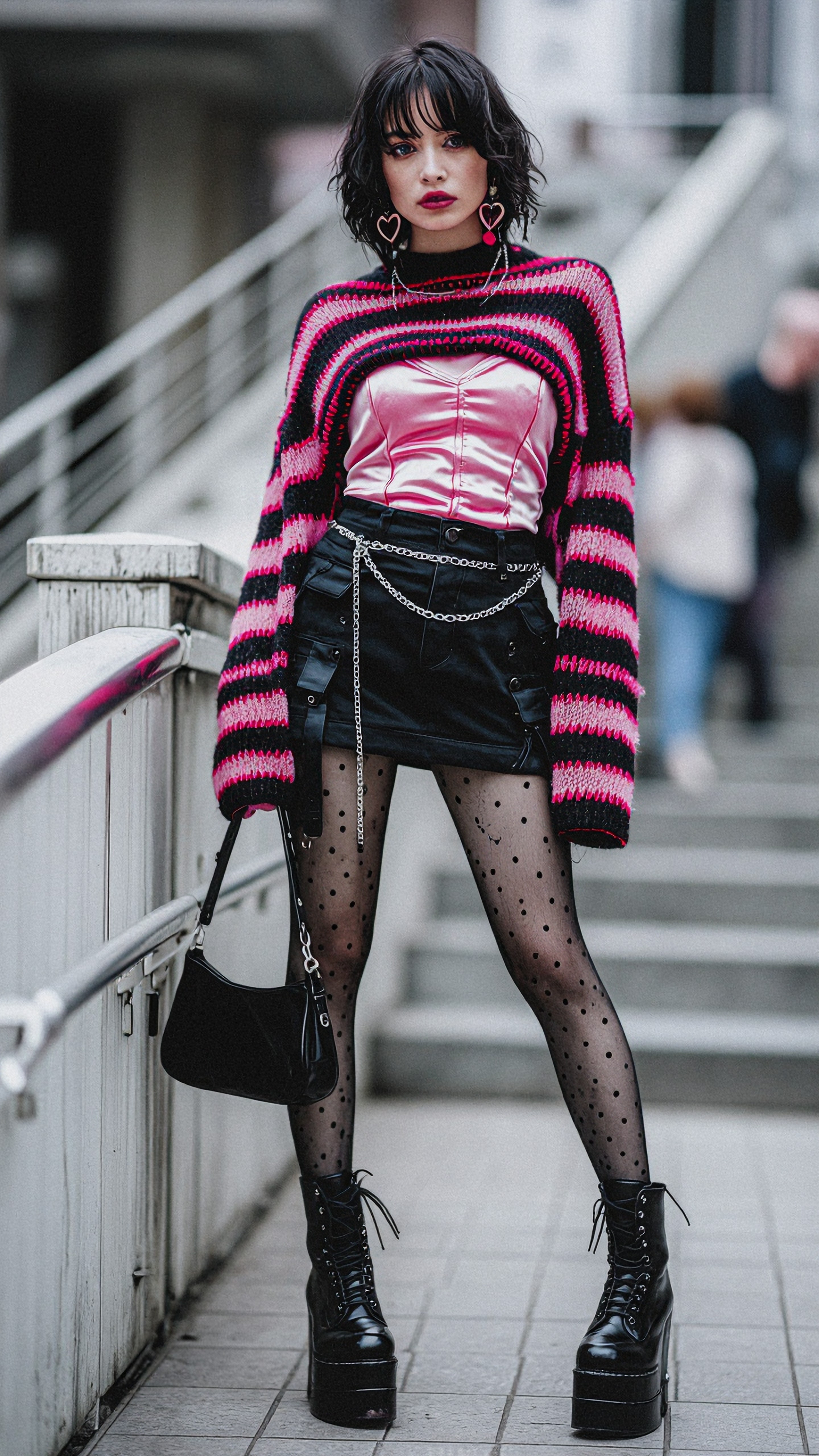
Look at whether the palette feels intentional. If the model introduces random neon green or extra pastel layers, that usually signals the prompt needs stricter color language.
Step 3: Use lookbook framing to test if the outfit actually works head-to-toe
Street scenes can hide weak styling because signage and background energy carry the image. A plain lookbook frame exposes whether the outfit itself holds together.
This prompt is meant to test style lock, hemline control, and shoe visibility without environmental distraction.
Topic: Head-to-toe Harajuku lookbook with clear layering logic
Genre: Lookbook Fashion
Camera: Nikon Z8
Lens: 40mm f/2
Lighting: Large softbox key with soft floor bounce
Location: Minimal studio cyc with pale mint backdrop
Style: Clean commercial lookbook
Final Prompt: head-to-toe lookbook image of a modern Harajuku outfit, full-body centered stance, oversized faux-fur trimmed cardigan worn open over a fitted graphic baby tee, tiered ruffle mini skirt over bike shorts, mismatched knee socks, platform Mary Janes, mini crossbody bag with plush charm, wrist cuffs, translucent bangles, beret with enamel pins, outfit designed to feel playful and sexy in a tasteful editorial way, emphasis on silhouette balance and visible layering, colorful eclectic palette of mint, cream, black, and candy pink, every garment fully visible from hat to shoes, minimal studio background for catalog clarity, Nikon Z8 detail, 40mm accurate proportions, crisp fabric texture and styling realism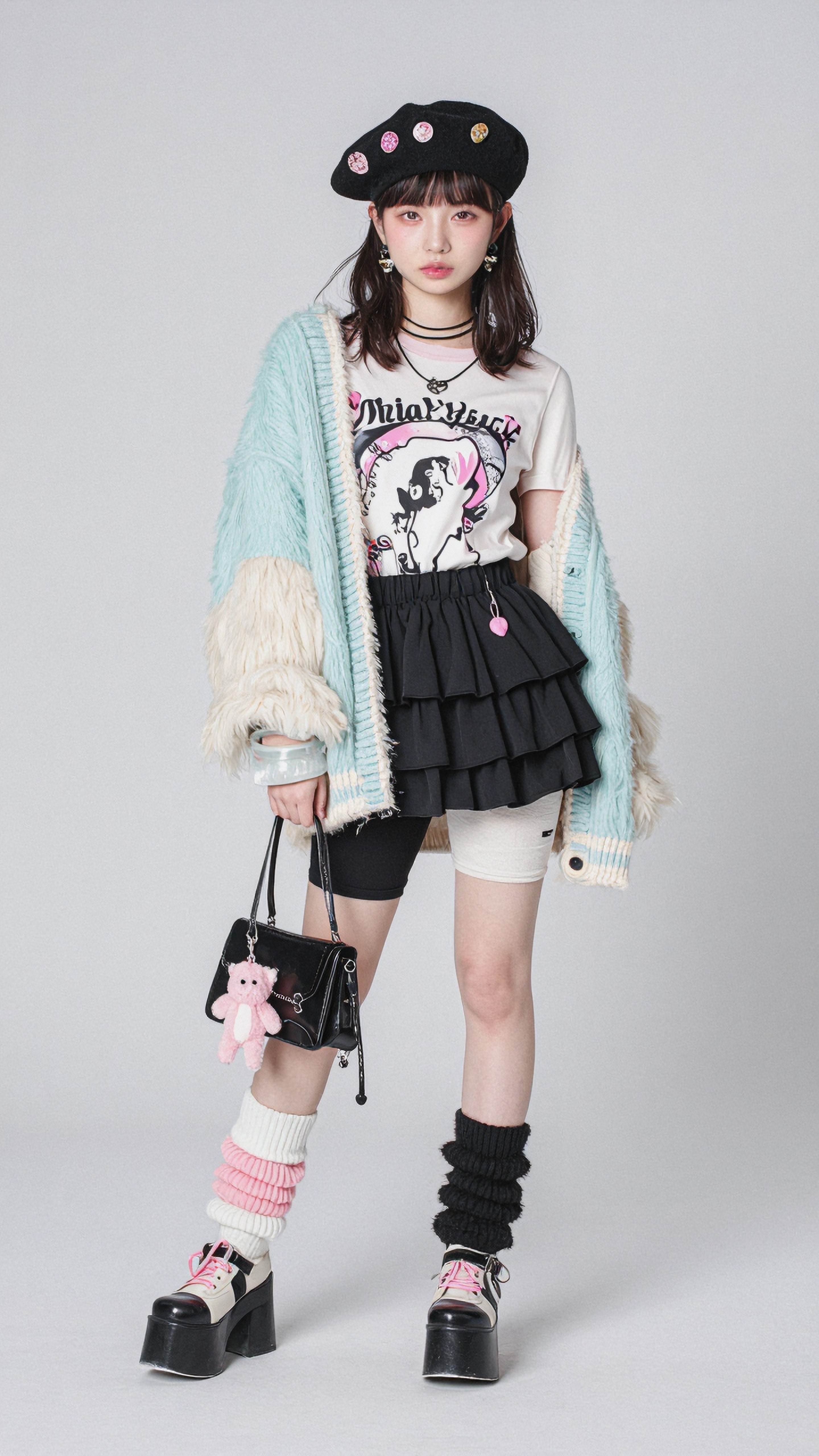
Check whether the image still feels like fashion when stripped of street context. In this test, the best lookbook outputs exposed one common issue fast: many models over-decorate skirts when the top half is already busy.
Step 4: Add one statement textile, not five
One of the easiest ways to make street style outfit ideas look fake is stacking too many statement materials at once. Vinyl, lace, faux fur, sequins, and tulle together usually read as costume inventory, not fashion styling.
This next prompt tests a catalog-grid approach to see whether controlled variation across outfits keeps the Harajuku identity while avoiding repetition.
Topic: Multiple Harajuku outfit ideas built around one hero textile per look
Genre: Catalog Fashion Page
Camera: Fujifilm GFX 100S
Lens: 45mm f/2.8
Lighting: Even studio panel lighting
Location: White seamless studio for e-commerce editorial grid
Style: Fashion catalog layout
Final Prompt: catalog grid page showing four distinct Harajuku outfit ideas, each look full-body and clearly separated, outfit one led by plaid, outfit two led by sheer mesh, outfit three led by faux fur trim, outfit four led by glossy vinyl, each styled with disciplined layering including outerwear, fitted top, mini skirt or shorts, socks or tights, platform footwear, mini bag, and hair accessory, colorful eclectic Tokyo street fashion direction, sexy but tasteful editorial silhouette, modern Japanese streetwear styling, clean fashion catalog presentation, balanced spacing, no costume chaos, Fujifilm GFX 100S clarity, 45mm accurate garment proportions, premium texture detail, magazine merchandising feel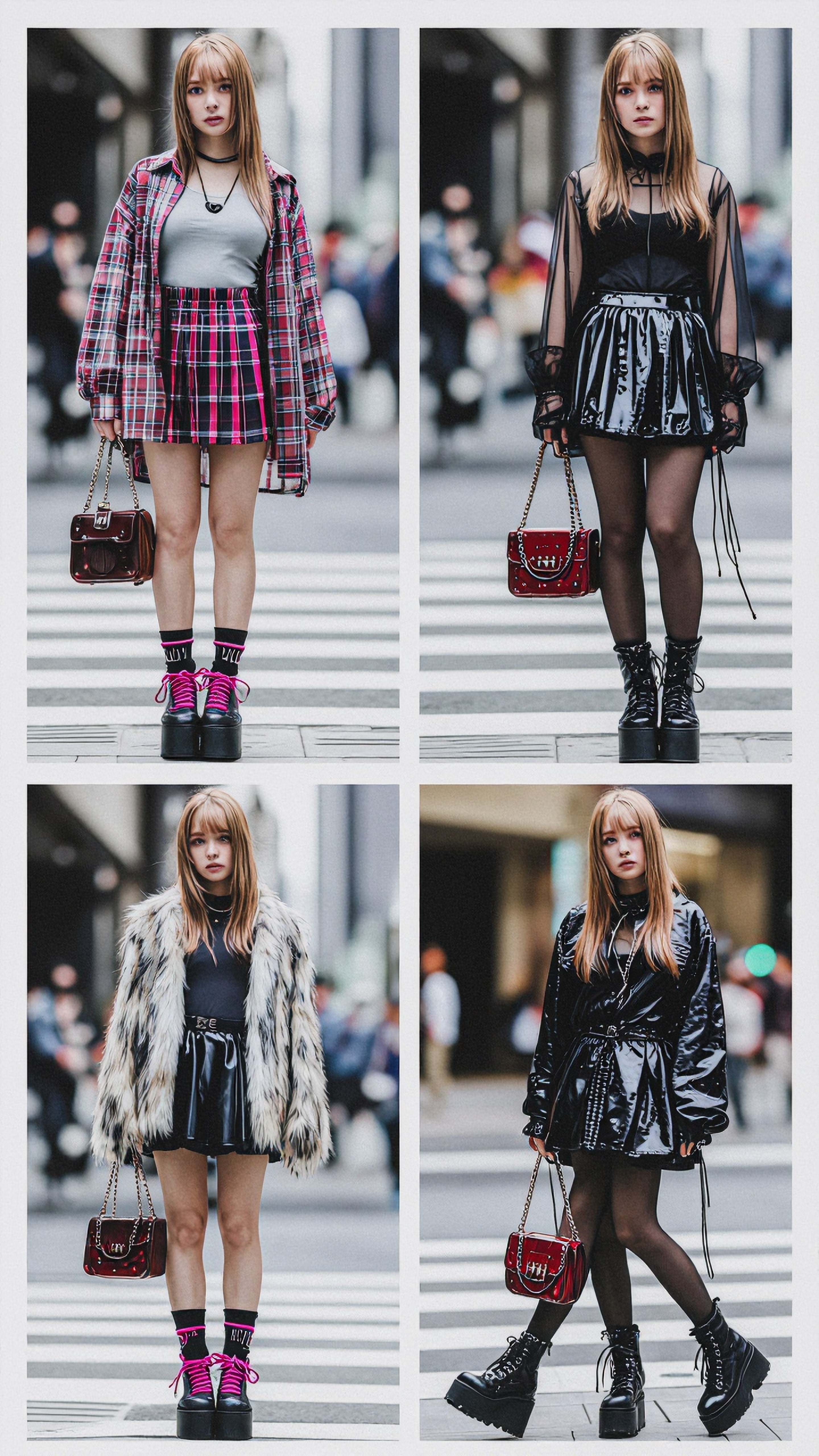
Inspect whether each look has a distinct center of gravity. The strongest generations make each outfit feel merchandisable; the weak ones let every look borrow every textile at once.
Step 5: Use runway or backstage prompts to stress-test layering realism
Backstage and runway prompts reveal whether the AI understands garment behavior in motion. This is where fake layers often collapse, especially around hems, stockings, and jacket openings.
This prompt checks motion, fabric separation, and whether a sexy mood can stay fashion-directed instead of glam-only.
Topic: Harajuku-inspired runway layering in motion
Genre: Runway Fashion
Camera: Canon EOS-1D X Mark III
Lens: 70mm f/2.8
Lighting: Mixed runway spotlights with dim ambient audience light
Location: Tokyo fashion week runway with backstage entrance visible
Style: Avant-pop runway editorial
Final Prompt: runway backstage moment featuring a Harajuku-inspired layered look in motion, model stepping out confidently in cropped faux-leather biker jacket, lace-trim camisole, asymmetric pleated micro skirt over fitted shorts, thigh-high patterned stockings, towering platform boots, metallic mini bag, crystal ear cuffs, layered belts, strong body-conscious silhouette, colorful eclectic Japanese streetwear translated into high-fashion runway language, sexy tasteful editorial mood, visible fabric movement and accurate garment overlap, cool pink and ultraviolet accent lighting, Tokyo runway context, Canon EOS-1D X Mark III sports-fashion sharpness, 70mm fashion event framing, cinematic backstage depth, premium textile detail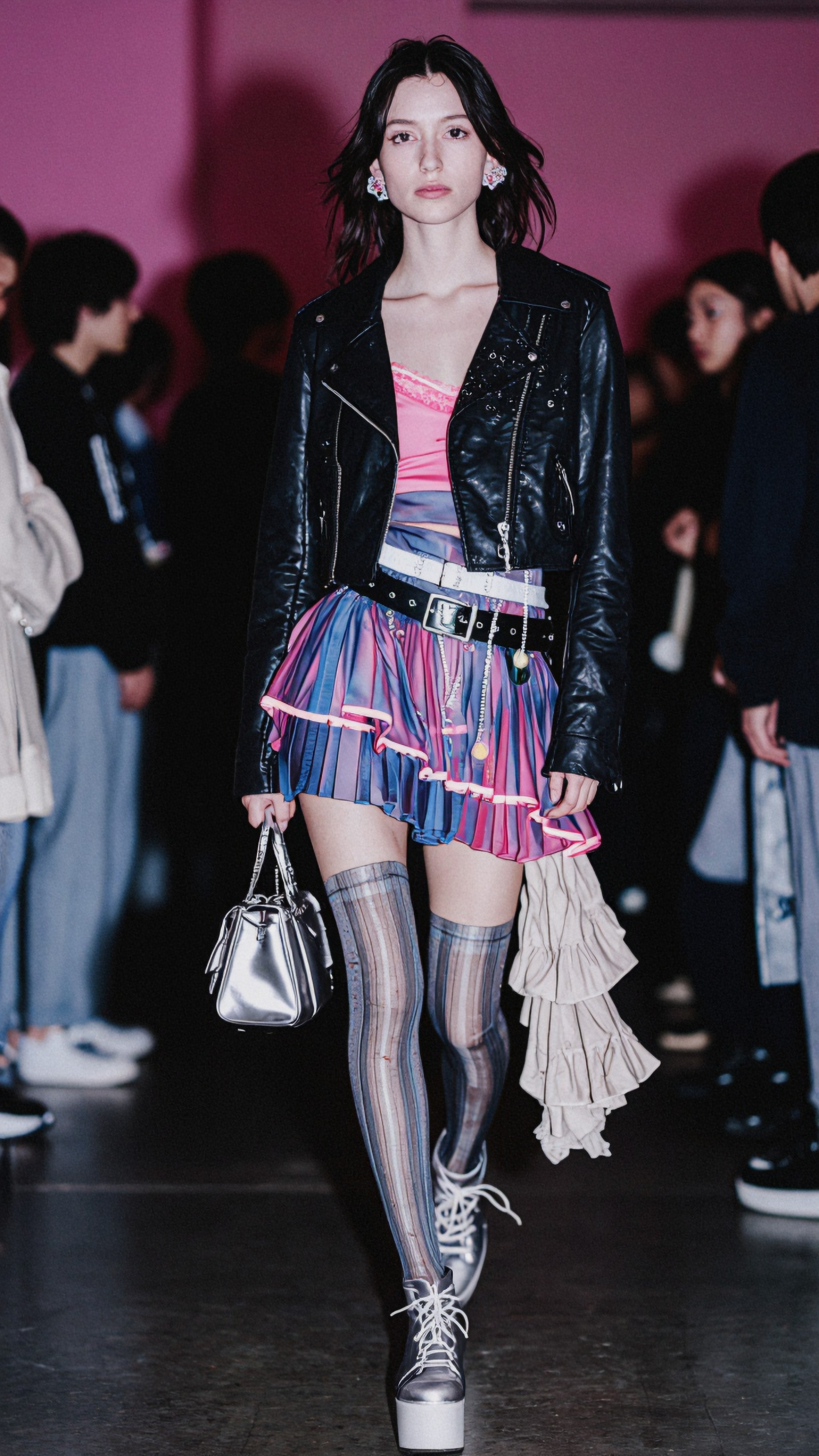
Watch the hems and legwear carefully. In this test, runway prompts often produced the most dramatic images, but they also had the highest risk of broken stockings, merged skirts, or impossible boot shapes.
Step 6: Flat lays are the fastest way to fix vague prompts
When the full-body outputs felt messy, I switched to flat lay prompts. This made it easier to see whether the outfit ingredients themselves were coherent before asking the model to place them on a body.
This prompt tests product clarity, color planning, and whether the wardrobe pieces still suggest authentic Harajuku outfit ideas without relying on a model.
Topic: Harajuku outfit flat lay with controlled layering pieces
Genre: Product Editorial
Camera: Hasselblad X2D 100C
Lens: 55mm f/2.5
Lighting: Soft overhead diffusion with side fill cards
Location: Studio tabletop with pale concrete texture
Style: Fashion product editorial
Final Prompt: product flat lay of a complete Harajuku outfit arranged with clear styling logic, cropped pink moto jacket, black mesh long-sleeve layer, lilac camisole, mixed plaid pleated mini skirt, white slouch socks, black platform loafers, mini chain bag, ribbon clips, charm accessories, silver rings, compact wallet, all pieces neatly styled and spaced, colorful eclectic Tokyo street fashion direction, sexy editorial taste through fitted shapes and glossy textures, clean merchandising composition, visible fabric detail, no clutter, Hasselblad X2D 100C precision, 55mm product framing, luxury editorial flat lay finish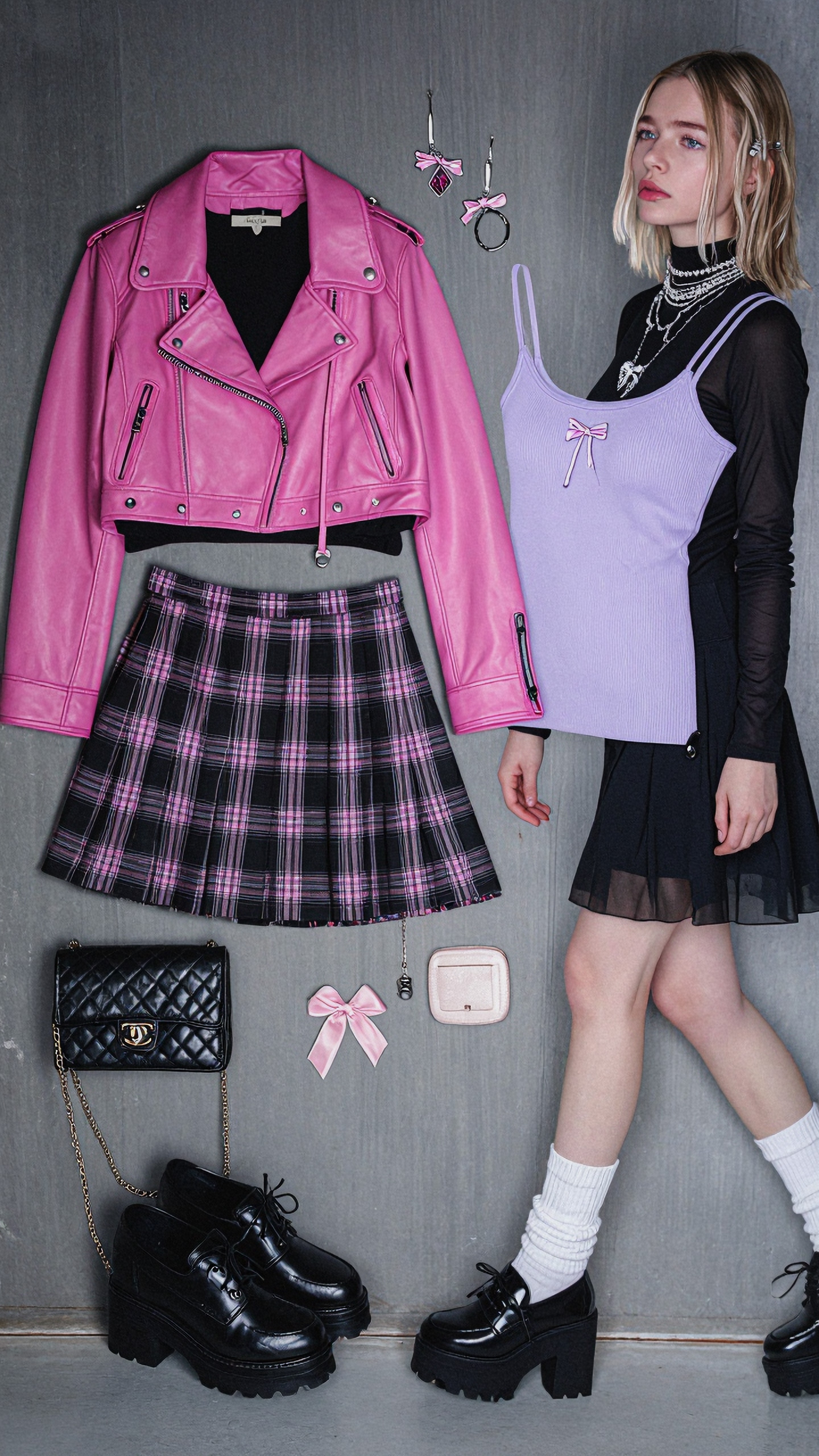
Inspect spacing and proportion. If the flat lay already looks chaotic, the full-body version will almost always look worse.
Step 7: Storefront scenes help separate fashion from cosplay
A very useful test was placing the outfit inside a retail environment. If the styling looks believable hanging in a curated store scene, it usually reads as fashion. If it only works in fantasy street chaos, it may be relying on noise.
This prompt checks merchandising realism and whether the look belongs to a coherent fashion world.
Topic: Harajuku boutique storefront with layered street-style merchandising
Genre: Retail Fashion Editorial
Camera: Leica SL2-S
Lens: 24-70mm f/4 at 35mm
Lighting: Window daylight with warm interior practicals
Location: Harajuku boutique storefront with mannequins, racks, stickers, and neon accents
Style: Editorial retail campaign
Final Prompt: storefront display image of a Harajuku fashion boutique, front window featuring one hero mannequin in a layered street-style outfit with cropped jacket, fitted graphic top, ruffle mini skirt, patterned tights, platform shoes, mini bag, hair accessories, surrounding racks showing coordinated colorful eclectic Japanese streetwear, tasteful sexy editorial merchandising, clear outfit logic, playful but curated Tokyo retail atmosphere, stickers, signage, reflective glass, warm shop lighting mixed with cool street daylight, Leica SL2-S realism, 35mm storefront composition, premium fashion campaign styling, detailed fabric and accessory presentation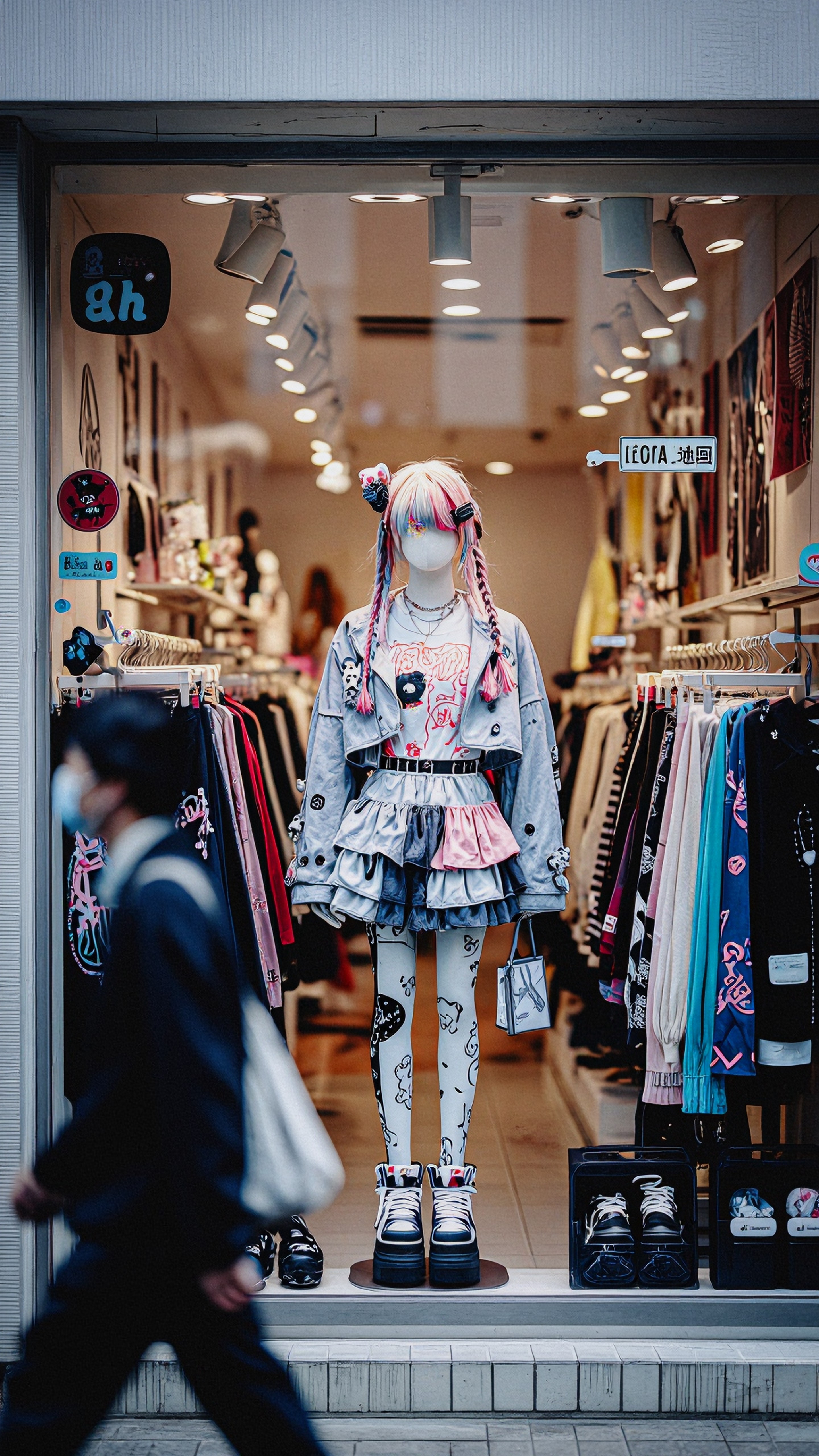
Look for curation. The best outputs make the shop feel like a place where the outfit could actually be sold; the weak ones fill the window with novelty props that drown the clothes.
Step 8: Finish with accessories close-up, then return to full body
Accessory close-ups are useful late in the workflow, not early. Starting with them tempted the model to overbuild the look around trinkets. But used at the end, they help sharpen the identity of the outfit family.
This prompt tests detail fidelity and whether accessories reinforce the styling rather than hijack it.
Topic: Harajuku accessories close-up supporting a layered street-style look
Genre: Accessories Campaign
Camera: Panasonic Lumix S1R
Lens: 85mm f/2
Lighting: Beauty softbox with magenta neon rim light
Location: Tokyo arcade entrance at dusk
Style: Youth luxury accessories editorial
Final Prompt: accessories close-up connected to a full Harajuku street-style outfit, framing hands, bag, belt line, skirt hem, tights texture, and platform shoe top edge, featuring chain mini bag with charms, stacked rings, heart buckle belt, lace glove detail, enamel hair clip reflected in storefront glass, sexy but tasteful fashion mood, colorful eclectic Tokyo street styling, visible context of layered outfit without becoming a face portrait, dusk arcade glow, Panasonic Lumix S1R detail, 85mm controlled fashion crop, crisp accessory texture, premium editorial finish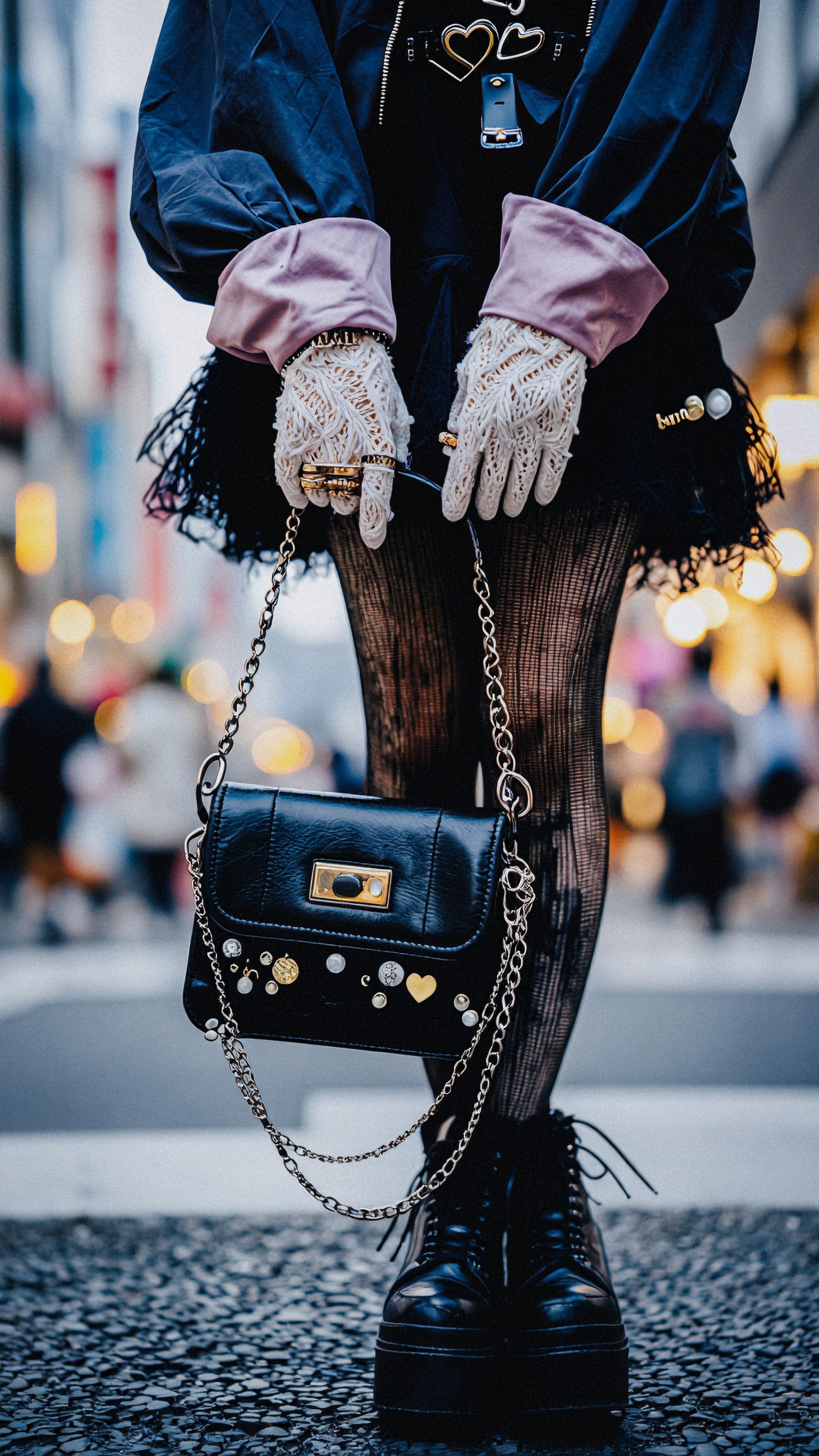
Inspect whether the close-up still implies the whole outfit. If accessories become toy-like or disconnected from the garment palette, the styling identity is breaking apart.
What worked best in this test
Strongest prompt ingredients
- Named shot types with full-body or three-quarter framing
- One clear silhouette sentence before accessory detail
- Palette limits with one dark anchor
- One hero textile per look
- Street or retail contexts specific to Harajuku
- Tasteful sexy mood expressed through fit and confidence, not exposed skin alone
Strongest overall workflow
The most reliable sequence was:
1. flat lay or lookbook for outfit logic 2. full-body street style for energy 3. retail or runway for context stress test 4. accessory close-up for finish
If you want to build and compare these quickly, I would draft prompts in [Create](/create), save variants to [Gallery](/gallery), and only upscale the winning image in [Upscaler](/upscaler) after checking the stockings, hardware, and shoe shapes.
Quality-control checklist for Harajuku outfit images
Use this after every generation.
Outfit quality checklist
- [ ] Can you identify every layer from outerwear to shoes?
- [ ] Does the outfit have one silhouette idea, not three conflicting ones?
- [ ] Are there only 3 to 4 key accessories?
- [ ] Does the palette feel edited rather than random?
- [ ] Do socks, tights, and shoes connect logically?
- [ ] Does the background support the styling without overwhelming it?
- [ ] Does the image read as fashion editorial or retail, not character cosplay?
- [ ] Is the sexy mood coming from attitude, fit, and styling rather than awkward pose design?
Troubleshooting weak outputs
If the image looks costume-like
Remove subculture labels and rewrite the outfit in plain garment language. Replace "kawaii Harajuku fantasy" with exact pieces and textures.
If layers merge together
Switch to a lookbook or flat lay prompt first. Then reintroduce the street setting after the outfit architecture is stable.
If the model adds too many props
Cap accessories in the prompt: one bag, one hair accessory family, one jewelry family. This reduced clutter consistently in my tests.
If the outfit turns generic Y2K instead of Harajuku
Add one location cue and one styling cue together, such as "Harajuku boutique frontage" plus "mixed plaid pleated mini and platform loafers." Location alone was not enough.
If the mood becomes too glam instead of street
Lower beauty emphasis and increase garment detail language. The more I described fit, fabric, and legwear, the less the model drifted into generic nightclub styling.
Limitations and failure risks
This workflow is strong for editorial ideation, but it still has weak points.
- Models often overproduce ribbons, pins, and dangling charms.
- Tights and slouch socks can fuse into one strange legwear layer.
- Plaid pattern scale may shift unpredictably between top and skirt.
- Backstage and runway images look dynamic, but they hide garment inaccuracies better than lookbooks do.
- The more anime-coded language you add, the more likely the result drifts away from wearable Tokyo street fashion.
For that reason, I would not use the first vivid image as the final answer. Compare at least three variants for each prompt family. Browsing adjacent tests in [Articles](/articles) can also help if you are refining broader street style outfit ideas workflows.
Practical recommendation: which prompt type is best for which goal?
Best for outfit planning
Use the flat lay and lookbook prompts first.
Best for social or editorial impact
Use the street-style full body and three-quarter editorial prompts.
Best for checking commercial believability
Use the storefront display prompt.
Best for drama and motion
Use the runway/backstage prompt, but treat it as a validation pass, not your first draft.
FAQ
How do I make Harajuku outfit ideas look fashionable instead of like cosplay?
Describe the outfit as layered garments with one silhouette idea, a limited palette, and only a few hero accessories. Use a street-style or lookbook shot type so the clothing stays visible.
What colors work best for Harajuku fashion prompts?
A dark anchor like black plus two bright tones and one soft neutral gave the cleanest results in this test. Too many unrelated colors made the outfit feel costume-like.
Which shot type is best for AI-generated Tokyo street fashion?
Full-body street style is best for checking outfit energy, while head-to-toe lookbook is best for checking whether the styling actually works.
Should I use anime wording in Harajuku prompts?
Only lightly, if at all, unless you want a clear illustrated direction. In photo-style generations, heavy anime wording often weakened garment realism and pushed results away from wearable Japanese streetwear.
Summary recommendation
If your goal is practical, image-ready Harajuku outfit ideas, use a checklist-led workflow: build the outfit as a silhouette first, keep the palette disciplined, test it in a plain lookbook or flat lay, then move into Harajuku street context for energy. In this test, the strongest result was the full-body street-style prompt supported by a flat lay validation pass.
Who should use this workflow: creators generating AI fashion editorials, stylists mocking up Tokyo street fashion concepts, and prompt writers who need layered looks that still read as sellable. Who should avoid it: anyone looking for fantasy cosplay visuals rather than fashion-led styling. The setting detail that mattered most was not the camera or even the model—it was the combination of a specific Harajuku location cue with a tightly described layer structure.