Short answer: the prompts in this set that gave a readable outfit all did two things at once. They asked for the full outfit in the reflection, and they gave the phone hand a simple job (one hand raised, phone in front of the face or chest). What still went wrong, in the eight Z-Image mirror selfies we have on record for this topic, was almost never the clothing. It was the small mechanical stuff: a third sneaker, garbled digits on an elevator panel, a jacket that does not attach to a body, and a phone that cuts off the top of the frame. This page walks through those mechanics image by image.
Every image below was made with Z-Image on 2026-07-12 and is 2880x5120 (9:16 portrait). The generation records keep the prompt but not the seed, steps or any settings, so nothing here can be reproduced exactly, and eight images are an anecdote, not a benchmark.
Where the phone goes decides the whole frame
In a mirror selfie the phone is the one object that always sits between the camera and the face, so it is where the image either holds together or does not. In all eight images the phone is held in one raised hand with its back (camera lenses) toward us, which is the geometry a real mirror selfie produces: the viewer sees the reflected back of the phone, not its screen. None of the eight shows a screen facing us. That part the model handled consistently.
What varied was how high the phone sits:
- Phone in front of the face (images 1, 4, 5): the phone covers the nose and mouth or the whole lower face. This is the safest outcome for a fashion-first image because faces are the most failure-prone part of a generation, and the clothes stay fully visible. The cost is that the picture has no face.
- Phone at chest level (image 3): the face is visible, sunglasses on, the phone sits below the chin. It reads as the most "influencer" frame of the set, and it is also the one that exposes the most detail to check.
- Phone at the very top edge of the frame (images 6 and 8): the phone and the head are cropped by the top of the image. This is a framing failure for a full-outfit shot, discussed below.
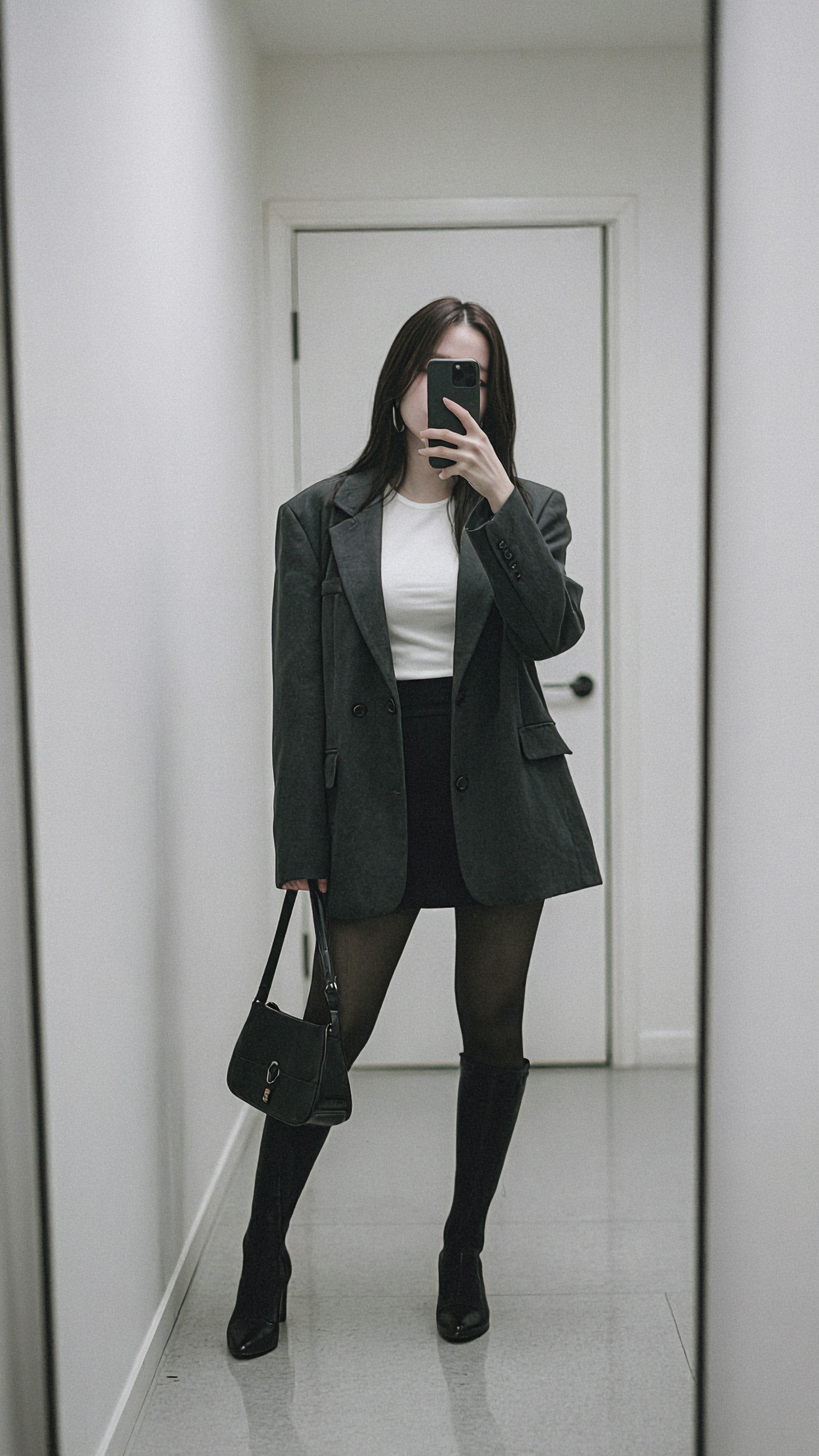
The first image (apartment entryway) is the cleanest in the set. The raised hand has five plausible fingers, the phone shows its camera block, the blazer has believable lapel, flap-pocket and cuff-button detail, and both boots reach the floor. One mismatch with the prompt: it asked for "one hand holding phone and the other relaxed at thigh", but the second hand is holding the bag by its handle. That is a reasonable interpretation, yet it means the prompt's hand instruction was not followed literally. The prompt, exactly as stored:
street-style full body mirror selfie of a Korean street fashion outfit in a minimal Seoul apartment entryway, styling-focused composition with the complete outfit clearly visible, oversized charcoal blazer over a fitted white ribbed tank, black high-waist mini skirt, sheer black tights, slim black knee-high boots, small structured shoulder bag, silver hoop earrings, sleek dark hair, confident casual pose with one hand holding phone and the other relaxed at thigh, slight hip shift, candid influencer mirror selfie energy, clean mirror reflection, neutral palette with soft contrast, polished concrete floor, matte white walls, subtle lived-in apartment details, Fujifilm GFX100S realism, 45mm documentary framing, premium fabric texture, tasteful body-conscious silhouette, natural posture, editorial but believable Instagram mood, sexy fashion mood, outfit-first fashion editorial, complete styling system, visible fabric texture, accessories, shoes, bag, scene context, natural pose or walking action, 35mm editorial photography, realistic street, runway, retail, or lookbook settingReflection logic: what the mirror has to get right
A mirror selfie asks the model to draw a room twice: once as the scene and once as the reflection. In practice the images avoid this by filling the frame with the mirror itself, so the "room" we see is already the reflection. You can see the mirror edges in images 1 (dark vertical frame lines on both sides), 2 (steel uprights with a clothing rack reflected at left and right) and 8 (thin black frame and reflected racks at the edges). That is a practical tip that follows from these images: if the mirror frame is visible, the reflected-room details (rack, door, stool) only need to be consistent with each other, not with a second "real" room.
Two places where reflection logic visibly breaks in this set:
- Text in reflections. In the elevator image (image 3) the button panel at the left shows digits that do not read as numbers ("COO", and mirrored-looking glyphs under it). Real elevator panels are mirrored in a reflection, so an unreadable result is expected, but here the characters are not recognisable in either direction. If a prompt puts a mirror in front of signage, keypads or a phone case with lettering, expect unreadable text. This is a known limitation of image models, and this image shows it.
- Duplicated objects in the floor area. In image 6 (apartment bedroom), a white sneaker also sits on the floor behind the subject's left side (a plausible shoe on the floor), but the subject's own feet show an extra sneaker shape: when the legs cross, three separate sneaker shapes are visible in front. This is the clearest anatomy-type failure in the set.
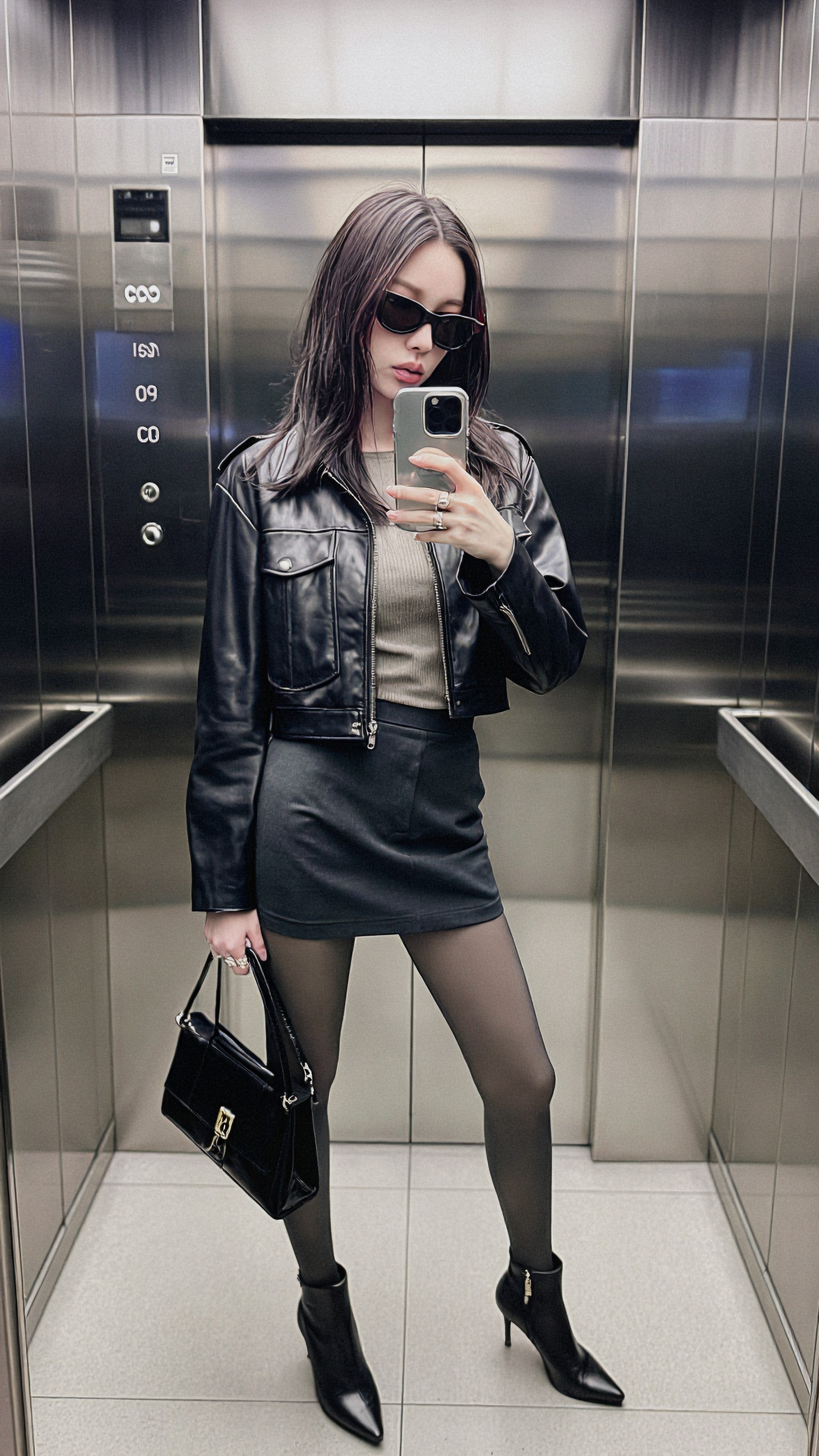
Image 3 is otherwise the strongest: the jacket shows chrome zips, chest pockets and a hem band, the ring-wearing hand holds a silver phone case, and the ankle boots with slim heels are crisp. The prompt:
street-style full body mirror selfie inside a brushed metal elevator in Hongdae, outfit-focused Korean street fashion look with cropped black leather jacket, fitted taupe knit top, dark charcoal micro mini skirt, semi-sheer tights, pointed ankle boots with slim heel, compact black top-handle bag, stacked silver rings, narrow sunglasses pushed onto head, confident slightly angled stance, one knee relaxed, candid but composed influencer mirror selfie, brushed metal reflections, cool urban tones, body-conscious silhouette with tasteful editorial sensuality, visible full outfit from jacket to boots, Canon EOS R5 sharpness, 35mm fashion documentary framing, realistic leather and knit texture, clean reflection geometry, minimal clutter, Seoul nightlife-adjacent but not clubwear, sexy fashion mood, outfit-first fashion editorial, complete styling system, visible fabric texture, accessories, shoes, bag, scene context, natural pose or walking action, 35mm editorial photography, realistic street, runway, retail, or lookbook settingThe prompt asks for "clean reflection geometry". In the image, the reflection behaves, apart from the button-panel text. The legs look long and narrow against the torso, but I could not identify a specific anatomical error in them, so I will not call them distorted.
Hands: the raised one is good, the other one is where the trouble starts
In every image the phone hand is coherent: visible fingers, nails, a believable grip. The second hand is the weak point. In images 1, 2, 3, 5 and 7 it simply holds a bag handle, which is a low-risk pose. The one place it breaks is image 8:
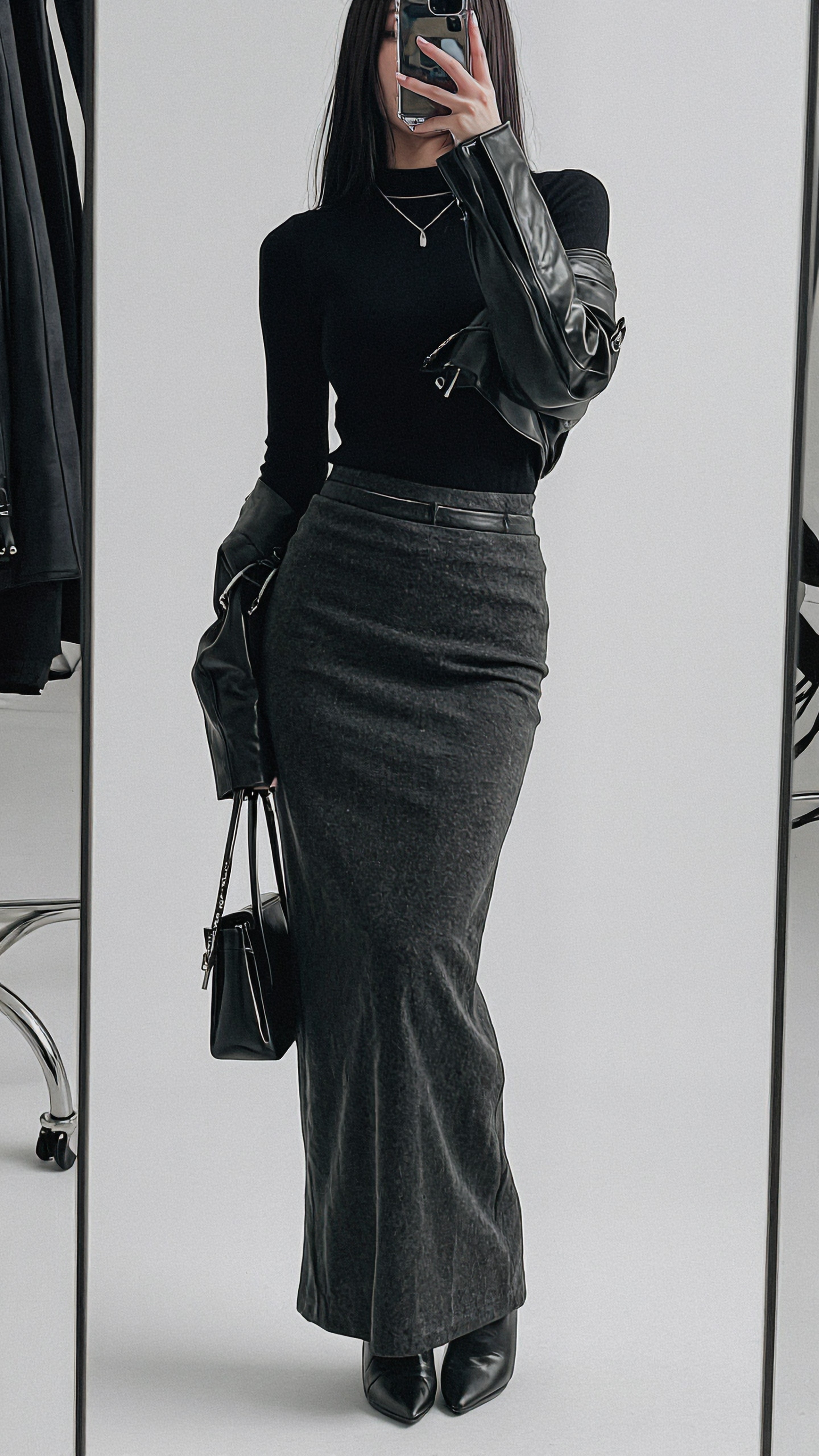
The prompt asked for "one hand holding phone, other hand tucked lightly into jacket edge" and "cropped leather jacket draped open". In the image, the jacket does not hang from the shoulders. Its sleeves bunch at the raised elbow and again at the lower arm, and it is hard to tell which sleeve belongs to which arm. The second hand holds a bag, not the jacket edge. The skirt is a column maxi with a leather-trimmed waist and reads well, and the knit and necklace are clean, but the jacket is the failure. The phone is also clipped by the top of the image, and the pointed boots are only barely in frame. The prompt:
head-to-toe lookbook mirror selfie in a clean Seoul dressing studio with a frameless tall mirror, complete influencer street style outfit featuring a black fitted long-sleeve knit, heather gray low-rise maxi skirt with a straight column silhouette, cropped leather jacket draped open, pointed black boots, compact shoulder bag, minimal silver jewelry, composed confident expression, one hand holding phone, other hand tucked lightly into jacket edge, full silhouette clearly visible from head to toe, soft neutral daylight, white dressing studio, Sony A7R V detail, 35mm fashion framing, chic restrained palette, body-conscious but elegant proportions, Korean street fashion with Instagram candid realism, no visual clutter, clear garment layering and hemline control, sexy fashion mood, outfit-first fashion editorial, complete styling system, visible fabric texture, accessories, shoes, bag, scene context, natural pose or walking action, 35mm editorial photography, realistic street, runway, retail, or lookbook settingThe lesson is structural: "draped" is an instruction about how a garment hangs off a body, which the model handles worse than "worn open". A plainly worn jacket (as in image 1 or image 3) gives the model a clear garment shape to draw.
Cropping: the prompt said "three-quarter" or "head-to-toe", the frame says otherwise
Two prompts in this set used "three-quarter outfit editorial mirror selfie" (images 2 and 6). Image 2 shows the head down to white sneakers, so the framing really is head to toe. Image 6 cuts the subject off at the nose. The top of the phone, hair and face are outside the image, and the shoes and floor are included instead.
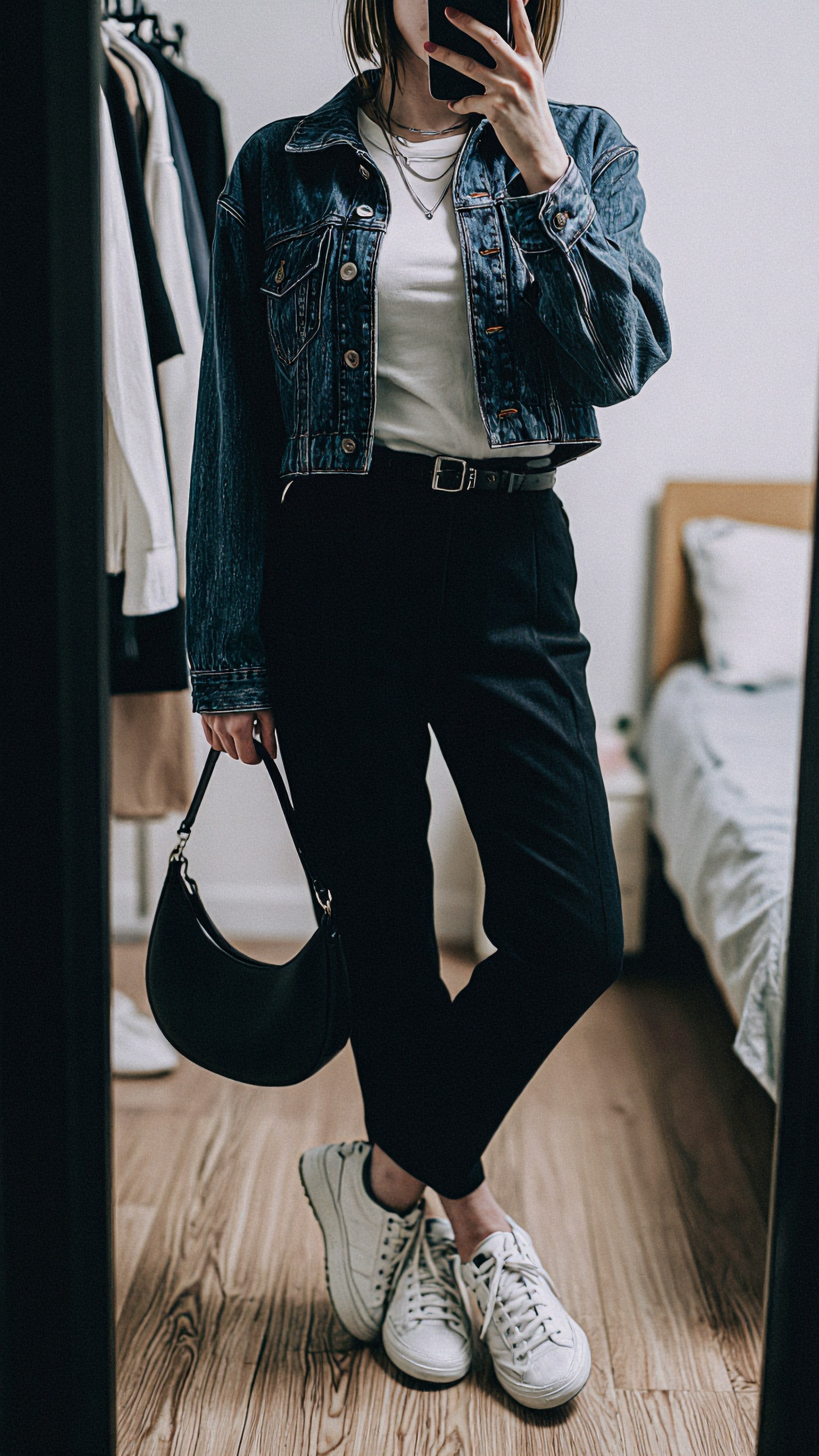
Here the garments themselves are the best-looking part: the denim jacket shows buttons, pocket flaps and orange stitching, the layered necklaces are separate and clear, and the crescent bag is clean. Two more things to note. First, the trousers look high-waisted and pleated rather than the "low-rise straight" cut in the prompt. Second, the crossed-leg stance that produced the extra sneaker shape is the cause of the foot confusion. The prompt:
three-quarter outfit editorial mirror selfie in a compact Seoul apartment bedroom, Korean street fashion styling built around a cropped indigo denim jacket over a fitted white baby tee, black low-rise straight trousers, white retro sneakers, thin black belt, crescent shoulder bag, layered silver necklace, styling-led reflection with outfit proportions clearly visible, relaxed stance, one leg slightly forward, natural GRWM mood, wood floor, clothing rack in background, muted apartment realism, Panasonic Lumix S5II color, 50mm balanced perspective, believable Instagram influencer selfie, body-conscious but casual, crisp denim texture, no excessive props, no luxury logo clutter, sexy fashion mood, outfit-first fashion editorial, complete styling system, visible fabric texture, accessories, shoes, bag, scene context, natural pose or walking action, 35mm editorial photography, realistic street, runway, retail, or lookbook settingThe prompts of images 1, 3, 8 and 6 also carry an identical tail of generic fashion phrases ("sexy fashion mood, outfit-first fashion editorial, complete styling system...") that was appended automatically. So the actual text sent was longer than the part someone wrote by hand.
Clothing structure you can see in the images
For a fashion prompt, the useful thing is which garment details the model rendered well:
- Structured outerwear: the lapels, flap pockets and cuff buttons of the charcoal blazer in image 1, and the zip pockets on the leather jacket in image 3.
- Knitwear texture: the ribbed cardigan in image 2 (but with some irregular frayed holes at the hem and uneven buttons), and the fine knit top in image 3.
- Denim: the dark jacket and acid-washed jeans in images 6 and 2. The jeans in image 2 fall cleanly to the sneakers without pooling.
- Hardware and jewellery: necklaces are separate chains in image 6. In image 7 (below) a "sculptural silver cuff" renders as a very large metallic lump at the wrist.
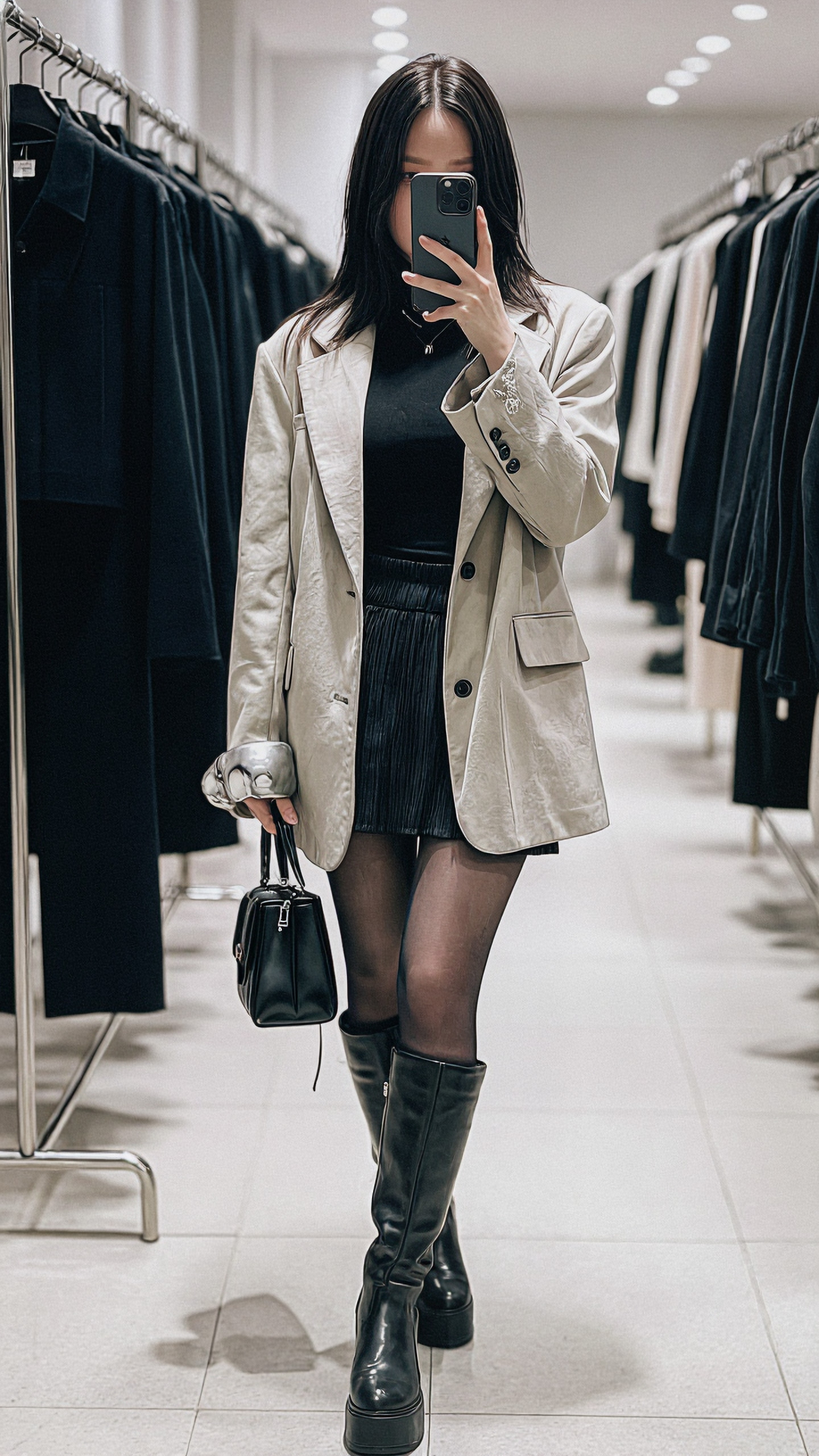
Image 7 shows the prompt's details quite literally: an oversized sand-coloured blazer with creased, slightly glossy fabric, a pleated mini skirt, and platform boots with a rounded toe. It also shows how a vague accessory word becomes an oversized object. The cuff is larger than the hand.
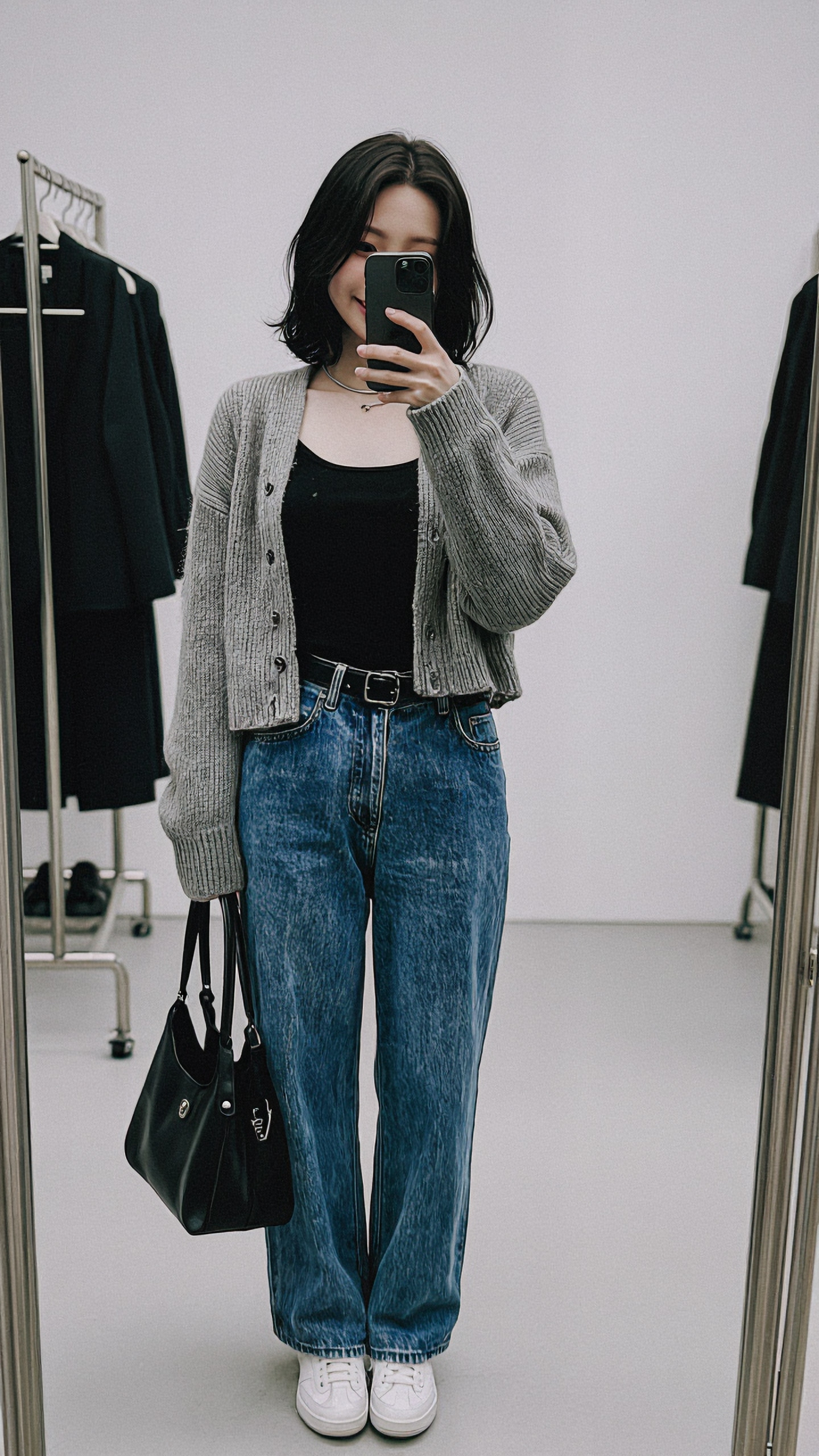
Image 2 is the one where the phone sits closest to the face while still leaving the eyes visible, and is the only image where you can see the subject's expression. The bag has some garbled hardware near the side clasp, which is small and would need zooming to notice. Two takeaways. Hardware and small decorations are where these images tend to fall apart first, so check them at full size before posting. And the full resolution (2880x5120) is useful here, since it lets you crop in to inspect details. If you want to recover detail in a smaller export, the [Upscaler](/upscaler/en) is the relevant tool, though we have not tested it on these particular files.
What to put in a mirror-selfie prompt (and what stays untested)
The following is general guidance drawn from what the eight images show, not a result of controlled comparison:
- Say which hand does what. The hand that holds the phone was always fine; the other hand is safer holding a bag than "tucked into a jacket".
- Ask for the full outfit visible in the reflection and name the framing; then check the top and bottom edges of the result, because two of eight images lost the head.
- Prefer worn-open to draped for outerwear.
- Keep text-bearing objects (elevator panels, phone cases, bag logos) out of the mirror, or accept that their text will be garbled.
- Avoid a crossed-leg stance if the shoes matter.
- Use one named accessory with a size, instead of a vague "sculptural" word.
Suggested prompt (unverified, not generated): full-length mirror selfie, head-to-toe framing with shoes and the top of the head visible, phone held at chest height in the right hand, left hand holding a small black bag, cropped denim jacket worn open over a white tee, black straight trousers, white sneakers, feet shoulder-width apart, frameless mirror, plain white wall.
We have not compared any of these ingredients against a version of the prompt without them, so whether they actually change results is not established. [Prompt Lab](/promptlab/en) can help restructure a prompt, and [Create](/create/en) is where to generate a new test. For a wider set of Seoul-styled looks, including street walks and cafe entries, see [Korean GRWM Outfit Prompts](/articles/korean-grwm-outfit-prompts/en).
FAQ
Why do these images hide the face behind the phone? In three of the eight (1, 4, 5) the phone covers most of the face. That is also how many real mirror selfies look, so it is an acceptable result, and it keeps attention on the outfit.
Can I rely on the phone case or screen text? No. In these images the phone back is shown without readable text, and text elsewhere (the elevator panel) is garbled.
Does more resolution fix errors like the extra sneaker? No. These are composition errors, and a higher-resolution copy only makes them easier to see.
Basis for this article
- Model: Z-Image (provenance records list the model as zimage; no model family, seed or settings recorded).
- Generated: 2026-07-12, 2880x5120 px each.
- Checked: all eight images were opened and examined at full size. Six are shown here. Images 4 and 5 (boutique fitting room, cafe entry) were viewed and left out as largely repeating the phone-covers-face pattern of image 1.
- Not checked: any comparison against alternative prompts or other models.