AI fashion prompts for a "Japan lookbook" mostly get the garment list right and quietly get the small print wrong. In the 16 Z-Image outputs reviewed here, the named jackets, skirts, coats and bags were usually there. The location word was not always obeyed, a four-season grid collapsed into one outfit, and several details (boot height, skirt versus trousers, logos on bags) drifted from the prompt. So treat each prompt as a checklist and audit the image against it before you keep anything.
Everything below comes from two earlier posts that were merged into this one. Each of the 16 images was opened and compared with the exact prompt recorded for it. All were generated with Z-Image on 2026-07-13 at 1088x1920.
What these prompts have in common
Every prompt was built the same way: a shot type first ("street-style full body fashion shot", "three-quarter outfit editorial image", "garment detail macro"), then a long garment list, then a place, then light and camera wording. Every prompt also ends with the same block of generic words. This is the tail, copied exactly from the records:
sexy fashion mood, outfit-first fashion editorial, complete styling system, visible fabric texture, accessories, shoes, bag, scene context, natural pose or walking action, 35mm editorial photography, realistic street, runway, retail, or lookbook settingBecause the tail never changed and no prompt was re-run with one ingredient removed, these records cannot tell you which single phrase caused which result. What they do show is how closely a finished image follows what the prompt literally said. That comparison is the useful part, so it is what the rest of this article is about.
A prompt that was followed closely
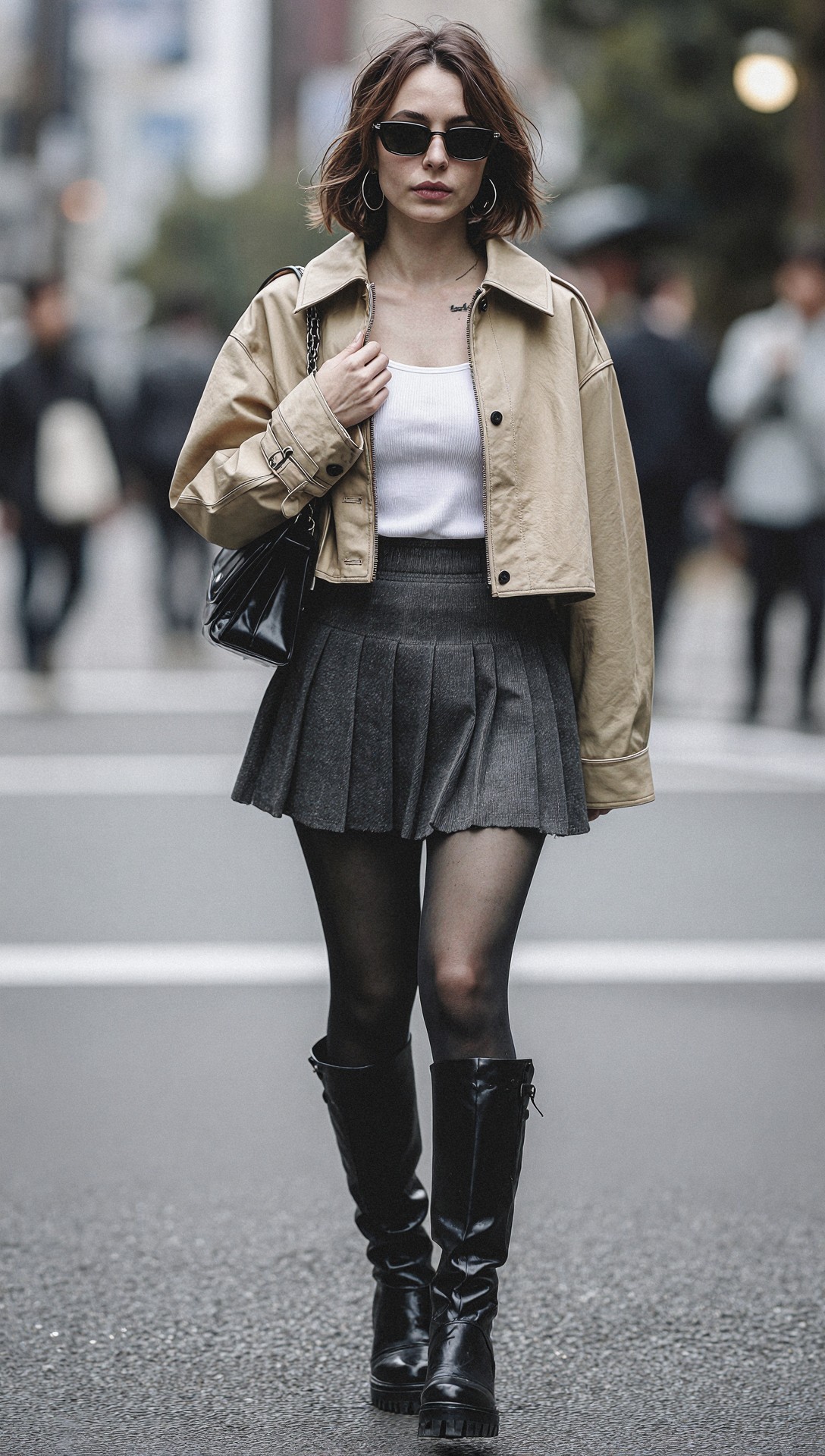
The first image in the set is a close match. The prompt asked for a "cropped khaki trench jacket over fitted white rib tank, high-waisted charcoal pleated mini skirt layered over sheer black tights, slouchy knee-high leather boots, compact shoulder bag, silver hoop earrings, slim rectangular sunglasses". In the image I can see the boxy khaki jacket with a collar and cuff straps, the white ribbed tank, a grey pleated skirt, sheer black tights, two glossy black knee-high boots, a black patent bag on a chain, hoop earrings and narrow sunglasses. The background is a blurred crosswalk with people. The skirt hem looks slightly frayed, which was not requested, and the white tank is the only layer visible under the jacket, so the "layering" is shallow. The prompt names a Harajuku side street; nothing in the frame identifies the location, so the place name can only be taken from the prompt.
A second street-walking prompt (autumn, "cropped dark brown leather jacket over a fitted cream fine-knit turtleneck, high-waisted plaid midi skirt with front slit") produced a dark leather jacket, cream ribbed turtleneck, plaid skirt with a visible side opening that shows the lining, a black top-handle bag and black suede heeled boots. The model is in profile and the hem is caught mid-stride. Here too the silhouette is readable from head to shoe.
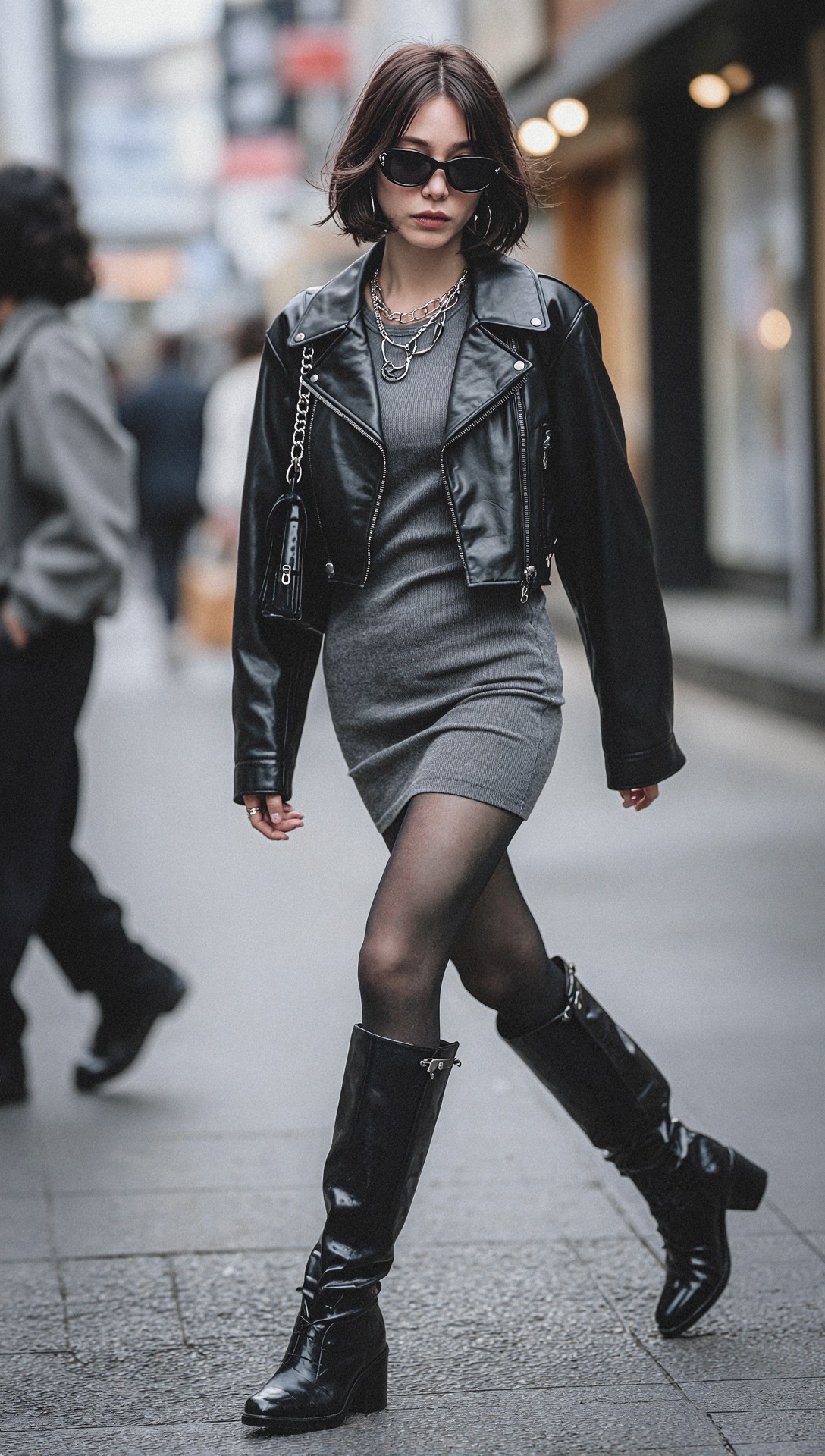
A third prompt in the same family describes "a cropped black leather jacket over a ribbed charcoal body-conscious mini dress, sheer black tights, square-toe knee-high leather boots, compact shoulder bag with silver hardware, layered chain necklace". The result shows the biker-style jacket with zips and studs, a grey ribbed dress, layered silver chains, a black patent bag on a chain strap and two tall buckle boots, all visible head to toe in mid-stride. Two small mismatches: the prompt says the sunglasses are "pushed up on head" and they are on her face, and it asks for "one hand adjusting jacket lapel" while both arms hang and swing.
Across these three looks, the pattern is that a full-body street prompt with every garment named gave a readable outfit. The misses were small behaviours (where the sunglasses sit, what the hand does), not missing garments.
Where the details drifted
The table lists differences I could see between the recorded prompt and the image. "Not visible" means the image does not show the item, which is different from saying it is wrong.
| Image | Prompt said | Image shows | |---|---|---| | Winter coat look, Marunouchi arcade prompt | "pointed knee-high boots", "leather gloves in one hand" | Pointed shoes or short boots with tights running above them, not knee-high; a small black glove visible at the cuff beside the bag handle | | Bridge look | "slim leather sandals" | Black ankle-strap block-heel sandals; a satin tie belt and a bag with gold lettering-like marks that the prompt did not list | | Shibuya night look | "pointed ankle boots"; "frame from mid-thigh upward" | Chunky lace-up platform boots; full body in frame | | Ginza coat prompt | "camel wrap coat cinched", "high-heel knee boots" | Oversized double-breasted camel coat, not cinched; black suede block-heel ankle boots | | Daikanyama trench prompt | "sheer espresso tights" | Brown opaque-looking tights; otherwise ivory open trench, grey pleated mini, loafer heels, brown handbag all present and clearly separated | | Accessories close-up | "silver chain belt" | Gold chain strap on the bag; no chain belt in frame; frame runs down to boots |
Boot height was the most frequent substitution: "knee-high" or "high-heel knee boots" came back as ankle boots in three separate images. If boot height matters to your look, it is worth re-rolling rather than accepting.
When the place word is ignored
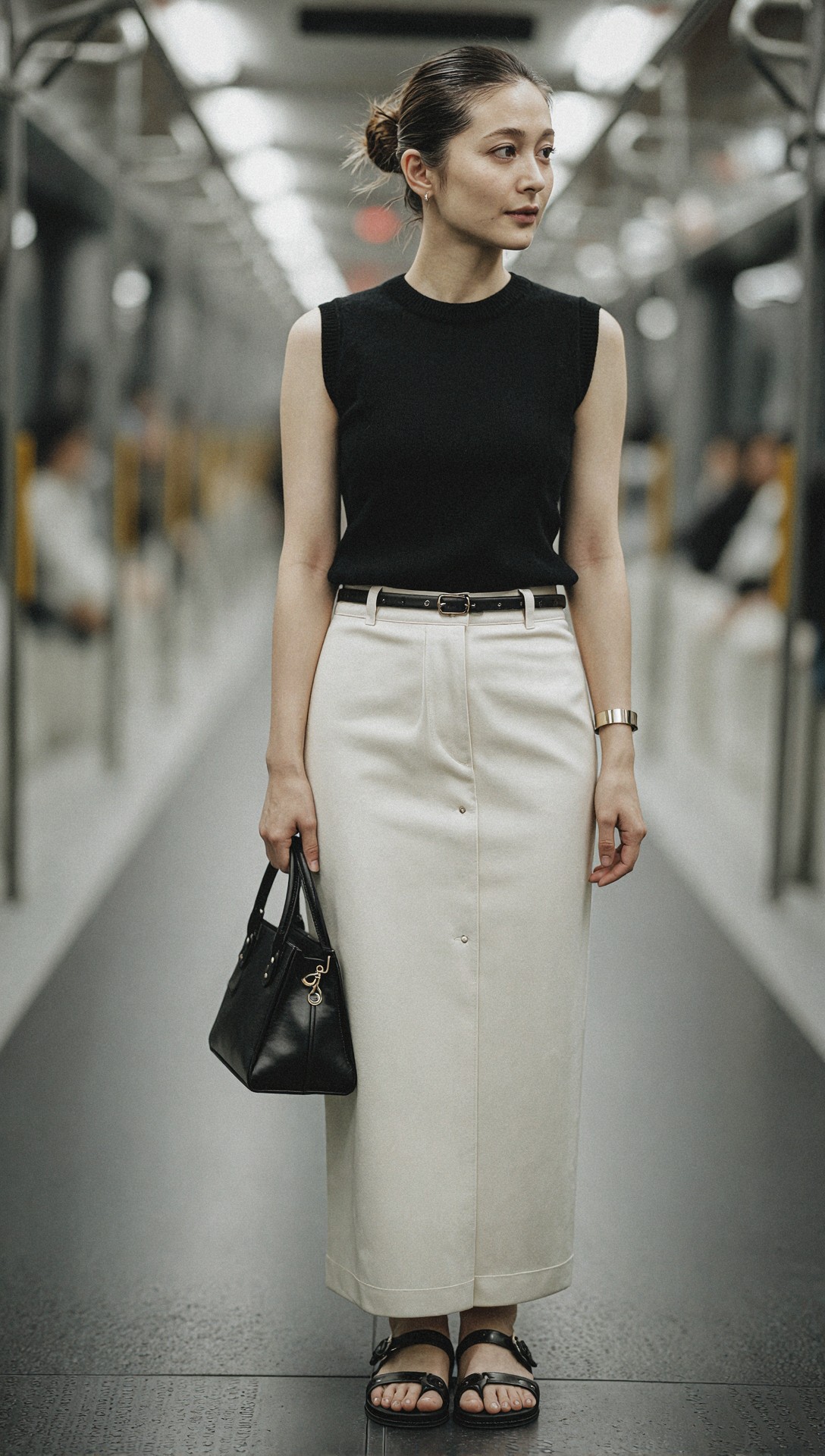
The prompt for this image reads, in full:
head-to-toe lookbook fashion image, Japan lookbook outfit with Japanese minimalist fashion direction for summer city dressing, fitted black sleeveless knit top tucked into a high-waisted ivory column midi skirt with side slit, thin leather belt, low sculptural sandals, small structured black handbag, delicate gold cuff, sleek pulled-back hair, body-conscious but refined silhouette, standing in a quiet Ginza-style arcade, full outfit visible, calm confident expression, soft daylight reflecting from concrete and glass, crisp garment edges, premium knit and matte cotton texture, restrained palette of black ivory and warm stone, clean editorial composition with minimal background clutter, sexy fashion mood, outfit-first fashion editorial, complete styling system, visible fabric texture, accessories, shoes, bag, scene context, natural pose or walking action, 35mm editorial photography, realistic street, runway, retail, or lookbook settingThe image shows the requested clothes well: black sleeveless knit, ivory column skirt, thin black belt, flat black sandals, gold cuff, small black handbag, hair in a low bun. But the setting is the inside of a train carriage, with grab handles overhead, seats and seated passengers blurred behind her, not an arcade. The skirt also closes with a centre-front row of snaps and has no side slit. The outfit is usable; the location is not what was written. If you need an arcade, a prompt that only says "Ginza-style" should not be expected to deliver one. Any Japan or Tokyo name in these prompts is, at most, a mood word, and the images should be judged on what is visible.
When a grid asks for four seasons
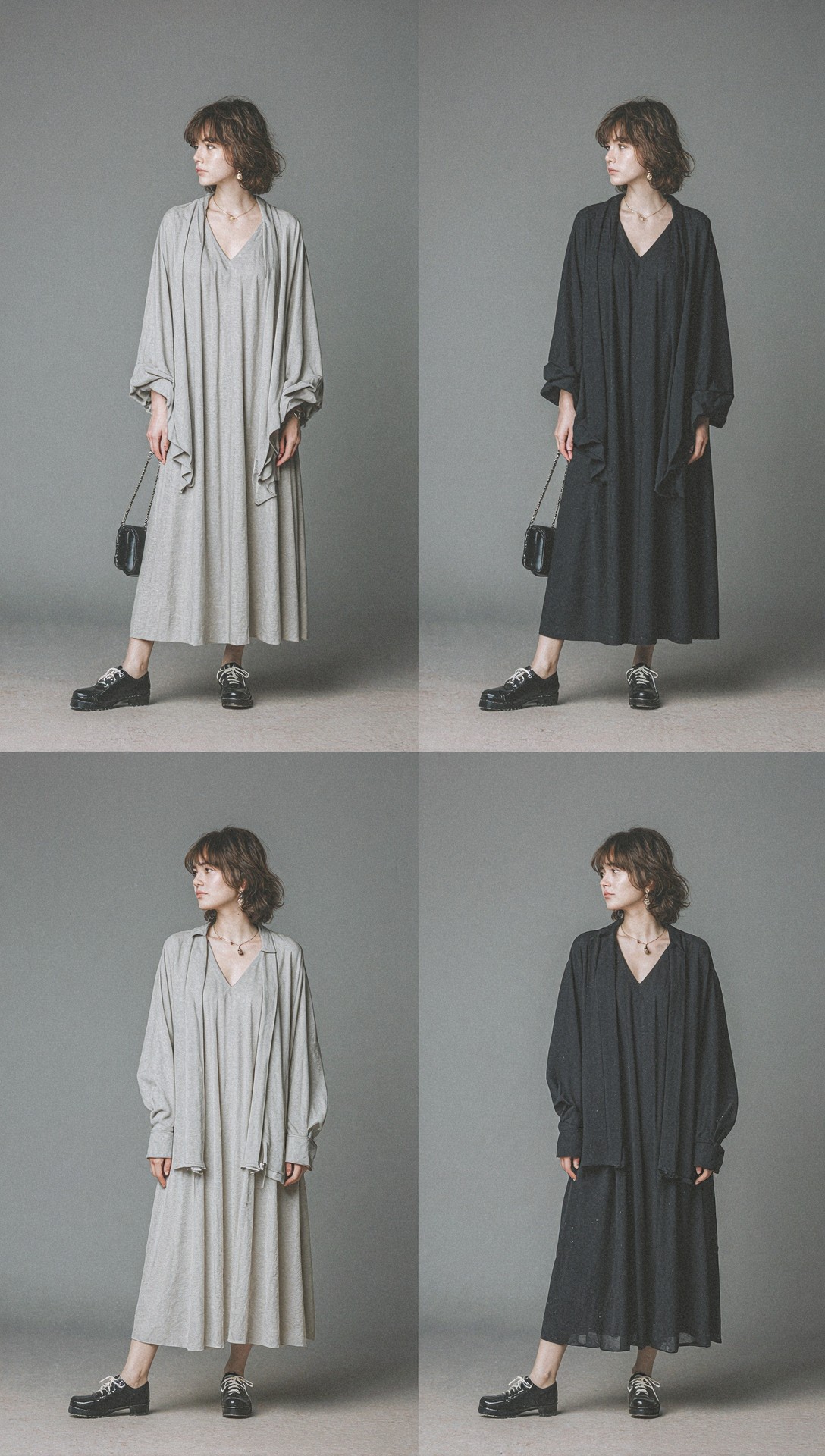
This prompt asked for "a catalog grid page showing four coordinated Japan lookbook outfit variations, each full body and clearly separated, spring Tokyo streetwear, summer Japanese minimalist fashion, autumn editorial travel tailoring, winter urban wool layering". The image is a clean 2x2 grid on a grey studio backdrop with one model at a consistent scale. But the four panels show the same garments: an oversized V-neck dress with a draped jacket over it and black lace-up shoes, once in grey and once in black, in two slightly different stances. There is no trench, no pleated skirt, no wool coat and no seasonal change. The bag appears only in the top row. So the grid is consistent in the way the prompt asked, but only because it repeated one outfit. "Four different looks in one image" is a request this prompt did not achieve. Generating each look separately and assembling the page afterwards is the safer approach, which is a general suggestion and not something tested here.
The similar mood-board prompt (a "planning board" with "fabric swatches, boutique façade fragments, wet pavement textures") gave a tiled sheet of street crops, flat-lay garments and bags in black, cream, burgundy and silver. There are no fabric swatches or wet-pavement close-ups, only outfit crops and product cutouts, and two of the bags are near-duplicates. It works as a rough palette reference, not as a literal board.
Close-ups can change the garment
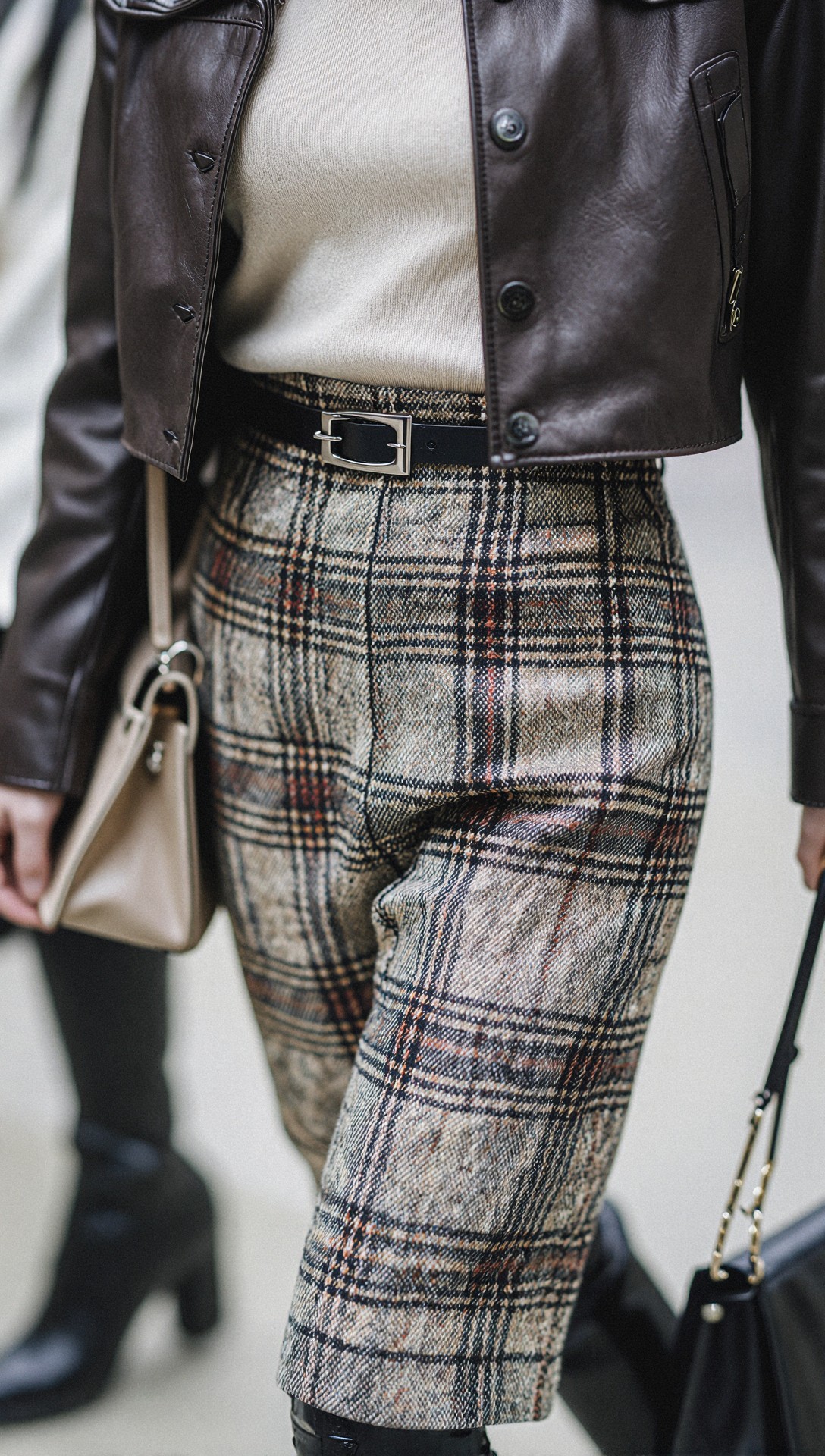
The garment detail prompt specified "fitted cream fine-knit top, high-waisted plaid midi skirt with precise front slit, black leather belt hardware". The image shows leather grain, knit, a silver-buckled black belt and crisp wool plaid very convincingly. However, the plaid piece is a pair of trousers, not a skirt: a centre crotch seam is visible and each leg is separate. The texture is excellent and the garment type is wrong. A second close-up of a black leather mini skirt with a double belt and a navy knit sleeve with four cuff buttons also looks sharp, and the ribbed tights texture is believable, but the "tucked ribbed knit top" is not clearly tucked.
The accessories close-up shows a croc-embossed black bag with a chain strap and two rings on one hand, with a clean hand and fingers. Its clasp has a small ornament whose design is not legible. Detail crops are where fabric quality is easiest to judge, and also where an incorrect garment type is easy to miss if you only look at texture.
Storefronts and logos
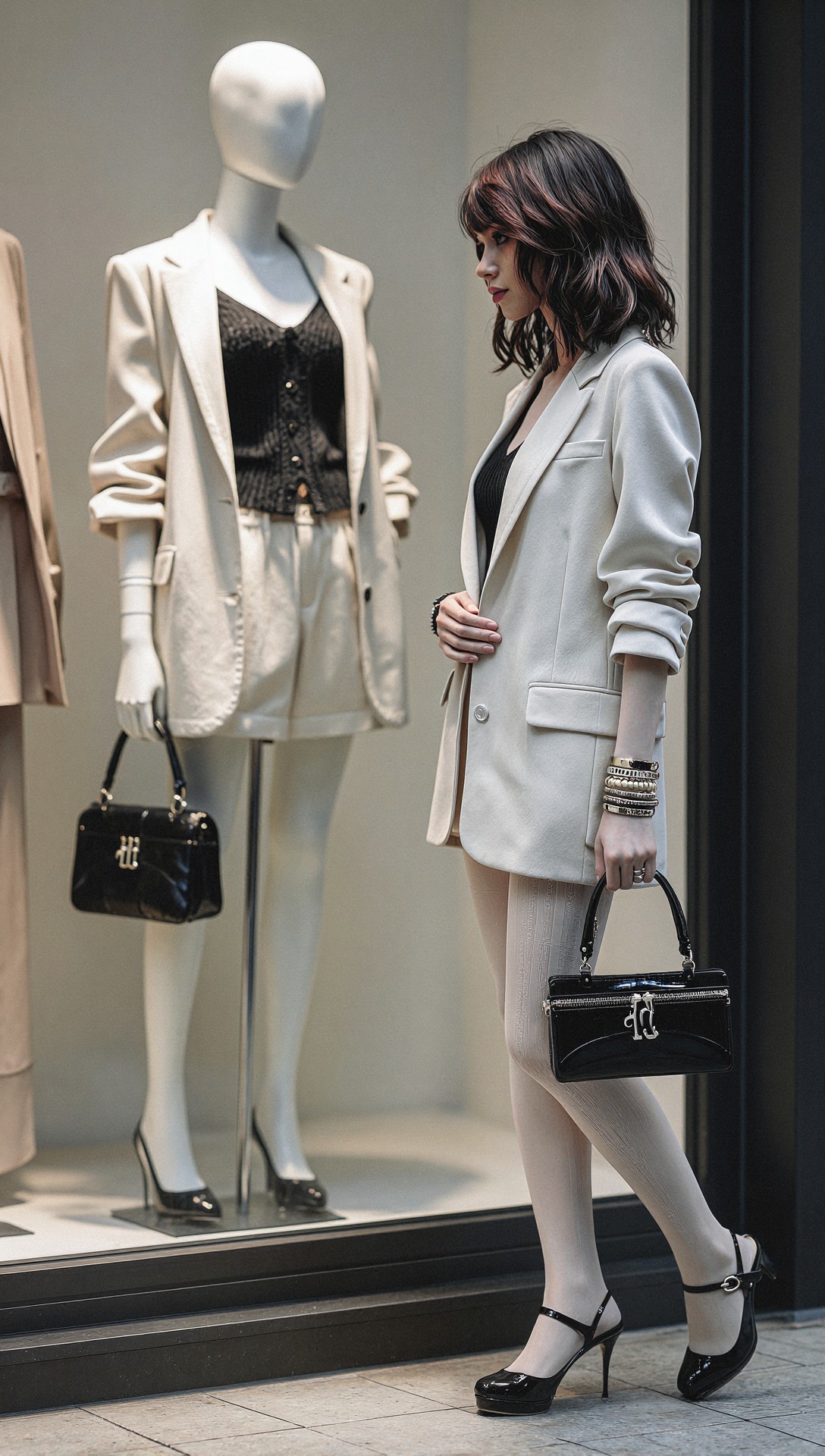
The storefront prompt asked for "a confident model beside a styled mannequin, matching outfit story with fitted cream blazer, black corset-inspired knit top, tailored shorts, sheer tights, patent slingback heels, compact handbag, layered bracelets". The image does deliver a model in profile beside a mannequin wearing a cream blazer, black ribbed knit vest with buttons, cream shorts and black pumps, with stacked bracelets on the model's wrist. Differences: the model's tights are cream and patterned, not sheer; her shoes are ankle-strap platform pumps, not slingbacks; and the model's shorts are hidden under the blazer. The same gold logo-like glyph is on both the model's bag and the mannequin's bag, and it does not read as a real letter or brand. If you are making product-style images, that kind of pseudo-logo is a reason not to use the output as-is.
The other retail prompt, an "Aoyama boutique window with two mannequins", gave a lit window with two mannequins. The left one has a black leather biker jacket, a brown knit top, a gathered patterned skirt and black lace-up boots; the right wears a textured brown coat, cream top and trousers and white heeled lace-ups. A pair of pink-beige shoes sits on the floor between them. It is a believable display, but the plaid skirt, "oversized blazer", satin camisole and "heeled sandals" from the prompt are not clearly there, so treat it as a window-display concept, not as the outfits described.
A way to audit your own generations
These are suggestions drawn from the mismatches above. They were not tested as a separate experiment.
- Write down the garments in the prompt and tick each against the image: outer layer, top, bottom, footwear with height, bag, jewellery.
- Check footwear first. Shoes and boot height were among the most common silent changes.
- Do not expect the place name to be respected. Judge the background on its own.
- For grids with several outfits, generate each outfit separately first.
- Check close-ups for garment type (skirt versus trousers), not just texture.
- Reject bags or signage with invented-looking lettering if the image is meant for anything commercial.
Good outputs can go through the [AI upscaler](/upscaler/en) once the garment structure is right. To refine wording before you generate, the [prompt lab](/promptlab/en) is one place to draft. For the same audit approach applied to other style directions, see [Korean GRWM outfit prompts](/articles/korean-grwm-outfit-prompts/en) and [Korean fashion trend prompt directions](/articles/korean-fashion-trends-2026-tested-ai-prompt-directions/en).
FAQ
Do Tokyo or Ginza words put the scene in that place?
Not reliably in these records. A "Ginza-style arcade" prompt produced a train carriage. A Harajuku or Shibuya name may still contribute mood, but the images themselves show nothing that confirms a real location.
Why did my boots come out shorter than the prompt?
In three of the images here, "knee-high" or "high-heel knee boots" produced ankle boots. This record does not explain why; re-generating or checking footwear in every image is the practical response.
Can one image show four seasonal looks?
In the one grid recorded here, no: it repeated a single grey-or-black outfit in four panels.
Evidence for this article
- Model: Z-Image, per the recorded generation data for all 16 images.
- Generated: 2026-07-13, all at 1088x1920.
- Checked: all 16 images were opened and compared to their recorded prompts. No image was re-generated and no prompt was varied for this article, so nothing here measures which prompt phrase changed a result.
- Merged from two earlier posts on Japan lookbook and Japanese street-style fashion prompts.