Can an AI image prompt tell you what Korean fashion looks like in 2026? No. Eight images generated with Krea2 Turbo on 2026-07-10 cannot show what is trending, because the model only draws the garments the prompt names. The words "for 2026" in these prompts did no visible work. What the images do show is narrower and more useful: how well a model renders specific garment structures (layers, tailoring, wide trousers, knits), which Seoul-flavored settings it can stage, and where the output breaks. This article reads those eight images for that, and treats "Korean fashion" as a styling direction you write out in garment terms.
Every "Korean" cue here came from the prompt
The prompts share a vocabulary: wide-leg trousers, longline or cropped outerwear, muted palettes (charcoal, ivory, taupe, olive, navy), square-toe shoes, slim bags, and a Seoul location such as Seongsu, Apgujeong or a gallery courtyard. Each of these words is in the prompt text. The images confirm that the model can draw them. They do not confirm that these silhouettes are what Korean designers or shoppers favored in 2026, and this article makes no such claim. If you want trend evidence, you need runway reports, sales data or street photography, not generated images.
One practical consequence: if you leave the garments out and type only "Korean fashion", nothing in these images shows what the model would do. The prompts here always listed garments, so this article cannot compare a vague prompt with a specific one. Treat advice that says otherwise as untested.
Street layers: what a good outfit read looks like
This was the first prompt, sent to Krea2 Turbo:
Full-body Korean street fashion look for 2026 photographed in Seongsu, model walking naturally across a narrow backstreet, layered styling with cropped charcoal bomber jacket over pale grey hooded sweatshirt, long white inner tee visible at hem, wide-leg washed black trousers with soft break, clean white sneakers, slim nylon crossbody bag, silver rings, loose dark hair, calm expression, realistic fashion week off-duty energy, overcast soft light, concrete walls, subtle Korean storefront typography in background, cinematic but clean composition, premium fabric texture, natural body proportions, full outfit clearly visible, editorial street style realism, Fujifilm GFX100 II look, GF 55mm f/1.7 depth and tonal detail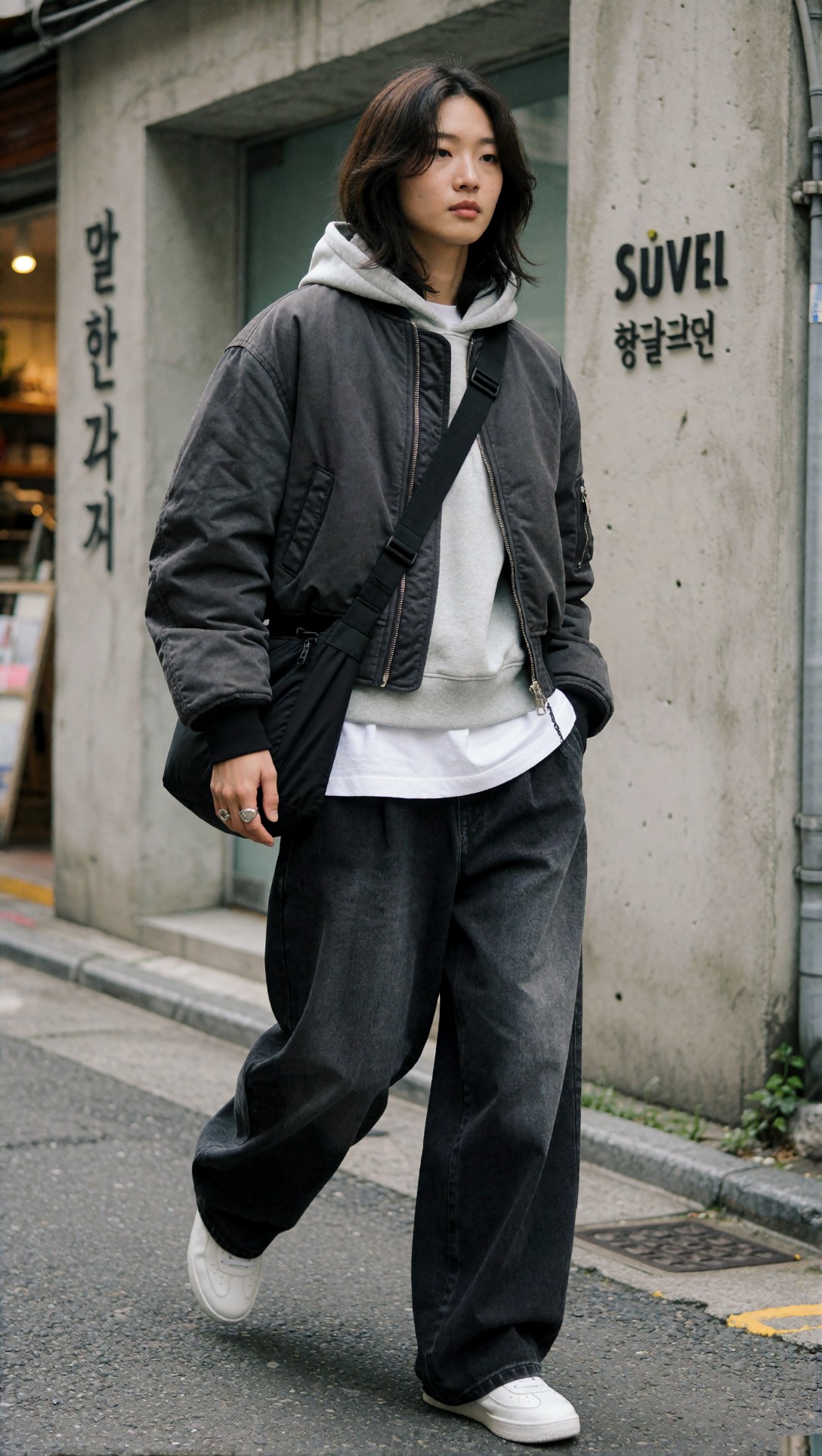
The layering instruction worked as written. The three layers are separable: a faded bomber with a ribbed cuff, the grey hoodie under it, and a white tee hem below the hoodie. The trousers are very wide and pool at the shoes, and the bag strap crosses the torso without hiding the layers. The hands hold up too: one in a pocket, the other visible with two rings.
The failure is in the background. The prompt asked for "subtle Korean storefront typography", and the wall shows vertical Hangul-like characters and a sign reading "SUVEL" above more pseudo-Hangul. These are not real words. If a generated Seoul street is meant to read as authentic, the signage is the first place where it stops doing so. Plan on cropping it, retouching it, or choosing a background with no text.
Tailoring: quiet outfits need structure words
The minimalist prompt was built around tailoring instead of layers:
Full-body Korean minimalist fashion editorial for 2026 inside a quiet Seoul apartment studio, model standing in relaxed three-quarter pose wearing an ivory collarless wool jacket, crisp light taupe sleeveless knit, high-waisted wide-leg cream trousers with sharp front crease, black square-toe flats, structured dark espresso leather handbag, minimal silver earrings, center-parted hair, neutral expression, restrained palette of ivory taupe espresso and soft black, emphasis on tailoring lines and fabric drape, uncluttered background, refined Korean minimalist fashion mood, realistic textile detail, clean composition with negative space, Canon EOS R5 realism, RF 50mm f/1.2L shallow depth of field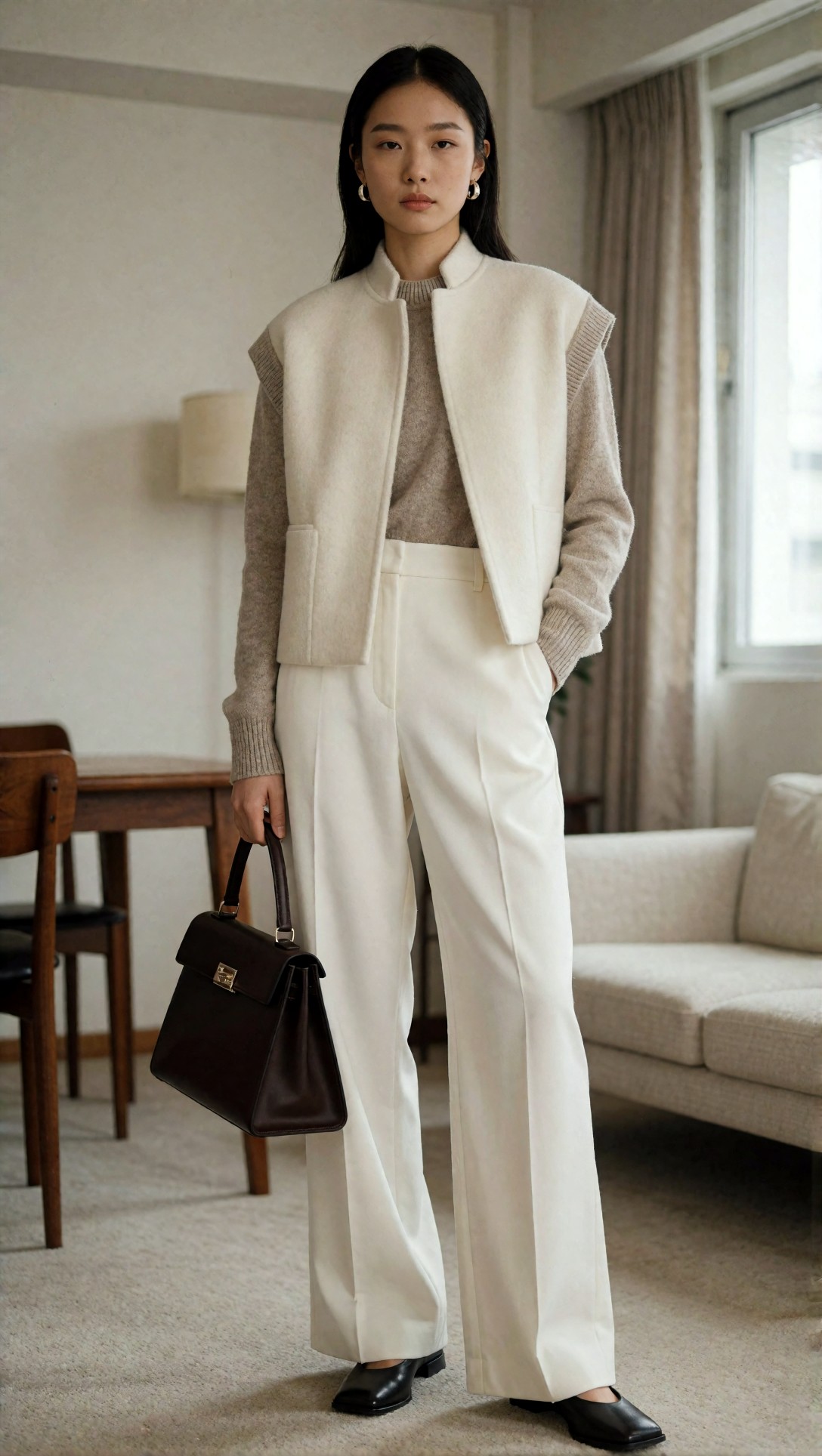
The crease on the cream trousers is sharp and the wool of the jacket has a visible felted texture, so "sharp front crease" and "wool" carried through. The palette stays in ivory, taupe and espresso. A few details depart from the prompt. The "sleeveless knit" became a long-sleeve knit whose cuffs and shoulder edge peek out from a cropped, sleeveless-looking jacket. The earrings look gold rather than silver. The room is a furnished living room with a sofa, a wooden table and carpet, not an "uncluttered" studio with concrete floor. So the garment words were followed more closely than the scene words. When garment accuracy matters, check each item against the prompt instead of assuming it held.
One outfit, two framings
The clearest comparison in this set is a pair of prompts that describe nearly the same wardrobe, once as a runway shot and once as a studio lookbook. Their wording is almost identical, but not exactly. The runway prompt says "soft olive technical cargo skirt" and the lookbook prompt says "soft olive technical wrap skirt". Treat this as a rough comparison, not a controlled one, and note that each prompt has one image.
The runway prompt:
Seoul Fashion Week runway image featuring a 2026 Korean fashion knit-layering concept, full-body model mid-stride wearing sand beige sleeveless longline knit over crisp white shirt with elongated cuffs, slim black neck scarf, soft olive technical cargo skirt layered over straight black trousers, angular leather ankle boots, sleek tucked-back hair, neutral runway face, cool-toned lighting, industrial venue with matte black seating and silver truss elements, avant-garde but wearable ready-to-wear styling, realistic catwalk posture, crisp garment layering logic, Canon EOS R3 action clarity, RF 70-200mm at 120mm compression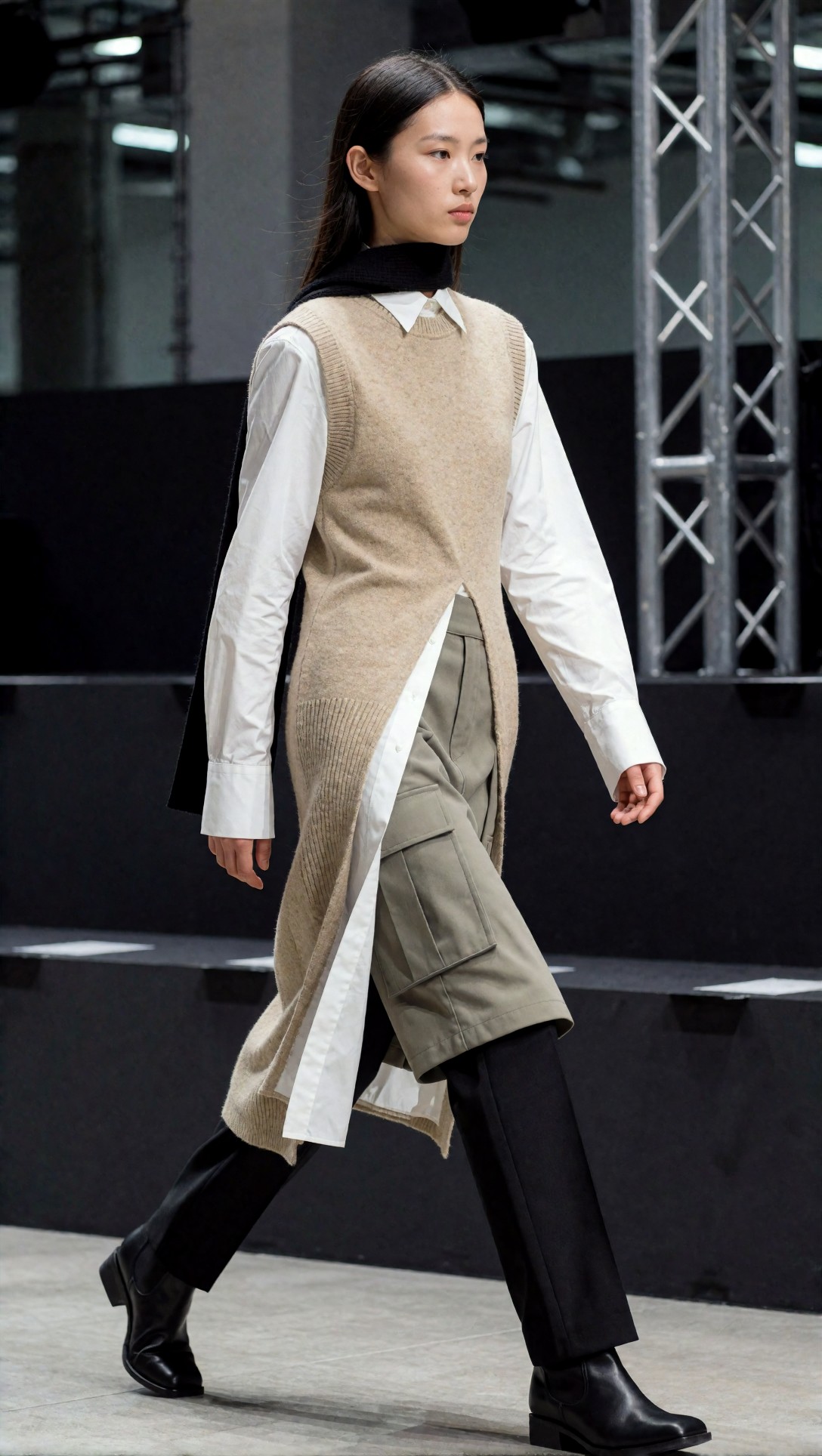
The lookbook prompt:
Full-body Korean fashion lookbook image for 2026 showing a wearable knit-layering outfit in a neutral studio, model standing front-facing with slight contrapposto, sand beige sleeveless longline knit over crisp white shirt with elongated cuffs, slim black neck scarf, soft olive technical wrap skirt layered over straight black trousers, angular leather ankle boots, clean tucked-back hair, minimal expression, warm grey seamless background, large soft light for accurate fabric color, commercial lookbook clarity, sharp separation between each garment layer, realistic textile texture, Panasonic Lumix S1R II detail, 65mm balanced full-body framing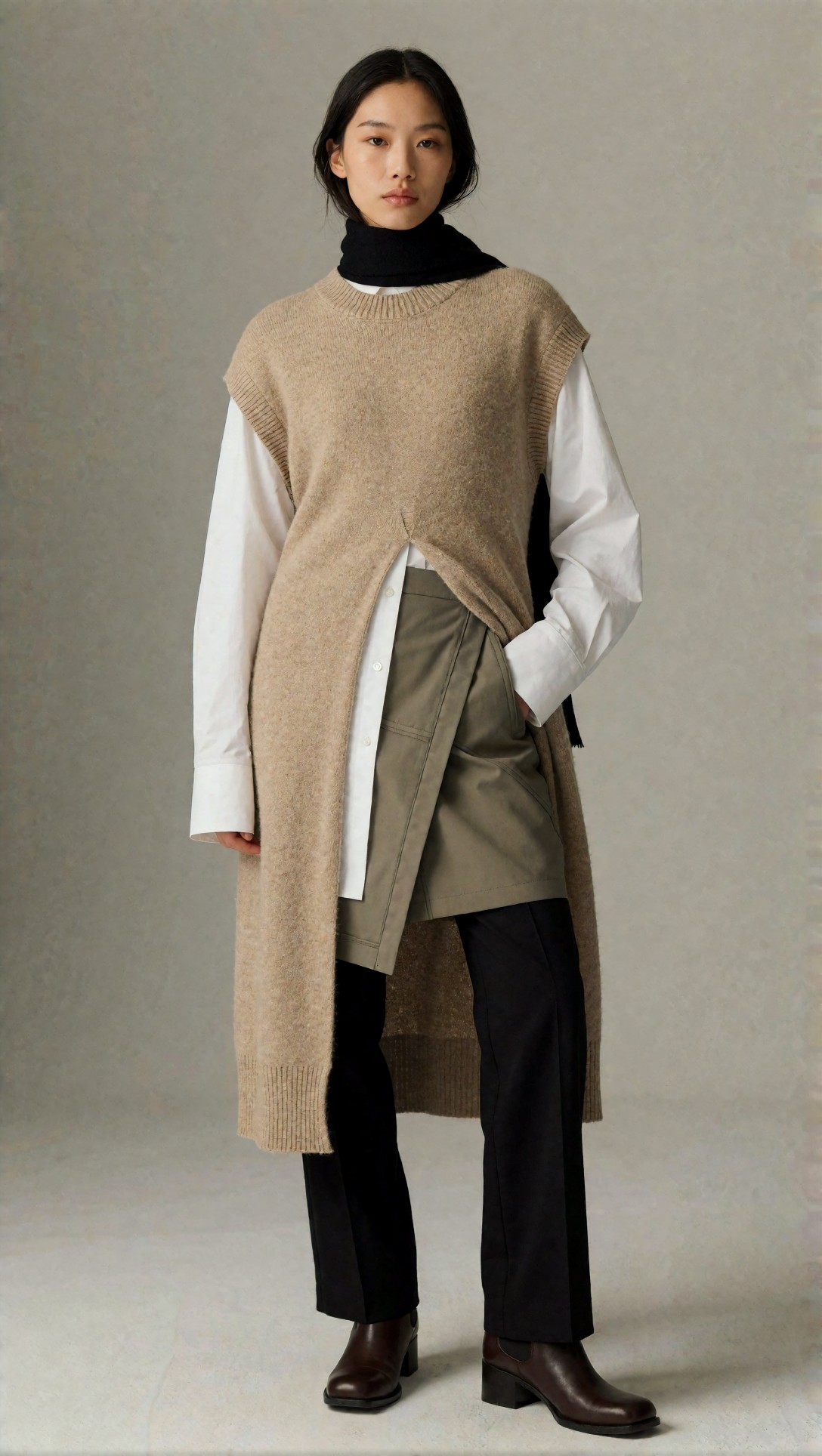
What the two images show:
- Layer readability. In the studio image every layer has its own edge: the scarf, the white shirt cuffs, the knit's front slit, the olive wrap with visible stitching, the black trousers. In the runway image the side-on walking pose hides the knit's front and the slit, and the olive piece reads as a cargo-pocket panel that could be shorts or a skirt. The lower body is still separable, because the white shirt tail, the olive piece and the black trousers have different tones, but you need to look twice.
- Garment accuracy. Both follow the garment list: a sand knit over a white shirt, an olive layer over black trousers, a black scarf, ankle boots. The boots differ: black and flat-soled on the runway, brown with a block heel in the studio. The prompt only said "angular leather ankle boots", so that detail was left to the model.
- Context. The runway image has the truss and the black platforms the prompt asked for, but no audience at all. The studio image has the warm grey seamless background and the front-facing stance.
If you need to judge a garment design, this pair suggests choosing a front-facing studio frame. If you want a show atmosphere, accept that some structure will be lost. That conclusion rests on this single pair.
A runway frame with more going on
The earlier runway prompt asked for a graphite blazer, a sheer layer, a belt and a skirt over trousers:
Seoul Fashion Week inspired runway look for 2026, full-body female model striding confidently on reflective runway, sharp graphite oversized blazer with sculpted shoulders, sheer smoke-grey inner layer, asymmetrical belt detail, fluid black maxi skirt over tailored trousers, pointed heeled boots, metallic ear cuff, slick low ponytail, composed runway expression, cool steel and charcoal color palette, directional spotlights cutting through dim venue atmosphere, seated audience in soft blur, realistic catwalk motion, editorial high-fashion styling with wearable Korean edge, Nikon Z9 runway capture, 135mm compression, crisp textile detail and natural movement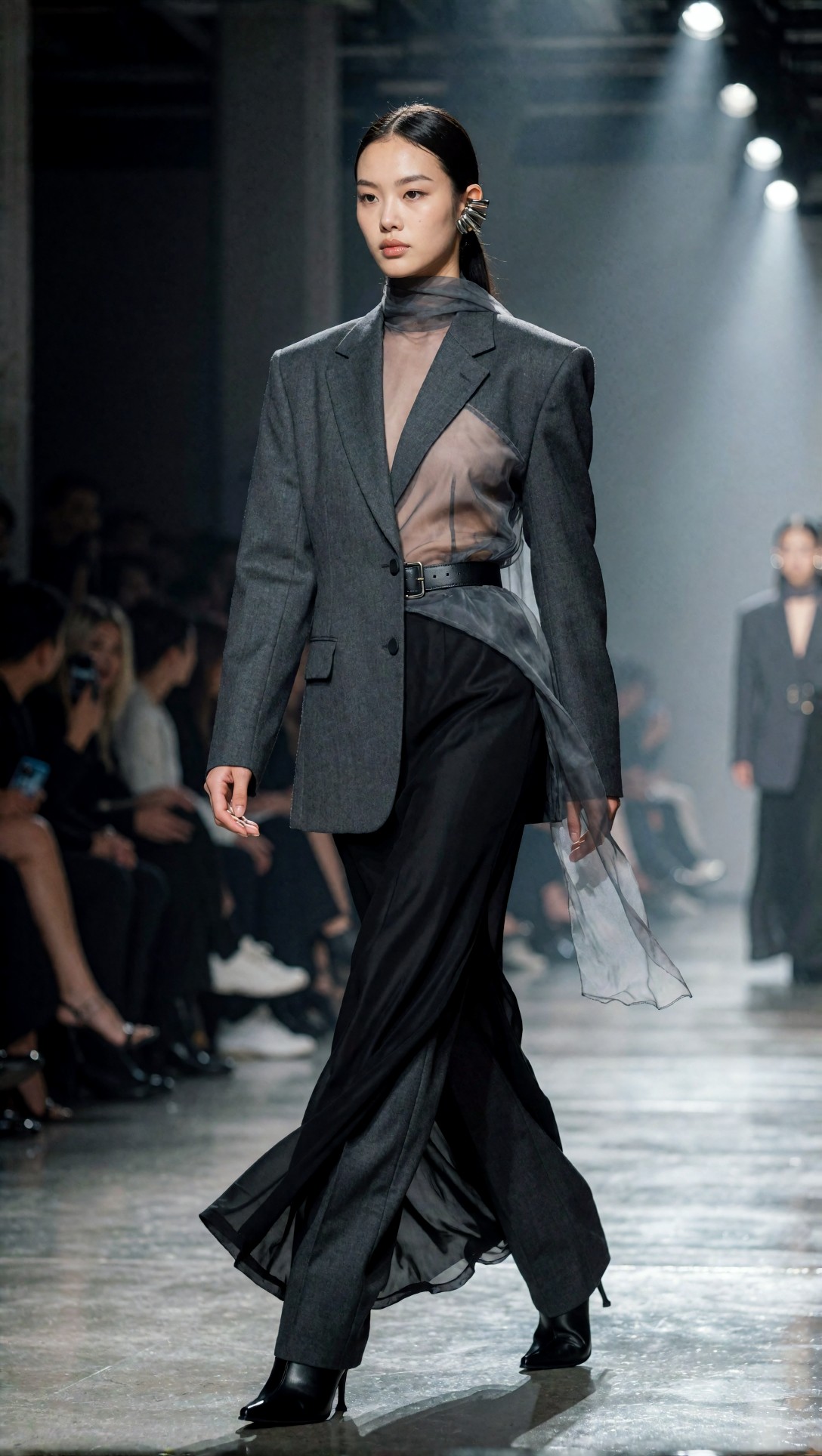
This one carries most of the prompt: the spotlights, reflective floor, blurred audience (one member holds a phone), a second model in the background, the metal ear cuff and the low ponytail. The black skirt is sheer enough that the grey trousers show through it, so the "skirt over trousers" idea is readable. The sheer layer is the part to watch. It merges into the blazer and belt at the waist, and it is hard to say where the sheer piece ends and the skirt begins. That kind of ambiguity is what makes a runway garment hard to reproduce from an image. The model's free hand is also a little loose in shape, in line with the known weakness of small hand details in generated images.
Retail displays and other uses
A fourth prompt asked for a concept-store display instead of a person:
Editorial retail scene showing Korean fashion trends 2026 inside a premium Seoul concept store, coordinated display of minimalist outfits on mannequins and racks, palette of soft stone, ink black, muted olive, and warm cream, longline coats, cropped jackets, wide-leg trousers, ribbed knits, square-toe shoes, compact leather bags, neatly folded textiles, polished brushed steel fixtures, clean stone tables, balanced composition with one mannequin in foreground wearing a complete K fashion outfit, realistic store lighting mixed with softbox refinement, premium textile texture, modern merchandising logic, Sony A7R V look, 35mm environmental framing, luxury campaign realism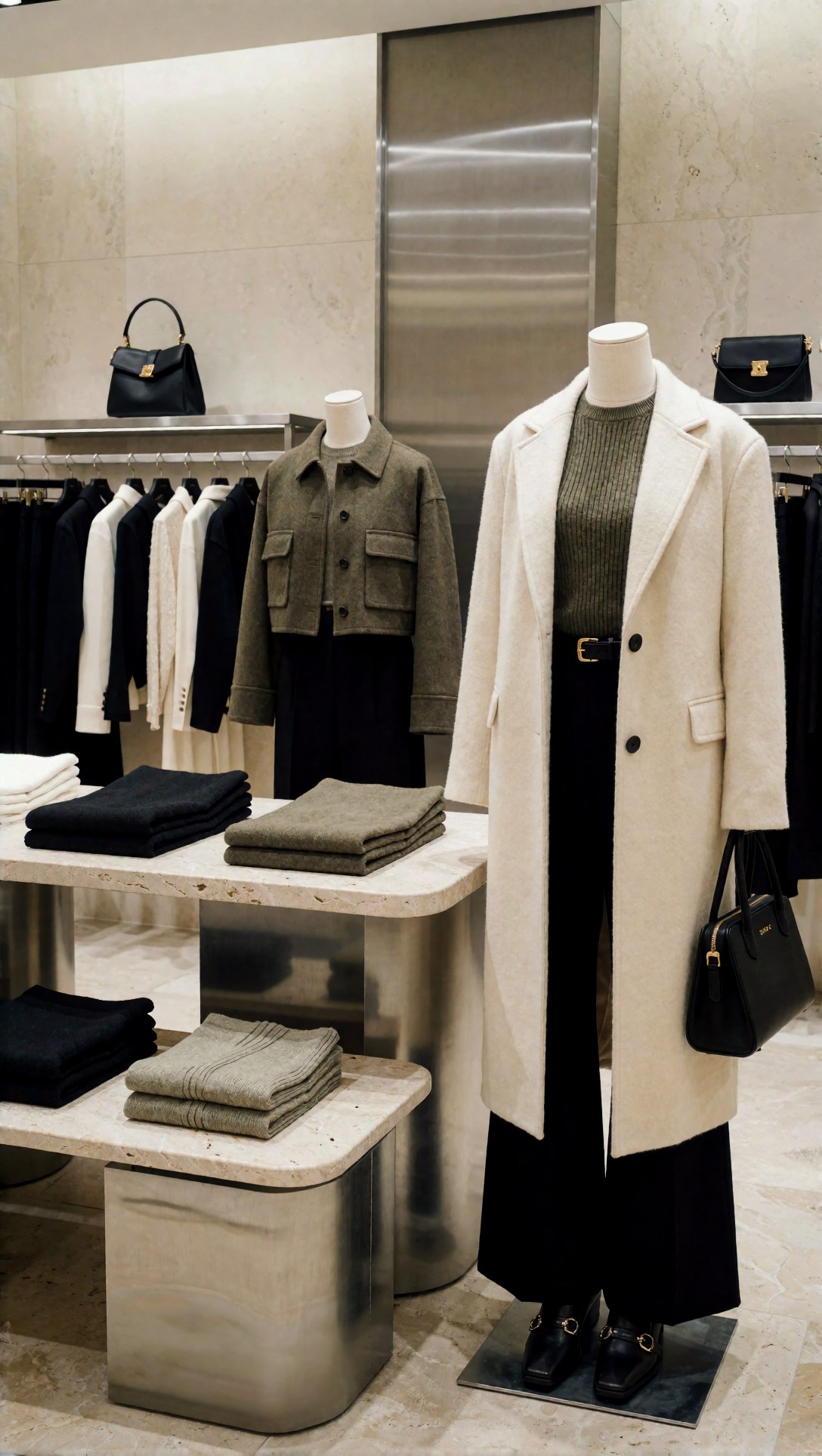
The palette follows the prompt closely (cream, black, olive, stone and steel), and the repeated pairing of olive and black across the coat, jacket and folded stock makes the display look planned. A small problem is that the black bag in the foreground carries tiny print that does not resolve into legible letters. This is the same failure as the street sign, at a smaller scale. The prompt's own text also contains "Korean fashion trends 2026", and the picture does not interpret that phrase in any visible way. It just shows a minimalist store.
Other two images, and what was not generated
Two more images from the same run are not shown. A night street in Apgujeong shows a navy mac coat, striped knit, cropped trousers with grey socks and loafers, a silver chain and a shoulder bag. The garments match the prompt and the pavement reflections stay secondary, but the lit sign at the top of the frame has garbled letters. A gallery-courtyard image shows an oversized blue-grey double-breasted blazer over a white tee and very wide pleated charcoal trousers, with a black portfolio bag and a wrist watch. It matches the prompt's "oversized blazer, wide trousers" proportions, and a pebble garden takes the place of the "sparse landscaping".
The source article also listed prompts for a spring blush-tailoring look and a Hongdae casual look. No images for those were available, so they are not discussed here.
What to take from it
- Name every garment, its cut and its fabric. The images follow those words closely and drift on the words that are loose.
- Expect text in the scene to fail. All three images with signs or printing (the Seongsu street, the night street and the retail bag) show unreadable characters. Choose settings without text, or plan to retouch.
- For judging a garment design, use a front-facing studio frame. For atmosphere, use a runway or street frame and accept looser structure.
- Check small-scale parts (hands, earrings, shoes) against the prompt one by one. In this set, they were the most likely to differ.
- Write the location in plain terms, but do not expect the model to honor a fine distinction such as "studio" versus "living room".
If you want to try these directions yourself, [PromptLab](/promptlab/en) can help restructure a garment list into a shot prompt, and [Create](/create/en) runs the generation. For a different set of Korean street-style prompts, see the Korean street fashion prompt test.
FAQ
Does adding "2026" to a fashion prompt change the look? Nothing in these images shows that it does. Every prompt had "2026" in the text, so there is no version without it to compare against.
Are the camera and lens names doing anything? This set cannot say. Each prompt named a different camera, and each image came from a single run, so any effect is mixed with everything else that changed.
Basis for this article
- Model: Krea2 Turbo, all eight images generated on 2026-07-10.
- Checked: all eight images were opened and examined. Six are embedded, and two are described in text. The prompts are the recorded generation prompts.
- Not checked: no trend data, no comparison against other models, and no repeated runs of the same prompt.