Korean Street Fashion Prompt Test: Which Outfit Keywords Create the Most Realistic Seoul Style Images? 한국어 요약
이 페이지는 ZView Space의 영어 원문을 한국어 검색 사용자도 이해할 수 있도록 정리한 SEO 요약입니다. 핵심은 단순한 얼굴 중심 이미지가 아니라 패션 에디토리얼, 룩북, 아웃핏, 프롬프트 테스트, 이미지 생성 워크플로우를 실제로 어떻게 구성할지입니다.
핵심 요약
- 원문 주제: Korean Street Fashion Prompt Test: Which Outfit Keywords Create the Most Realistic Seoul Style Images?
- 목적: AI 이미지 생성에서 outfit, silhouette, fabric, pose, location, camera framing을 더 명확하게 설계합니다.
- 활용 범위: Z-Image Turbo, Krea2 Turbo, Qwen Image, Anima, SeedVR2 같은 이미지 생성 및 업스케일 워크플로우에 적용할 수 있습니다.
- SEO 관점: 제목, 설명, 이미지 alt, 프롬프트 예시가 실제 검색 의도와 맞아야 색인 가능성이 높아집니다.
한국어 사용자를 위한 체크포인트
1. 프롬프트가 얼굴 묘사에만 머물지 않고 전체 스타일과 의상 구성을 설명하는지 확인합니다. 2. 패션 이미지라면 상의, 하의, 아우터, 신발, 액세서리, 소재감, 촬영 장소를 분리해서 씁니다. 3. 생성 결과는 바로 게시하지 말고 디테일, 손, 의상 형태, 배경 일관성, 이미지 품질을 비교합니다. 4. 글 본문에는 실제 테스트 기준과 실패를 줄이는 방법이 들어가야 검색엔진에서 얇은 콘텐츠로 보일 가능성이 줄어듭니다.
원문 미리보기
If you are trying to generate believable korean street fashion images, the hard part is not getting a stylish person in a city. Most models can do that. The real problem is getting a result that reads specifically as modern Seoul street style instead of generi
---
If you are trying to generate believable korean street fashion images, the hard part is not getting a stylish person in a city. Most models can do that. The real problem is getting a result that reads specifically as modern Seoul street style instead of generic global streetwear, K-pop stage costume, or luxury editorial cosplay.
In this test, I compared outfit keyword combinations to see which ones actually improved realism. The useful pattern was clear: broad labels like "K fashion outfit" or "trendy Korean look" were too vague, while prompts built around layering logic, silhouette, retail-grade garment language, and Seoul-specific urban context produced more convincing images.
What was tested
I tested prompt variants designed for comparison rather than pure aesthetics. The goal was to see which keyword groups best preserved a realistic Seoul street style look across different scenes.
Test focus:
- full-body outfit realism
- silhouette accuracy
- fabric and layering detail
- accessory consistency
- street context that feels like Seoul rather than anonymous neon Asia
- whether the model drifted into idol styling, cosplay, or generic Western streetwear
Keyword groups compared:
- broad style labels: "Korean street fashion", "K fashion outfit"
- garment-specific language: wide-leg trousers, cropped puffer, pleated mini skirt, loafer socks, oversized blazer
- styling-system language: tonal layering, clean silhouette, understated accessories, youth retail lookbook
- location anchors: Hongdae side street, Seongsu cafe district, Apgujeong luxury street, subway entrance, convenience store frontage
Why AI models miss Seoul style so often
The failure pattern was consistent. When the prompt only said korean street fashion, most models produced one of three shortcuts:
1. K-pop performance styling: too glossy, too costume-like, too much leather and stage makeup. 2. Tokyo/Harajuku bleed: louder color clashes and styling exaggeration than typical daywear. 3. Generic Pinterest streetwear: workable image quality, but no specific Seoul retail or lookbook feel.
This happens because "Korean street fashion" is a high-volume visual label with mixed training data. The model has likely seen runway edits, music promo images, tourist blogs, online shopping catalogs, and fan edits all attached to similar text. Without better prompt constraints, it averages them.
The strongest outputs came from describing how the outfit is built, not just what region it references. In practice, that meant specifying:
- outerwear shape
- trouser or skirt cut
- shoe and sock pairing
- bag type
- grooming restraint
- urban setting that matches the styling tier
The workflow that gave the most reliable result
The workflow that worked best was simple: start with a specific Seoul context, then define the outfit as a retail-ready system, then add camera and lighting choices that support texture and proportion.
I had the best consistency using this order:
1. Anchor the district or scene type 2. Describe the silhouette before the small details 3. Add 3-5 garment keywords that belong together 4. Control the styling temperature: understated, polished, casual, youth retail, minimalist, campus, cafe-street 5. Choose a camera/lens combo that supports full-body realism 6. Avoid overloaded beauty language unless the image is meant to be editorial
A useful insight from this test: if the prompt emphasized garments and composition first, the model was less likely to mutate the outfit into glam performance wear.
Prompt tests and what each one revealed
1) Baseline: broad keyword only
This first prompt checks what the model thinks korean street fashion means without much help. It is useful as a baseline because the weaknesses become obvious fast.
Topic: Korean street fashion baseline look on a Seoul side street
Genre: Street Style
Camera: Canon EOS R5
Lens: 50mm f/2
Lighting: Overcast diffusion
Location: Hongdae side street with cafes, signage, and pedestrian traffic
Style: Clean commercial look
Final Prompt: full-body korean street fashion look on a young woman walking through a Hongdae side street, contemporary Seoul street style, casual confident pose, oversized top and fashionable bottoms, clean sneakers, shoulder bag, natural makeup, urban cafe background, soft overcast daylight, realistic skin texture, candid street style composition, retail-ready styling, authentic Seoul mood, Canon EOS R5 realism, 50mm f/2, detailed fabric folds, natural body proportions, commercial fashion photography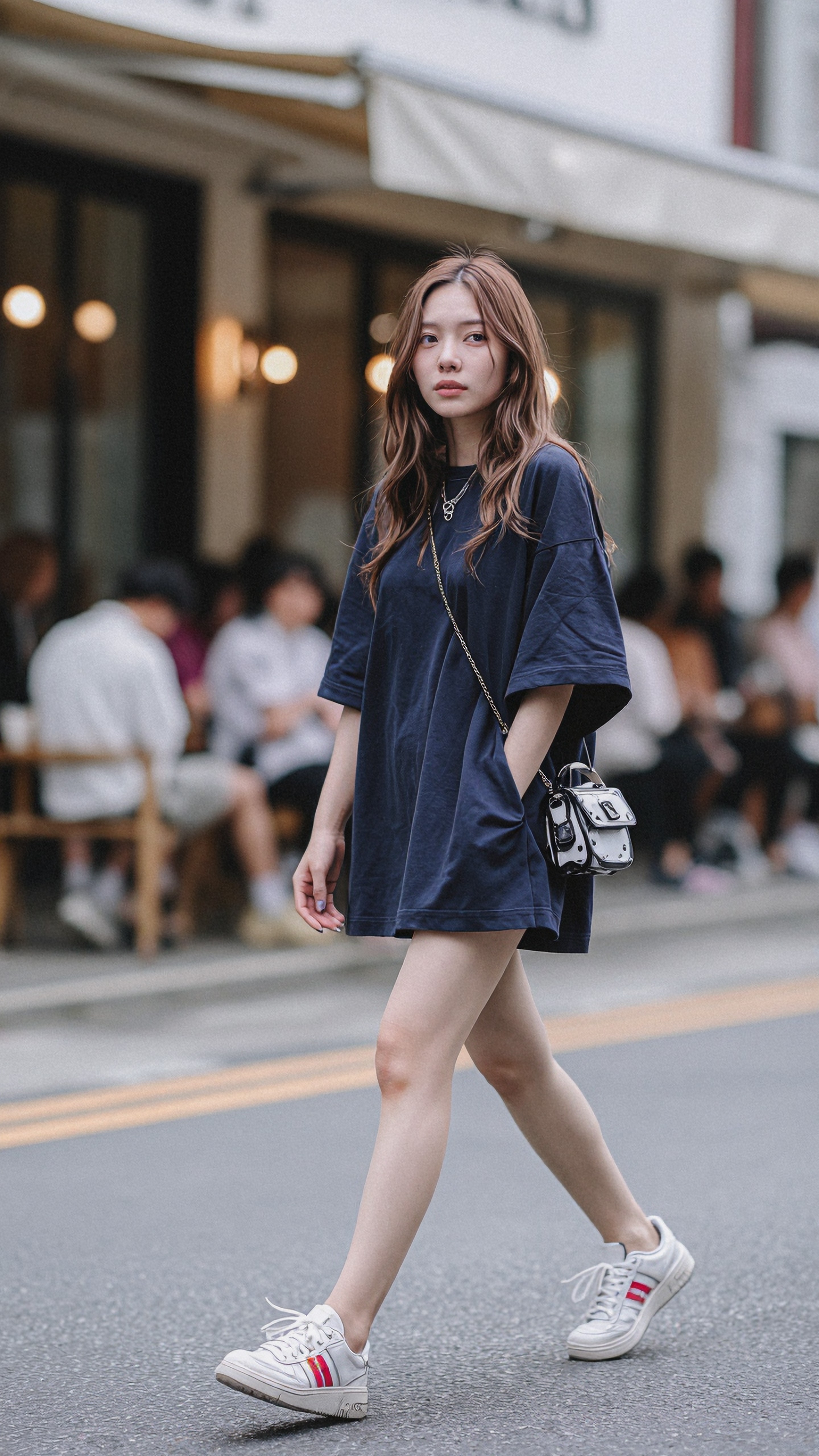
Inspect whether the image feels specifically Seoul-based or just generally trendy. In my test, this type of prompt often produced a decent image, but the outfit logic was vague and the city identity was weak.
2) Adding silhouette control for everyday Seoul realism
This prompt tests whether a clearer layering structure improves realism. It did. Wide-leg trousers plus a cropped outer layer gave the model a more current Seoul retail silhouette.
Topic: Seoul street style with cropped puffer and wide-leg trousers
Genre: Fashion Editorial
Camera: Sony A7 IV
Lens: 35mm f/1.8
Lighting: Cold morning natural light
Location: Seongsu industrial cafe district
Style: Korean magazine street editorial
Final Prompt: young Korean woman in realistic Seoul street style standing near a concrete cafe frontage in Seongsu, cropped charcoal puffer jacket, white ribbed top, high-waisted wide-leg black trousers, slim crossbody bag, understated silver jewelry, clean sneakers, loose straight hair, calm expression, full-body composition, balanced silhouette, muted grey and cream palette, cold morning natural light, editorial but wearable styling, realistic textile texture, visible trouser drape, Sony A7 IV look, 35mm f/1.8, authentic Korean fashion trends, urban lookbook photography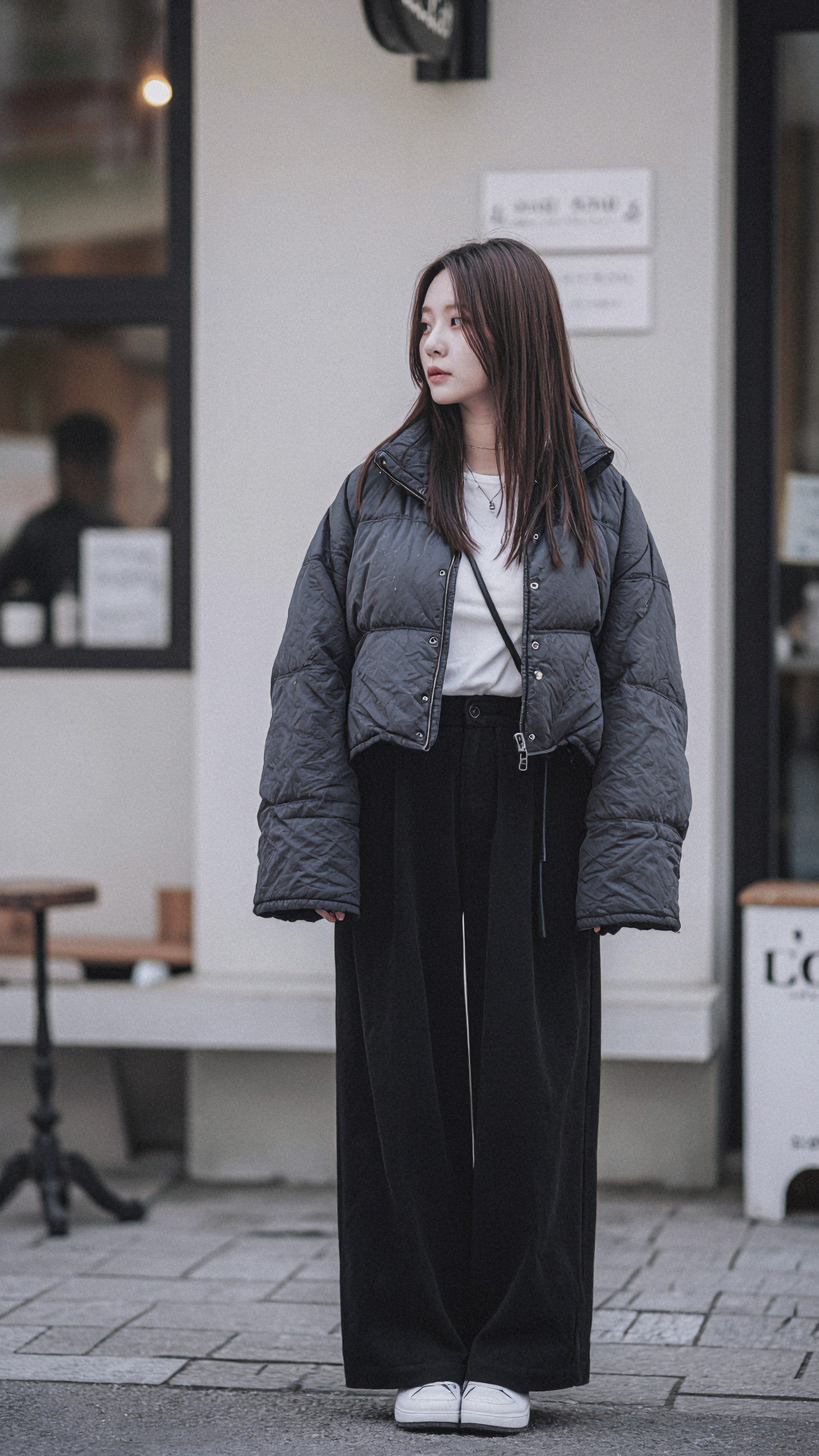
Check the trouser drape, the length relationship between jacket and pants, and whether the accessories stay understated. This setup gave one of the most believable K fashion outfit results because the garments worked as a system.
3) Preppy-minimal styling for campus and retail lookbook output
This test checks whether softer preppy keywords produce more believable youth fashion than loud streetwear terms. In this test, they usually did.
Topic: Korean campus-inspired street fashion with knit layering
Genre: Lifestyle Portrait
Camera: Fujifilm GFX 100S
Lens: 63mm f/2.8
Lighting: Soft cloudy daylight
Location: Ewha campus-adjacent street with brick walls and small boutiques
Style: Youth retail lookbook
Final Prompt: full-body Korean street fashion look inspired by Seoul campus style, young woman wearing a navy oversized knit cardigan over a crisp white shirt, grey pleated mini skirt, black knee socks, polished loafers, compact leather shoulder bag, natural makeup, tidy bangs, relaxed standing pose near brick storefronts, clean cool-toned palette, soft cloudy daylight, wearable preppy styling, fashion retail realism, detailed knit texture, sharp pleat definition, Fujifilm GFX 100S medium-format clarity, 63mm f/2.8, authentic Seoul street style, lookbook photography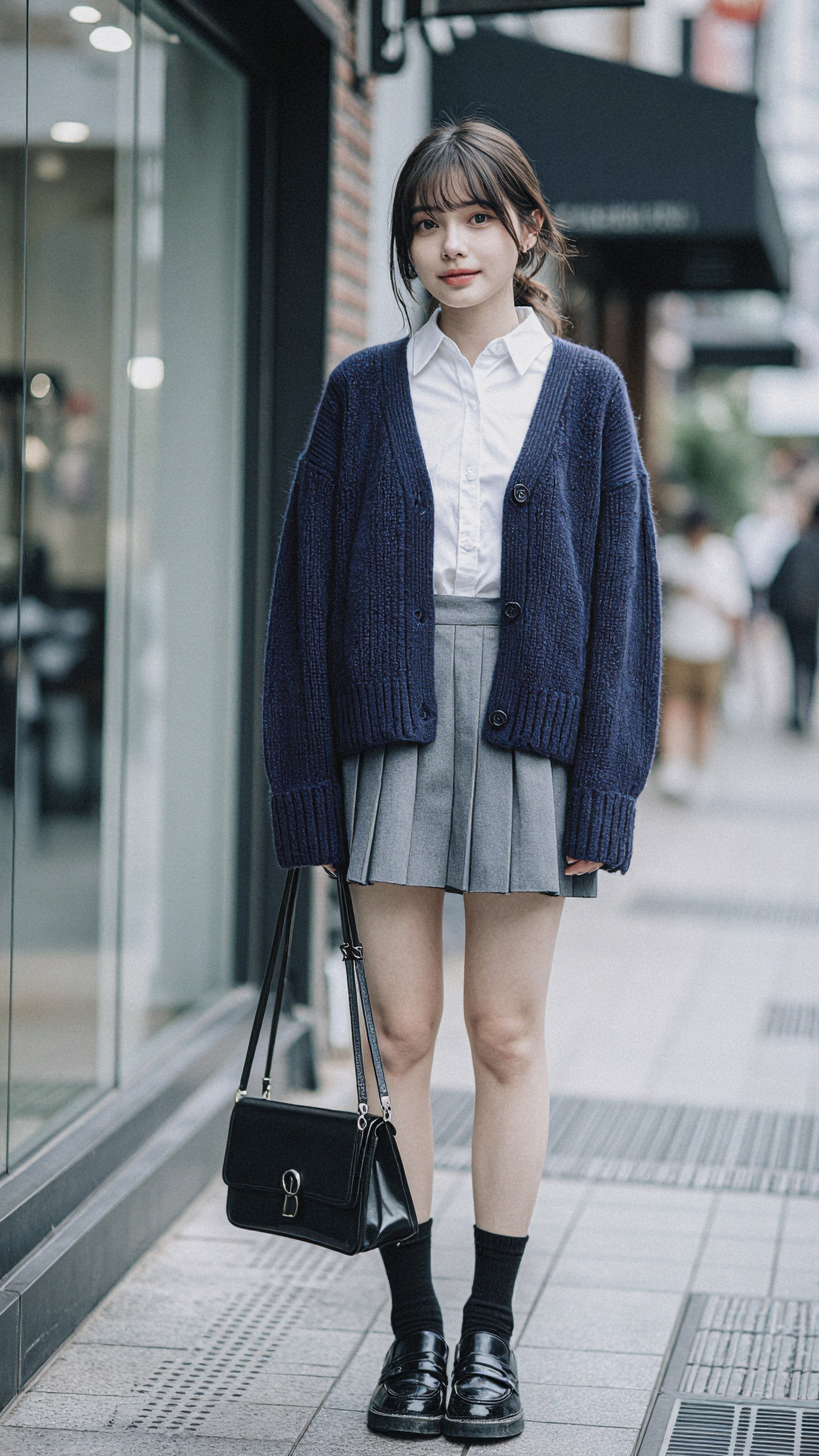
Inspect the sock-shoe relationship and skirt construction. The strongest outputs here looked like real Korean fashion e-commerce or a street lookbook, not costume styling.
4) Menswear test: oversized blazer language versus generic streetwear
This prompt was meant to test whether menswear realism improves when you replace "streetwear" with more tailored garment language. That change produced a more modern Seoul look in my runs.
Topic: Men’s Seoul street style with oversized blazer and straight denim
Genre: Street Style
Camera: Nikon Z8
Lens: 85mm f/1.8
Lighting: Late afternoon city light
Location: Apgujeong sidewalk near luxury storefronts
Style: Minimal luxury street campaign
Final Prompt: Korean male model in refined Seoul street style, oversized black blazer over a washed white tee, straight-leg blue denim, black leather belt, square-toe loafers, slim tote bag, neat textured hair, neutral expression, full-body pose walking past polished Apgujeong storefronts, muted luxury palette, realistic late afternoon city light, understated fashion campaign energy, sharp tailoring edges, authentic denim texture, natural proportions, Nikon Z8 realism, 85mm f/1.8, lookbook-ready Korean street fashion image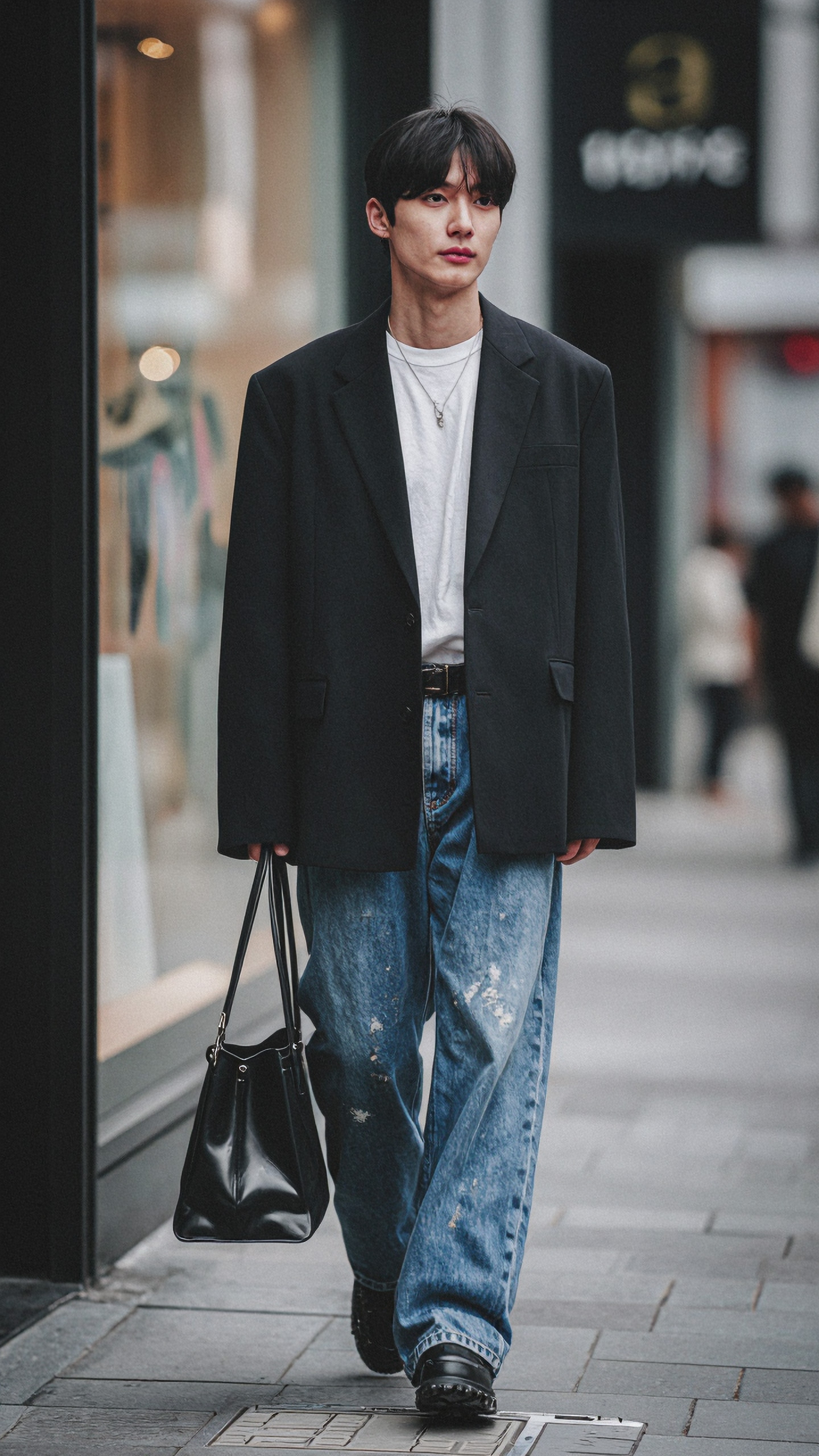
Look at shoulder shape, sleeve length, and whether the loafers remain coherent with the denim. This prompt showed that Seoul street style often reads more realistically when the model is pushed toward clean tailoring rather than hype-heavy streetwear labels.
5) Convenience-store realism test
This test was designed to see if a mundane urban anchor improves authenticity. It often does, especially when fashion remains polished but not overproduced.
Topic: Korean street fashion outside a neighborhood convenience store at night
Genre: Cinematic Travel
Camera: Leica SL2-S
Lens: 28mm f/2
Lighting: Mixed fluorescent and neon spill
Location: Seoul convenience store frontage with vending machines and wet pavement
Style: Cinematic realism
Final Prompt: realistic Korean street fashion scene at a Seoul convenience store at night, young woman in beige trench coat over a black hoodie, straight dark trousers, white sneakers, canvas tote bag, loosely tied hair, subtle makeup, standing with one hand holding a drink can, wet pavement reflecting signage, fluorescent interior glow mixed with soft neon spill, candid full-body framing, restrained color palette of beige black green and silver, believable everyday Seoul style, realistic fabric response to night light, Leica SL2-S cinematic texture, 28mm f/2, urban documentary fashion image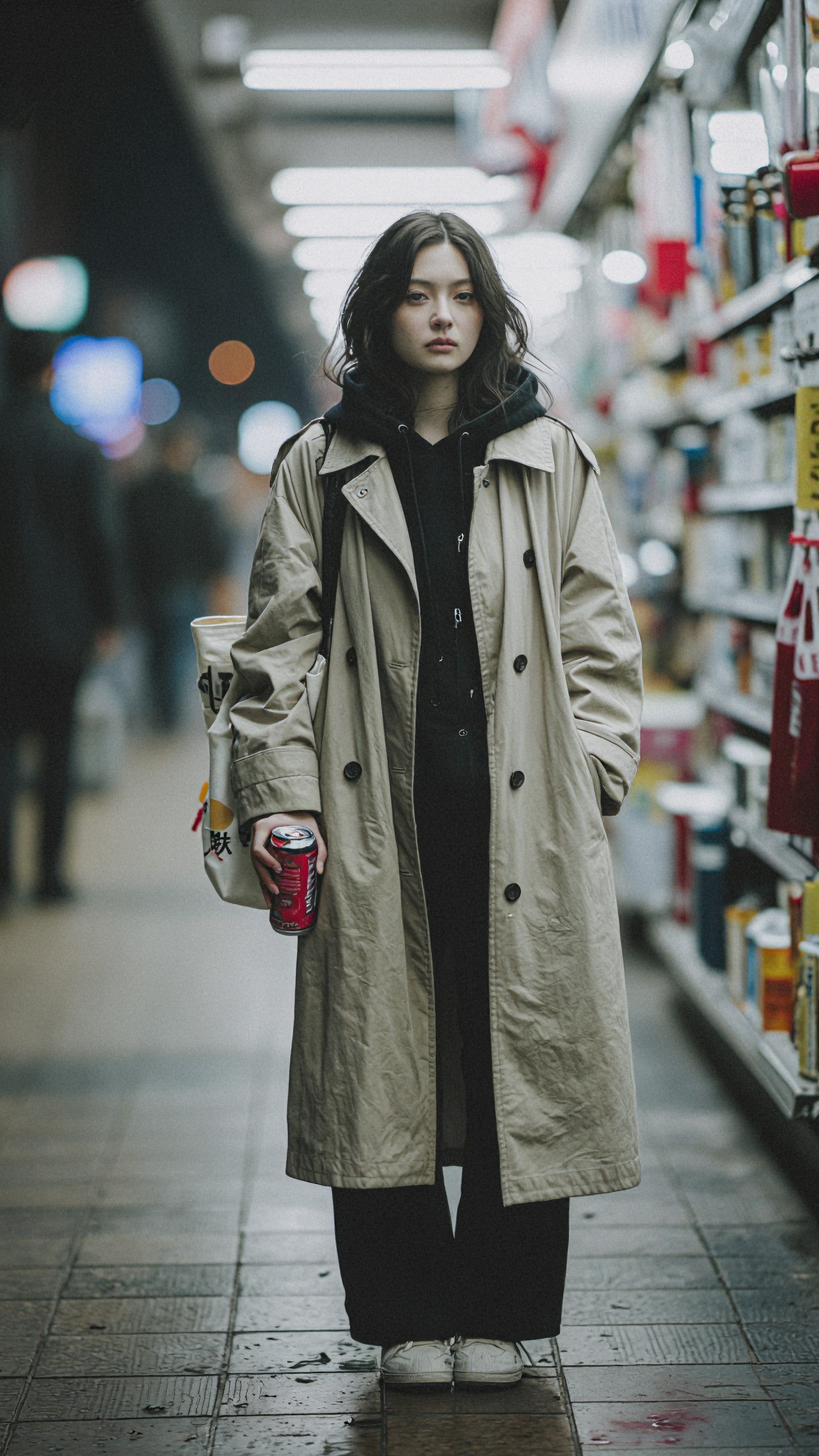
Inspect whether the coat, hoodie, and tote feel like lived styling rather than a movie costume. This setup was strong for mood and place, but wide lenses increased hand and limb distortion risk.
6) Feminine street look without drifting into idol styling
This prompt tests a common edge case. Many models over-sexualize fitted skirts and boots when you ask for Korean fashion. The fix was to frame it as editorial daywear with restrained beauty cues.
Topic: Feminine Seoul street style with fitted jacket and midi skirt
Genre: Fashion Editorial
Camera: Panasonic Lumix S5II
Lens: 70mm f/2.8
Lighting: Soft sunset backlight
Location: Garosu-gil tree-lined shopping street
Style: Contemporary Korean magazine cover
Final Prompt: elegant but wearable Korean street fashion on a Seoul shopping street, young woman wearing a fitted cream cropped jacket, black ribbed midi skirt with clean straight silhouette, low-heel ankle boots, small structured handbag, delicate earrings, softly styled hair, composed expression, full-body editorial stance, tree-lined Garosu-gil background, warm soft sunset backlight, refined neutral palette, realistic movement in skirt fabric, understated upscale Seoul fashion trends, Panasonic Lumix S5II realism, 70mm f/2.8, polished magazine-quality lookbook photography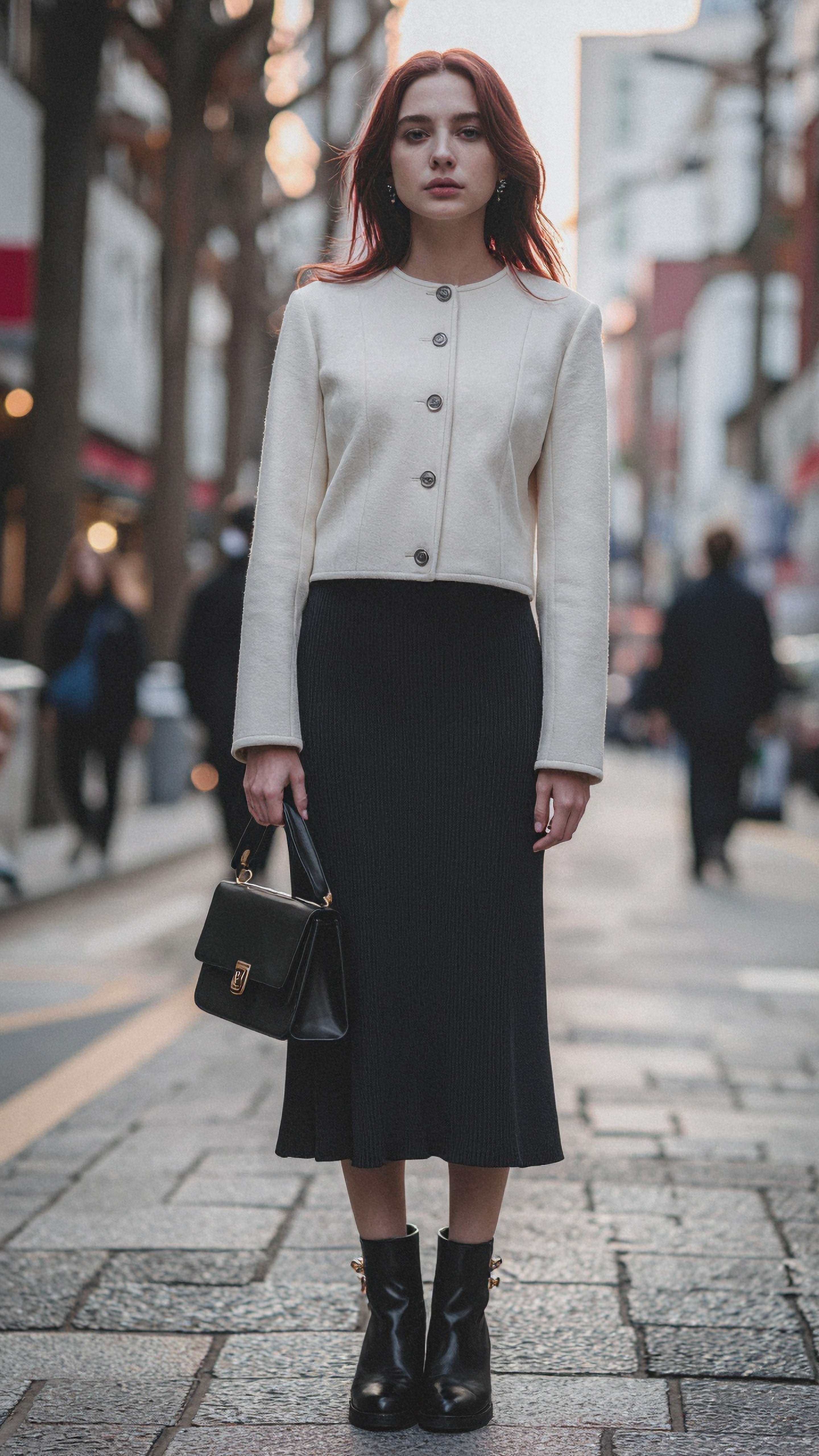
Check whether the result stays in daywear territory. The weak point to watch is glam drift: makeup, body shape exaggeration, and overly dramatic pose language can quickly push this away from realistic streetwear campaign output.
7) Layer-heavy winter styling for texture detail
This test checks whether winter prompts can hold multiple textiles without collapsing into visual clutter. In this test, texture-rich prompts worked well if the palette stayed controlled.
Topic: Winter Korean street fashion with layered neutrals
Genre: Luxury Campaign
Camera: Hasselblad X2D 100C
Lens: 55mm f/2.5
Lighting: Bright winter overcast
Location: Bukchon-adjacent quiet alley with stone walls and modern cafe signage
Style: High-end editorial realism
Final Prompt: full-body winter Korean street fashion image in Seoul, young woman wearing a long oatmeal wool coat over a taupe turtleneck, charcoal wide-leg slacks, soft scarf, leather gloves, chunky sole derby shoes, structured handbag, clean center-part hair, minimal makeup, poised walking pose in a quiet Seoul alley, layered neutral palette, bright winter overcast light, clear wool texture and fabric separation, high-end editorial realism, authentic Seoul sophistication, Hasselblad X2D 100C medium-format detail, 55mm f/2.5, premium lookbook photography with believable proportions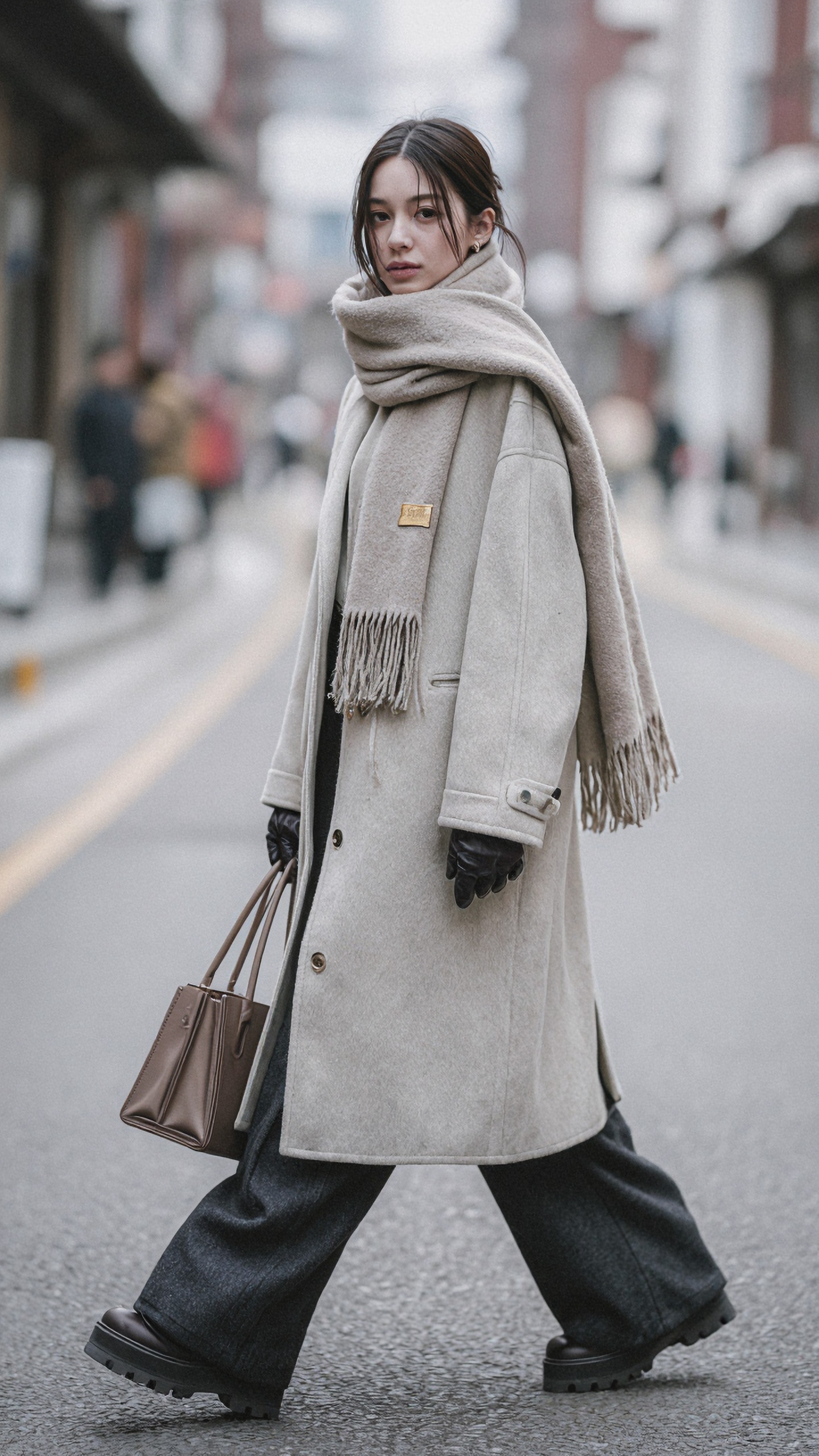
Inspect fabric separation between coat, knit, scarf, and trousers. This was one of the strongest setups for realism because layered neutrals gave the model many specific cues without forcing visual noise.
8) Group lookbook test for brand campaign consistency
This final prompt checks whether the styling language stays coherent across multiple subjects. Group scenes are where many models fall apart, so this is useful if you are building a lookbook photography or campaign set.
Topic: Korean street fashion group lookbook for a Seoul retail campaign
Genre: Product Editorial
Camera: Canon EOS R3
Lens: 35mm f/4
Lighting: Large softbox key with ambient window fill
Location: Minimal Seoul concept store interior with garment racks and concrete floor
Style: Streetwear campaign
Final Prompt: three young Korean models in a Seoul retail campaign lookbook, full-body group composition inside a minimal concept store, coordinated Korean street fashion outfits with varied silhouettes: one in oversized blazer and pleated shorts with loafers, one in cropped bomber jacket and parachute pants with retro sneakers, one in striped knit and straight denim with leather flats, clean accessory styling, neutral to muted color palette with one controlled pop color, natural expressions, campaign-ready spacing between models, visible garment racks and polished concrete floor, soft studio-commercial lighting blended with window fill, high texture detail, realistic retail styling, Canon EOS R3 look, 35mm f/4, coherent streetwear campaign image, Korean fashion trends with product clarity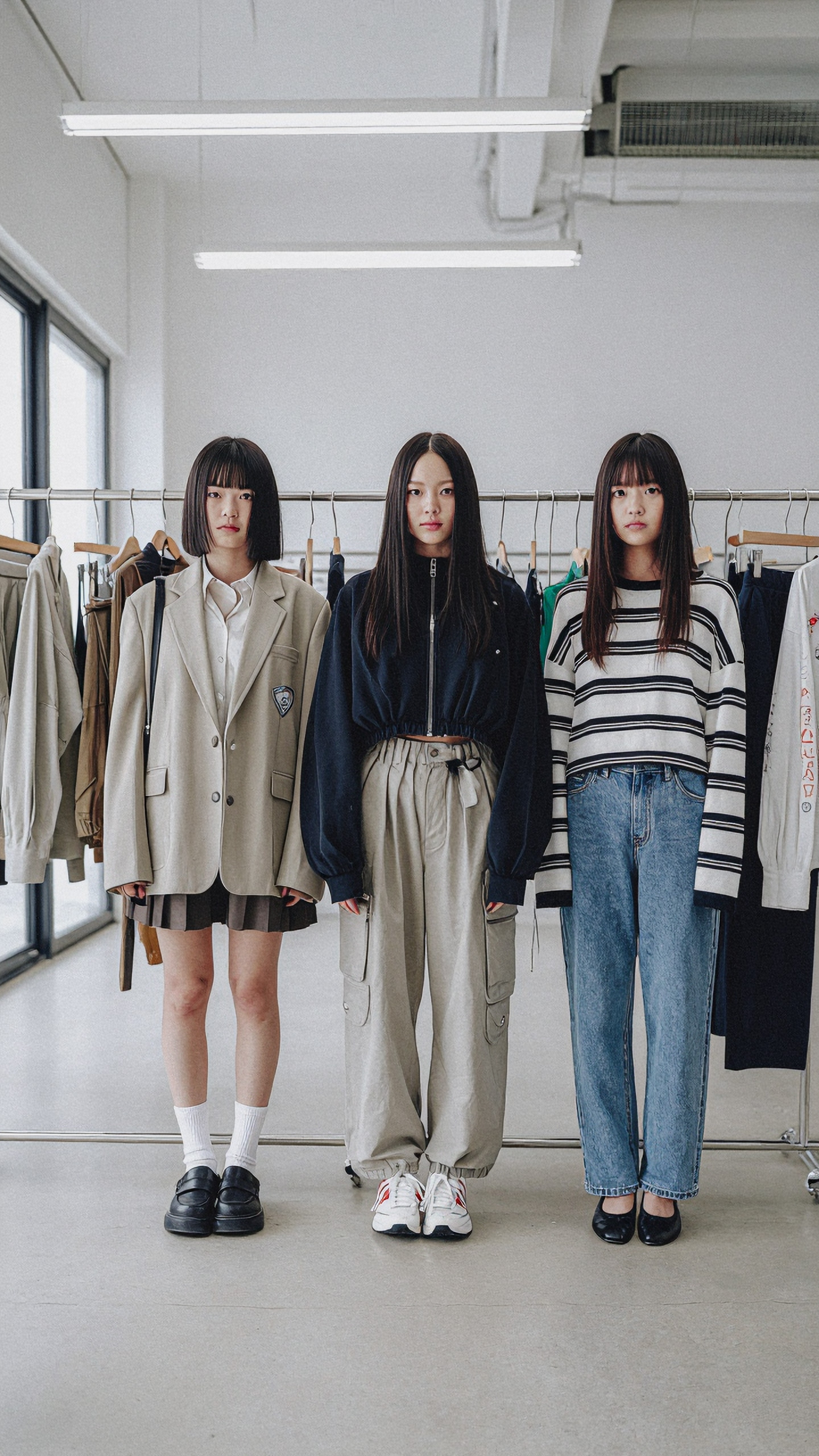
Inspect hand count, foot placement, and whether each outfit keeps its own identity without clashing. This is the best stress test for style lock, and also the easiest place to spot synthetic inconsistency.
What consistently worked
Garment-specific keywords beat trend labels
The strongest result did not come from saying Korean fashion trends more often. It came from specifying pieces like:
- cropped puffer
- oversized blazer
- pleated mini skirt
- straight denim
- wide-leg trousers
- loafers with visible socks
- trench over hoodie
- structured shoulder bag
Those terms gave the model enough fashion logic to build a believable silhouette.
Seoul district cues improved context
"Seoul street" helped a bit. Named districts helped more. Hongdae, Seongsu, Apgujeong, Garosu-gil, and campus-adjacent retail streets produced more grounded environments than generic "city street with neon signs."
Retail and lookbook language reduced glam drift
Words like youth retail lookbook, clean commercial look, Korean magazine street editorial, and product clarity often produced more wearable styling than prompts framed as celebrity fashion.
Common mistakes that hurt realism
1) Using only broad style labels
If the prompt is just "Korean street fashion girl in Seoul," the output may still be attractive, but it often lacks garment intention.
2) Overloading with too many trend terms
When I stacked cargo pants, platform boots, chains, mini bag, neon makeup, oversized faux fur, and cyber lighting into one prompt, the result drifted away from everyday Seoul style and into synthetic trend mashup.
3) Forgetting full-body composition
For fashion testing, waist-up crops hide the real failures. You need to see trouser break, skirt length, sock exposure, footwear proportion, and bag scale.
4) Asking for "K-pop" unless you really want idol styling
This was the biggest style contaminant in the test. It can be useful for high-gloss campaign energy, but it often damages realism.
5) Choosing lenses that exaggerate proportions
Wide-angle scenes were helpful for place, but full-body fashion looked more reliable between 50mm and 85mm unless the environment was central to the shot.
Practical checklist before you keep a result
Use this quick review after generation:
- Does the outfit read as a complete system rather than random trendy pieces?
- Do hem lengths, shoe choice, and bag scale make sense together?
- Does the setting feel like Seoul retail, campus, cafe street, or upscale district rather than anonymous nightlife?
- Are fabrics readable: wool, denim, knit, nylon, leather?
- Does the styling stay wearable, or has it drifted into idol costume territory?
- Are hands, feet, and full-body proportions intact?
- Is the image useful for your goal: editorial, retail lookbook, streetwear campaign, or moodboard reference?
Best workflow by use case
Use broad prompts when
- you are moodboarding fast
- you only need a rough street-fashion direction
- city specificity is less important than overall vibe
Use garment-system prompts when
- you want believable Seoul street style
- you need retail-grade outfit clarity
- you are comparing silhouettes or building fashion references
Use group lookbook prompts when
- you are testing campaign cohesion
- you need multiple outfits in one frame
- you can tolerate a higher failure rate in hands and spacing
Final recommendation
If your goal is realistic korean street fashion imagery, do not rely on the phrase by itself. In this test, the most reliable workflow was: Seoul location anchor + silhouette-first outfit description + restrained accessory language + retail/editorial framing.
The strongest result came from prompts that described wearable outfit architecture, especially wide-leg trousers, cropped outerwear, clean knit layering, loafers or sneakers, and understated bags. The weak point was always the same: once the prompt leaned too hard into celebrity, hype, or generic trend language, the model stopped looking like it understood everyday Seoul style.
Who should use this workflow: fashion marketers, moodboard builders, lookbook planners, and prompt users who need images that feel close to Korean retail/editorial reality.
Who should avoid it: users seeking exaggerated pop-star fantasy, maximal avant-street styling, or highly abstract campaign visuals.
The prompt detail that matters most is not "Korean" by itself. It is the specific garment relationship that tells the model how Seoul style is worn in practice.