If you write an airport outfit prompt as a stylist's list (coat, top, trousers, shoes, bag), an image model will usually keep the big pieces and the overall silhouette. It will quietly change the small ones: a shoe style, a bag's position, a missing tied sweater. So the useful habit is to check each generated image against your own list, garment by garment, and to treat the list as a request, not a guarantee. That is what this article does with eight Z-Image airport outfit images generated on 2026-07-15. I opened all eight and compared each one with the prompt that produced it. Six are shown here.
The one that followed the brief: a long open trench
The first image is the closest match to its prompt. The prompt, exactly as the generation record stores it:
street-style full body fashion photograph of a model off duty airport outfit, complete head-to-toe silhouette visible while walking past an airport curbside entrance, wearing a camel trench coat over a white fitted t-shirt, black wide-leg tailored trousers, suede loafers, oversized structured leather tote, slim dark sunglasses, aluminum carry-on suitcase, minimal gold jewelry, polished casual luxury travel styling, neutral palette of camel black white and steel gray, confident relaxed stride, paparazzi-meets-editorial framing, airport glass reflections in background, clean composition with outfit fully readable, realistic fabric drape, premium wool and leather texture, documentary fashion energy, Canon EOS R5 look, 35mm full-body visibility, trend led fashion mood, outfit-first fashion editorial, complete styling system, visible fabric texture, accessories, shoes, bag, scene context, natural pose or walking action, 35mm editorial photography, realistic street, runway, retail, or lookbook setting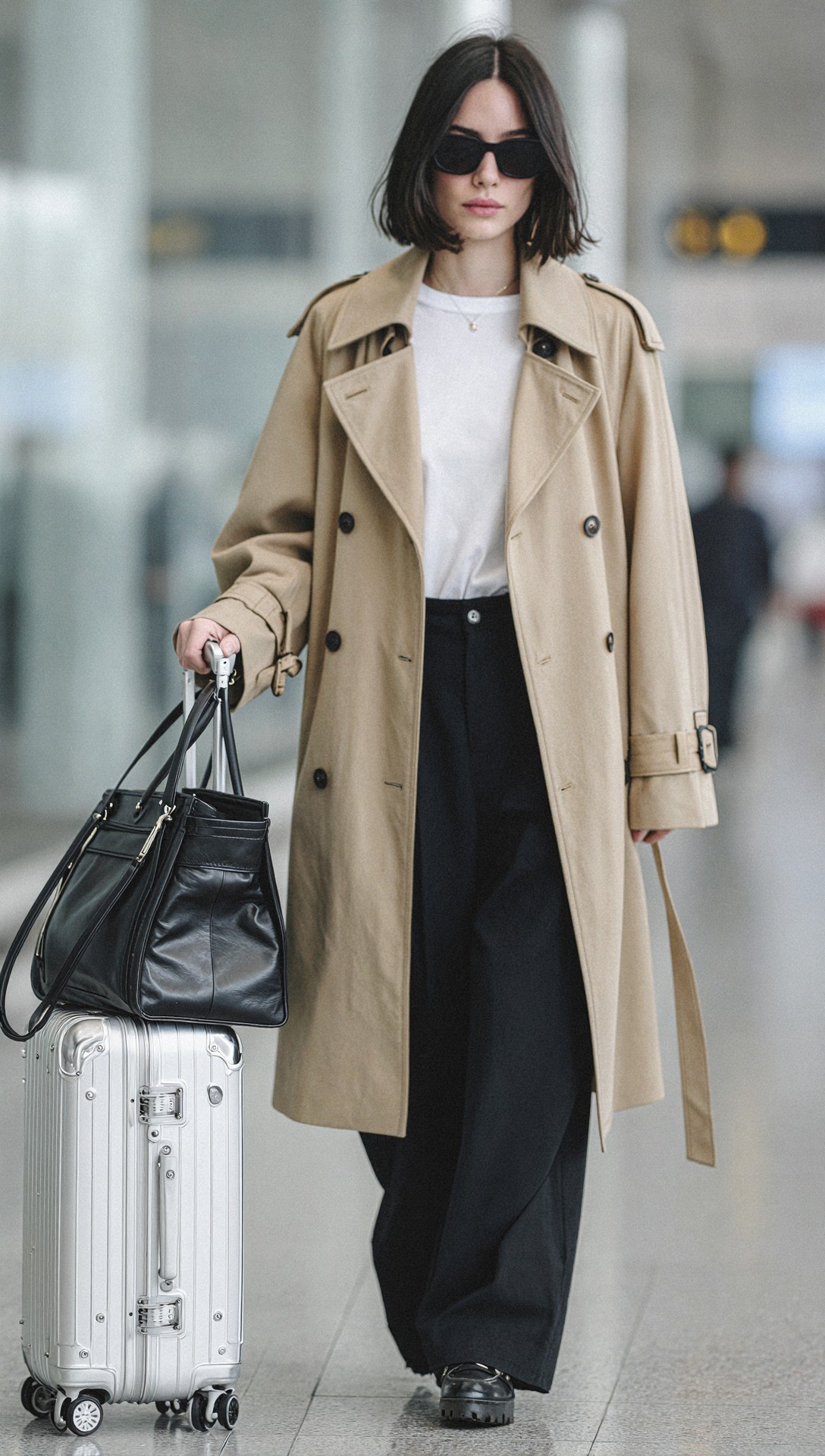
What is visible: the trench hangs open, with epaulettes, a storm flap, buttoned cuff straps and a belt that trails loose on the right. The white tee and the black waistband stay distinct from the coat, so the three-layer read works. The suitcase is silver and ribbed, and its telescoping handle is straight. The hand gripping it has readable fingers.
What differs from the prompt: the loafers are black with a thick lug sole, and only one shoe is clearly visible at the bottom edge. The tote is not carried but sits balanced on top of the suitcase. The scene is an airport interior rather than a curbside entrance. None of these is a failure, but anyone who needs "suede" or "curbside" should not assume the prompt delivered it.
The reason this image reads well is probably structural. An open coat, a plain light top and dark trousers give three separate tonal blocks. That is an observation about this one image, not a measured rule.
A second long-coat image that also kept its layers
The seated image is the other strong one. The prompt asked for "a sand-colored lightweight trench over a striped knit top, cream relaxed trousers, brown loafers, leather weekend bag at feet, silk scarf tied to bag handle" and "one ankle extended so shoes remain visible".
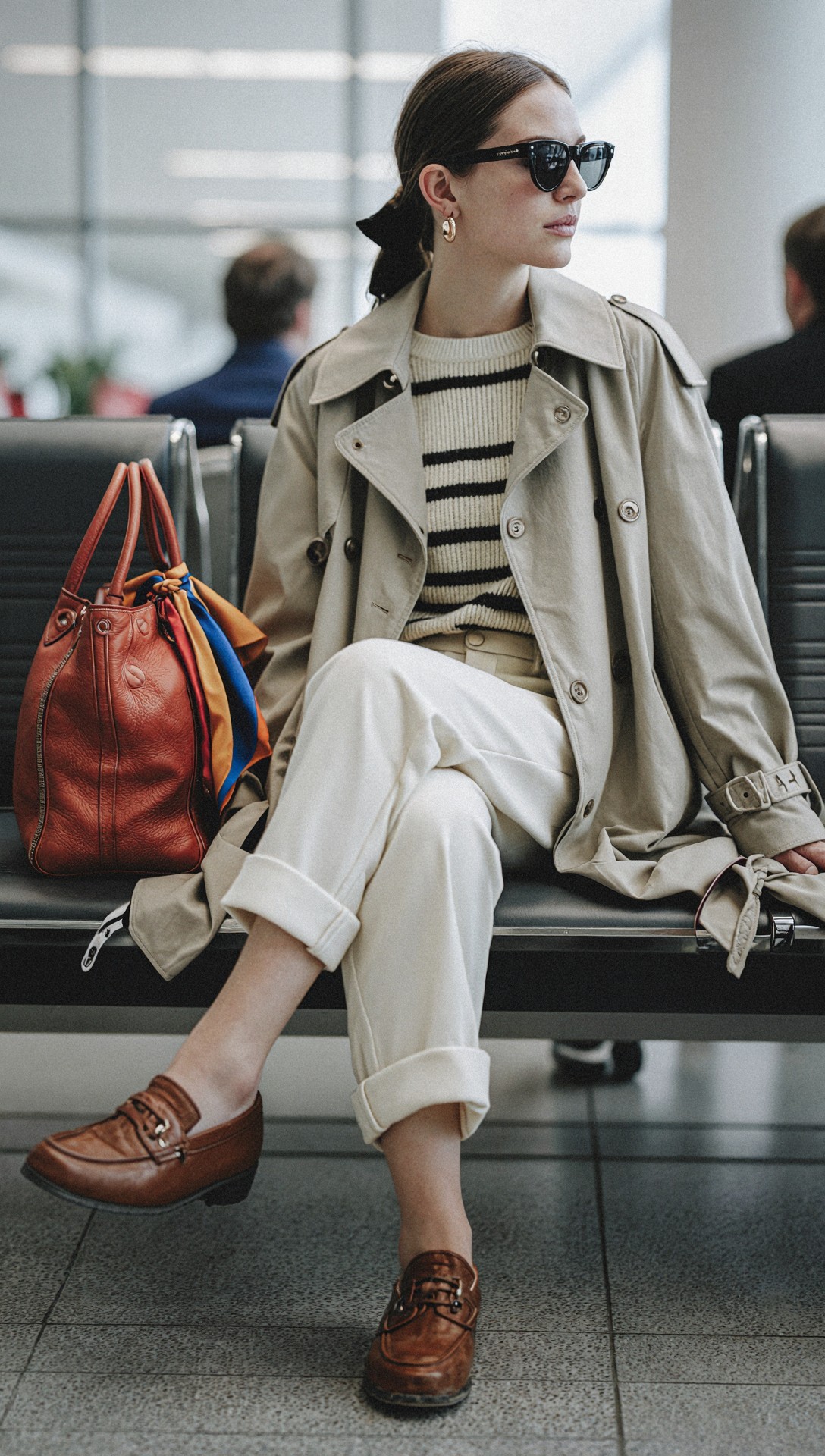
Both loafers are in frame, and the crossed-leg pose keeps the trouser cuffs and shoes visible, which is what the ankle instruction was for. The striped knit, trench lapels and cuffed trousers are all separate. The scarf is tied to the bag as requested.
The deviations are small and typical. The bag sits on the bench beside her rather than at her feet. She has a black hair ribbon and a gold hoop earring that the prompt did not mention. The right hand is half hidden under the coat, and a knotted strap hangs near the coat hem on the right without an obvious owner. The cuff tab and the sunglasses temple carry tiny lettering that does not form words.
Where the garment list drifted
The table compares what the prompt asked for with what the image shows, for the four images where the mismatch was largest.
| Prompt asked for | Image shows | |---|---| | Cream cashmere crewneck over white poplin shirt, sweater tied over shoulders, tonal cap (image 2) | Sleeveless cream knit vest over a white shirt with pushed-up sleeves, beige cap, no tied sweater | | Stone pleated trousers, soft leather crossbody bag (image 3) | Cream pleated trousers with a paperbag waist and belt, a brown strap over the shoulder but no bag visible | | White t-shirt visible at collar, passport wallet in hand, leather duffel on shoulder (image 5) | Beige knit collar and cardigan under the coat, brown handbag carried in the other hand, no passport wallet visible | | Black ballet flats, one carry-on in the opposite hand (image 4) | Black low kitten-heel shoes with bows, and a second brown tote in hand instead of a suitcase |
The swaps go in a consistent direction: the model reaches for a familiar neighbour of the named garment (vest for crewneck, dressier shoe for flat, handbag for duffel). I have only these four cases, so this is a pattern in a small set, not a statistic. I opened image 4, but it is not shown here to stay within the six-image limit.
The lookbook shot
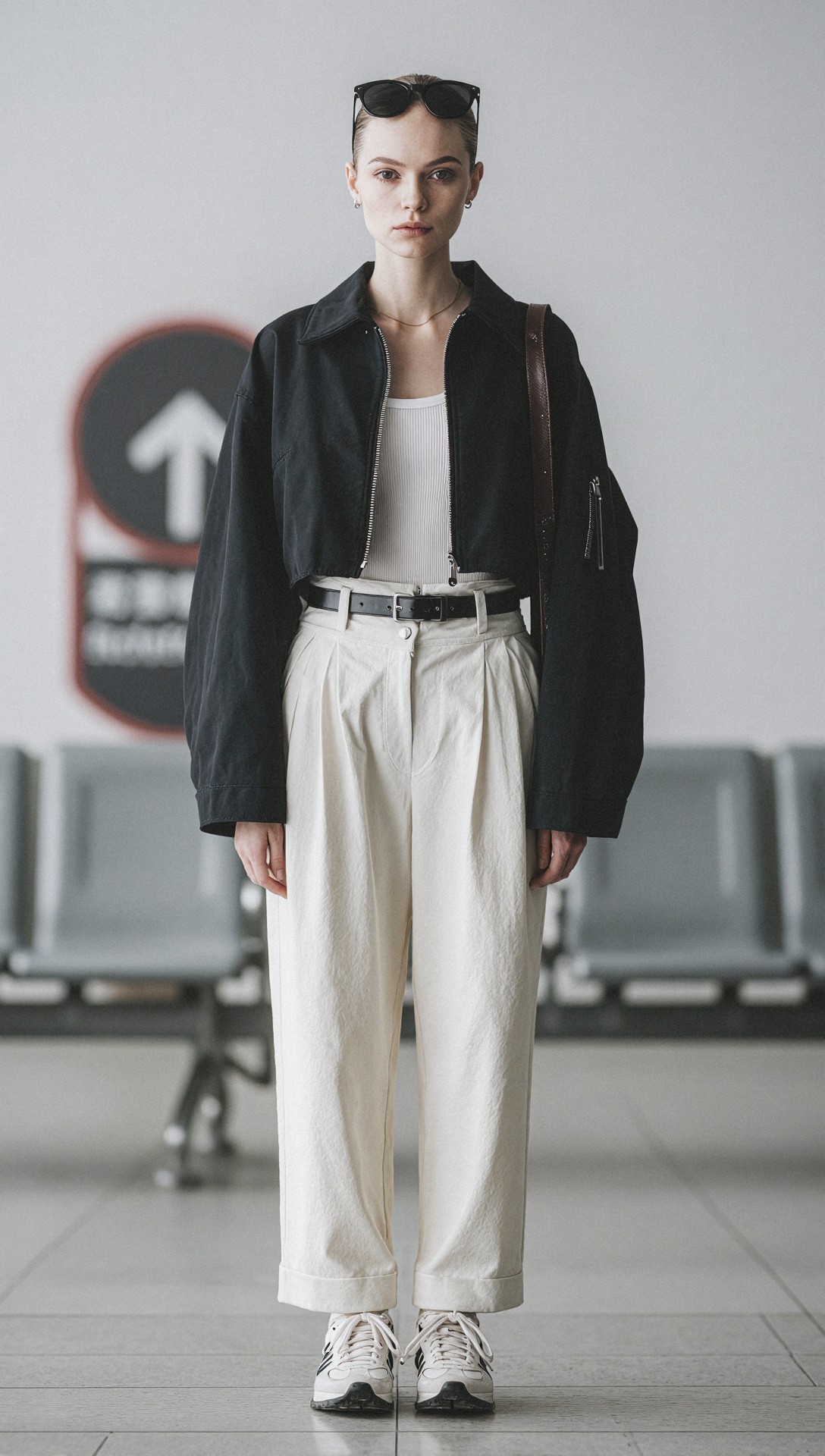
The head-to-toe stance shows garment construction most clearly: the cropped bomber's zip and sleeve pocket, the ribbed tank, the front pleats and cuffs. Arms hang at her sides, so hands are not a problem. It is also the stiffest image, closer to a catalogue than to a candid airport moment. The prompt's "soft leather crossbody bag" appears only as a strap. Behind her, the sign's arrow is clear but its text is unreadable.
Extra people and props nobody asked for
Two images added things the prompt did not describe.
The cap-and-vest image contains a second, blurred copy of the same model seated on the bench behind her, dressed identically. The prompt said "seated then rising from lounge chair", and the model appears to have drawn both states. Whether that wording caused it is not proven, but it is a reasonable suspect, and the seated image above used a single instruction that produced a single person.
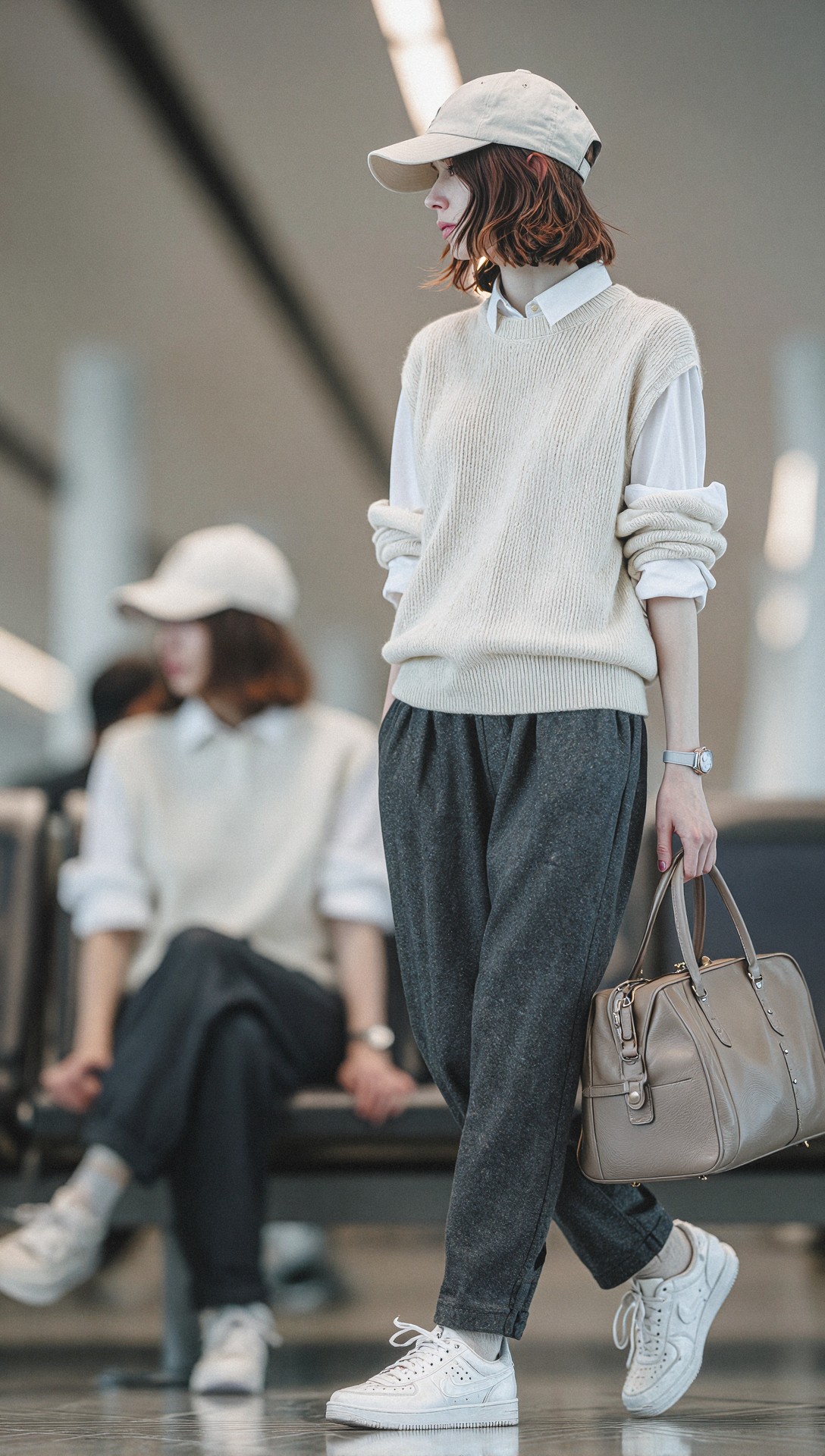
The same image shows another known risk. The white sneakers carry a swoosh-shaped mark on the side that resembles a real brand's logo, although the prompt never mentioned one.
The flat-lay prompt produced a mix:
product flat lay of a model off duty airport outfit capsule arranged on neutral linen, camel trench coat, white rib tank, charcoal knit cardigan, black relaxed trousers, white leather sneakers, oversized dark sunglasses, taupe tote bag, slim gold hoops, travel-size beauty pouch, boarding pass sleeve, styling arranged with clean spacing and visible layering logic, quiet luxury travel outfit palette in camel charcoal cream black and taupe, elevated retail editorial mood, crisp overhead composition, premium textile detail, Panasonic Lumix S1R product realism, trend led fashion mood, outfit-first fashion editorial, complete styling system, visible fabric texture, accessories, shoes, bag, scene context, natural pose or walking action, 35mm editorial photography, realistic street, runway, retail, or lookbook setting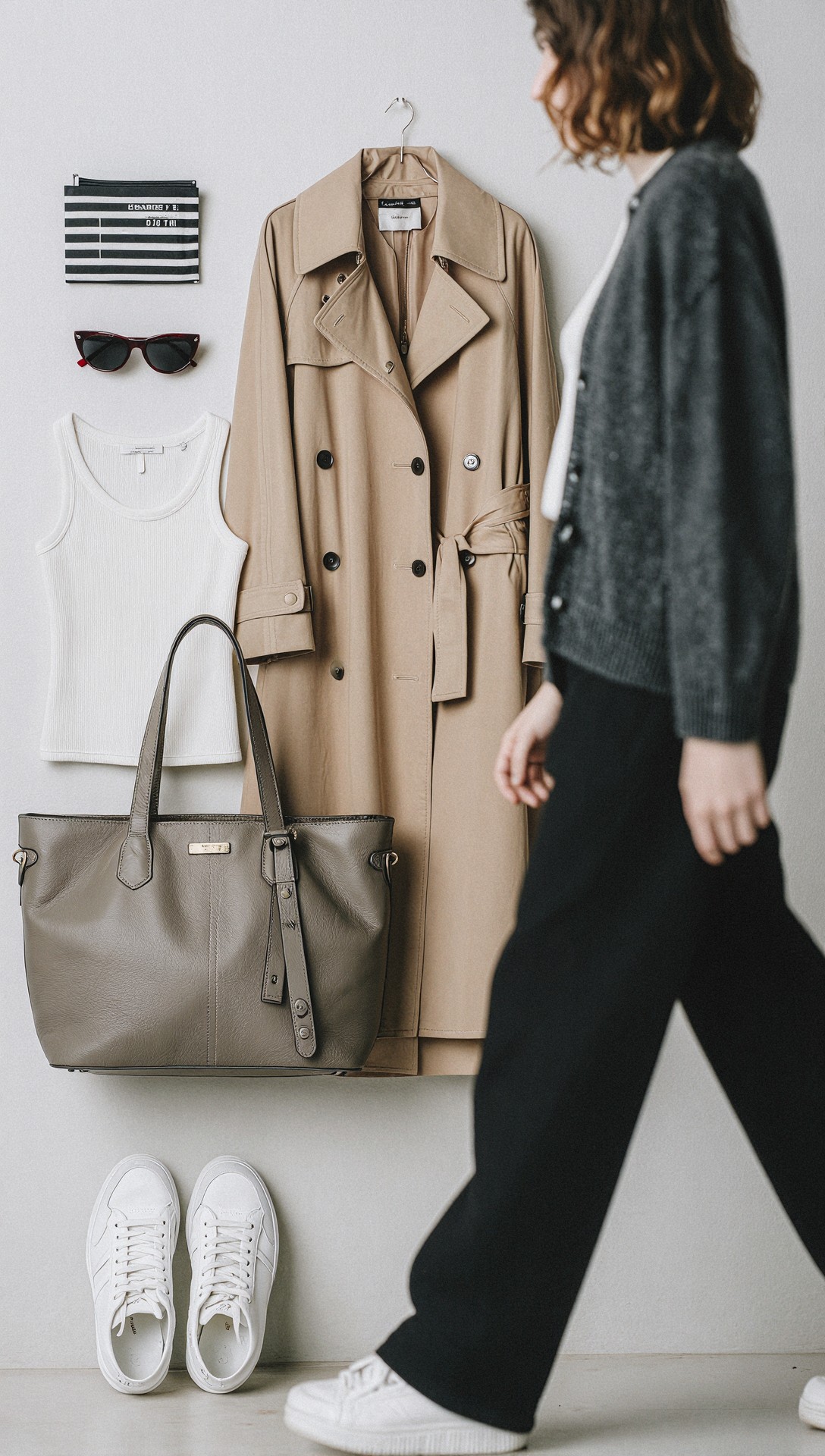
The items are individually clear, but they hang on a wall instead of lying flat, and a walking woman wearing the charcoal cardigan and black trousers intrudes on the right. The stored prompt ends with generic shot-plan phrases, including "natural pose or walking action". Those phrases are a plausible cause of the extra figure, but I cannot confirm it. The trench tag and the striped pouch have garbled lettering.
The accessories close-up (opened, not shown) failed more thoroughly. The cardigan the prompt called "ribbed cashmere" turned into a tangle of black fabric with zip-like hardware, and a person's legs and mismatched sneakers appear behind the table. Its bag hardware is also jumbled.
Busy terminals hide less than expected, but they cost readability
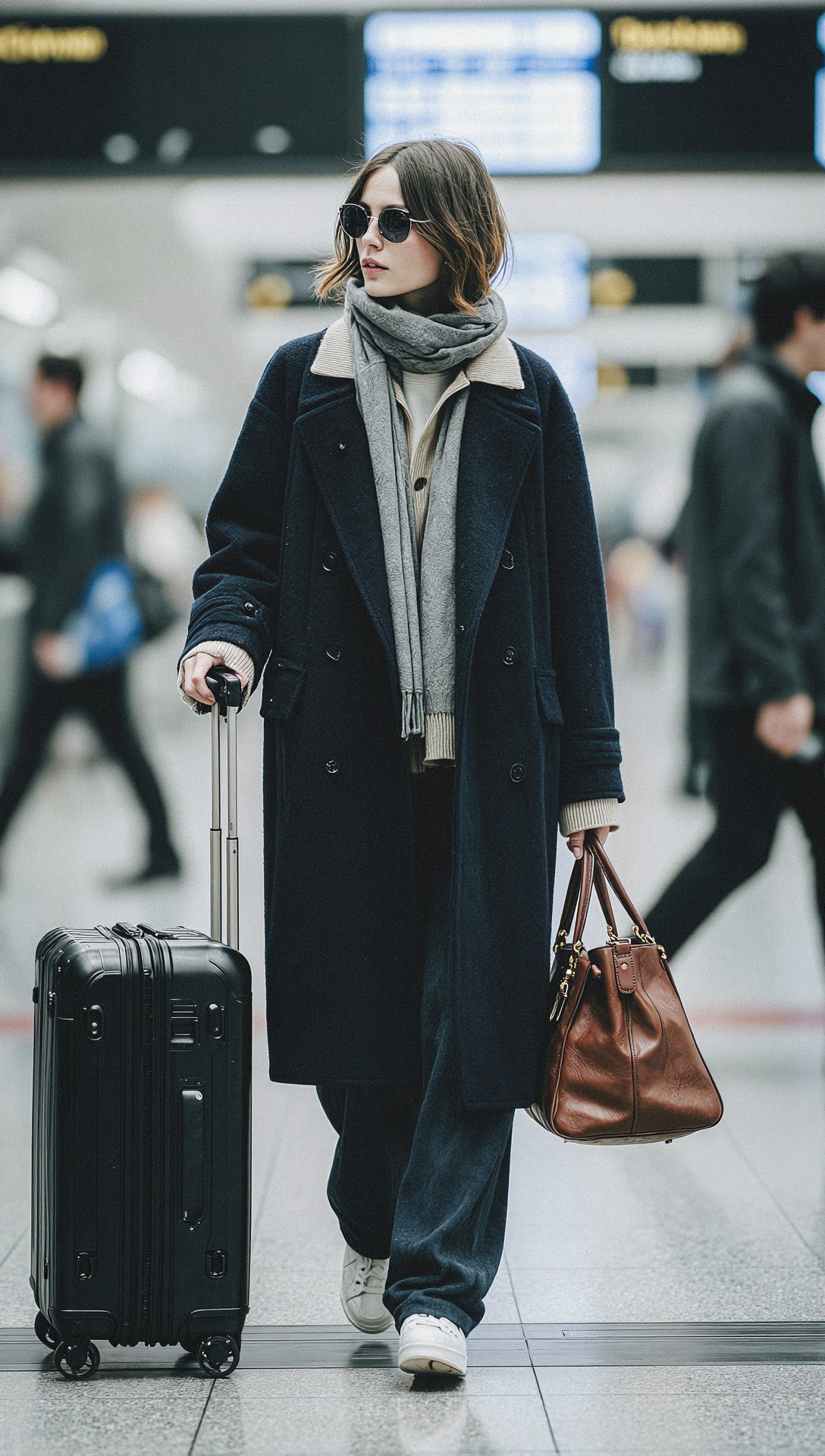
The busy departures hall was the stress test. The suitcase handle is intact and the pulling hand is readable. The departure boards carry text that does not form words. The bigger issue for an outfit image is tone: the navy coat and the navy trousers merge at the hem, so the layer boundary is hard to see compared with the camel-on-black trench image. A gray scarf and a beige collar do give the upper body a clear layered read.
What to do with this
These are suggestions drawn from the comparisons above, not tested procedures.
1. After generating, tick off each garment from your list against the image before judging overall quality. Substitutions like kitten heels for flats are easy to miss when the picture looks good. 2. Give each outfit piece a tonal contrast with its neighbour. The best two images here had clear light and dark blocks. 3. Use one body state per prompt. The "seated then rising" wording coincided with a duplicated figure. 4. For a flat lay, avoid people-oriented phrases in the prompt. Whether that helps is unverified, so proposed wording should be tested.
Proposed prompt (unverified): a pure garment flat lay, no model phrases at all: "overhead flat lay on neutral linen of a camel trench coat laid flat, white ribbed tank, black relaxed trousers, white leather sneakers, taupe tote, sunglasses, each item separate with space between, no person, no hanger".
If you want to draft the wording first, the [Prompt Lab](/promptlab/en) is set up for that, and you can test variations in the [image generator](/create/en). For a close check of knit texture or seams on a keeper, the [Upscaler](/upscaler/en) is one option. I did not test any upscaling on these images.
FAQ
Do camera names like "Canon EOS R5" help an airport outfit prompt?
These eight prompts all contained camera and lens phrases, so there is nothing to compare against. No camera name appears as printed text in the six images shown, but I have no control prompt without one.
Is it better to ask for suede, linen and other materials by name?
The images do show some material cues: a wool-like coat with visible weave, a wrinkled blazer, a pebbled leather bag. Whether the prompt word caused them is not something this set can show. The black loafers in the first image are a reminder that a named material was not reproduced.
Which shot type reads the outfit best?
In these images, the front-on lookbook and the open-coat walking shot showed garment construction most clearly. The seated shot was best for shoes. That is three images, so treat it as a starting point.
> What this article is based on. Model: Z-Image (zimage), eight images generated on 2026-07-15 (files dated 2026-07-16). Prompts are quoted from the generation records where shown in full. I opened and examined all eight images; six are shown. No sampler settings, resolution or seeds were recorded, so none are given. Anything marked unverified was not tested.