Quiet Luxury Outfits vs Streetwear: Which US Style Search Is Winning This Week? 한국어 요약
이 페이지는 ZView Space의 영어 원문을 한국어 검색 사용자도 이해할 수 있도록 정리한 SEO 요약입니다. 핵심은 단순한 얼굴 중심 이미지가 아니라 패션 에디토리얼, 룩북, 아웃핏, 프롬프트 테스트, 이미지 생성 워크플로우를 실제로 어떻게 구성할지입니다.
핵심 요약
- 원문 주제: Quiet Luxury Outfits vs Streetwear: Which US Style Search Is Winning This Week?
- 목적: AI 이미지 생성에서 outfit, silhouette, fabric, pose, location, camera framing을 더 명확하게 설계합니다.
- 활용 범위: Z-Image Turbo, Krea2 Turbo, Qwen Image, Anima, SeedVR2 같은 이미지 생성 및 업스케일 워크플로우에 적용할 수 있습니다.
- SEO 관점: 제목, 설명, 이미지 alt, 프롬프트 예시가 실제 검색 의도와 맞아야 색인 가능성이 높아집니다.
한국어 사용자를 위한 체크포인트
1. 프롬프트가 얼굴 묘사에만 머물지 않고 전체 스타일과 의상 구성을 설명하는지 확인합니다. 2. 패션 이미지라면 상의, 하의, 아우터, 신발, 액세서리, 소재감, 촬영 장소를 분리해서 씁니다. 3. 생성 결과는 바로 게시하지 말고 디테일, 손, 의상 형태, 배경 일관성, 이미지 품질을 비교합니다. 4. 글 본문에는 실제 테스트 기준과 실패를 줄이는 방법이 들어가야 검색엔진에서 얇은 콘텐츠로 보일 가능성이 줄어듭니다.
원문 미리보기
This week’s quiet luxury outfits vs streetwear comparison is less about declaring one aesthetic better and more about which visual system is easier to generate cleanly, control consistently, and adapt to current US fashion search intent. In this test, quiet lu
---
This week’s quiet luxury outfits vs streetwear comparison is less about declaring one aesthetic better and more about which visual system is easier to generate cleanly, control consistently, and adapt to current US fashion search intent. In this test, quiet luxury produced more reliable outfit reads, cleaner fabric hierarchy, and better retail/editorial versatility. Streetwear still won when the goal was energy, layered attitude, and trend signal, but it also failed more often through logo noise, messy proportions, and accessory drift.
If you are building trend-led fashion images for editorials, lookbooks, or search-driven thumbnails, the prompt needs to separate styling logic from model description. That matters more here than almost any camera setting.
Quick answer
- Quiet luxury is easier to control when you need polished, minimal luxury outfits with visible tailoring and fabric quality.
- American streetwear is stronger when you want movement, layered styling, and a more obvious trend signal.
- In this test, quiet luxury gave the highest keeper rate for full-body fashion images; streetwear gave the most visually interesting hits but also the most broken ones.
- The biggest prompt lever was not realism wording. It was specifying garment structure, silhouette, and retail/editorial context.
- If you need side-by-side comparisons fast, start in [Prompt Lab](/promptlab), then save winners to [Gallery](/gallery).
What was tested
I tested the same comparison theme across eight shot types to see which style held together under different image demands:
- full-body street-style framing
- three-quarter editorial shots
- head-to-toe lookbook output
- catalog grid layout
- runway/backstage context
- storefront display scenes
- garment detail and accessory crops
- mood-board collage direction
The goal was not to measure live search volume. It was to see which style system currently translates better into AI fashion images when the search intent is comparison-driven: quiet luxury outfits, American streetwear, streetwear vs quiet luxury, and minimal luxury outfits.
What the prompt needs to accomplish
For this topic, a good prompt has to do three things at once:
1. Make the outfit logic visible from head to toe. 2. Show what distinguishes quiet luxury from American streetwear without relying on brand logos. 3. Keep the background and camera choice supportive, not dominant.
That last point mattered in this test. When the scene got too cinematic, the model started prioritizing atmosphere over styling accuracy. Quiet luxury survived that better because the silhouettes were simpler. Streetwear often turned into random layers, oversized shapes with no fit logic, or mismatched sneakers.
Comparison checklist: quiet luxury trend vs American streetwear
| Prompt ingredient | Quiet luxury outfits | American streetwear | What I observed | |---|---|---|---| | Silhouette | clean, tailored, elongated | oversized, layered, relaxed | quiet luxury stayed readable more often | | Fabric cues | wool, cashmere, poplin, suede, leather | jersey, denim, nylon, fleece, technical fabrics | fabric contrast is essential for both | | Accessories | restrained belt, structured bag, loafers, watch | cap, tote, chains, sneakers, layered bags | streetwear accessories drifted more | | Color palette | cream, camel, charcoal, navy, black | washed black, heather gray, team colors, earth tones, pops | muted palettes stabilized outputs | | Failure risk | too plain, generic e-commerce | logo clutter, chaotic layering, proportion errors | streetwear had more misses | | Best use | editorials, luxury retail, comparison explainers | trend recaps, youth fashion, energetic covers | choose by use case, not hype |
Breaking the prompt apart: subject, style, camera, light, location
Subject: styling system first
The subject here is not “a fashionable person.” It is the outfit system.
For quiet luxury outfits, the subject should specify:
- coat or blazer shape
- knit or shirting layer
- trouser rise and leg line
- shoe type
- bag structure
- palette restraint
- one texture cue worth rendering
For American streetwear, the subject should specify:
- outer layer volume
- hoodie or tee proportion
- pant shape
- sneaker category
- cap, tote, chain, or headphones
- visible layering order
- a setting that makes the style make sense
Style direction
Quiet luxury responds well to words like: understated, tailored, tonal, refined, minimal luxury, polished retail, editorial restraint.
Streetwear responds better to: layered, oversized, downtown, lived-in, graphic, utility, sneaker-led, New York sidewalk, skate-adjacent, trend-aware.
Camera choice
In this test, 35mm and 50mm were the safest for full outfits. Wider than that started distorting footwear and pant hems. Tighter than that reduced silhouette readability.
Light choice
Quiet luxury liked soft overcast, window light, or diffused studio setups because they preserved fabric hierarchy.
Streetwear improved with mixed city light, late afternoon edge light, or controlled flash because the layers needed separation.
Location choice
Minimal luxury outfits looked strongest in gallery-like sidewalks, upscale retail exteriors, hotel corridors, and quiet studio sets.
Streetwear worked best in New York sidewalks, basketball-court edges, transit underpasses, storefront corners, and concrete plazas.
Baseline prompt: simple side-by-side comparison
This first test checks whether the model can separate the two fashion directions without overcomplicating the scene.
Topic: Quiet luxury outfits vs American streetwear side-by-side fashion comparison
Genre: Fashion Editorial
Camera: Canon EOS R5
Lens: 50mm f/2
Lighting: Soft overcast daylight
Location: New York sidewalk outside a clean stone retail facade
Style: Comparative fashion editorial
Final Prompt: side-by-side fashion editorial comparison of two US style directions on a New York sidewalk, left look is quiet luxury outfits with a camel wool overcoat, cream fine-gauge knit, pleated charcoal trousers, black leather loafers, structured tote, restrained watch, tonal palette, refined tailoring, right look is American streetwear with oversized washed black bomber jacket, gray hoodie, loose straight-leg cargo pants, vintage basketball sneakers, beanie, crossbody bag, layered casual fit, full-body framing, clear head-to-toe visibility, styling-focused composition, subtle editorial realism, fabric texture visible, clean urban background, balanced spacing between looks, modern magazine comparison layout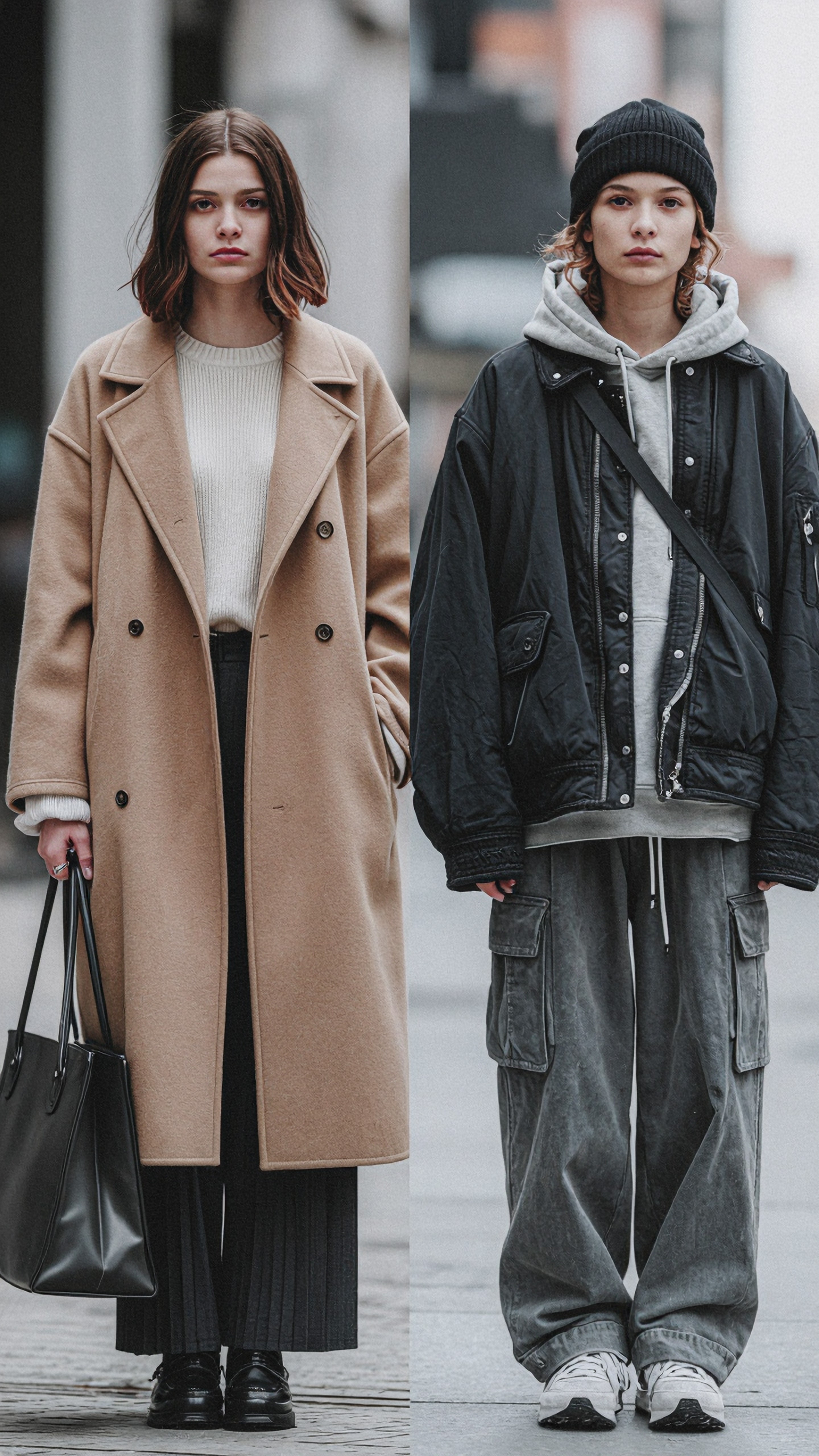
Inspect whether the image actually creates two distinct style systems. The strongest result should make the garments readable at a glance. The weak point is usually that both outfits collapse toward the middle and look like generic city fashion.
First improvement: lock the silhouette and styling hierarchy
The baseline often gives a decent comparison, but not a precise one. The first improvement is to define what sits over what, how long each garment should be, and what the pants and shoes are doing.
That change matters more than adding more adjectives.
This test checks whether the model respects tailored proportion in the quiet luxury look.
Topic: Quiet luxury outfits full-body street-style test
Genre: Street Style
Camera: Nikon Z8
Lens: 35mm f/2.8
Lighting: Bright overcast diffusion
Location: Upper East Side sidewalk with muted storefront reflections
Style: Minimal luxury fashion coverage
Final Prompt: street-style full body fashion image of quiet luxury outfits in a New York upscale neighborhood, styling system visible from head to toe, long single-breasted camel coat worn open over a fine cream mock-neck knit, high-waisted charcoal pleated trousers with a relaxed straight leg, polished black loafers, structured dark leather tote, slim belt, subtle gold watch, soft tucked hair, neutral expression, walking pose with one step forward, coat movement minimal, palette of camel cream charcoal and black, no visible logos, emphasis on fabric quality and fit accuracy, Nikon Z8 documentary editorial look, 35mm framing, realistic sidewalk depth, clean composition, refined fashion-week street coverage aesthetic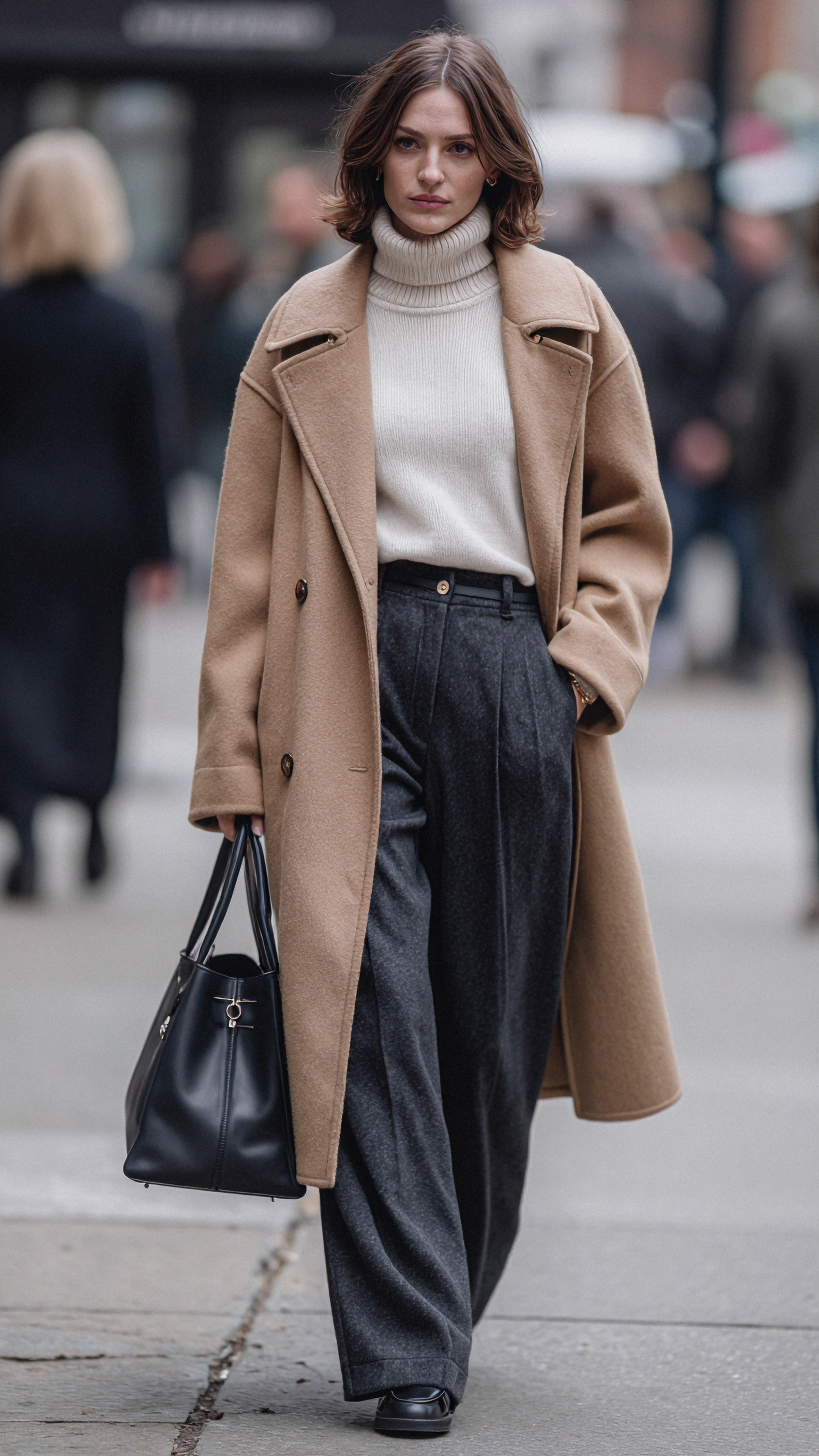
Look at trouser break, coat length, and bag shape. Quiet luxury fails when the coat gets too dramatic, the knit turns chunky and casual, or the bag becomes loud and trendy instead of structured.
Refined prompt: give streetwear enough structure to stay coherent
Streetwear needed more scaffolding in this test. If the prompt was too loose, the model added extra layers, stray graphics, or impossible sneaker proportions.
This test checks style lock for American streetwear while keeping the outfit commercially readable.
Topic: American streetwear full-body sidewalk outfit
Genre: Street Style
Camera: Sony A7R V
Lens: 40mm f/2.5
Lighting: Late afternoon side light with soft building bounce
Location: SoHo corner with crosswalk, concrete, and retail windows
Style: Contemporary US streetwear editorial
Final Prompt: street-style full body fashion shot of American streetwear on a SoHo corner, oversized washed black bomber jacket layered over a heather gray hoodie and long white tee hem, loose olive cargo pants with visible pocket structure, classic high-top basketball sneakers in off-white and black, knit beanie, silver chain, compact crossbody bag, relaxed stance near crosswalk, complete outfit logic visible, layered proportions intentional, urban energy without clutter, no oversized logos, no extra accessories beyond listed items, realistic late afternoon light, Sony A7R V crisp editorial detail, 40mm street fashion framing, textured concrete and storefront reflections, trend-led US fashion mood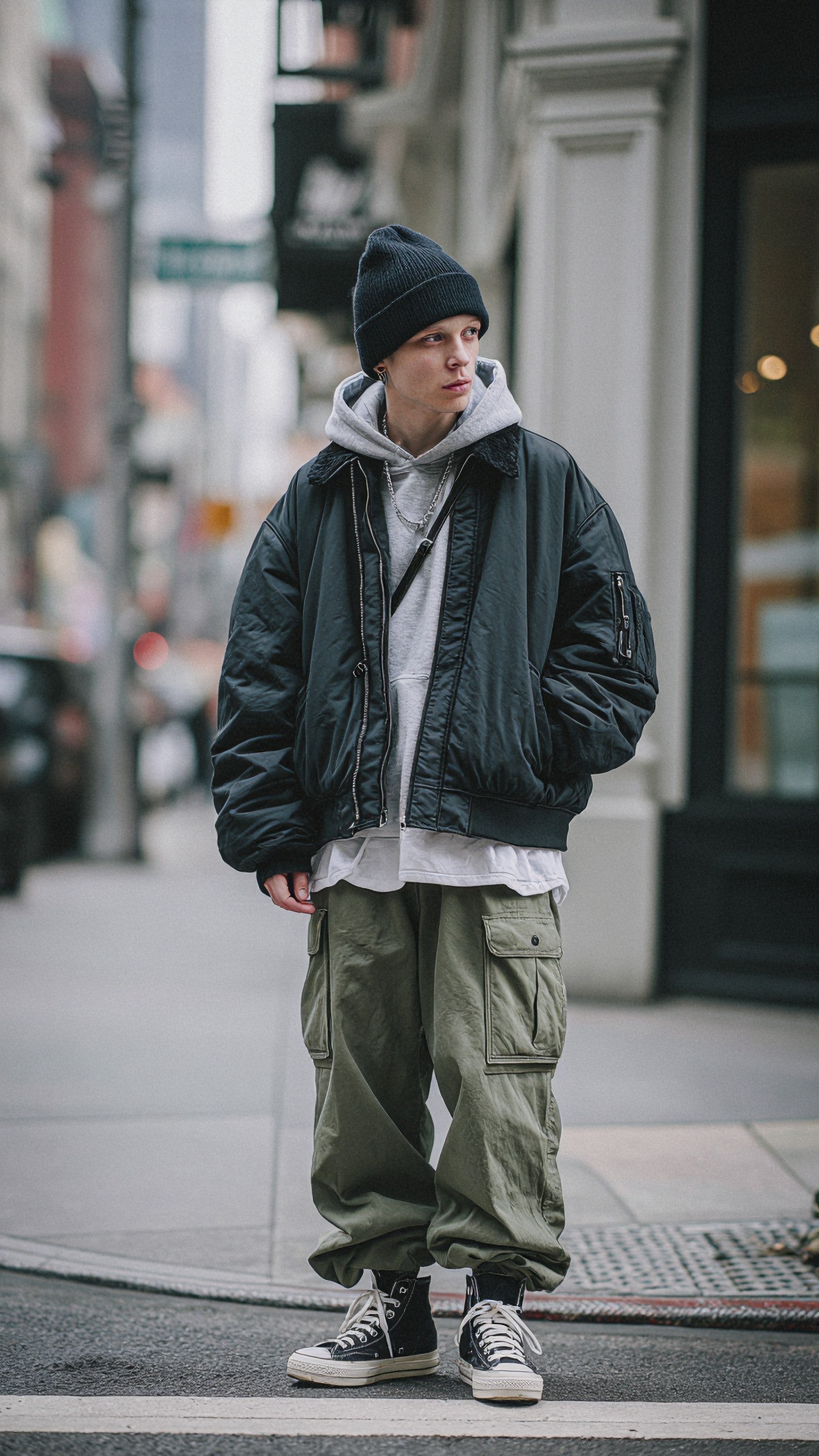
Inspect the sneaker scale and whether the tee, hoodie, and bomber stack in the right order. The weak point is often layer inflation: sleeves too big, hem lengths inconsistent, or pants ballooning into costume territory.
Where quiet luxury is winning this week in image generation
In this test, quiet luxury won three practical categories:
1. Cleaner first-pass accuracy
The model usually understood tonal dressing faster than it understood complex streetwear layering. That means fewer rerolls when you need a thumbnail or comparison hero image quickly.
2. Better fabric readability
Wool, poplin, leather, and cashmere-like textures rendered more consistently than fleece, technical nylon, stacked jersey, and distressed denim combinations.
3. Easier adaptation across formats
Quiet luxury translated well from street-style shots to retail displays, catalog pages, and detail macros. Streetwear looked best in environment-heavy shots but lost precision in catalog-like formats.
This prompt tests whether quiet luxury still reads when moved from street coverage into a more controlled editorial frame.
Topic: Quiet luxury three-quarter outfit editorial
Genre: Fashion Editorial
Camera: Fujifilm GFX100S
Lens: 45mm f/2.8
Lighting: Large north-window daylight with white bounce
Location: Quiet hotel corridor with stone floor and warm wood accents
Style: Luxury fashion campaign
Final Prompt: three-quarter outfit editorial focused on quiet luxury trend styling, model secondary to wardrobe, double-breasted navy blazer with soft tailoring over a white poplin shirt, fine knit draped neatly under the blazer, ivory wide-leg tailored trousers, dark brown leather loafers, structured top-handle bag, slim gold earrings, understated grooming, standing near a hotel corridor wall with subtle turn of the body, visible garment lines and fabric drape, palette of navy ivory white and dark brown, controlled minimal luxury campaign feel, Fujifilm GFX100S medium-format clarity, 45mm natural editorial perspective, soft window daylight, polished but restrained composition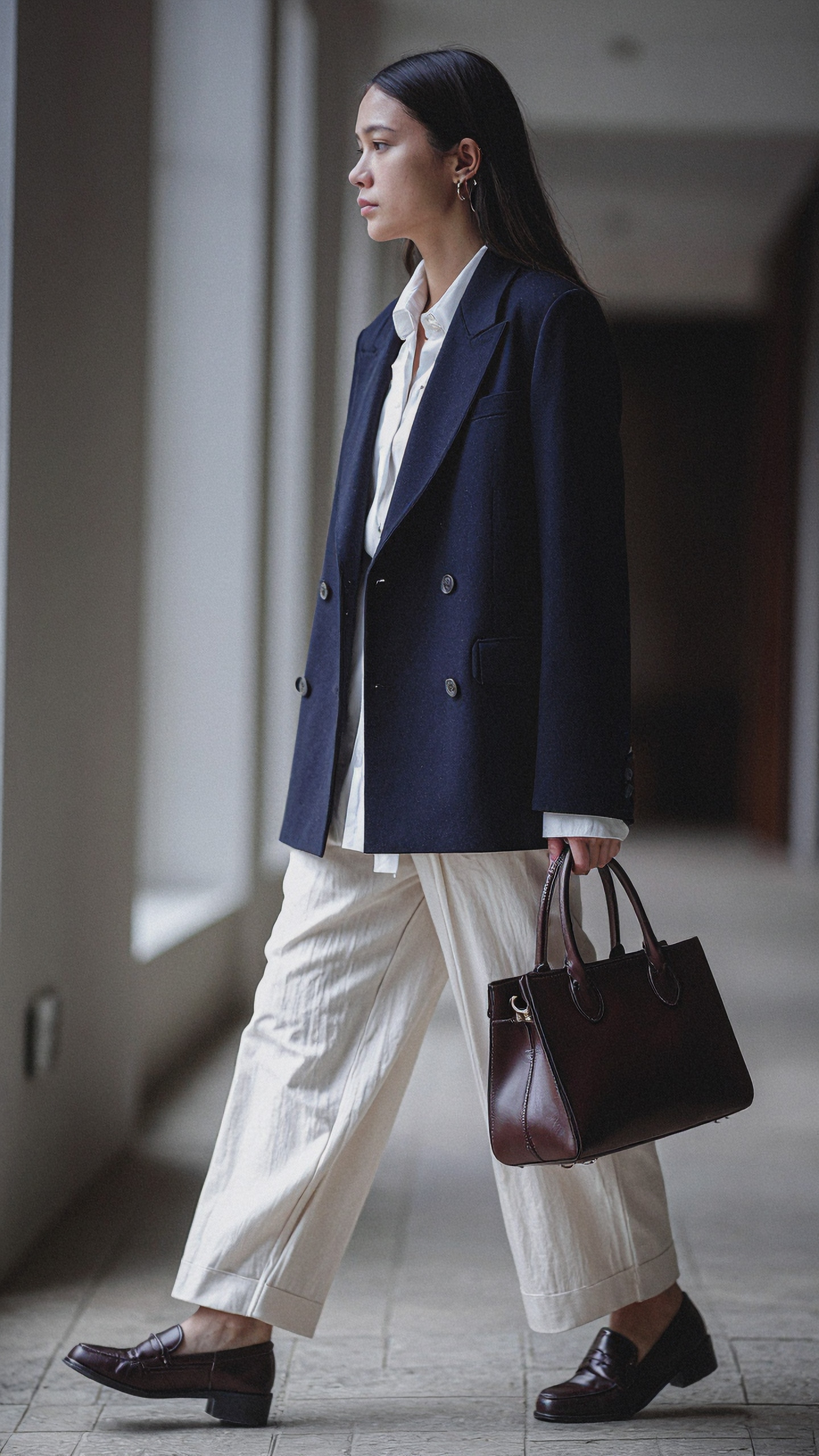
Check whether the shirt collar, blazer lapel, and trouser line remain crisp. A strong output should look intentional, not sterile. If it feels like officewear, the prompt needs a better luxury cue through fabric and bag choice.
Where streetwear still wins
Streetwear was not the weaker style overall. It was the riskier one. When it worked, it delivered images that felt more current and socially native.
Best for trend signal
If you need an image that instantly reads “US fashion trends,” streetwear is faster at telegraphing cultural context.
Best for movement and attitude
Layered outerwear, sneakers, and casual stance create more visual motion. That helps covers, carousels, and social crops.
Best when background matters
Streetwear often needs the city to complete the picture. The scene is part of the styling logic.
This test checks whether a more editorial streetwear shot can stay readable without devolving into random accessories.
Topic: American streetwear three-quarter outfit editorial
Genre: Fashion Editorial
Camera: Leica SL2
Lens: 50mm f/2
Lighting: On-camera flash mixed with dusk ambient light
Location: Lower Manhattan sidewalk outside a closed metal shutter
Style: Downtown street-fashion editorial
Final Prompt: three-quarter outfit editorial of American streetwear at dusk in Lower Manhattan, oversized charcoal varsity jacket over a faded graphic hoodie, baggy dark denim with a clean stack over retro sneakers, baseball cap, wired headphones around neck, silver ring and chain, one hand in pocket, body angled toward camera, flash-lit foreground with ambient blue dusk background, strong layering order visible, modern downtown energy, no chaotic logos, no duplicated accessories, realistic metal shutter texture, Leica SL2 fashion-documentary look, 50mm framing, gritty but controlled street style image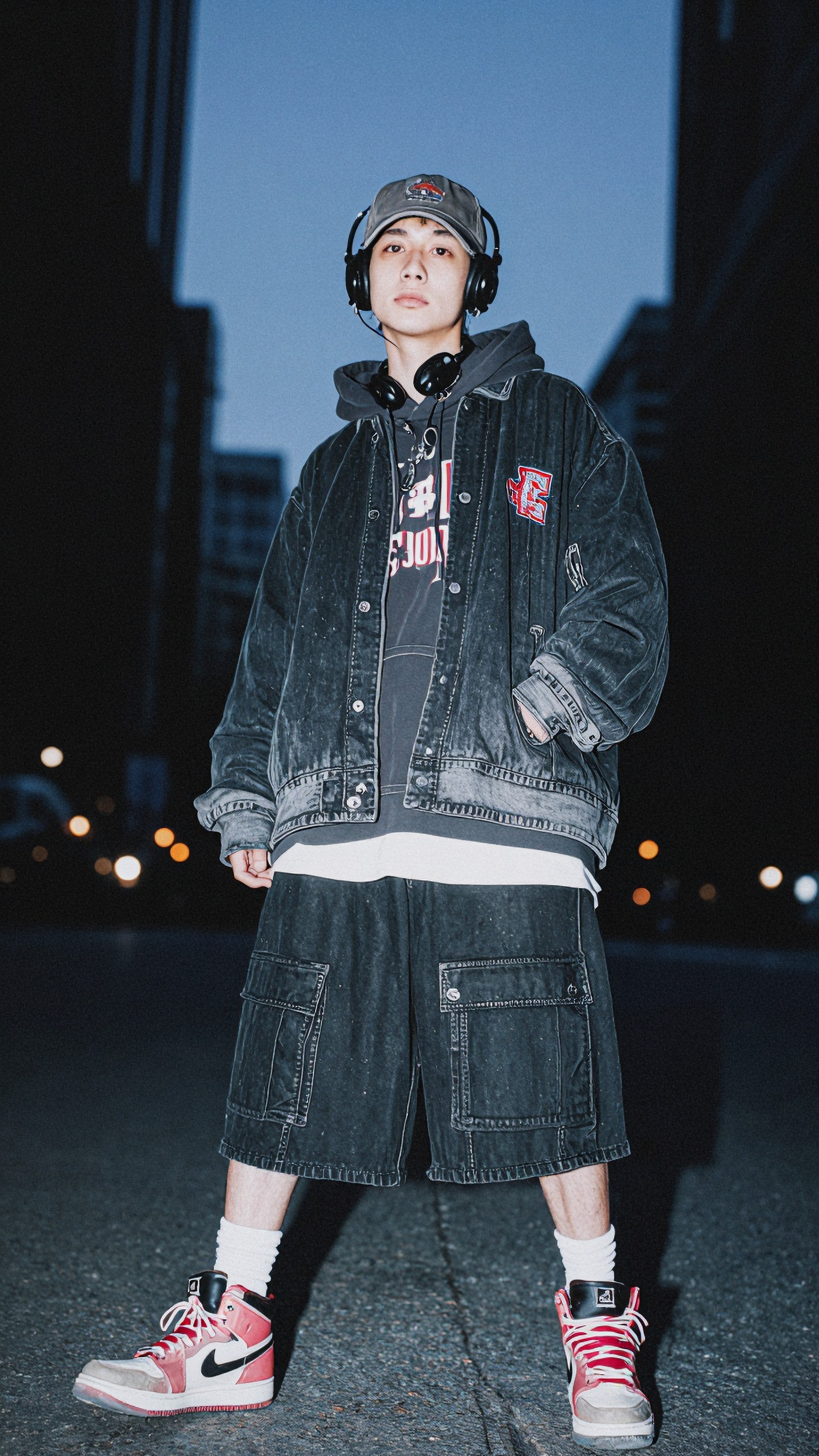
Inspect hand rendering, cap shape, and denim stack. Flash can help streetwear separate from the background, but it also reveals proportion mistakes more aggressively.
Prompt examples for catalog and lookbook comparison
The next failure point was format shift. A lot of prompts look good in a single editorial frame and fall apart in retail or lookbook layouts.
This test checks whether quiet luxury can hold up in a clean head-to-toe lookbook format.
Topic: Quiet luxury head-to-toe lookbook outfit
Genre: Lookbook Photography
Camera: Hasselblad X2D 100C
Lens: 55mm f/2.5
Lighting: Soft studio key light with low-contrast fill
Location: Seamless warm gray studio backdrop
Style: Clean luxury lookbook
Final Prompt: head-to-toe lookbook image of quiet luxury outfits on a seamless warm gray studio backdrop, styling-focused full-body pose with arms relaxed and feet visible, ivory longline coat, oatmeal cashmere crewneck, black tailored ankle-length trousers, dark espresso leather loafers, slim belt, structured shoulder bag, subtle earrings, refined neutral expression, minimal luxury outfit hierarchy clearly visible, precise hem length, rich textile detail, no dramatic pose, no beauty-first framing, Hasselblad X2D 100C high-detail studio fashion look, 55mm clean perspective, soft low-contrast light, premium retail-ready presentation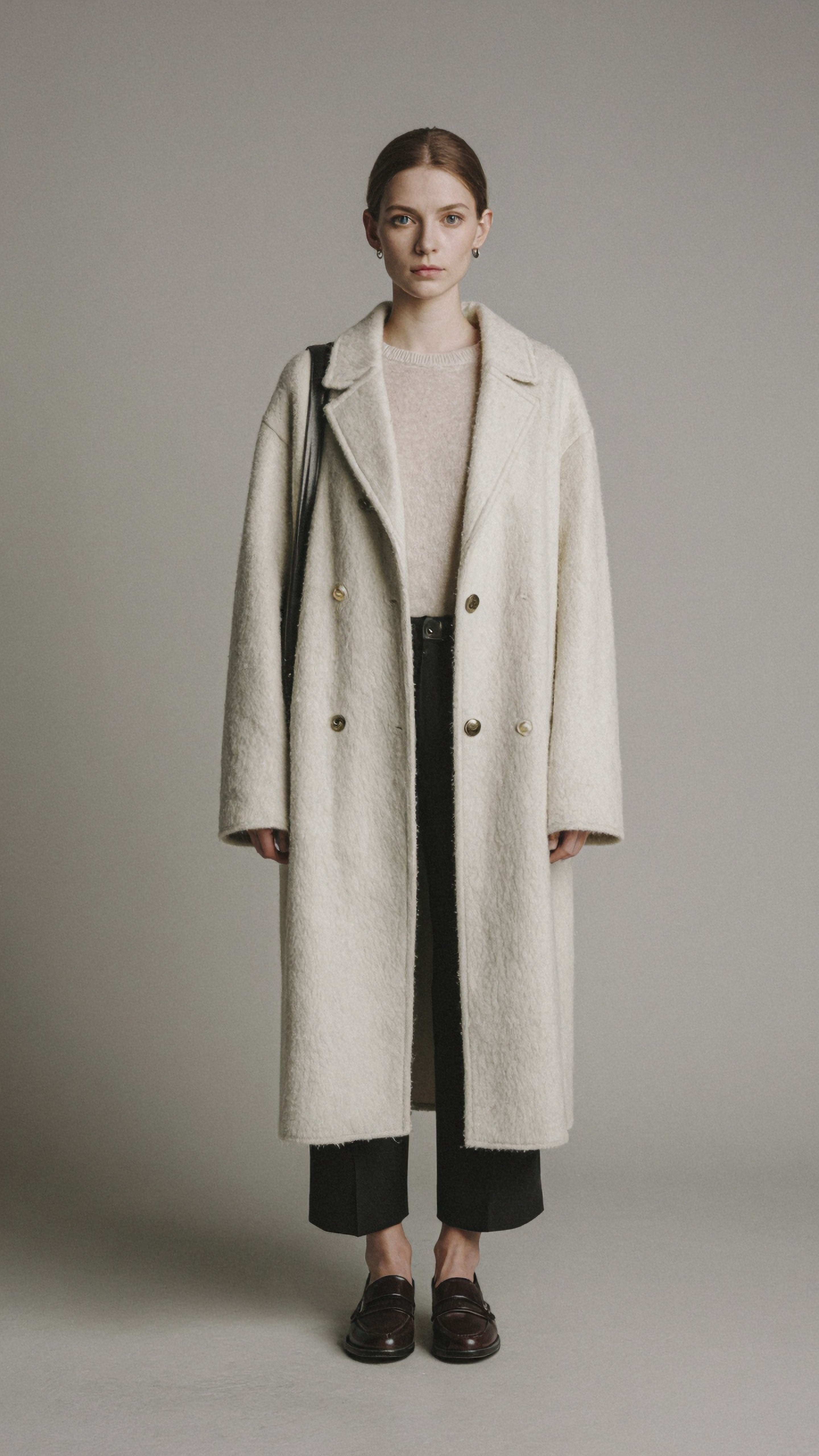
The key inspection point is whether the silhouette stays elegant rather than flat. If the output feels lifeless, add one movement cue such as a slight turn or coat opening, not a stronger light setup.
This test checks a streetwear catalog-grid setup, which is where many models start to lose consistency between panels.
Topic: American streetwear catalog grid page
Genre: Product Editorial
Camera: Canon EOS R3
Lens: 70mm f/4
Lighting: Even studio softbox setup
Location: Neutral studio cyclorama for multi-panel layout
Style: Modern streetwear catalog page
Final Prompt: catalog grid page showing American streetwear outfit variations in four clean panels, each panel full-body and styling-led, core outfit remains consistent with oversized navy coach jacket, ash gray hoodie, white tee layer, loose black carpenter pants, classic skate sneakers, baseball cap, canvas tote, panel one front view, panel two side view, panel three walking motion, panel four seated retail-style pose, neutral studio background, even lighting, consistent proportions across panels, no extra random accessories, no text, no logos, fashion catalog clarity, Canon EOS R3 commercial precision, 70mm controlled retail framing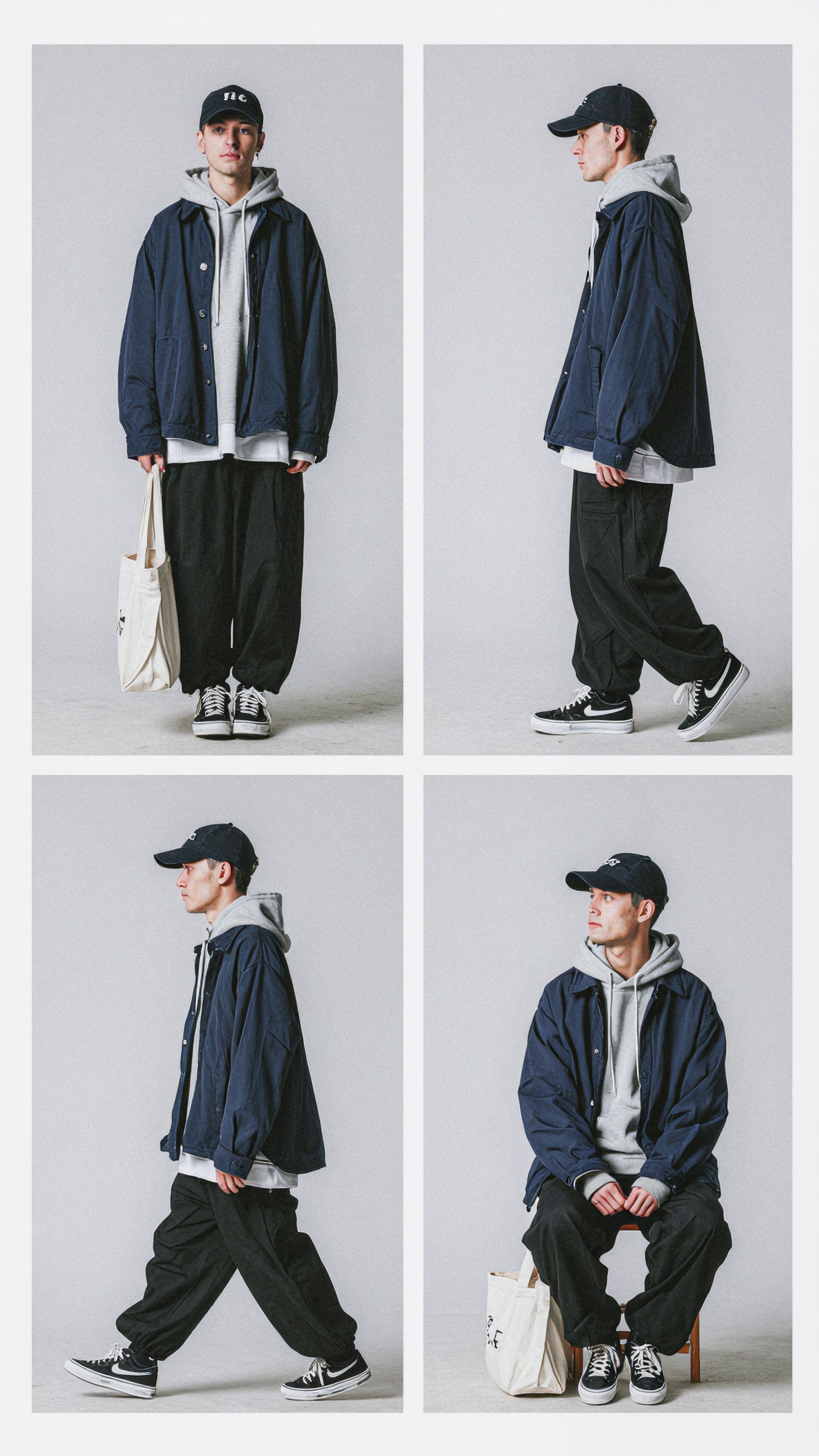
Look for panel drift. The common failure is that each frame mutates into a different outfit. If consistency breaks, reduce the number of accessories before you simplify the clothing.
Likely failure points: what breaks first
Quiet luxury failures
- outfit becomes generic business casual
- fabrics lose hierarchy and all read as the same matte texture
- accessories become too sparse and the look lacks luxury signal
- studio outputs become sterile and e-commerce-like
Streetwear failures
- oversized pieces become shapeless instead of intentional
- sneakers mutate in scale or detail
- graphics and logos appear even when not asked for
- too many accessories compete with the clothing
- poses bend the outfit, hiding the silhouette you wanted to compare
This test isolates a runway/backstage moment to see which style remains coherent in motion-heavy context. Streetwear often gains energy here, but consistency is fragile.
Topic: Streetwear vs quiet luxury backstage runway comparison
Genre: Runway Documentary
Camera: Nikon D850
Lens: 24-70mm at 50mm f/3.5
Lighting: Mixed backstage practicals with soft diffused key
Location: New York fashion week backstage corridor
Style: Fashion documentary realism
Final Prompt: runway backstage moment comparing two styling directions in a New York fashion week corridor, one look built around quiet luxury with charcoal long coat, cream knit, tailored black trousers and polished loafers, second look built around American streetwear with oversized technical parka, gray hoodie, loose cargo trousers and retro sneakers, both outfits visible head to toe while assistants and racks stay soft in background, candid movement but styling remains readable, backstage realism, garment textures and layering emphasized, no giant logos, no crowd clutter dominating frame, Nikon D850 documentary fashion feel, 24-70mm at 50mm, mixed practical light controlled for clean detail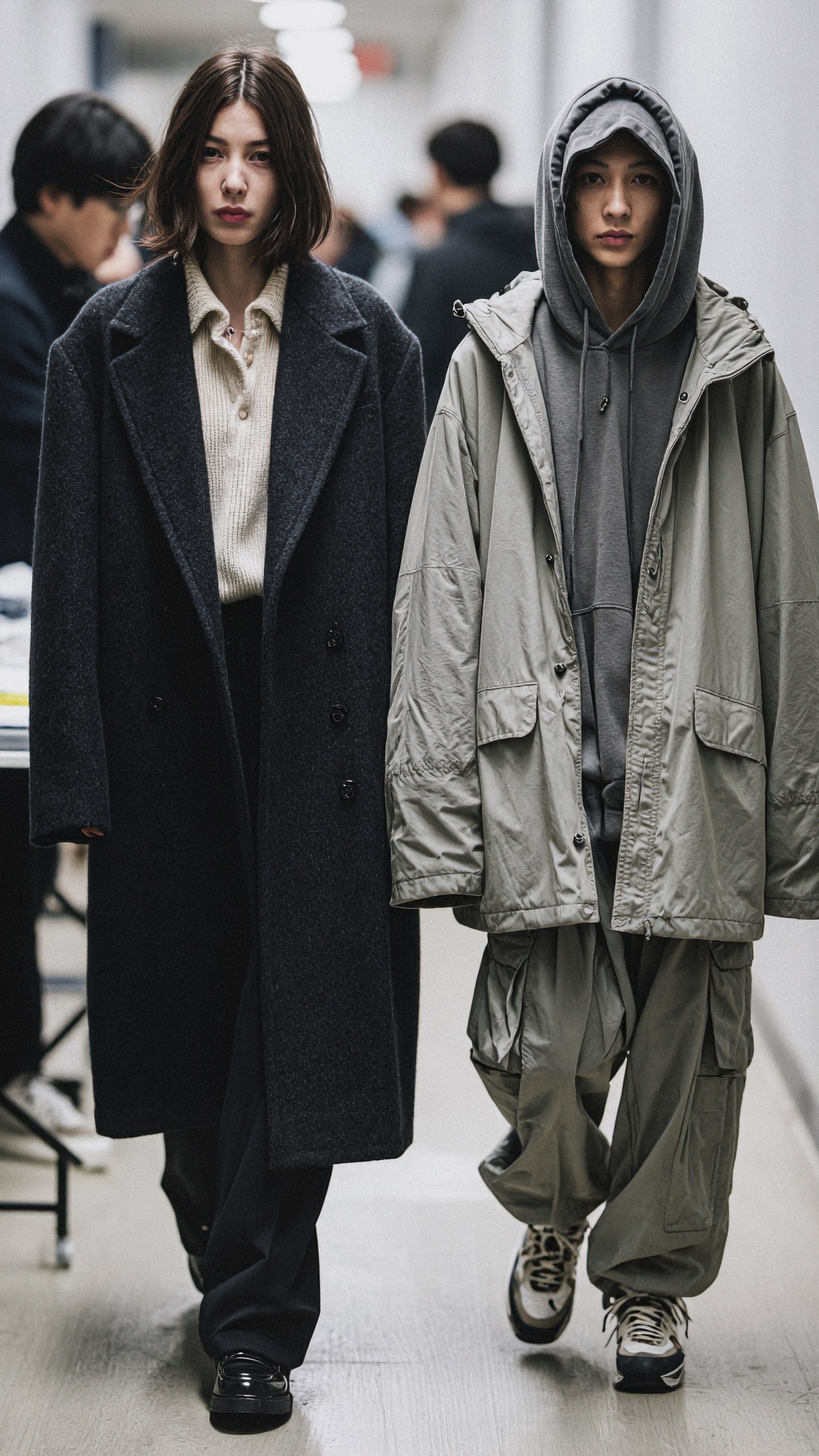
Inspect whether the background steals attention. A good result keeps the backstage atmosphere while preserving outfit clarity. If not, the prompt needs stronger instruction on subject priority.
Product and retail scenes: where the comparison gets more useful
Trend comparison becomes more practical when you test whether the styling system also works without a person. This is where quiet luxury widened its lead.
This prompt checks whether a storefront display can express minimal luxury outfits through merchandising alone.
Topic: Quiet luxury storefront display
Genre: Retail Visual Merchandising
Camera: Sony A1
Lens: 35mm f/4
Lighting: Warm interior retail lighting with soft window reflection
Location: Madison Avenue boutique window display
Style: Minimal luxury retail campaign
Final Prompt: storefront display for quiet luxury outfits in a Madison Avenue boutique window, mannequin styling shown head to toe with long camel wrap coat, cream silk blouse, stone wide-leg trousers, dark leather belt, polished loafers, structured handbag on pedestal, folded knitwear and leather accessories arranged nearby, restrained palette, premium materials visible through glass, elegant retail spacing, warm interior lighting, subtle city reflections, visual merchandising focused on outfit logic and fabric quality, Sony A1 commercial detail, 35mm storefront framing, clean upscale American retail mood
Check whether the mannequin styling remains believable and whether the accessory scaling makes sense. Quiet luxury usually succeeds here because the visual merchandising is already built around restraint.
This test checks a flatter product-led streetwear setup, where the style can become generic unless texture and layering are explicit.
Topic: American streetwear product flat lay
Genre: Product Editorial
Camera: Phase One XF IQ4
Lens: 80mm f/5.6
Lighting: Overhead diffused studio light
Location: Concrete tabletop studio set
Style: Streetwear product editorial
Final Prompt: product flat lay of American streetwear outfit components on a concrete tabletop, oversized faded black hoodie, olive cargo pants, vintage high-top sneakers, ribbed beanie, silver chain, crossbody bag, white crew socks, all arranged in a clear head-to-toe outfit system, sleeves and pant legs positioned naturally, texture detail in fleece denim-like twill and leather, muted downtown palette, no logos, editorial retail composition rather than marketplace layout, Phase One high-detail commercial capture, overhead view, clean spacing, trend-led US streetwear merchandising
Inspect edge cleanup and whether the items feel like a coherent outfit rather than random products. This setup works well for article graphics because it reduces anatomy errors entirely.
Detail prompts: texture, accessories, and why they matter
The image comparison became more convincing when I stopped relying only on full-body shots. Detail crops gave better evidence for what separates the two aesthetics.
This test checks if the model understands quiet luxury through accessories and material restraint rather than obvious statement pieces.
Topic: Quiet luxury accessories close-up
Genre: Luxury Product Campaign
Camera: Canon EOS R5 Mark II
Lens: 85mm f/2
Lighting: Soft directional window light with subtle bounce
Location: Marble console in a refined hotel suite
Style: Understated luxury accessories editorial
Final Prompt: accessories close-up expressing quiet luxury trend on a marble console in a refined hotel suite, structured dark brown leather bag, slim gold watch, black leather loafers, folded cream cashmere knit, tortoiseshell sunglasses, silk scarf partly visible, tonal arrangement with negative space, premium material realism, soft shadows, no monograms, no clutter, luxury editorial composition, Canon EOS R5 Mark II crisp accessory detail, 85mm controlled depth, sophisticated minimal palette of cream espresso black and gold
Look for leather finish and hardware discipline. If the image adds flashy embellishment, the model is drifting away from quiet luxury and needs stricter wording around restraint.
Reusable prompt pattern for streetwear vs quiet luxury
After eight test types, the reusable pattern was simple: define the outfit architecture first, then the scene, then the camera. Not the other way around.
Prompt pattern
- Shot type: street-style full body, lookbook, catalog grid, storefront display, runway/backstage, flat lay, detail macro, accessories close-up, mood-board collage
- Style direction: quiet luxury or American streetwear
- Outer layer: specific garment and cut
- Core layer: knit, shirt, tee, hoodie, blouse
- Bottom: trouser, denim, cargo, skirt with fit description
- Shoes: exact category
- Accessories: 2 to 4 max
- Palette: keep it controlled
- Location: fashion-relevant US context
- Lighting: chosen to support textile separation
- Constraint line: no logos, no extra accessories, full outfit visible, styling-focused
This final test uses a mood-board collage to compare both directions in one visual planning sheet. It is useful before committing to a full campaign batch in [Create](/create) or building variants in [Tools](/tools).
Topic: Quiet luxury outfits vs American streetwear mood-board collage
Genre: Mood Board Collage
Camera: Mixed editorial reference capture style
Lens: Mixed 35mm and 85mm editorial crops
Lighting: Mixed daylight, studio soft light, and city dusk references
Location: New York fashion editorial planning board
Style: Trend-led comparative fashion direction board
Final Prompt: mood-board collage comparing quiet luxury outfits and American streetwear as current US fashion trends, balanced editorial planning board with full-body outfit reference, fabric swatches, shoe and bag details, storefront and sidewalk scene fragments, quiet luxury side built from camel coat, ivory tailoring, leather loafers, structured bag, wool and cashmere textures, streetwear side built from bomber jacket, hoodie, loose cargos, retro sneakers, cap and crossbody bag, muted contemporary palette with clear contrast between polished minimal luxury and layered downtown casual, magazine art-direction layout, no text overlays, no brand logos, styling system more important than faces, mixed crop sizes, sophisticated editorial mood
Inspect whether the collage communicates two distinct systems without becoming messy. This is one of the safest ways to plan a comparison article because it tolerates variation better than full-body generation.
Practical recommendations
Use quiet luxury when you need:
- cleaner first-pass outputs
- luxury retail or editorial layouts
- minimal luxury outfits with visible tailoring
- comparison thumbnails where the outfit must read instantly
Use American streetwear when you need:
- stronger trend energy
- social-first urban context
- more movement and attitude
- youth-oriented US fashion trends coverage
What I would change next
If I were extending this test, I would split streetwear into two narrower buckets:
- classic New York streetwear
- cleaner contemporary luxury-street crossover
The broad term American streetwear pulls in too many visual subcultures. That is a big reason outputs drift.
Output quality checklist
Before saving a winner, check these quickly:
- Is the full silhouette readable in under two seconds?
- Do the layers make physical sense?
- Are shoes proportionate to pant volume?
- Does the palette support the intended trend?
- Are accessories helping the style or just adding noise?
- Does the location reinforce the outfit instead of distracting from it?
If two or more of these fail, reroll with fewer accessories and stricter garment descriptions rather than adding more quality buzzwords.
FAQ
What is the difference between quiet luxury outfits and streetwear in prompts?
Quiet luxury prompts rely on tailoring, fabric hierarchy, restraint, and tonal palettes. Streetwear prompts rely on layering, relaxed proportion, sneakers, and a stronger city-context signal.
Which style is easier for AI image generation right now?
In this test, quiet luxury was easier to control. Streetwear produced more exciting wins, but also more broken outputs.
How do I stop streetwear prompts from getting messy?
Limit accessories, specify layer order, avoid broad wording like “trendy streetwear,” and define pant and sneaker proportions clearly.
How do I make quiet luxury not look boring?
Add one high-value material cue, one structured accessory, and a fashion-relevant location such as an upscale sidewalk, boutique window, or hotel corridor.
Should I use logos for American streetwear prompts?
Usually no. Logos often create clutter or legal-looking knockoff details. In this test, cleaner non-logo prompts gave more usable results.
Conclusion
For quiet luxury outfits vs streetwear, quiet luxury is winning this week if your priority is clean execution, better outfit readability, and lower prompt friction. Streetwear is still the better choice when you need trend heat, movement, and a stronger US street context, but it asks for tighter control.
This workflow is best for editors, prompt builders, and creators making comparison visuals, lookbooks, or trend explainer graphics. Avoid it if you want spontaneous abstract fashion imagery; the method is deliberately structured and styling-first.
The prompt detail that matters most is simple: name the shot type, then lock the outfit architecture. Once the garments, layer order, and accessories are stable, the camera and mood can do their job. For more iterative testing, build variants in [Prompt Lab](/promptlab), review outcomes in [Gallery](/gallery), and compare prompt edits across [Articles](/articles).