Runway Outfit Ideas This Week: Turning Catwalk Trends Into Current AI Fashion Photography 한국어 요약
이 페이지는 ZView Space의 영어 원문을 한국어 검색 사용자도 이해할 수 있도록 정리한 SEO 요약입니다. 핵심은 단순한 얼굴 중심 이미지가 아니라 패션 에디토리얼, 룩북, 아웃핏, 프롬프트 테스트, 이미지 생성 워크플로우를 실제로 어떻게 구성할지입니다.
핵심 요약
- 원문 주제: Runway Outfit Ideas This Week: Turning Catwalk Trends Into Current AI Fashion Photography
- 목적: AI 이미지 생성에서 outfit, silhouette, fabric, pose, location, camera framing을 더 명확하게 설계합니다.
- 활용 범위: Z-Image Turbo, Krea2 Turbo, Qwen Image, Anima, SeedVR2 같은 이미지 생성 및 업스케일 워크플로우에 적용할 수 있습니다.
- SEO 관점: 제목, 설명, 이미지 alt, 프롬프트 예시가 실제 검색 의도와 맞아야 색인 가능성이 높아집니다.
한국어 사용자를 위한 체크포인트
1. 프롬프트가 얼굴 묘사에만 머물지 않고 전체 스타일과 의상 구성을 설명하는지 확인합니다. 2. 패션 이미지라면 상의, 하의, 아우터, 신발, 액세서리, 소재감, 촬영 장소를 분리해서 씁니다. 3. 생성 결과는 바로 게시하지 말고 디테일, 손, 의상 형태, 배경 일관성, 이미지 품질을 비교합니다. 4. 글 본문에는 실제 테스트 기준과 실패를 줄이는 방법이 들어가야 검색엔진에서 얇은 콘텐츠로 보일 가능성이 줄어듭니다.
원문 미리보기
This week’s runway outfit ideas this week test was less about chasing one trend and more about translating catwalk signals into images that still read like usable fashion photography. In this test, the strongest outputs came from prompts that treated styling a
---
This week’s runway outfit ideas this week test was less about chasing one trend and more about translating catwalk signals into images that still read like usable fashion photography. In this test, the strongest outputs came from prompts that treated styling as a system: outerwear, base layer, bottom, shoes, bag, jewelry, and setting all specified together. The weak outputs were the usual AI failures: trend soup, broken layering logic, and images that looked expensive but not current.
Quick answer
- The best AI fashion images came from prompts built around one silhouette direction, not a list of trends.
- Street-style full body and head-to-toe lookbook shots were the most reliable for showing runway outfit ideas clearly.
- If you want a luxury fashion editorial feel, lock the fabric story and accessory hierarchy before adding mood words.
- Backstage and storefront scenes worked well for trend context, but only when garment details were named directly.
- For cleaner results, start with styling logic first, then camera, lighting, and location.
Test setup: what was tested
I tested a simple workflow for converting current catwalk cues into image prompts for AI fashion photography:
1. Pick one runway direction per image. 2. Translate it into visible outfit structure. 3. Choose a shot type that proves the styling. 4. Add environment only after the clothes are fully described.
The trend directions used in this round were:
- oversized tailored outerwear
- sheer layering over structured basics
- silver accessories with dark neutrals
- low-slung trousers with sharp jackets
- utility streetwear with luxury finishing
- soft beige retail minimalism
- backstage monochrome styling
- texture-first accessories and garment details
I used this as a prompt-planning exercise rather than a single-tool comparison. If you want to generate and refine these quickly, the practical combo is [Create](/create) for image runs and [PromptLab](/promptlab) for tightening style language.
The main finding: current beats dramatic
The best images did not look like fantasy runway stills. They looked like campaign, lookbook, or street-style frames that borrowed from current runway logic. That matters because the search intent here is inspiration. People looking for runway outfit ideas this week usually want styling direction they can adapt, not abstract spectacle.
The strongest result used a full-body street-style setup with one clear silhouette: long charcoal coat, fine knit layer, wide-leg trouser, pointed boots, sculptural tote, silver earrings. That produced an image that felt current because every piece supported the same line.
Best result: street-style full body with one silhouette anchor
This was the most reliable format in the test. Full-body framing exposed whether the outfit actually worked from shoulder to shoe. It also reduced the common AI habit of hiding weak garment transitions behind crops.
This prompt tests silhouette control and whether the model can hold a coherent outerwear-led look without inventing random extra layers.
Topic: Runway-inspired charcoal tailoring with silver accents
Genre: Street Style
Camera: Canon EOS R5
Lens: 40mm f/2.8
Lighting: Overcast diffusion
Location: Paris sidewalk outside a fashion week venue, muted stone facade, light traffic blur
Style: Luxury fashion street editorial
Final Prompt: street-style full body fashion photograph of a current runway-inspired outfit, model secondary to styling, long charcoal oversized wool coat worn open over a fine black knit top, low-slung wide-leg tailored trousers, pointed black leather ankle boots, structured dark gray tote bag, slim silver earrings, narrow black belt, clean layered silhouette, walking across a Paris sidewalk outside a fashion week venue, full head-to-toe framing, natural stride, coat movement visible, restrained cool palette, sharp fabric texture, documentary fashion energy, Canon EOS R5 look, 40mm editorial framing, realistic garment drape, luxury fashion street editorial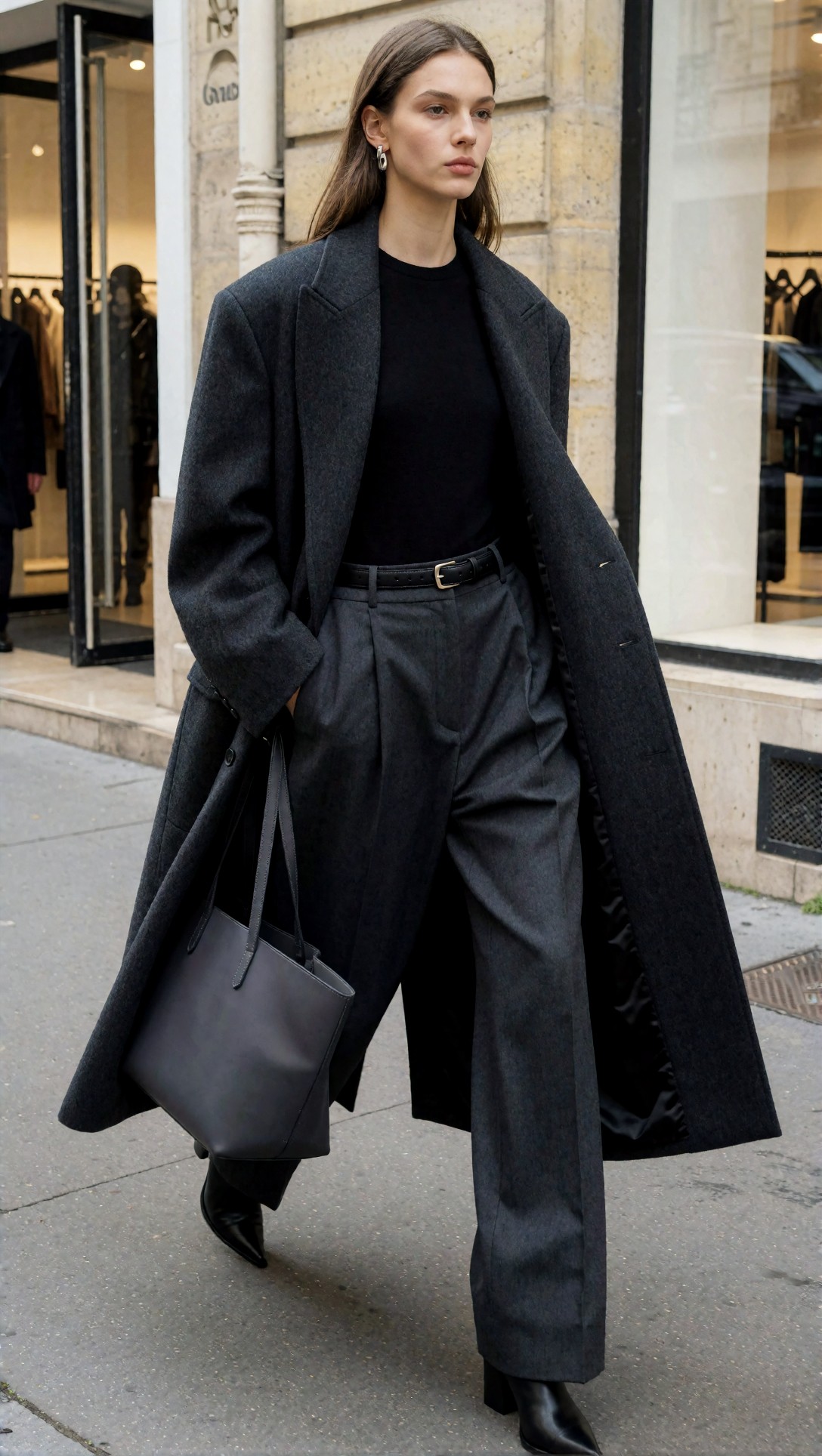
Inspect the coat opening, trouser break, and boot visibility first. In the strongest outputs, the silhouette read immediately; in weaker ones, the coat swallowed the trousers or the AI added a second phantom bag.
Why this worked
The prompt did three useful things:
- It named the hero garment first.
- It kept the palette narrow.
- It gave the AI a believable editorial setting instead of a vague “fashion city” backdrop.
When I compared this to more trend-packed prompts, the simpler version felt more current. Real runway influence usually arrives through proportion and styling tension, not six competing statement pieces.
Where runway outfit ideas became more editorial: three-quarter fashion framing
Three-quarter editorial shots worked best when the trend idea was about layering and texture rather than total silhouette. This was useful for editorial fashion AI images meant to feel magazine-led without losing outfit readability.
This prompt checks whether sheer layering can stay believable over structured garments, which is a common failure point in fashion image generation.
Topic: Sheer layering over structured tailoring
Genre: Fashion Editorial
Camera: Nikon Z8
Lens: 50mm f/2
Lighting: Soft window light with negative fill
Location: Minimal Paris studio with raw plaster walls and pale gray floor
Style: Contemporary luxury fashion editorial
Final Prompt: three-quarter outfit editorial photograph focused on current runway layering, translucent smoke-gray sheer top layered over a crisp white bandeau base and a sharply cut black cropped jacket, high-waisted column skirt with subtle slit, knee-high leather boots, compact silver shoulder bag, thin stacked bracelets, styling system clearly visible from shoulder to below knee, model standing with slight torso turn, neutral expression, soft window light with controlled shadow, pale gray studio, fabric transparency and structure both visible, restrained luxury palette, Nikon Z8 realism, 50mm magazine framing, elegant editorial composition, premium textile detail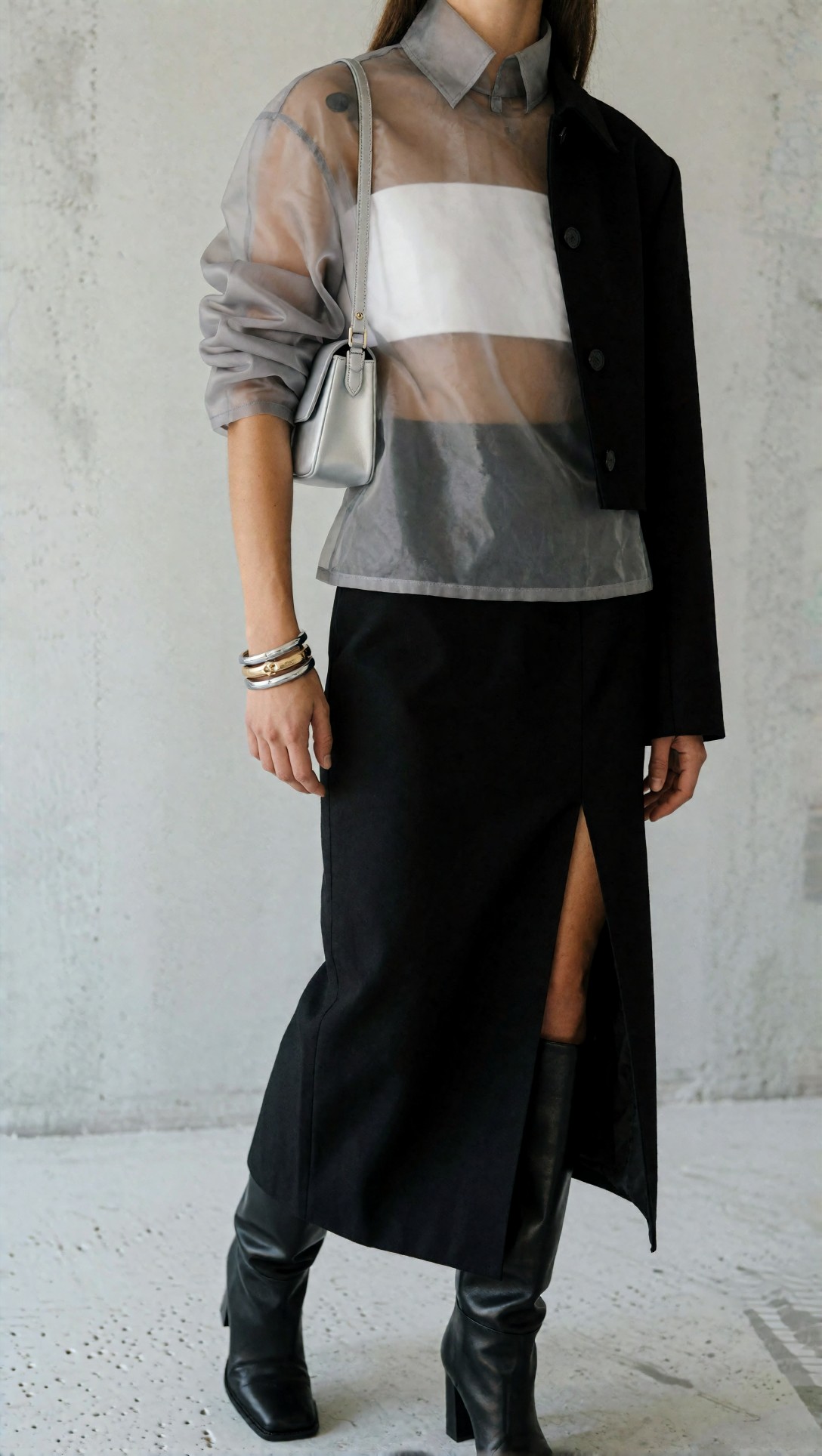
Check the transition between the sheer top, jacket hem, and waistband. The best outputs preserved the layered logic; weaker ones merged fabrics into a single synthetic-looking surface.
Practical checklist: which shot type worked for which runway idea?
| Shot type | Best for | What usually worked | Common failure | |---|---|---|---| | Street-style full body | Tailoring, outerwear, wide-leg shapes | Strong silhouette read, current fashion context | Extra accessories appear randomly | | Three-quarter outfit editorial | Sheer layers, jacket styling, bags | Better texture focus | Cropped framing can hide weak bottoms | | Head-to-toe lookbook | Clean commercial presentation | Best for outfit comparison and repeatability | Can feel flat if lighting is too generic | | Runway/backstage moment | Trend atmosphere, monochrome sets | Strong context and movement | Hands, badges, rails, and overlapping garments break easily | | Storefront display | Retail trend translation | Good for visual merchandising ideas | Reflections and text signage often distort | | Product/detail macro | Fabric, hardware, trims | Useful supporting image | Not enough for full outfit inspiration alone |
Head-to-toe lookbook gave the cleanest trend reference
If the goal is a usable visual board for lookbook photography, this was the most practical format. It was less exciting than street-style images, but more dependable when comparing several outfit directions side by side.
This prompt tests style lock and garment clarity in a neutral commercial setup.
Topic: Minimal runway lookbook with beige tailoring
Genre: Fashion Lookbook
Camera: Sony A7R IV
Lens: 35mm f/4
Lighting: Large softbox key with soft fill
Location: Seamless studio in warm ivory
Style: Clean commercial lookbook photography
Final Prompt: head-to-toe lookbook fashion image showing a runway-inspired minimal beige outfit, long sand-colored trench coat, fine ribbed cream knit top, straight-leg taupe trousers, dark chocolate loafers, slim leather belt, structured tan handbag, small gold hoop earrings, full outfit centered and fully visible, relaxed standing pose, clean ivory seamless background, even studio light, garment fit and silhouette prioritized over facial detail, soft luxury retail color palette, Sony A7R IV clarity, 35mm commercial framing, crisp catalog-grade styling accuracy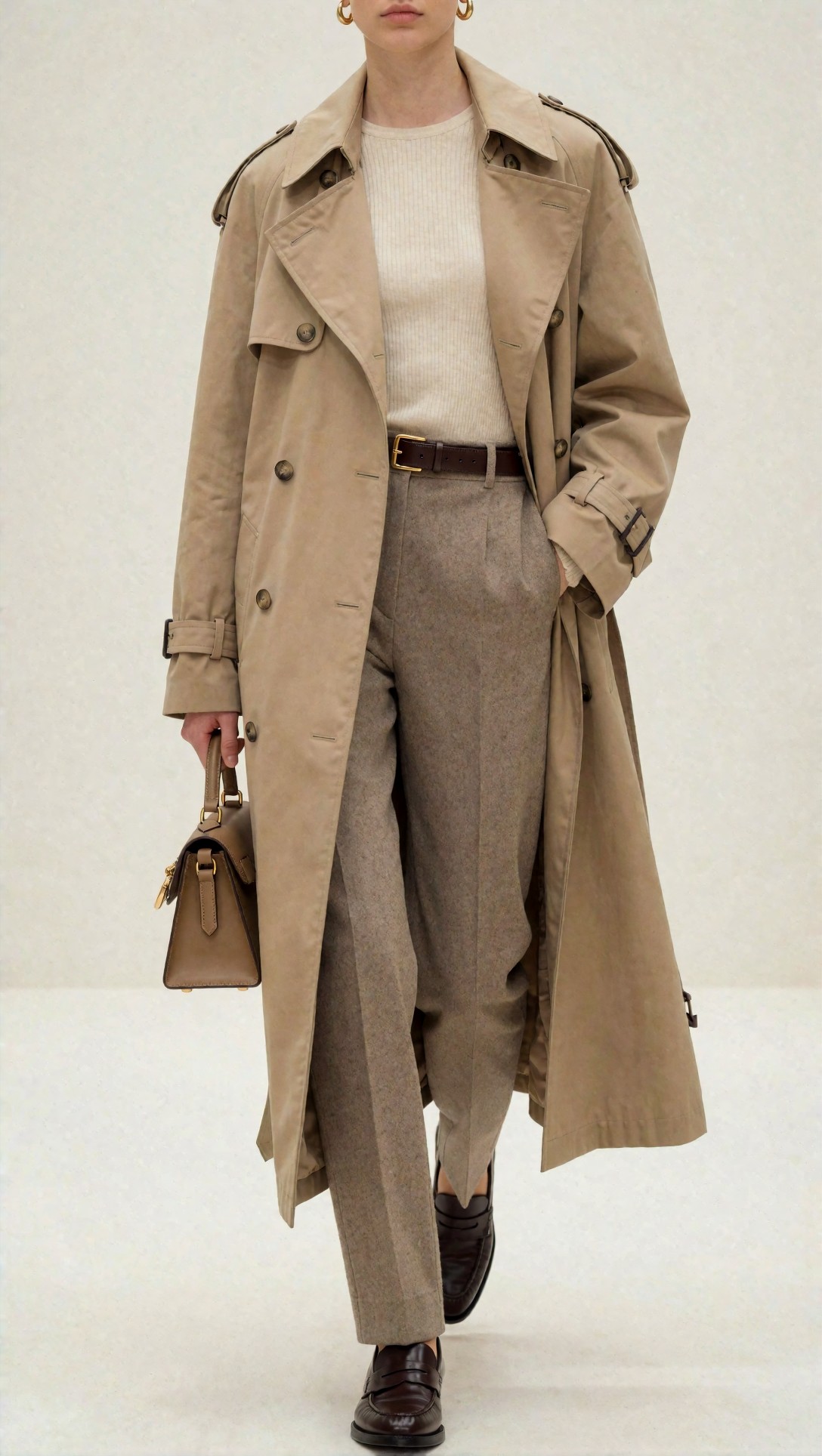
Inspect whether the shoes stay fully visible and whether the trench length matches the trouser shape. In the better renders, this looked close to premium e-commerce or press lookbook imagery.
When trend context mattered more than polish: runway/backstage scenes
Backstage prompts were useful for inspiration because they added urgency and realism. They also exposed how fragile some models are with layered garments, clothing racks, staff overlap, and partial motion.
This prompt checks background consistency and whether a monochrome styling story survives in a busy runway environment.
Topic: Monochrome backstage tailoring story
Genre: Documentary Fashion Editorial
Camera: Fujifilm GFX100S
Lens: 45mm f/2.8
Lighting: Mixed backstage LED and overhead practical light
Location: Milan runway backstage area with garment racks, mirrors, and taped floor marks
Style: High-end backstage fashion report
Final Prompt: runway backstage moment focused on styling, monochrome black and graphite outfit with cropped structured jacket, fluid wide trousers, square-toe boots, long leather gloves tucked under one arm, slim crossbody pouch, silver ear cuff, visible garment racks and mirror edges, model adjusting jacket cuff before lineup, head-to-toe outfit mostly visible in candid editorial framing, realistic backstage clutter kept orderly, cool mixed lighting, fashion week urgency, Fujifilm GFX100S medium-format detail, 45mm documentary composition, premium textile texture, authentic luxury fashion report atmosphere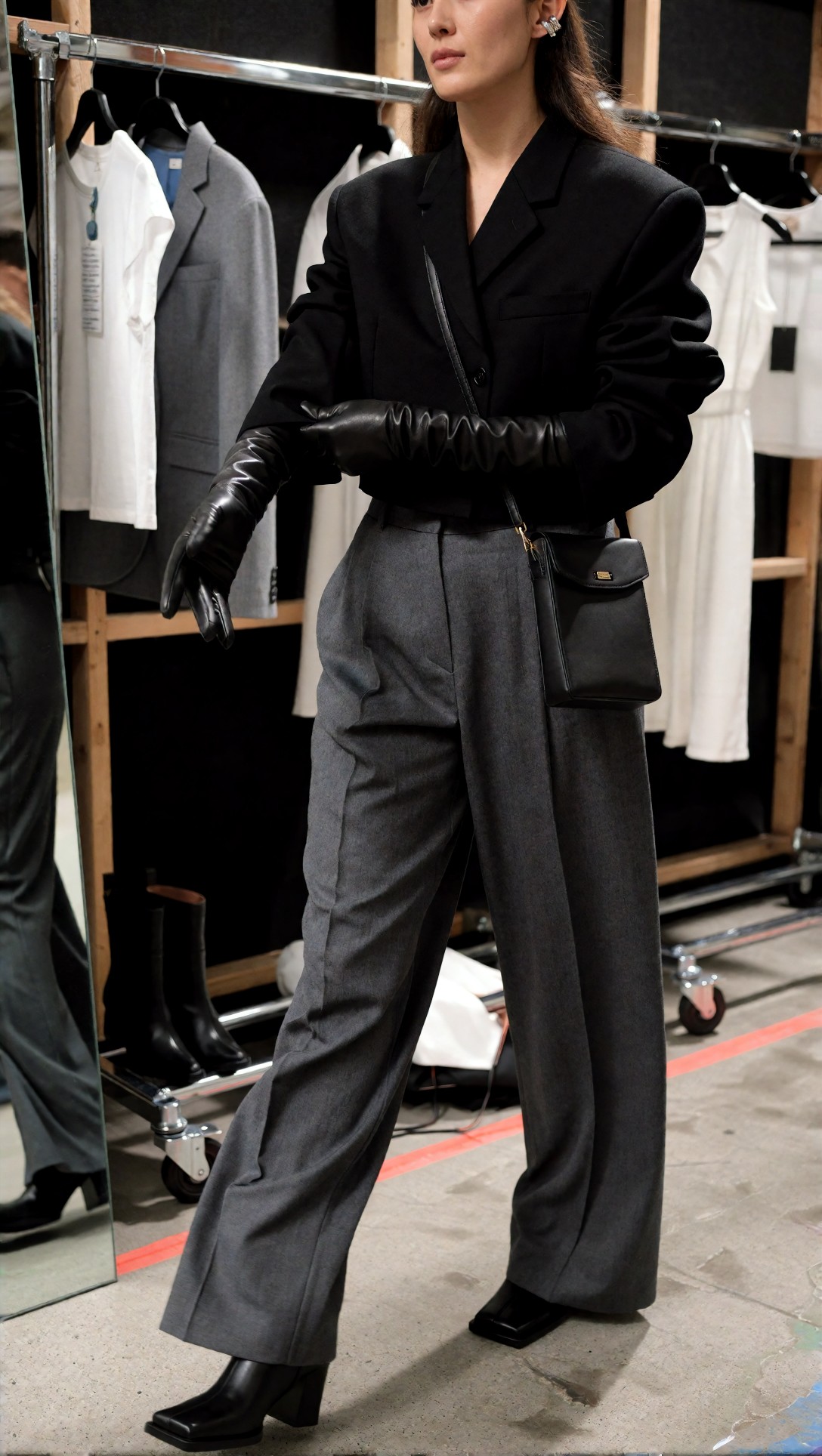
Look closely at rack lines, mirror reflections, and glove placement. Good results feel alive; bad results become obvious AI collage with duplicated sleeves and broken accessories.
Streetwear campaign prompts needed stricter garment hierarchy
For a streetwear campaign angle, the model often tried to add too much: cargo details, straps, logos, chains, layered hoodies, and oversized bags all at once. The stronger approach was to choose one utility element and one luxury finish.
This prompt is meant to test whether utility styling can remain premium instead of turning into generic techwear noise.
Topic: Luxury utility streetwear in Seoul
Genre: Streetwear Campaign
Camera: Sony A1
Lens: 35mm f/1.8
Lighting: Cloudy daylight with soft reflected fill
Location: Seongsu side street, concrete storefronts, subtle signage, damp pavement
Style: Contemporary luxury streetwear campaign
Final Prompt: street-style full body fashion campaign image centered on runway-inspired utility streetwear, cropped black bomber jacket with matte technical finish, slate gray fitted jersey layer, dark olive parachute trousers with controlled volume, polished black leather sneakers, compact crossbody bag with minimal hardware, thin silver chain, styling visible from head to shoes, walking past a Seongsu storefront on damp pavement, cool urban palette, soft cloudy daylight, premium streetwear not exaggerated, Sony A1 crisp detail, 35mm campaign framing, realistic fabric contrast between technical nylon and polished leather, contemporary luxury streetwear campaign mood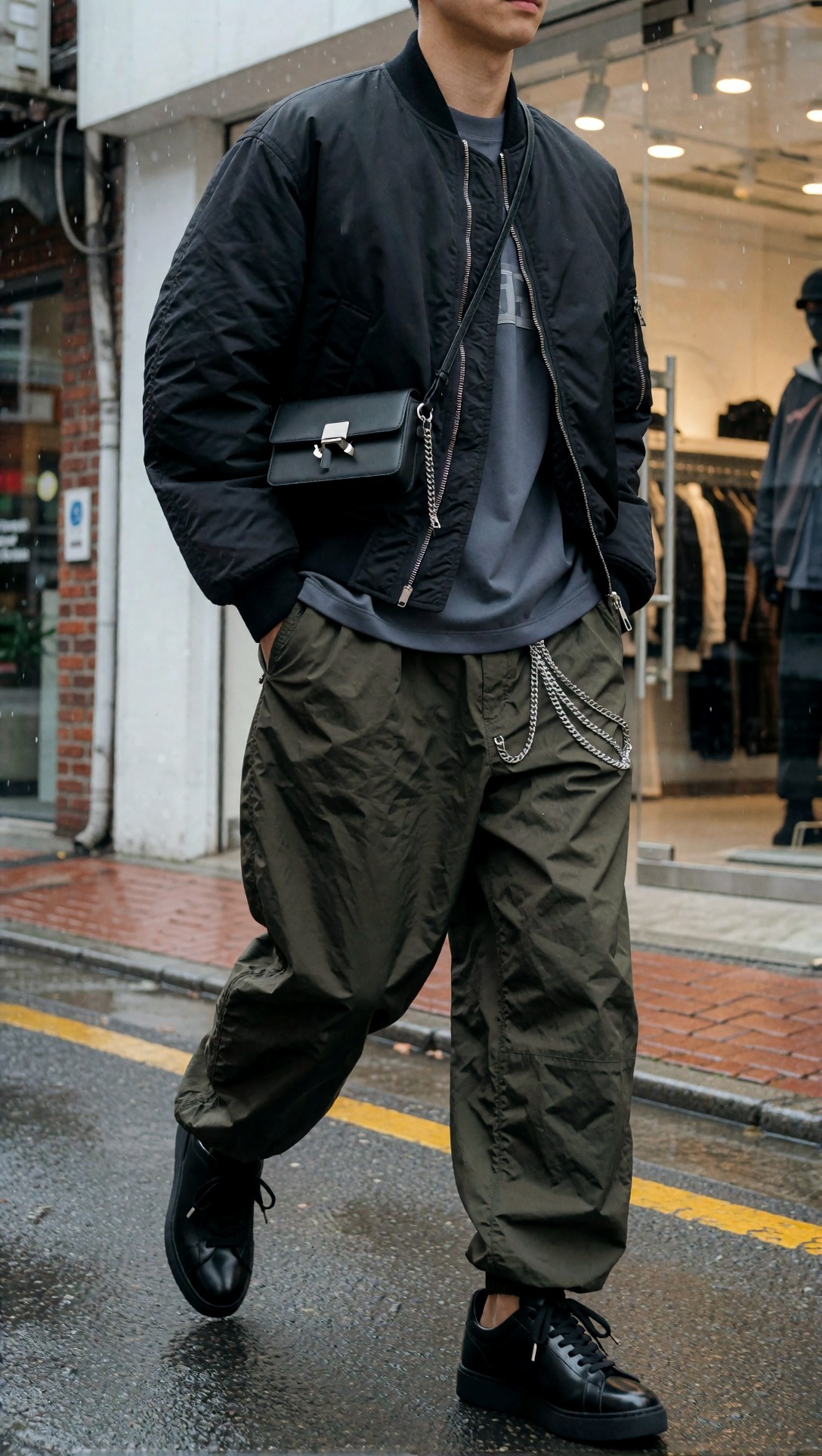
Inspect whether the trousers stay controlled rather than ballooning into costume territory. The best outputs kept one clear line from jacket hem to shoe.
Retail translation: storefront display was better than I expected
A useful surprise from this test: storefront prompts turned runway ideas into something closer to real shopping inspiration. For trend-led readers, this bridges catwalk reference and retail imagination better than another model-on-sidewalk frame.
This prompt checks product clarity, outfit grouping, and whether the display still feels current instead of generic department-store styling.
Topic: Runway trend translated into luxury storefront display
Genre: Product Editorial
Camera: Leica SL2
Lens: 24-70mm at 50mm f/4
Lighting: Evening window display lighting with warm spot accents
Location: Milan luxury boutique window, brushed stone, smoked glass, minimal props
Style: Luxury retail visual merchandising
Final Prompt: storefront display fashion image inspired by this week’s runway outfit ideas, mannequin-led styling with long ivory coat, pale gray draped knit, sharp black midi skirt, knee-high burgundy boots, sculptural top-handle bag, oversized silver cuff, coordinated accessory plinth beside the main look, visible boutique window reflections kept subtle, Milan luxury boutique setting, warm display spots against cool evening exterior, refined palette, composition focused on outfit logic and merchandising balance, Leica SL2 realism, 50mm product editorial framing, high-end retail visual storytelling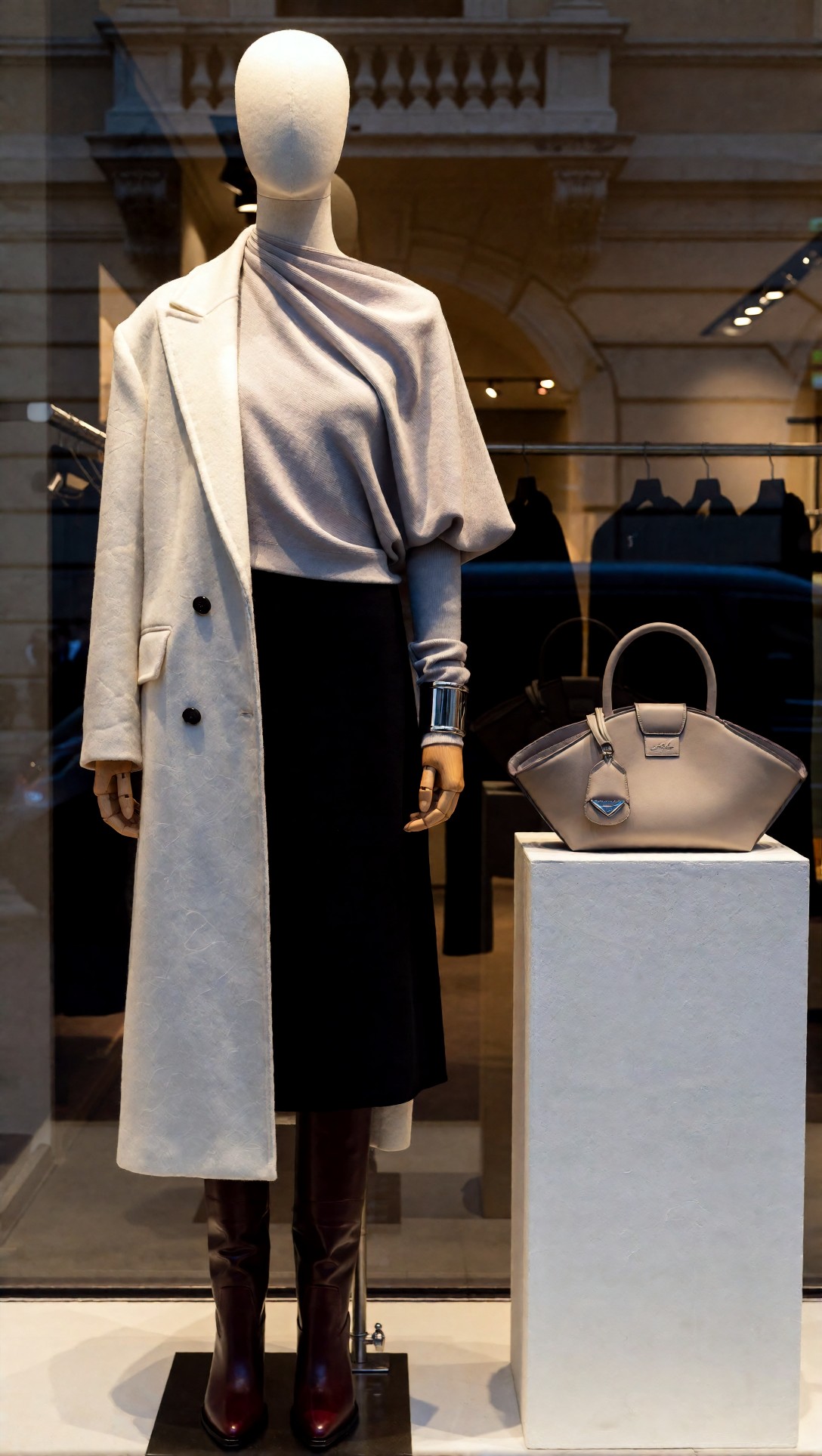
Check whether the mannequin proportions stay believable and whether glass reflections overpower the outfit. On strong generations, this became useful visual merchandising reference.
Texture-first prompts helped luxury fashion editorial images feel expensive
When the trend idea was subtle, fabric description did more than mood language. Naming brushed wool, compact leather, washed satin, rib knit, or metallic hardware gave the image something to hold onto.
This prompt is designed to test whether a restrained palette can still feel rich through textile contrast.
Topic: Dark neutral luxury editorial with texture contrast
Genre: Luxury Fashion Editorial
Camera: Hasselblad X2D 100C
Lens: 55mm f/2.5
Lighting: Directional softbox with low fill
Location: London editorial studio with charcoal backdrop and black pedestal
Style: Modern luxury magazine spread
Final Prompt: three-quarter outfit editorial emphasizing texture-rich runway dressing, brushed black wool blazer with elongated shoulder line, washed charcoal satin skirt, ribbed graphite knit layer, pointed calfskin boots, soft leather clutch tucked under arm, oxidized silver cuff and ring set, pose angled slightly toward camera with one foot forward, styling visible and intentional, dark neutral palette separated by textile finish, controlled studio shadows, luxury magazine atmosphere, Hasselblad X2D detail, 55mm polished editorial framing, tactile fabric realism, modern London fashion spread aesthetic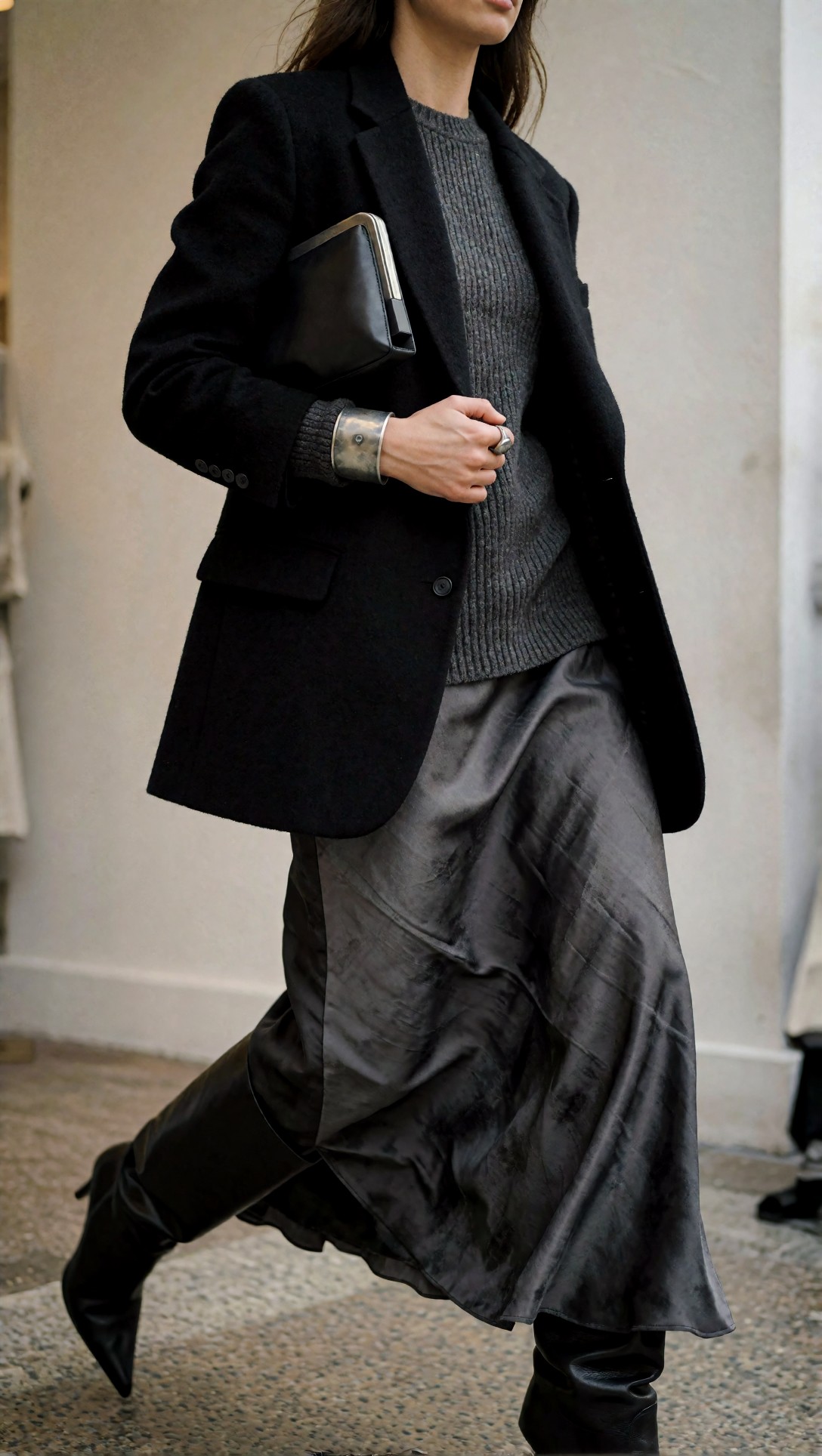
Inspect separation between wool, satin, and leather. If the surfaces all look equally glossy, the model missed the point and the editorial effect collapses.
Detail images were useful support, not the main event
Garment and accessory detail prompts were helpful for validating whether the trend direction had enough material personality. They worked best as supporting assets in a set, not as the lead answer to runway outfit ideas this week.
This prompt checks hardware accuracy and leather texture without drifting into beauty-crop territory.
Topic: Silver accessory story for current runway styling
Genre: Accessories Editorial
Camera: Canon EOS R3
Lens: 85mm f/2
Lighting: Focused soft key with cool edge light
Location: Minimal brushed steel tabletop set in a studio
Style: High-end accessories campaign
Final Prompt: accessories close-up editorial linked to a current runway outfit story, structured black leather top-handle bag with brushed silver clasp, stacked silver cuff, slim ring set, pointed black shoe partially entering frame, charcoal wool coat hem visible at edge, styling system implied rather than portrait-led, brushed steel tabletop and cool studio environment, clean composition, premium hardware reflections controlled, Canon EOS R3 detail, 85mm close framing, luxury accessories campaign with tactile leather grain and polished metal contrast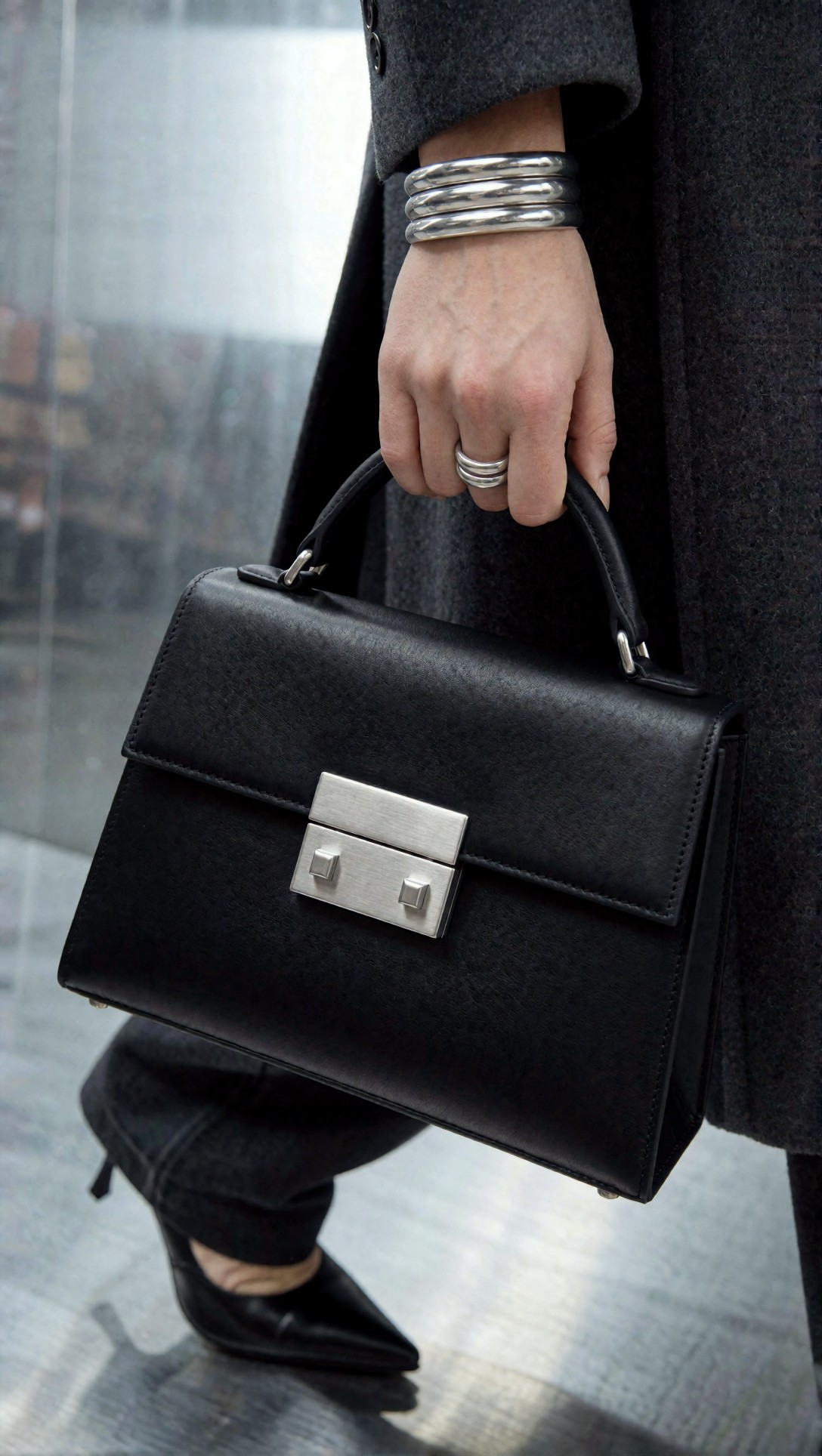
Check clasp geometry, strap attachment, and metal reflections. This is where many models still fake luxury badly if hardware is underspecified.
Mood-board collage prompts were good for direction setting, not final images
Mood-board style outputs can help teams agree on palette and silhouette before making hero images. In this test, they were strongest for planning and weakest for finished publication visuals.
This prompt tests whether multiple fashion references can coexist without turning into visual clutter.
Topic: Weekly runway direction board for tailoring and streetwear
Genre: Mood-Board Collage
Camera: Mixed editorial capture aesthetic
Lens: Mixed 35mm and 50mm editorial framing
Lighting: Soft studio and overcast street mix
Location: Composite board combining Paris street, Seoul retail, Milan backstage, and studio swatches
Style: Fashion editor planning board
Final Prompt: mood-board collage for this week’s runway outfit ideas, curated fashion editor board with four coherent panels: oversized charcoal tailoring street-style look, beige minimal lookbook outfit, monochrome backstage tailoring moment, luxury utility streetwear on a Seoul street, plus fabric swatches of wool, satin, leather, and technical nylon, silver accessory references, restrained neutral palette with burgundy accent, clean magazine layout, sharp panel borders, premium print editorial feel, styling system emphasized across all panels, contemporary fashion planning board aesthetic
Inspect whether the panels stay visually distinct and whether one palette ties them together. If the collage feels random, the prompt is carrying too many trend directions at once.
Where the output struggled
The weak point across almost all tests was garment interaction.
Typical failures included:
- coat hems merging into trousers
- belts disappearing under layers
- bags attaching at impossible angles
- asymmetrical hems becoming accidental tears
- hands interfering with sleeves and cuffs
- footwear changing between left and right foot
- backstage mirrors producing duplicate limbs or extra garments
A second issue was trend overloading. Prompts that combined metallics, sheers, tailoring, sportswear, fringe, oversized bags, and dramatic color accents often generated images that looked “fashion-ish” but not current. The result was less runway-inspired and more synthetic editorial collage.
Recommended prompt changes and settings
Based on the test, here is what I would change next when refining AI fashion photography for runway-inspired outputs.
1. Build the outfit in layers, not adjectives
Use this order:
- outerwear
- top or base layer
- bottom
- shoes
- bag
- jewelry
- silhouette note
- environment
This gave more stable results than leading with words like edgy, chic, elevated, or avant-garde.
2. Keep the palette to two neutrals plus one accent
This mattered more than expected. Once the palette widened too far, accessory drift increased and materials became muddy.
3. Choose lenses that respect outfit visibility
35mm, 40mm, and 50mm performed best for fashion context. 85mm was useful only for detail support. Wider framing kept the outfit readable, which is essential for runway outfit ideas content.
4. Use one movement cue only
“Walking,” “turning,” or “adjusting cuff” worked. Multiple action cues increased anatomy errors.
5. Specify one luxury signal
Good examples:
- brushed silver hardware
- elongated shoulder line
- compact leather finish
- wool-satin contrast
- sculptural top-handle bag
One signal reads editorial. Five signals read confused.
If you need iterative prompt cleanup, [PromptLab](/promptlab) is the right place to shorten and structure these descriptions. If the output is almost right but textures are soft, [Upscaler](/upscaler) helps reveal seam lines and fabric grain.
Who should use this workflow
This approach works well for:
- content teams making fashion moodboards
- creators planning luxury fashion editorial concepts
- sellers or stylists building lookbook references
- marketers testing streetwear campaign directions before a shoot
- AI users who want current styling without fantasy drift
It is less useful for:
- pure beauty portraits
- heavily surreal runway scenes
- fast one-line prompting with no styling detail
- anyone expecting perfect garment construction on the first pass
You can also compare your outputs against broader visual references in the [Gallery](/gallery) or browse other prompt breakdowns in [Articles](/articles).
FAQ
How do I make runway outfit ideas this week look current in AI images?
Focus on one silhouette direction and one accessory story. Current-looking results usually come from proportion, fabric, and styling logic rather than dramatic set design.
What is the best shot type for AI fashion photography inspiration?
Street-style full body is the best all-round choice. It shows the entire outfit clearly and gives trend context without flattening the clothes.
Why do AI fashion prompts often look generic even when the clothes sound detailed?
The usual reason is that the styling order is unclear. If outerwear, layers, shoes, bag, and silhouette are not structured cleanly, the model fills gaps with generic fashion tropes.
Should I use lookbook or editorial prompts for runway-inspired outfits?
Use lookbook prompts when you need clean comparison and repeatability. Use editorial prompts when texture, mood, and layered styling matter more.
What detail matters most in these prompts?
Silhouette hierarchy matters most. If the model understands which garment leads the look, the rest of the outfit is more likely to stay coherent.
Editorial conclusion
In this test, the most useful way to turn runway outfit ideas this week into images was not to imitate a runway exactly. It was to extract one clear styling system and place it into a believable fashion image type: street style, lookbook, backstage, retail display, or detail support.
Who should use this workflow: editors, marketers, stylists, and AI image users who want trend-led inspiration that still reads as practical fashion photography. Who should avoid it: users looking for instant one-prompt spectacle or highly experimental couture surrealism. The setting and prompt detail that mattered most was simple: lock the silhouette first, then describe materials and accessories with restraint.