Seoul Fashion Week AI Image Guide: Runway Looks, Backstage Details, and Show Set Prompts 한국어 요약
이 페이지는 ZView Space의 영어 원문을 한국어 검색 사용자도 이해할 수 있도록 정리한 SEO 요약입니다. 핵심은 단순한 얼굴 중심 이미지가 아니라 패션 에디토리얼, 룩북, 아웃핏, 프롬프트 테스트, 이미지 생성 워크플로우를 실제로 어떻게 구성할지입니다.
핵심 요약
- 원문 주제: Seoul Fashion Week AI Image Guide: Runway Looks, Backstage Details, and Show Set Prompts
- 목적: AI 이미지 생성에서 outfit, silhouette, fabric, pose, location, camera framing을 더 명확하게 설계합니다.
- 활용 범위: Z-Image Turbo, Krea2 Turbo, Qwen Image, Anima, SeedVR2 같은 이미지 생성 및 업스케일 워크플로우에 적용할 수 있습니다.
- SEO 관점: 제목, 설명, 이미지 alt, 프롬프트 예시가 실제 검색 의도와 맞아야 색인 가능성이 높아집니다.
한국어 사용자를 위한 체크포인트
1. 프롬프트가 얼굴 묘사에만 머물지 않고 전체 스타일과 의상 구성을 설명하는지 확인합니다. 2. 패션 이미지라면 상의, 하의, 아우터, 신발, 액세서리, 소재감, 촬영 장소를 분리해서 씁니다. 3. 생성 결과는 바로 게시하지 말고 디테일, 손, 의상 형태, 배경 일관성, 이미지 품질을 비교합니다. 4. 글 본문에는 실제 테스트 기준과 실패를 줄이는 방법이 들어가야 검색엔진에서 얇은 콘텐츠로 보일 가능성이 줄어듭니다.
원문 미리보기
If you want AI images that actually feel connected to seoul fashion week rather than generic "fashion show" output, the main job is not adding more adjectives. It is controlling three things at once: silhouette logic, venue context, and editorial framing. In t
---
If you want AI images that actually feel connected to seoul fashion week rather than generic "fashion show" output, the main job is not adding more adjectives. It is controlling three things at once: silhouette logic, venue context, and editorial framing. In this test, the strongest results came from prompts that described garments as systems, not single pieces, and that treated the show environment as part of the styling story.
I tested runway, backstage, and show-set prompt structures aimed at inspiration use: look development, editorial moodboarding, and visual direction for Korean fashion trends, luxury fashion editorial work, and AI fashion photography. The guide below is built like an operator checklist, based on what held together across multiple generations and what broke first.
What was tested
- Text-to-image prompts for runway, backstage, and editorial show environments
- Prompt structures focused on full-body styling rather than face-first portrait output
- Variations in lighting, lens choice, and location specificity
- Failure points around hands, accessory logic, textile rendering, crowd clutter, and logo-like text artifacts
- Whether prompts could produce images that read closer to Korean magazine editorial direction than generic western runway photography
The consistent pattern in this test: when the prompt led with "fashion week" alone, many models defaulted to a broad Paris/Milan visual language. When I anchored the scene with Seoul-specific cues like LED-heavy venue design, minimalist industrial interiors, sharp layered tailoring, and clean Korean magazine editorial composition, the output became more useful.
Start here: the preparation checklist
Before generating, I would set up the brief with these decisions already made.
1. Define the image role
Choose one:
- runway documentation
- luxury fashion editorial inspired by show looks
- backstage preparation detail
- showroom or installation-style set image
- street-to-runway transitional styling reference
This matters because the same garment prompt behaves differently under documentary runway language versus magazine editorial language. In this test, "fashion editorial" gave better garment control, while "runway photography" gave better stage context but more anatomy risk.
2. Lock the silhouette before the mood
For seoul fashion week inspiration, the useful visual cues were:
- long coats over shorts or micro-hems
- wide-leg tailored trousers with structured outerwear
- tonal monochrome layering
- technical fabrics mixed with polished leather
- precise accessories: pointed boots, slim bags, gloves, metal hardware
- styling asymmetry: one exposed shoulder, uneven hems, layered collars, belted volume
If the silhouette was vague, the model often overfilled the frame with random trend noise.
3. Decide how much venue context you need
Use one of these levels:
- Low context: editorial crop with only hints of show environment
- Medium context: visible runway, seating, light rig, or backstage racks
- High context: immersive set design with audience, screens, staff, and staging
Medium context was the safest in this test. High context created the most cinematic images, but also introduced crowd deformation, inconsistent chairs, and unreadable signage.
4. Write garment detail in layers
The most stable order was:
1. silhouette 2. hero garment 3. material 4. accessories 5. pose and movement 6. environment 7. color palette
That order reduced the common failure where the model understood the mood but ignored the clothes.
Workflow step 1: build a clean runway base image
I start with a runway prompt that prioritizes full-body proportion, garment readability, and stage geometry. This gives a baseline image to judge whether the model understands the brief before moving into more complex editorial scenes.
This first test checks silhouette integrity, runway spacing, and whether the image reads as a show look rather than a glam portrait.
Topic: Seoul Fashion Week tailored runway look with layered outerwear
Genre: Fashion Runway Photography
Camera: Canon EOS R5
Lens: RF 70-200mm f/2.8 at 135mm
Lighting: Cool overhead runway lighting with soft front fill
Location: Minimalist Seoul fashion week venue with matte concrete runway and low audience seating
Style: Korean magazine runway report
Final Prompt: Full-body runway image inspired by Seoul Fashion Week, model walking with controlled stride on a matte concrete runway, wearing a charcoal oversized tailored coat layered over a sharp white poplin shirt, slate grey wide-leg trousers, pointed black leather boots, slim structured shoulder bag, subtle metal belt detail, clean center-part hair, neutral expression, cool overhead runway lights, faint audience silhouettes, minimalist industrial venue, precise garment motion, strong shoulder line, premium textile texture, editorial runway composition, realistic proportions, Korean magazine fashion report aesthetic, Canon EOS R5 look, 135mm compression, crisp fabric detail, subdued grey blue black palette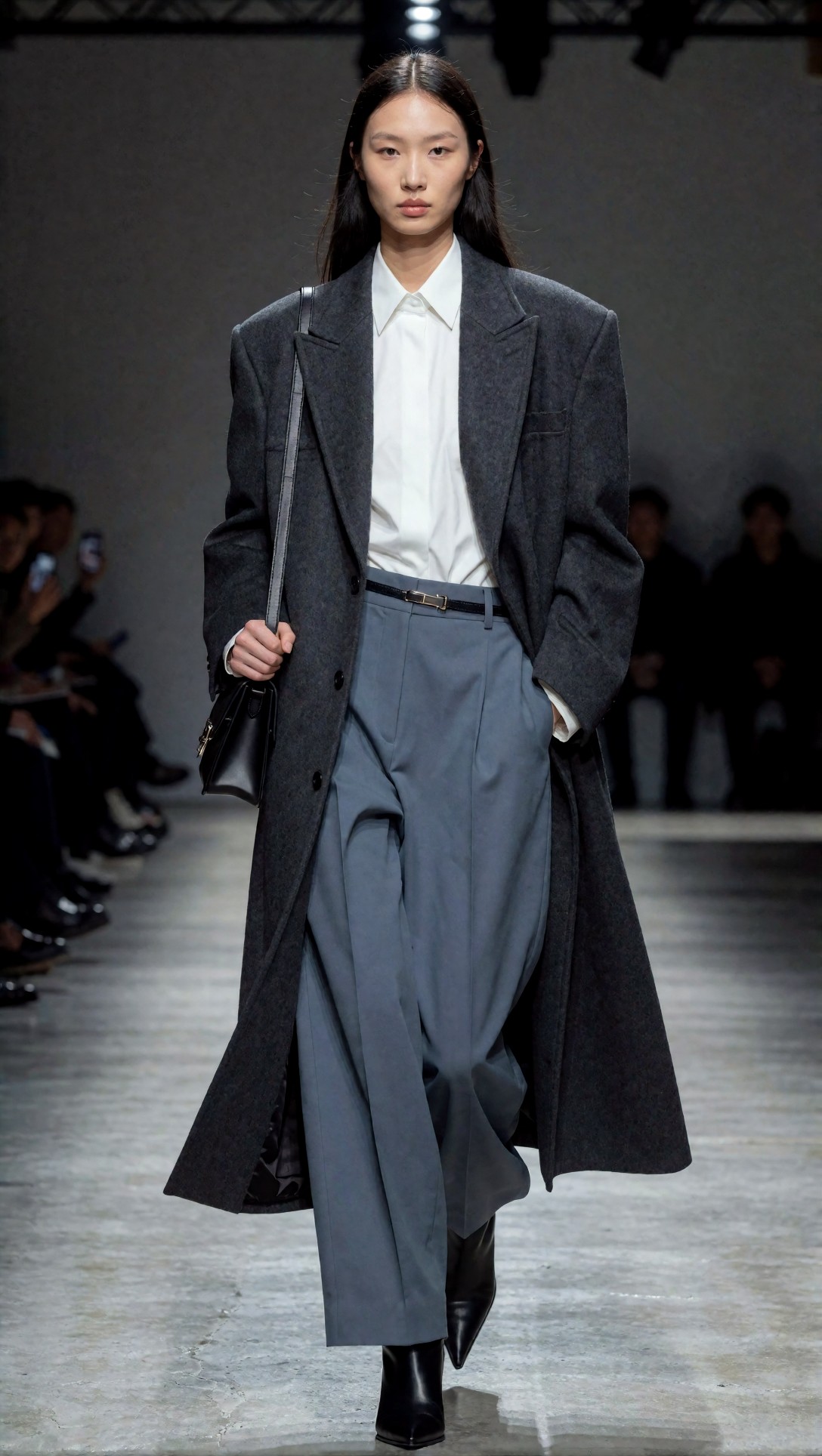
Inspect whether the coat hangs cleanly from shoulder to hem, whether both legs remain readable in motion, and whether the audience stays secondary. In my test, strong outputs preserved trouser width and boot shape without turning the image into a beauty portrait.
A second baseline is useful if you want a more feminine silhouette with stronger color blocking. This test is mainly for fabric separation and movement.
Topic: Seoul Fashion Week feminine runway look with sculptural volume
Genre: Luxury Fashion Editorial
Camera: Nikon Z9
Lens: NIKKOR 85mm f/1.8 S
Lighting: Bright runway key light with soft ambient shadow falloff
Location: LED-framed runway hall in Seoul with reflective black floor
Style: Luxury fashion editorial
Final Prompt: Full-length fashion image inspired by Seoul Fashion Week, model standing at the turn of a reflective runway wearing a sculptural ivory cropped jacket with exaggerated sleeves, liquid silver midi skirt, sheer black tights, sharp ankle boots, stacked silver ear cuffs, miniature top-handle bag, poised chin-up stance, controlled serious expression, LED runway frame glowing in soft white, polished black floor reflections, elegant Korean luxury editorial direction, clean negative space, visible silhouette from head to toe, realistic fabric drape, refined metallic texture, premium magazine styling, Nikon Z9 clarity, 85mm fashion framing, cool white and silver palette with sharp contrast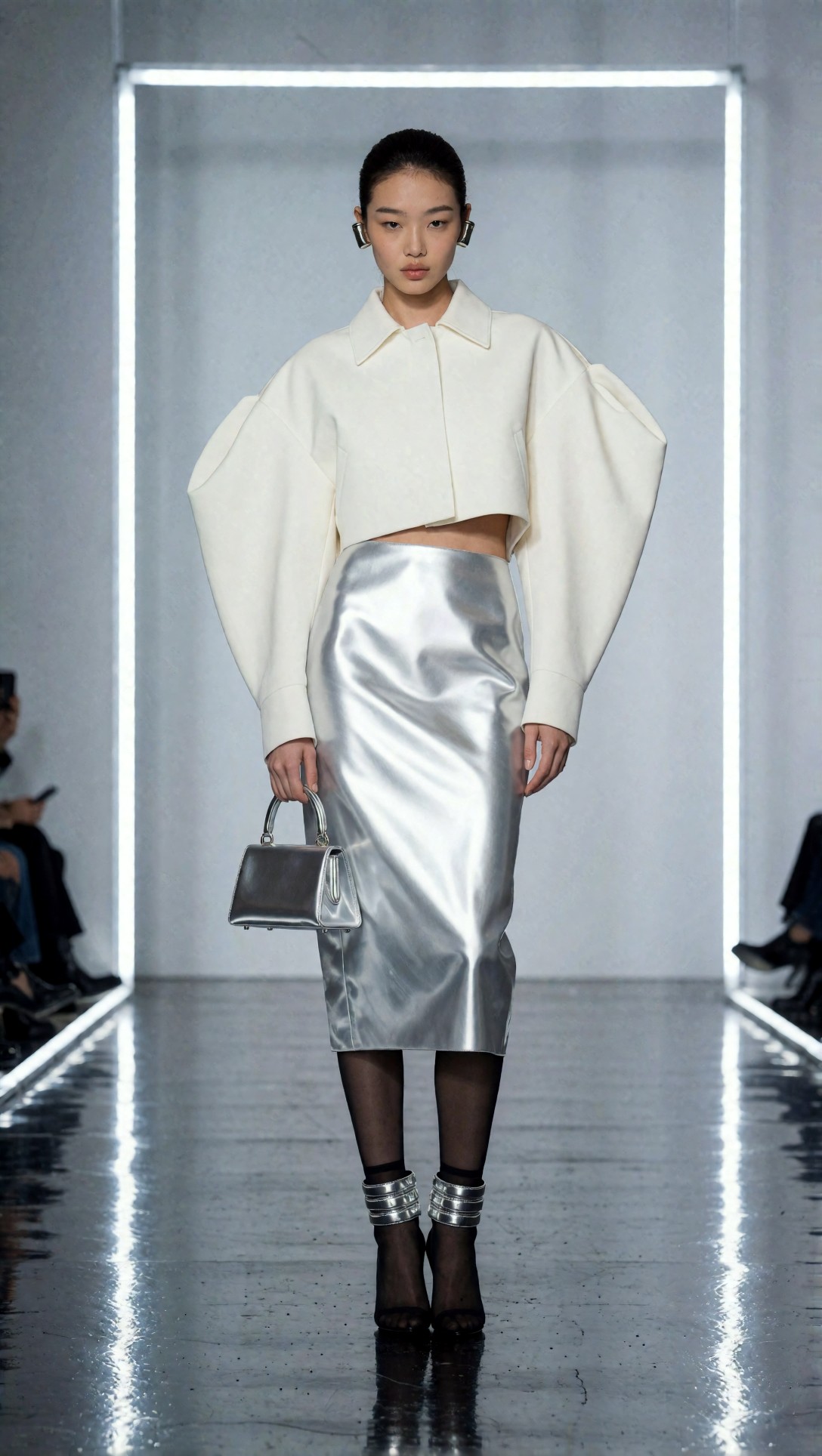
Check whether the metallic skirt reads as fabric rather than melted chrome, and whether the cropped jacket keeps its sculptural volume. The weak outputs in this setup usually lost sleeve architecture first.
Workflow step 2: add backstage images without losing garment logic
Backstage prompts are useful for inspiration because they reveal texture, fittings, racks, makeup stations, and garment handling. They are also riskier. In this test, backstage scenes failed when too many people were introduced too early.
My recommendation is to keep the subject count low: one model plus one stylist, or one model near a rack. That preserves realism and still gives the image documentary value.
This prompt checks backstage density, garment detail, and hand risk around styling interactions.
Topic: Backstage Seoul Fashion Week final fitting moment
Genre: Documentary Fashion Photography
Camera: Fujifilm GFX100 II
Lens: GF 55mm f/1.7
Lighting: Mixed backstage vanity bulbs and overhead fluorescent spill
Location: Narrow backstage dressing area with garment racks, mirrors, and steaming station
Style: Korean magazine backstage report
Final Prompt: Documentary-style backstage image inspired by Seoul Fashion Week, one model standing near a rolling garment rack while a stylist adjusts the cuff of a structured black blazer, layered over a cream turtleneck and tailored shorts, knee-high leather boots, clipped show pass, mirror lights glowing softly in the background, visible hangers with monochrome garments, makeup tools on a crowded station, realistic pre-show tension, natural body posture, hands interacting with fabric, premium textile detail, intimate editorial composition, Korean magazine backstage aesthetic, Fujifilm GFX100 II realism, 55mm environmental framing, muted black cream steel palette, honest working atmosphere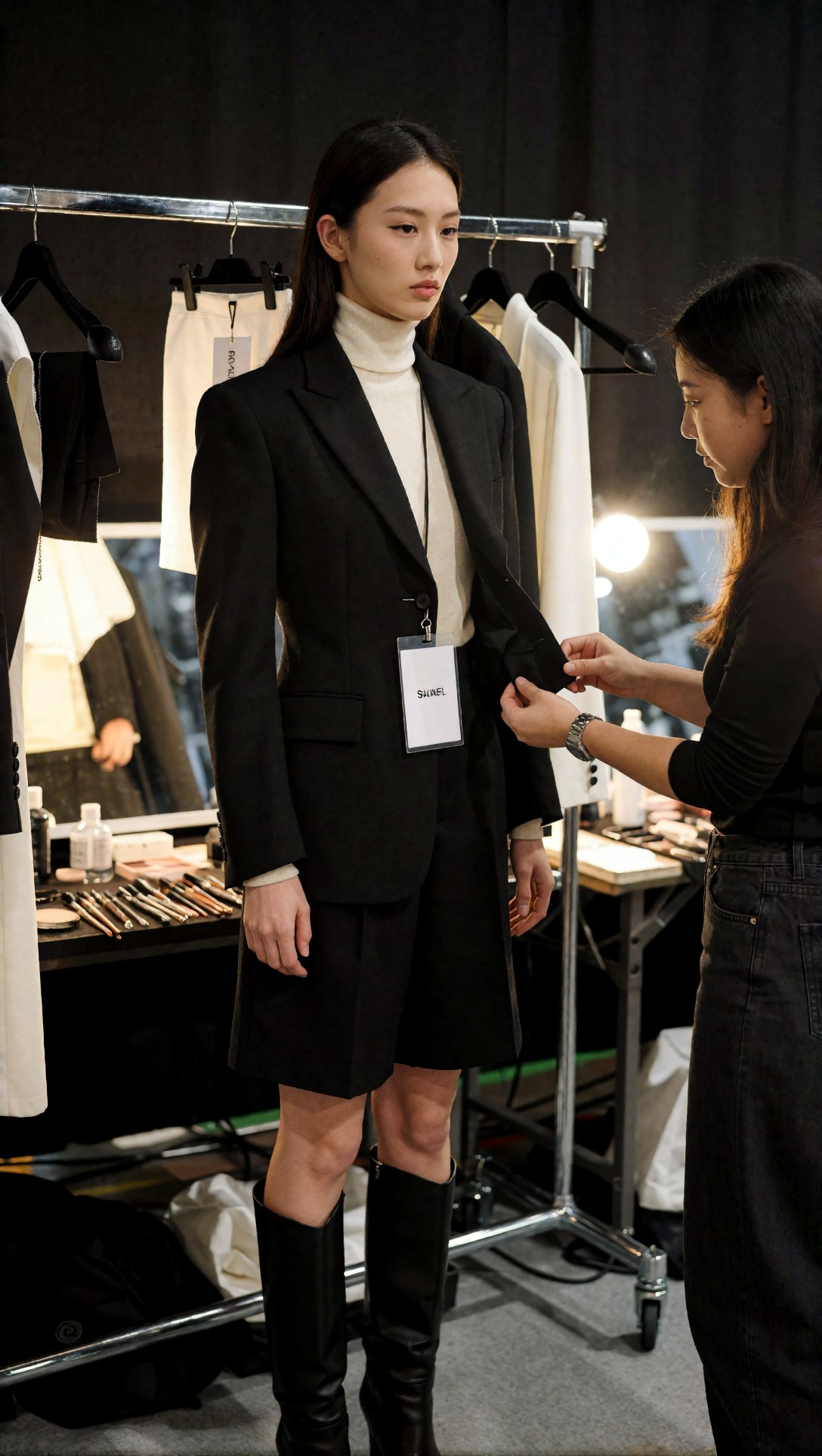
Inspect the hands first. If the stylist interaction looks broken, simplify the action in the next pass. The strongest results showed believable cuff handling and clutter that felt used, not randomly generated.
A tighter backstage beauty-styling image can support the fashion story as long as the clothes remain visible enough to matter. This one tests face stability without becoming a face-only image.
Topic: Seoul Fashion Week backstage hair and styling detail
Genre: Beauty Editorial
Camera: Sony A7R V
Lens: FE 50mm f/1.2 GM
Lighting: Warm vanity mirror bulbs with gentle side shadow
Location: Backstage mirror station during pre-show preparation in Seoul
Style: Korean magazine editorial
Final Prompt: Mid-length backstage fashion beauty image inspired by Seoul Fashion Week, model seated at a lit mirror station wearing a glossy navy satin trench loosely draped over a ribbed black dress, one stylist hand visible adjusting a sculptural hair accessory, soft focused garment racks behind, calm concentrated expression, luminous skin with natural texture, visible collar structure and layered accessories, vanity bulbs creating warm highlights, intimate Korean editorial mood, realistic backstage environment, premium hair and fabric detail, Sony A7R V precision, 50mm close environmental framing, navy black warm gold palette, refined but working backstage atmosphere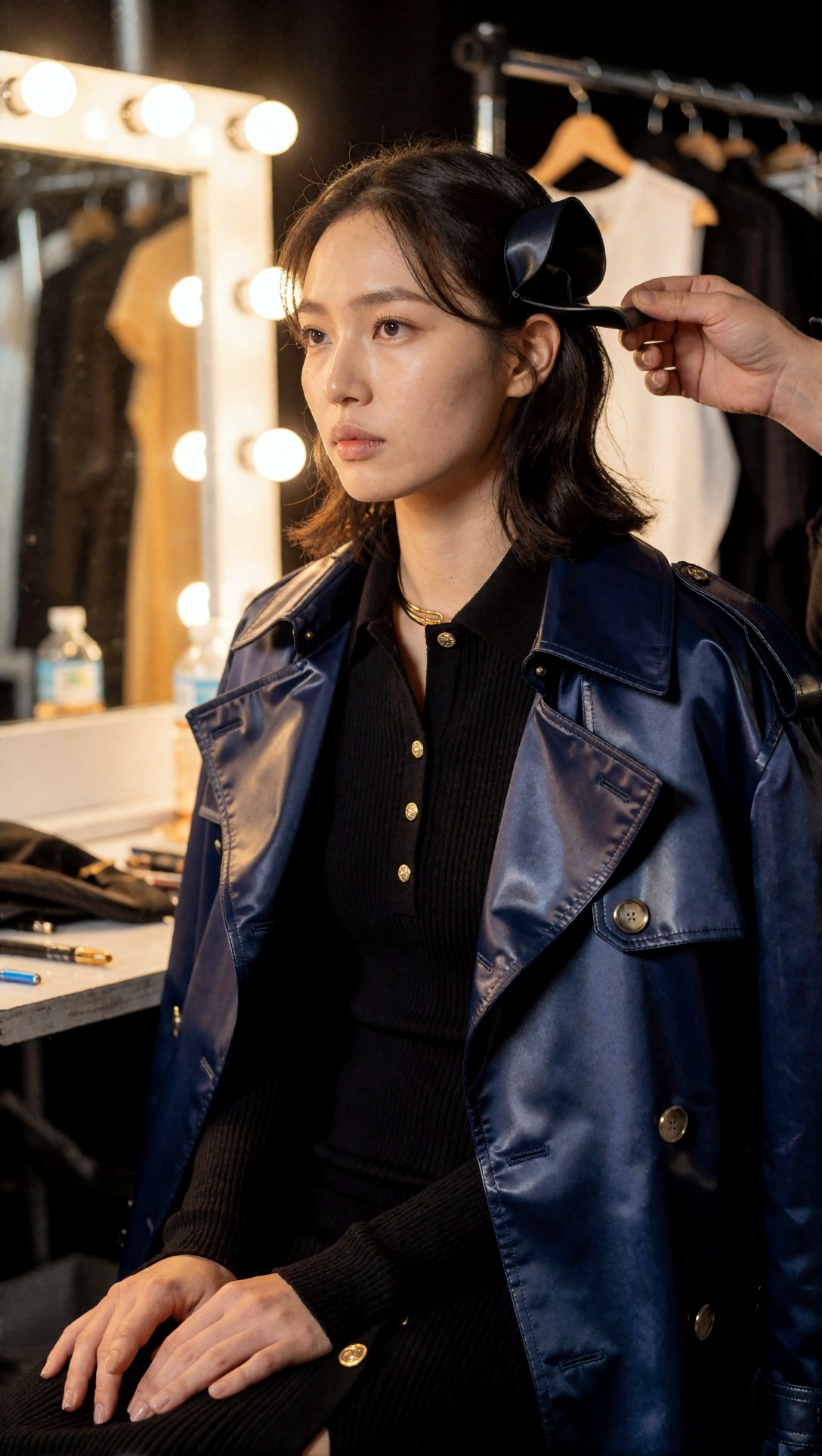
Look for a balance between styling intimacy and wardrobe readability. If the image turns into generic beauty campaign output, the prompt needs stronger garment language or a wider crop.
Workflow step 3: generate show-set images for mood and scale
Show-set prompts are where AI becomes genuinely useful for fashion inspiration. They can suggest venue concepts, runway installation design, and editorial mood in one frame. The tradeoff is structural instability. Screens, steps, seating, and reflective floors are all common failure zones.
I had the best luck when the set was described with only two hero elements, not five or six.
This prompt checks environment control: stage design, color discipline, and whether the model still reads as the focal point.
Topic: Seoul Fashion Week show set with monolithic installation
Genre: Fashion Set Design Editorial
Camera: Hasselblad X2D 100C
Lens: XCD 38V
Lighting: Controlled spotlight pools with dark ambient surround
Location: Large industrial exhibition hall in Seoul with monolithic black set pieces
Style: High-fashion installation editorial
Final Prompt: Wide fashion show set image inspired by Seoul Fashion Week, model positioned at the edge of a monumental black geometric installation, wearing an ink-black cocoon coat over a graphite column dress, sleek leather gloves, square-toe boots, minimalist silver ear jewelry, long deliberate posture, dark polished floor reflecting thin beams of light, sparse audience presence in shadow, architectural stage design with monolithic blocks and narrow illuminated runway lines, luxury Korean editorial atmosphere, cinematic realism, strict black grey white palette, premium material contrast, Hasselblad X2D 100C medium-format clarity, wide environmental composition, calm dramatic tension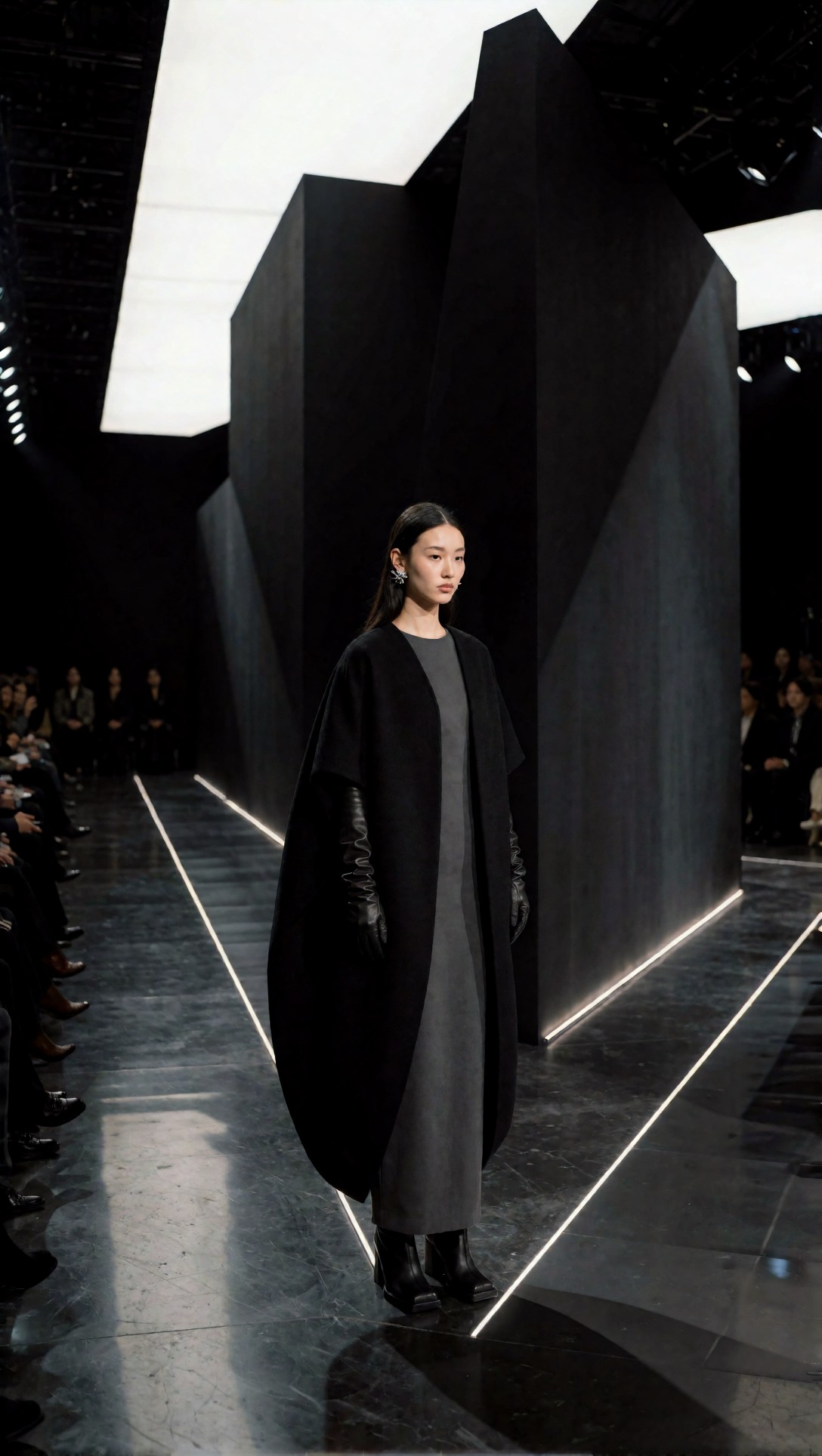
Inspect whether the set geometry remains straight and whether the reflective floor helps rather than confuses the subject outline. In weak outputs, the monoliths warped into random stage clutter.
This next variation tests a brighter, more commercial luxury setup with stronger screen-led color.
Topic: Seoul Fashion Week runway set with digital screen atmosphere
Genre: Luxury Campaign
Camera: Leica SL2-S
Lens: APO-Summicron-SL 75mm f/2
Lighting: Soft frontal key light with colored LED ambient wash
Location: Seoul runway venue with towering translucent screens and glossy catwalk
Style: Clean commercial luxury editorial
Final Prompt: Fashion image inspired by Seoul Fashion Week inside a modern runway venue with towering translucent screens casting pale lavender and icy blue light, model walking forward in a sand-beige belted trench over a white asymmetric dress, tall cream boots, slim metallic clutch, polished wet-look hair, focused expression, glossy catwalk reflections, controlled audience blur, clean commercial luxury composition, elegant Korean editorial styling, pastel-cool lighting contrast, visible textile seams and belt structure, Leica SL2-S cinematic sharpness, 75mm runway framing, premium campaign finish without logo text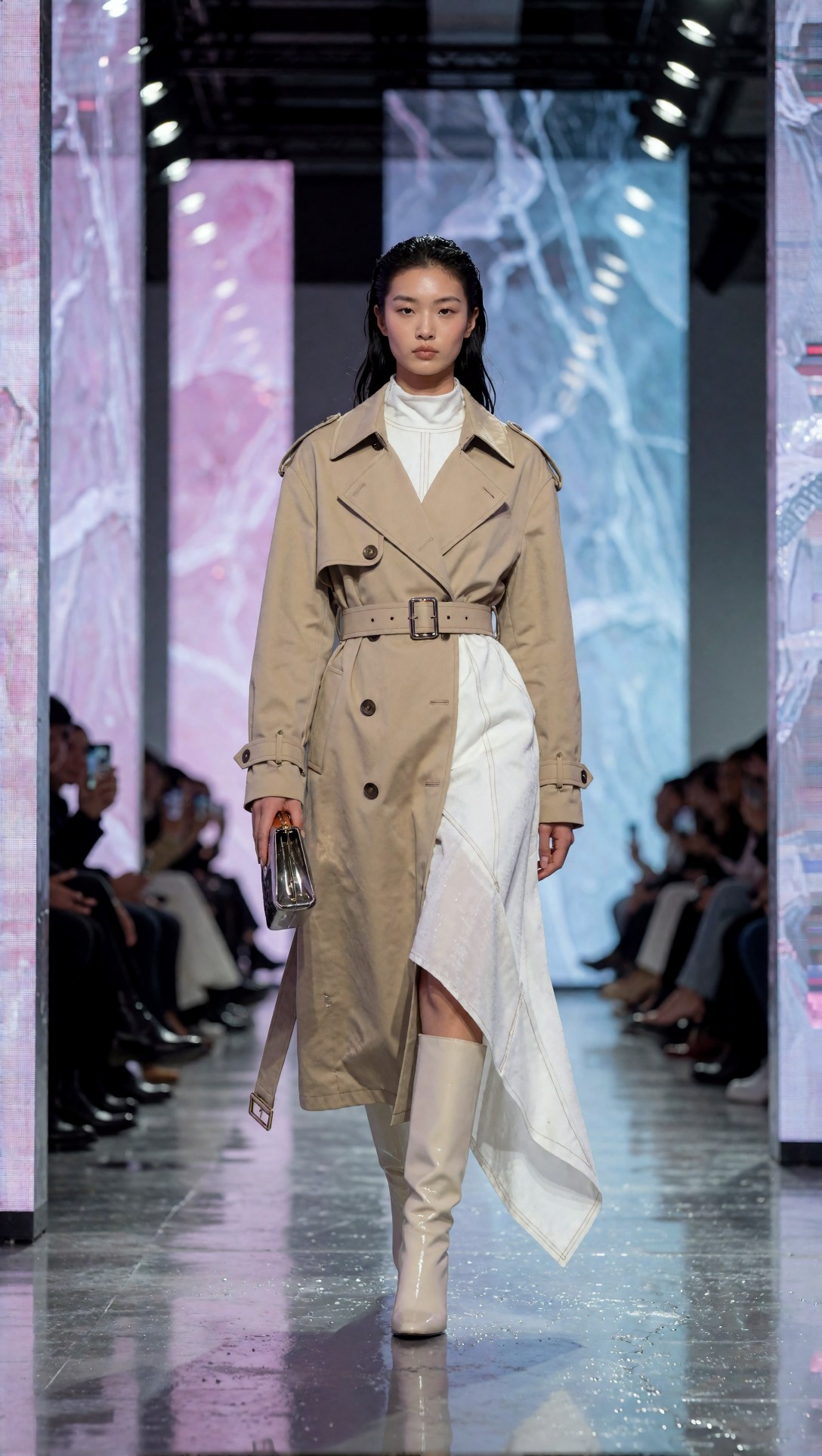
Check whether the LED color contaminates skin too heavily. The better outputs kept the lavender-blue atmosphere in the set while preserving garment color accuracy.
Workflow step 4: build editorial images from runway inspiration
Once the runway base works, I usually switch genres. This is the key move if your goal is inspiration rather than fake event reportage. Editorial prompts can preserve the seoul fashion week styling language while giving cleaner composition and stronger product detail.
This first editorial conversion checks whether the runway look can survive outside the runway and still feel coherent.
Topic: Seoul Fashion Week inspired street-to-editorial tailored look
Genre: Street Style Editorial
Camera: Panasonic Lumix S1R II
Lens: 35mm f/1.8
Lighting: Overcast daylight diffusion
Location: Outside a contemporary design complex in Dongdaemun, Seoul
Style: Korean magazine street editorial
Final Prompt: Full-body street editorial inspired by Seoul Fashion Week, model standing outside a contemporary design complex in Seoul, wearing a boxy dove-grey blazer over a fine black knit, pleated charcoal maxi skirt layered with tailored trousers, pointed boots, slim sunglasses, compact leather crossbody bag, wind lifting the hem slightly, composed editorial stance, concrete architecture and glass panels in the background, overcast soft light, realistic urban luxury styling, Korean magazine street-fashion aesthetic, visible layering system, clean neutral palette with subtle silver accents, Panasonic Lumix S1R II detail, 35mm environmental fashion composition, candid but highly controlled mood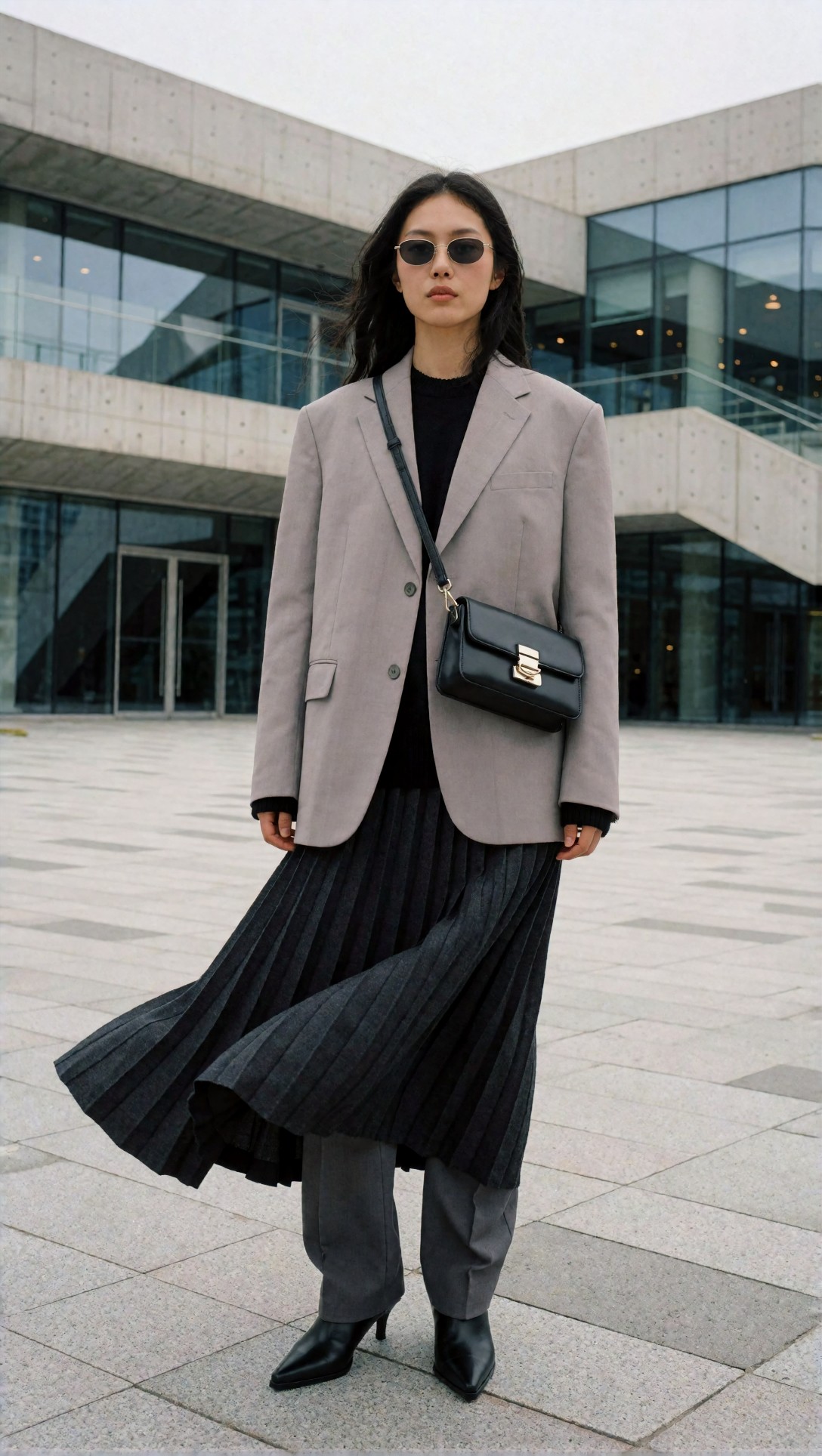
Inspect the layering carefully. Trouser-under-skirt combinations are a good stress test for fashion logic. Strong outputs keep the silhouette intentional instead of collapsing the lower half into one shapeless mass.
A more polished magazine-style variation is useful when you want luxury fashion editorial references rather than street energy. This prompt checks style lock and textile rendering.
Topic: Korean magazine editorial inspired by Seoul Fashion Week evening look
Genre: Fashion Editorial
Camera: Phase One XF IQ4
Lens: Schneider Kreuznach 80mm LS f/2.8
Lighting: Large softbox key with subtle silver bounce and low-contrast fill
Location: Minimal studio set with smoked acrylic panels and brushed steel platform
Style: Korean magazine cover editorial
Final Prompt: High-end Korean magazine editorial inspired by Seoul Fashion Week, full-length model on a brushed steel platform wearing a deep plum satin column gown layered under a sharply tailored black leather blazer, long crystal drop earrings, narrow heeled boots barely visible beneath the hem, sleek pulled-back hair, cool self-possessed expression, smoked acrylic panels creating depth behind the figure, polished but restrained studio lighting, luxury editorial composition with strong vertical lines, rich satin sheen, realistic leather grain, elegant monochrome-plum palette, Phase One medium-format precision, 80mm studio fashion rendering, cover-worthy composition with clean premium negative space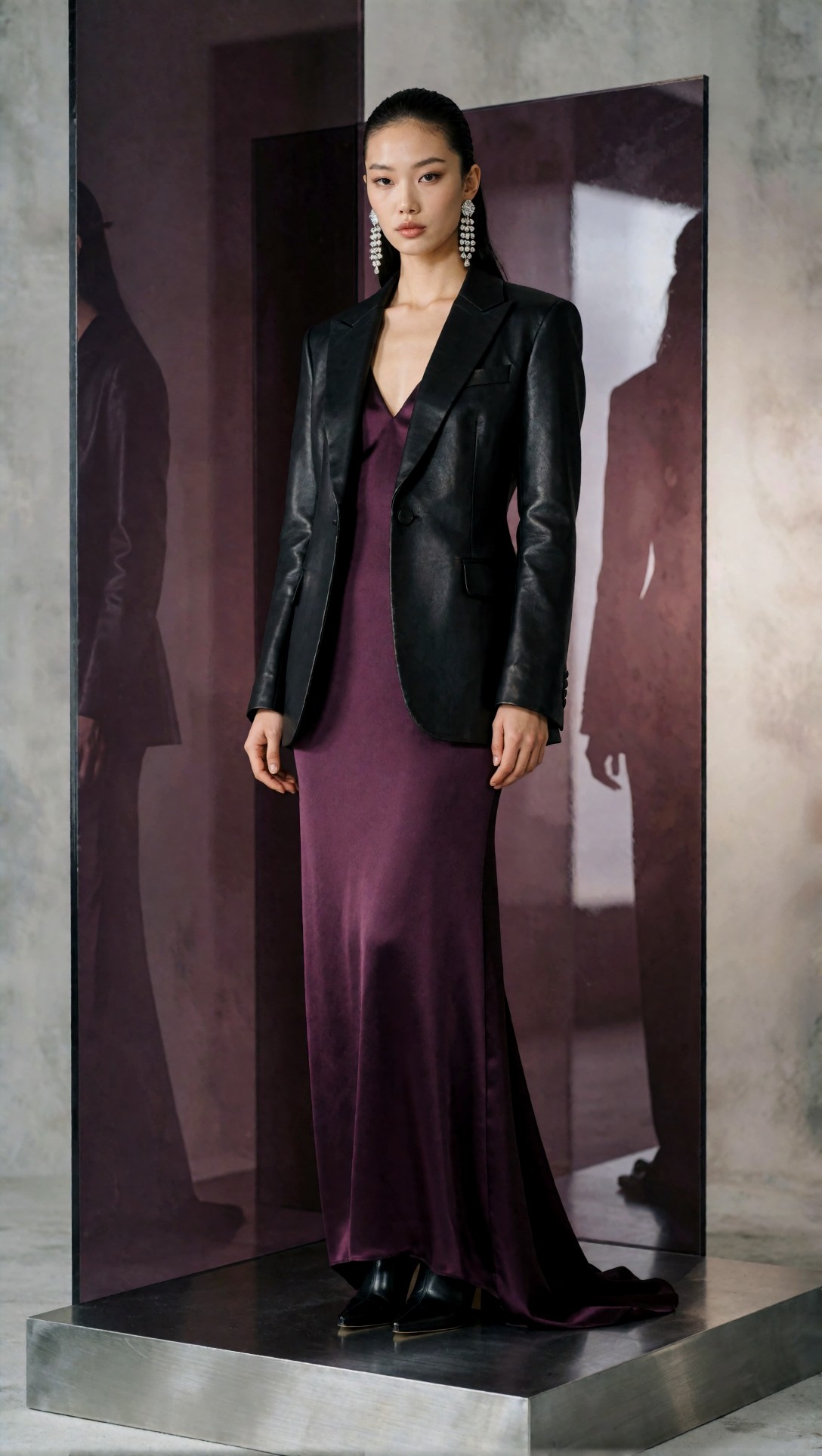
Look for two things: whether satin and leather stay materially distinct, and whether the pose remains fashion-led rather than mannequin-stiff. In this setup, the strongest result had very clean vertical composition with controlled texture separation.
Workflow step 5: use accessory and detail prompts to support the set
A full article about runway inspiration should not rely only on full-body figures. You also need details that explain why the styling works: bags, gloves, hardware, shoes, makeup stations, and textile close-ups. These are useful for moodboards and for testing whether a model understands Korean fashion trends beyond general tailoring.
This close detail test checks product clarity and material realism in a show context.
Topic: Seoul Fashion Week accessory detail on runway seating
Genre: Product Editorial
Camera: Canon EOS R3
Lens: RF 100mm f/2.8L Macro IS USM
Lighting: Narrow soft spotlight with gentle ambient falloff
Location: Front-row runway seat with folded show notes and brushed metal bench detail
Style: Luxury accessory editorial
Final Prompt: Close editorial product image inspired by Seoul Fashion Week, structured black leather mini bag resting on a brushed metal front-row bench beside folded show notes and sleek leather gloves, silver clasp hardware, subtle embossed texture, edge of a tailored wool coat entering frame, cool focused spotlight, dark runway atmosphere beyond, premium Korean luxury accessory styling, realistic leather grain, clean composition, restrained monochrome palette, Canon EOS R3 macro realism, 100mm close detail, magazine-quality product clarity without visible brand logos
Inspect hardware shape, stitch lines, and whether the leather texture looks believable instead of plastic. In my test, accessory prompts were one of the most reliable ways to get polished output quickly.
A practical quality-control checklist
Before keeping any image, I would run through this short review list.
Garment checklist
- Can you identify the silhouette in one glance?
- Do layers sit logically on the body?
- Are fabric types clearly separated, especially leather, satin, wool, and sheer materials?
- Do boots, bags, and jewelry match the styling direction rather than appearing as random extras?
Runway and set checklist
- Are runway lines straight enough to feel intentional?
- Does the audience remain background information instead of visual noise?
- Are reflections helping depth, or are they duplicating limbs and confusing the silhouette?
- Does the venue feel like a contemporary Seoul fashion environment rather than a generic gala hall?
Anatomy and pose checklist
- Hands first, feet second
- Check whether stride poses preserve knee direction and heel contact
- Make sure neck length and shoulder angle still look fashion-natural
- Watch for bag straps fusing into coats or arms
Editorial consistency checklist
- Is the color palette controlled to 2-4 major tones?
- Does the crop support the garment story?
- Is the image runway documentation, backstage reportage, or luxury editorial? It should not accidentally become all three.
Where the outputs were strongest
The strongest result in this test was the combination of:
- one model
- full-body framing
- one hero garment
- one secondary accessory system
- medium venue context
- tightly controlled color palette
This setup consistently produced useful inspiration images for seoul fashion week, especially when the prompts referenced Korean magazine editorial language rather than celebrity red-carpet language.
Accessory close-ups also performed better than expected. They were less likely to drift stylistically and gave reliable material detail. If you are building an editorial concept deck, these detail images are worth generating early because they help define the visual system around the runway looks.
Where the weak points showed up
The weak point was scene density. As soon as I asked for multiple models, backstage teams, racks, mirrors, screens, audience, and runway in a single prompt, realism dropped fast.
The most common failures were:
- broken stylist hands in backstage scenes
- warped seating rows in front-row shots
- melted metallic skirts and overreflective satin
- generic western couture styling replacing the intended Korean fashion direction
- face-priority framing that cropped out the clothing logic
- fake text and unusable signage on tickets, passes, and screens
Another recurring issue: using "K-pop" references inside fashion week prompts often shifted the output away from runway editorial and toward idol promo imagery. That can be useful for some campaigns, but in this test it diluted the garment-first goal.
Troubleshooting weak outputs
If the image looks like generic fashion week content
Add:
- industrial-minimal Seoul venue cues
- Korean magazine editorial style language
- specific layering logic
- cleaner monochrome or cool-toned palette
Remove:
- broad luxury buzzwords without garment detail
- too many trend labels in one sentence
If the model keeps generating portraits instead of fashion images
Use these corrections:
- add "full-body" or "full-length"
- specify boots, hemline, trouser width, and runway floor visibility
- place pose language after the wardrobe, not before it
If backstage scenes break
Reduce the action.
Instead of: stylist team, makeup artist, assistant, mirrors, racks, cords, steamers, audience spill.
Use: one model, one rack, one mirror, one stylist hand action.
If the clothes lose structure
Name the garment architecture more precisely.
For example, replace:
- "dramatic jacket"
with:
- "cropped ivory jacket with exaggerated sculptural sleeves and rigid shoulder line"
That one change improved consistency in this test more than adding abstract mood terms.
If the set overwhelms the model
Lower the environment complexity and reduce reflective surfaces. One runway line, one monolithic object, one LED screen concept is usually enough.
My recommendation by use case
Best for runway outfit ideas
Use a runway-documentation base prompt first, then convert the best silhouette into editorial variants. This gives you stronger outfit logic and fewer random accessories.
Best for Korean magazine editorial inspiration
Skip crowded runway scenes and move directly into studio or architectural editorial prompts that keep the Seoul styling language. The images will usually be cleaner and more reusable.
Best for luxury fashion editorial decks
Generate three layers:
1. full-body hero look 2. one show-set wide shot 3. one accessory or textile close-up
That mix gives enough range to sell a concept without relying on one perfect image.
Best for AI fashion photography tests
Use backstage prompts only after you already have a stable wardrobe system. Backstage is good for realism testing, but it is not the easiest place to establish style from scratch.
Summary recommendation
If your goal is seoul fashion week inspiration, this workflow works best for art directors, prompt builders, stylists, and editorial teams who need garment-led AI fashion images with recognizable runway context. It is less suitable for users who want instant one-line prompts, because the quality difference here came from structured wardrobe description and controlled scene density.
Who should use it: anyone building runway outfit ideas, Korean fashion trend references, luxury fashion editorial boards, or AI fashion photography tests where silhouette and set matter equally.
Who should avoid it: anyone expecting crowd-heavy event realism, readable signage, or highly complex backstage choreography in a single pass.
The setting that mattered most in this test was not the camera name or even the venue. It was the combination of full-body composition, clear layering order, and medium scene complexity. When that setup works, the image feels specific. When it fails, the output slides back into generic fashion imagery very quickly. If I were refining this further, what I would change next is building a second pass specifically for shoes, bags, and hem detail, because those small fashion anchors did the most work in making the images feel editorially credible.