Streetwear Campaign Ideas Trending Now: Tested AI Setups for Drops, Sneakers, and City Editorials 한국어 요약
이 페이지는 ZView Space의 영어 원문을 한국어 검색 사용자도 이해할 수 있도록 정리한 SEO 요약입니다. 핵심은 단순한 얼굴 중심 이미지가 아니라 패션 에디토리얼, 룩북, 아웃핏, 프롬프트 테스트, 이미지 생성 워크플로우를 실제로 어떻게 구성할지입니다.
핵심 요약
- 원문 주제: Streetwear Campaign Ideas Trending Now: Tested AI Setups for Drops, Sneakers, and City Editorials
- 목적: AI 이미지 생성에서 outfit, silhouette, fabric, pose, location, camera framing을 더 명확하게 설계합니다.
- 활용 범위: Z-Image Turbo, Krea2 Turbo, Qwen Image, Anima, SeedVR2 같은 이미지 생성 및 업스케일 워크플로우에 적용할 수 있습니다.
- SEO 관점: 제목, 설명, 이미지 alt, 프롬프트 예시가 실제 검색 의도와 맞아야 색인 가능성이 높아집니다.
한국어 사용자를 위한 체크포인트
1. 프롬프트가 얼굴 묘사에만 머물지 않고 전체 스타일과 의상 구성을 설명하는지 확인합니다. 2. 패션 이미지라면 상의, 하의, 아우터, 신발, 액세서리, 소재감, 촬영 장소를 분리해서 씁니다. 3. 생성 결과는 바로 게시하지 말고 디테일, 손, 의상 형태, 배경 일관성, 이미지 품질을 비교합니다. 4. 글 본문에는 실제 테스트 기준과 실패를 줄이는 방법이 들어가야 검색엔진에서 얇은 콘텐츠로 보일 가능성이 줄어듭니다.
원문 미리보기
If you are searching for streetwear campaign ideas trending now , the short version is this: the best AI results right now come from splitting the job into two workflows. One workflow is better for atmospheric city editorials and trend heavy campaign images. T
---
If you are searching for streetwear campaign ideas trending now, the short version is this: the best AI results right now come from splitting the job into two workflows. One workflow is better for atmospheric city editorials and trend-heavy campaign images. The other is better for clean lookbook control, product visibility, and repeatable drop assets. In this test, the strongest outputs were not the most dramatic ones. They were the images that kept silhouette, sneaker shape, fabric texture, and layering logic intact across multiple shots.
Quick answer
- Use a cinematic editorial workflow when you need mood, motion, nightlife energy, and trend-coded city context.
- Use a structured lookbook workflow when the drop needs readable garments, accurate shoe profiles, and consistent framing.
- For sneakers, bags, and logo-heavy pieces, prompt for product clarity first, then add atmosphere second.
- The biggest failure point in this test was not faces. It was outfit drift: changing hems, missing layers, and inconsistent footwear between angles.
- The best results came from treating each image like a fashion shot list, not a one-line prompt.
What was tested
I tested two practical AI fashion photography setups for a mock streetwear campaign:
- Option A: single-pass editorial prompting for city campaign images
- Option B: modular prompt workflow for lookbooks, drop pages, sneaker callouts, and campaign extensions
The goal was not to find the most artistic image in isolation. The goal was to find which setup produces useful campaign assets for:
- hero drop imagery
- sneaker launch visuals
- city editorials
- lookbook pages
- detail shots
- storefront and retail concepts
Comparison criteria
I scored outputs by what matters in a streetwear campaign, not by raw beauty:
| Criteria | Option A: Editorial single-pass | Option B: Modular lookbook workflow | |---|---|---| | Mood and trend energy | Strong | Moderate to strong | | Outfit consistency across shots | Weak to moderate | Strong | | Sneaker shape accuracy | Moderate | Strong | | Fabric and texture readability | Moderate | Strong | | Background realism | Strong | Moderate | | Speed for ideation | Strong | Moderate | | Reliability for campaign sets | Moderate | Strong | | Best use | Hero concepts, teaser visuals | Lookbooks, PDP support, repeatable campaigns |
I also used [zview Prompt Lab](/promptlab) style iteration thinking during prompt rewrites, and checked upscale behavior for fabric grain and outsole detail with [zview Upscaler](/upscaler).
The verdict first: what actually worked
For streetwear campaign ideas trending now, Option A produced the most current-looking images at first glance. It handled Seoul alley neon, New York sidewalk motion, and late-evening editorial atmosphere well. But it often drifted on the practical details: cargo pocket shape changed, sneaker midsoles softened, crossbody bags jumped sides, and logo placements became unreliable.
Option B looked slightly less spontaneous on the first pass, but it was the better production workflow. It kept silhouettes readable, held onto layering systems, and made it easier to build a full campaign package around one drop.
If I had to choose one for a real launch, I would use Option A for concepting and Option B for final asset generation.
Option A: the strongest setup for city editorial energy
The appeal of Option A is obvious. It gives you campaign mood fast. If the brief is "oversized varsity jacket, washed denim, technical runner, urban dusk, youth culture energy," this setup tends to produce a frame that already feels like a poster.
In this test, Option A did especially well with:
- wet pavement reflections
- layered outerwear silhouettes
- motion in trousers and jackets
- trend-coded neighborhoods like Seongsu, Harajuku, Lower East Side
- gritty flash plus ambient light mixes
Its weak point was control. The stronger the atmosphere, the more likely the model was to improvise garment details.
Test 1: street-style full body for a drop hero
This first prompt checks whether the model can hold a complete outfit system in a single editorial frame: outerwear, tee, bottom, sneakers, bag, and accessories.
Topic: Oversized varsity jacket streetwear drop hero
Genre: Street Style
Camera: Sony A7R V
Lens: 40mm f/2.5
Lighting: Overcast diffusion with subtle storefront bounce
Location: Seongsu side street with concrete walls, parked scooters, and small fashion retail signage
Style: Contemporary Korean streetwear campaign
Final Prompt: street-style full body fashion image of a gender-neutral model wearing an oversized black and forest green varsity jacket, faded charcoal boxy t-shirt, wide-leg washed denim, silver chain, black technical crossbody bag, white crew socks, grey and green retro runner sneakers, complete head-to-toe outfit visible, relaxed stride across a Seongsu side street, documentary fashion framing, concrete textures, muted city palette with green accents, realistic garment weight, visible denim fading, readable sneaker profile, natural urban posture, clean editorial composition, Sony A7R V realism, 40mm street perspective, magazine-ready campaign image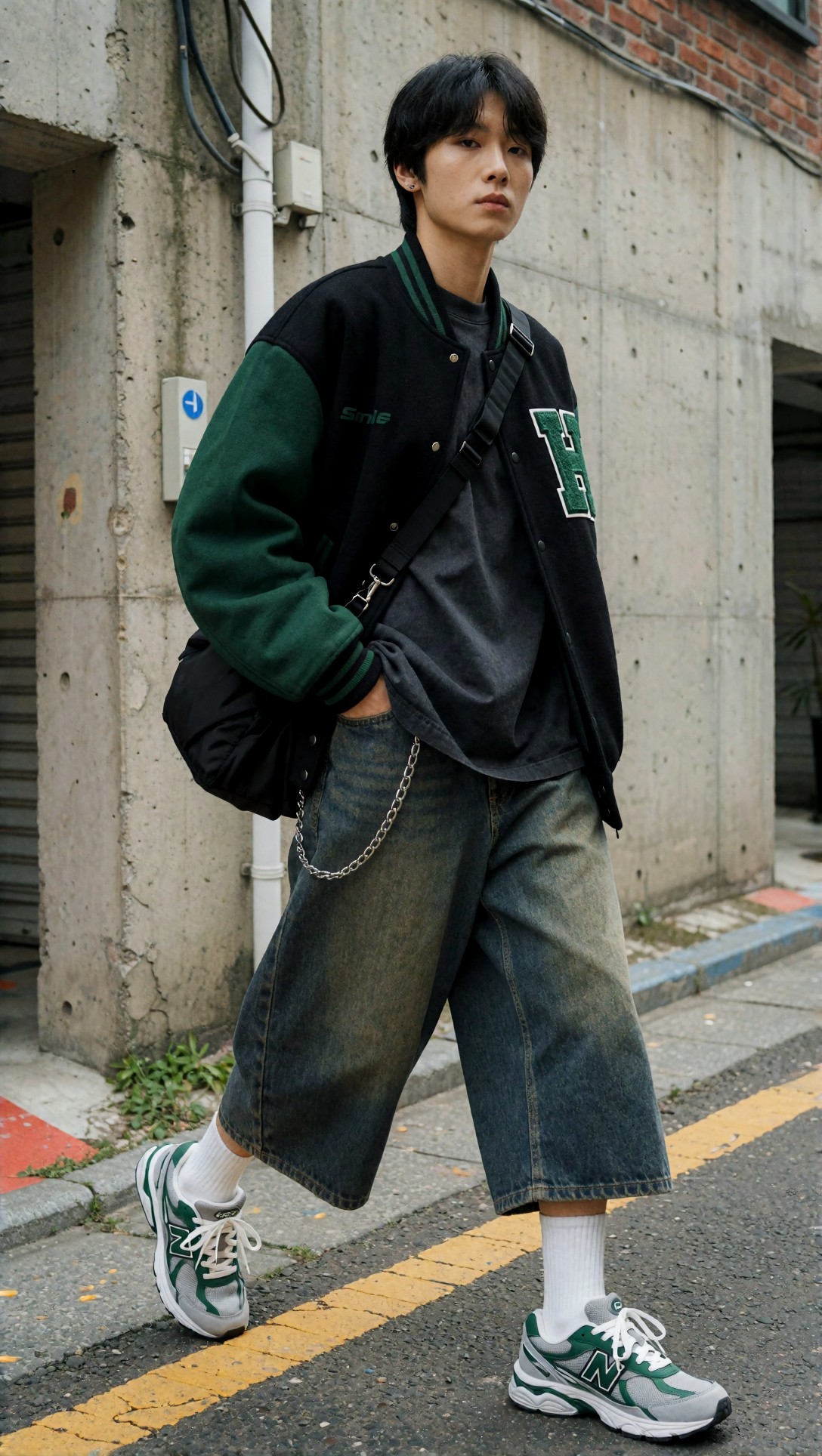
Inspect whether the varsity jacket keeps its proportions and whether the sneaker sidewall stays readable. In my test, the mood was excellent, but the bag strap and sock height varied more than they should.
Why Option A feels current
This workflow matches what is trending in streetwear campaigns right now: less polished studio perfection, more lived-in city context. Slight motion blur, practical layering, flash spill, and believable sidewalks all help the image read as campaign material instead of generic AI fashion.
Test 2: three-quarter outfit editorial for sneaker-led styling
This prompt is meant to expose sneaker hierarchy. Can the image keep the shoes important without losing the outfit logic?
Topic: Sneaker-led streetwear editorial with layered utility styling
Genre: Fashion Editorial
Camera: Canon EOS R5
Lens: 35mm f/1.8
Lighting: Late afternoon hard sun with silver reflector fill
Location: Lower East Side sidewalk near brick storefronts and metal shutters
Style: Gritty global streetwear magazine editorial
Final Prompt: three-quarter outfit editorial image focused on sneaker-led styling, model wearing cropped utility bomber in sand nylon, off-white rib tank, deep olive parachute pants with articulated knees, black web belt, stacked silver rings, compact sling bag, cream and gum sole lifestyle sneakers clearly visible, body angled against a brick storefront on a Lower East Side sidewalk, strong late afternoon shadows, tactile nylon and cotton textures, full styling logic readable from jacket to shoes, confident neutral expression, fashion magazine framing, realistic fabric creases, urban editorial color grade, Canon EOS R5 detail, 35mm environmental composition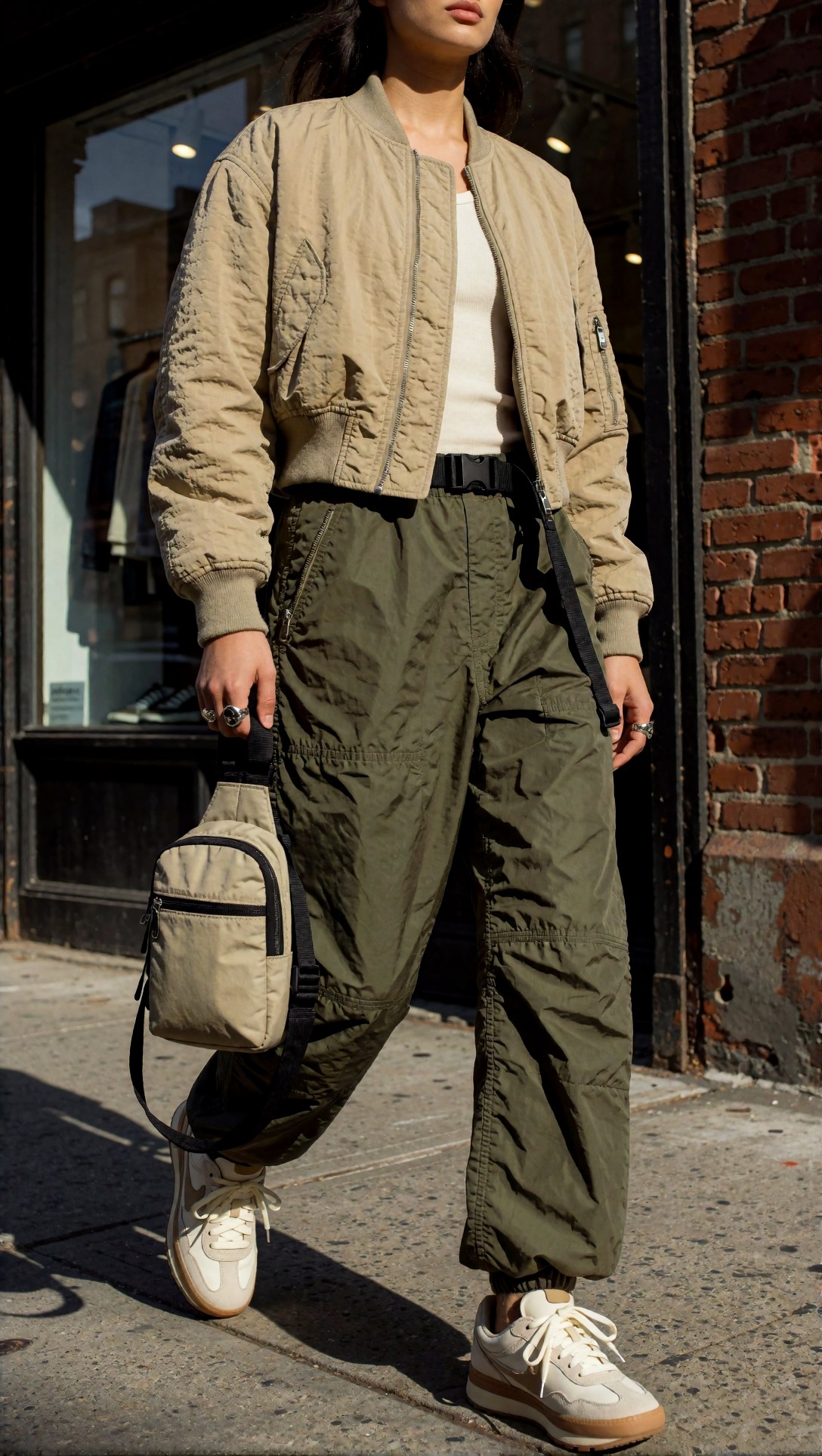
Look at the trouser break over the sneakers and the articulation in the knees. In stronger outputs, the pants supported the shoe launch. In weaker ones, the cuff swallowed the sneaker shape.
Where Option A fails
Single-pass editorial prompting tends to break when the brief includes too many product-specific demands:
- exact outsole shape
- repeatable logo placement
- front, side, and moving pose consistency
- matching the same outfit across a mini campaign
- clear e-commerce style visibility
This is where many AI fashion photography tests look impressive but become hard to use. A hero image is not enough if the follow-up lookbook no longer matches the hero outfit.
Option B: the better workflow for lookbook control and campaign systems
Option B uses a modular build. Instead of prompting only for vibe, it prompts for shot type, garment hierarchy, product visibility, and context separately inside one structured brief. This produced fewer flashy first images, but far more usable outputs overall.
In this test, Option B was strongest for:
- head-to-toe lookbook consistency
- repeatable sneaker and bag visibility
- catalog and grid-style campaign support
- product scenes that still felt editorial
- detail crops for denim, knit, mesh, suede, and hardware
This is the workflow I would use if a drop needs both a hero campaign image and supporting assets for product pages, social crops, and retail display mockups.
Test 3: head-to-toe lookbook for silhouette control
This prompt checks full-body clarity. The goal is not mood first. The goal is to preserve proportion, fit, and layering.
Topic: Head-to-toe monochrome streetwear lookbook with technical layering
Genre: Lookbook Photography
Camera: Nikon Z8
Lens: 50mm f/4
Lighting: Large softbox key with subtle floor bounce
Location: Minimal industrial studio with pale grey seamless and brushed concrete floor
Style: Clean commercial streetwear lookbook
Final Prompt: head-to-toe lookbook photograph of a full streetwear outfit, model standing straight with slight contrapposto, wearing oversized matte black technical shell, washed black hoodie layered under shell, elongated white inner tee hem visible, relaxed charcoal carpenter pants, black leather belt, tonal beanie, compact nylon shoulder bag, black and off-white skate sneakers, full silhouette clearly visible from head to toe, neutral studio background, emphasis on garment fit, seam construction, fabric texture, hem lengths, shoe proportions, clean commercial styling, minimal shadow, catalog-ready composition, Nikon Z8 crisp detail, 50mm balanced perspective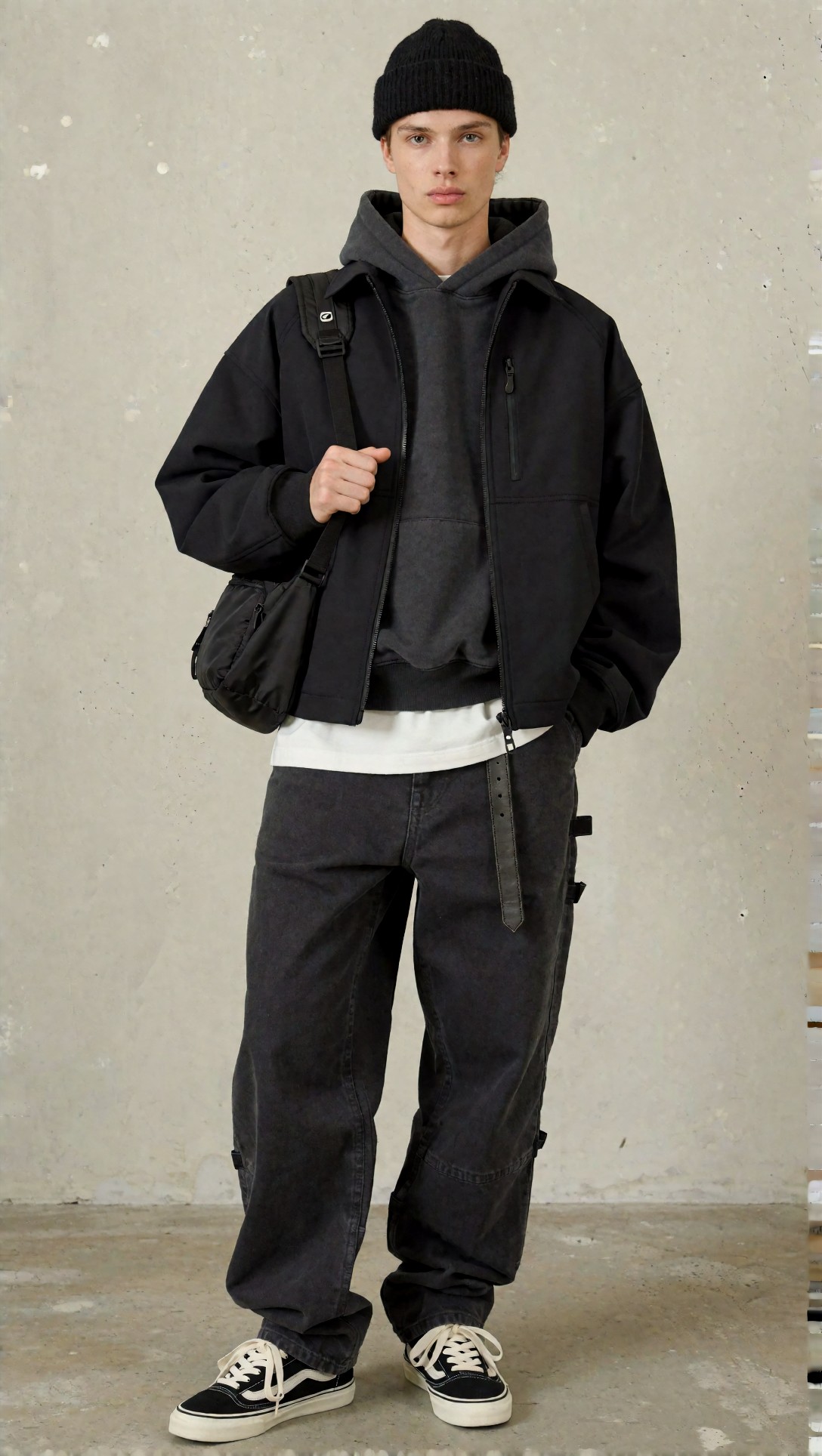
Check the hem stacking and the distance between pant break and shoe upper. In the best outputs, the outfit read like a real merch line. In weaker outputs, the hoodie hem disappeared or merged with the shell.
Why Option B is better for real campaign production
Streetwear launches usually need more than one image type. You need the city hero, but you also need controlled support images. Option B is stronger because it survives this expansion.
You can build a campaign set around one styling language, then branch into [zview Create](/create) for variations and [zview Gallery](/gallery) references for mood calibration.
Test 4: catalog grid page for drop planning
This prompt tests whether the model can think in retail layout terms instead of only editorial cinema.
Topic: Multi-look streetwear drop catalog grid
Genre: Product Editorial
Camera: Fujifilm GFX100S
Lens: 45mm f/5.6
Lighting: Even studio soft light with top fill
Location: Minimal white studio set for fashion catalog production
Style: Modern retail lookbook layout
Final Prompt: catalog grid page showing four coordinated streetwear looks from the same drop, each figure visible head-to-toe in separate clean panels, collection includes nylon track jacket, heavyweight graphic hoodie, washed denim, pleated cargo pants, skate sneakers, technical runner sneakers, beanies, crossbody bags, clear silhouette differences between looks, consistent palette of graphite, stone, moss green, and faded blue, clean spacing, readable garment details, premium retail layout feel, no clutter, fashion buying guide presentation, Fujifilm GFX100S clarity, balanced studio perspective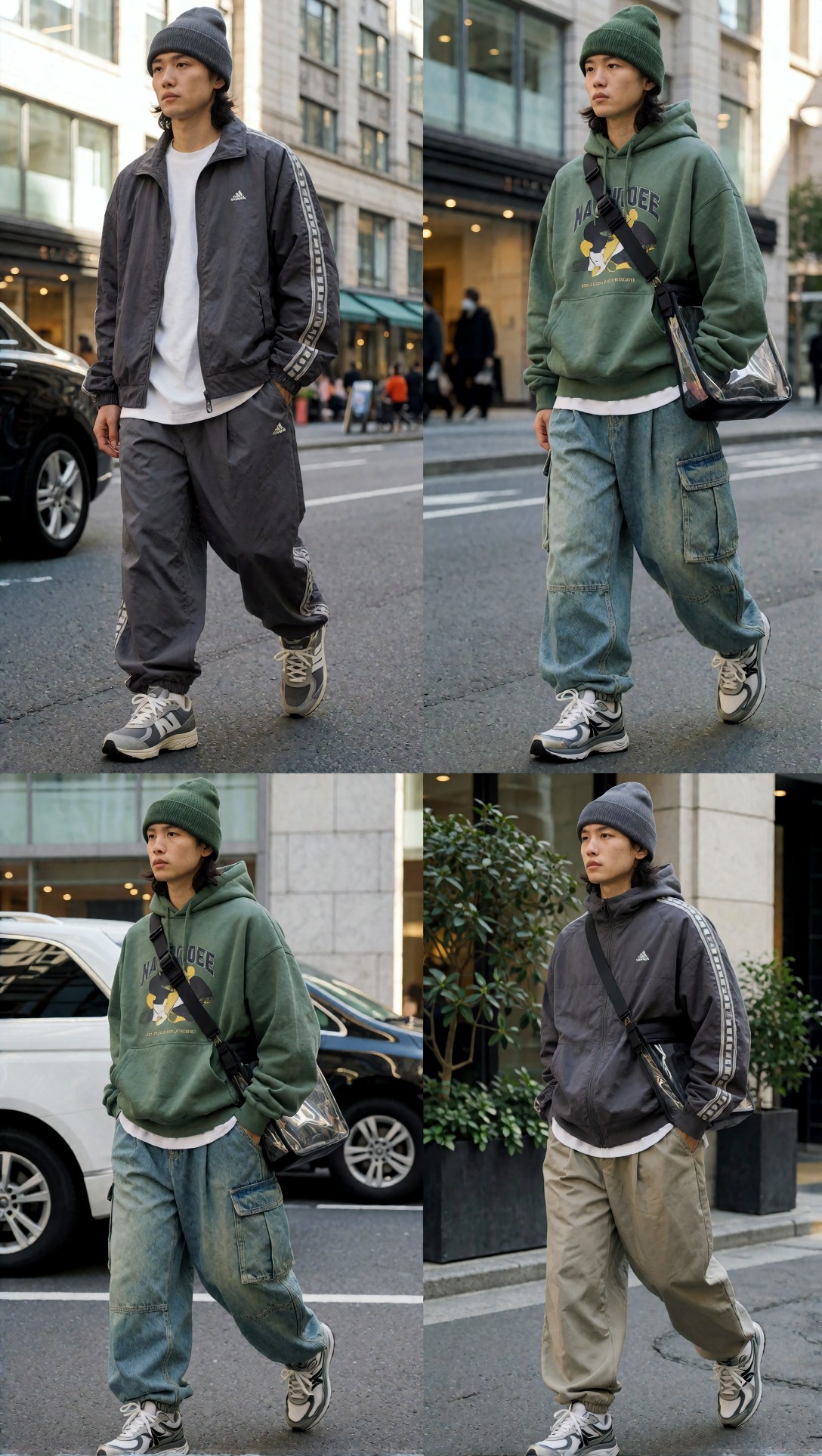
Inspect whether all four looks feel like one collection rather than four unrelated outfits. The useful result here is consistency of palette, footwear family, and accessory repetition.
Side-by-side tradeoffs that matter in practice
Here is the simplest way I would explain the difference after testing both workflows.
Choose Option A if you need:
- a hero image for social launch
- mood-board validation for campaign direction
- nightlife, motion, or gritty city realism
- trend-coded editorial energy over exact product control
Choose Option B if you need:
- consistent lookbook sets
- sneaker and garment readability
- campaign images that can also support retail use
- repeatable prompts for multiple SKUs or outfit colorways
Common failure risks in both workflows
- Hands around bags or phones: still a risk in active street poses
- Layer drift: inner tee length changes between generations
- Sneaker inflation: midsoles become oversized or vague
- Accessory disappearance: chains, carabiners, and straps may vanish
- Fabric confusion: nylon can turn into leather-like sheen if lighting is too dramatic
Prompt tests that exposed the biggest differences
The clearest differences appeared when I moved beyond full-body campaign shots and tested detail, retail, and runway-adjacent formats.
Test 5: runway/backstage moment for trend scouting visuals
This test checks whether the system can suggest runway outfit ideas without losing streetwear practicality.
Topic: Streetwear runway backstage layering study
Genre: Fashion Documentary
Camera: Leica SL2-S
Lens: 24-70mm at 50mm f/2.8
Lighting: Mixed backstage tungsten and soft LED fill
Location: Milan runway backstage with garment racks, taped floor marks, and styling tables
Style: Editorial fashion reportage
Final Prompt: runway backstage moment showing a streetwear collection styling study, full outfit visible on model standing near garment racks, oversized charcoal trench layered over cropped zip hoodie, striped football jersey peeking through, wide pleated nylon trousers, sculpted black sneakers, fingerless gloves, metal key clip, stylist hands adjusting shoulder line in background, busy but organized backstage context, taped floor marks, folded looks on table, textured fabrics, practical streetwear silhouette, documentary realism, Leica SL2-S tonality, 50mm fashion reportage framing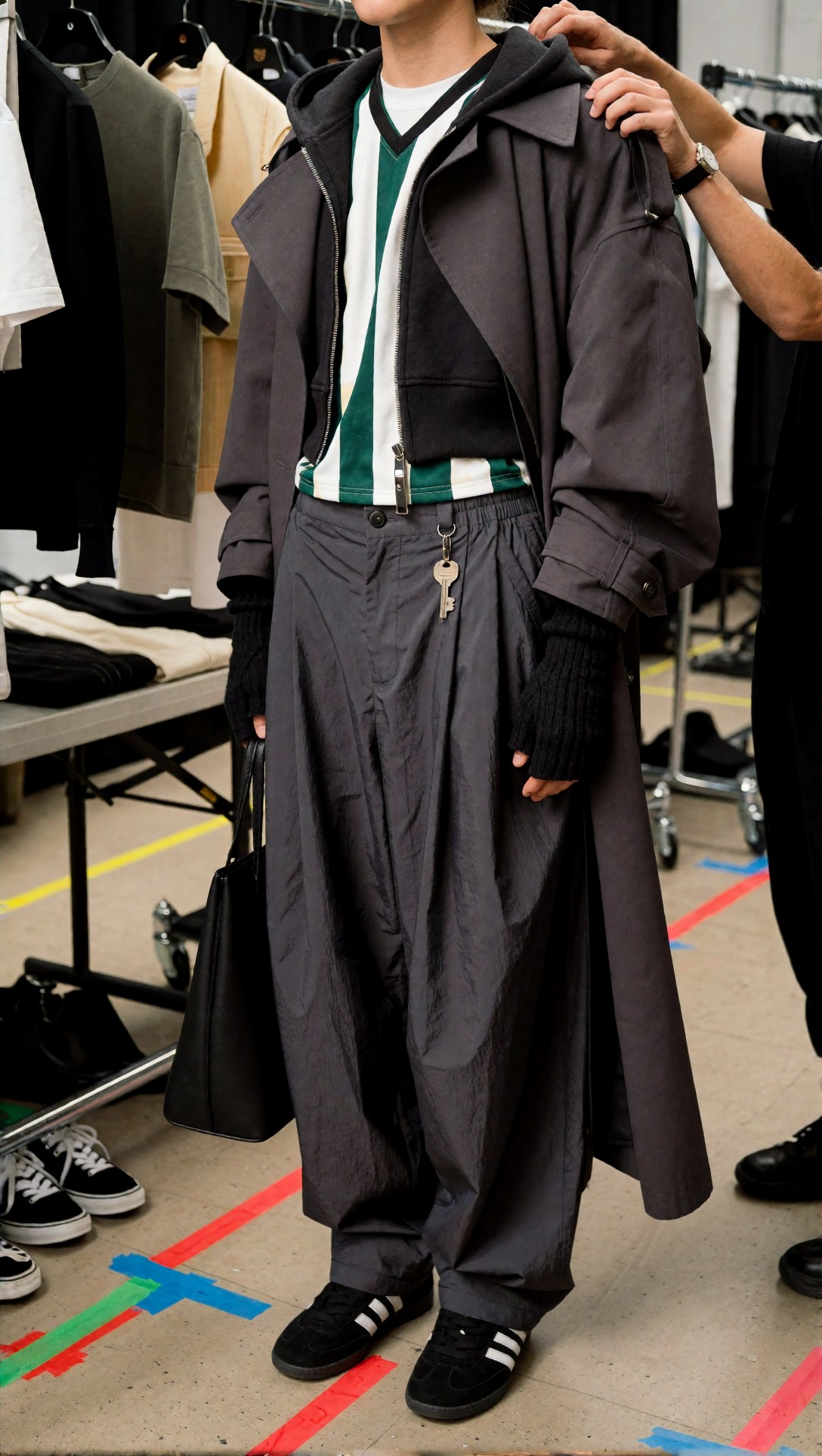
Look for whether the layered pieces still read cleanly in a busy scene. In my test, Option A made better atmosphere here, but Option B kept the garment logic more intact.
Test 6: product flat lay for drop support assets
This prompt is meant to expose product discipline. Flat lays reveal whether the model understands the collection as objects, not just outfits on people.
Topic: Streetwear drop flat lay with sneakers and accessories
Genre: Product Editorial
Camera: Phase One XF IQ4
Lens: 80mm f/5.6
Lighting: Overhead softbox with controlled side flags
Location: Studio tabletop with matte concrete surface
Style: Premium streetwear merchandising still life
Final Prompt: product flat lay of a coordinated streetwear drop arranged with fashion merchandising precision, oversized washed black hoodie, olive nylon cargo pant folded to show pocket construction, grey and moss retro runner sneakers side by side, black technical sling bag, ribbed socks, silver chain, branded swing tags, matte concrete tabletop, top-down composition, clean spacing, visible textile grain, premium retail campaign styling, neutral palette with moss accent, sharp object edges, realistic folds, luxury streetwear still-life direction, Phase One crisp detail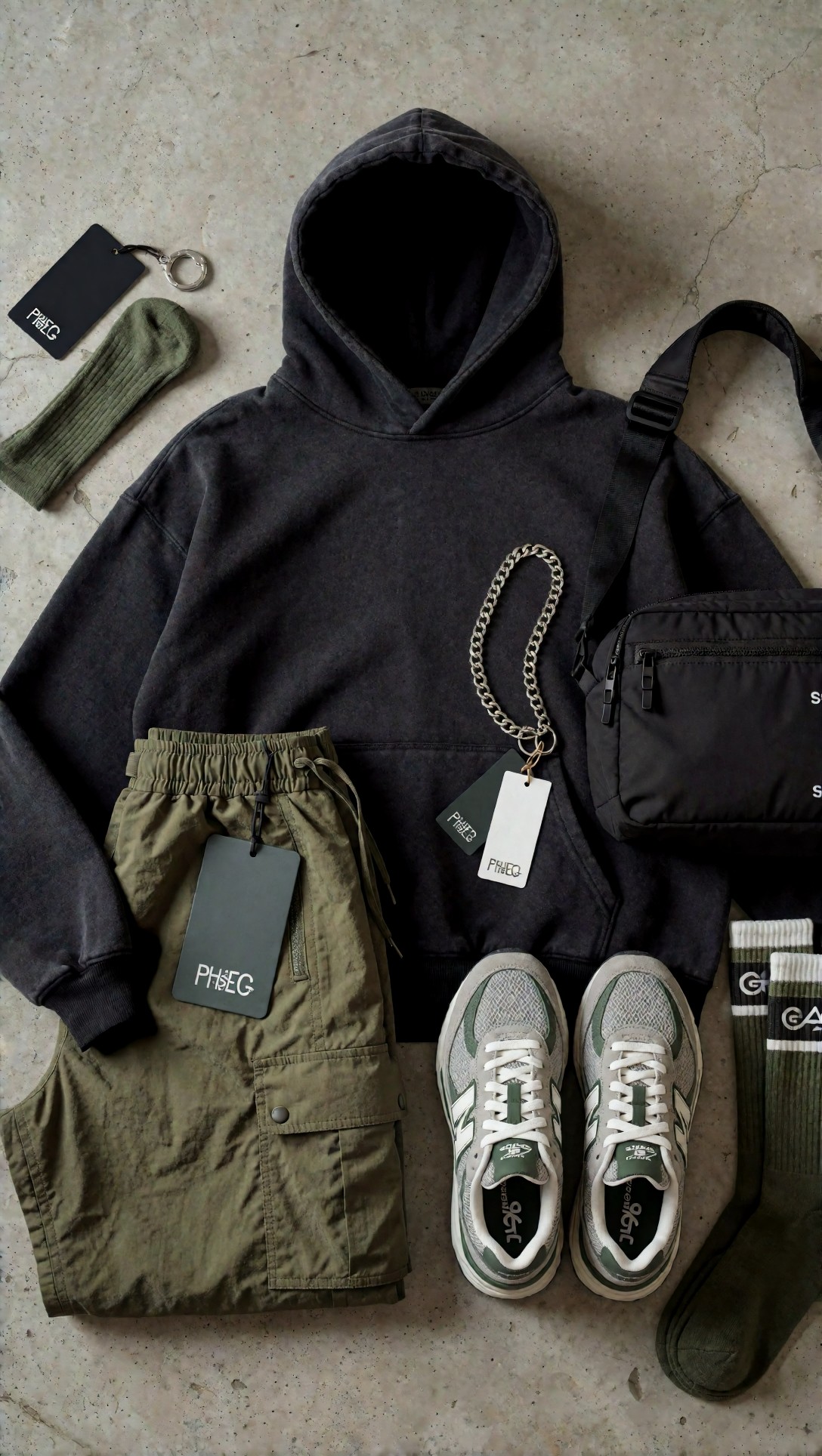
Inspect laces, outsole symmetry, and pocket construction. This was one of the easiest ways to see if the workflow could support a real drop page.
Test 7: storefront display for retail concepting
This test checks visual merchandising. It is useful when the campaign needs not only images of outfits but also a physical-world concept for launch week.
Topic: Streetwear storefront window display concept
Genre: Retail Visual Merchandising
Camera: Hasselblad X2D 100C
Lens: 38mm f/4.5
Lighting: Evening interior display lighting with cool street reflections
Location: Tokyo Harajuku storefront with glass facade and polished concrete entry
Style: Minimal luxury streetwear retail campaign
Final Prompt: storefront display concept for a streetwear campaign launch, two mannequins in full coordinated looks visible through glass, one in oversized cobalt puffer, grey hoodie, black cargo skirt over pants, trail sneakers and beanie, the other in cropped varsity jacket, loose denim, technical tote, retro basketball sneakers, folded product stacks, sneaker plinths, campaign poster in window, cool evening reflections from Harajuku street, premium visual merchandising, crisp garment silhouettes, high-fashion retail realism, Hasselblad X2D clarity, 38mm storefront composition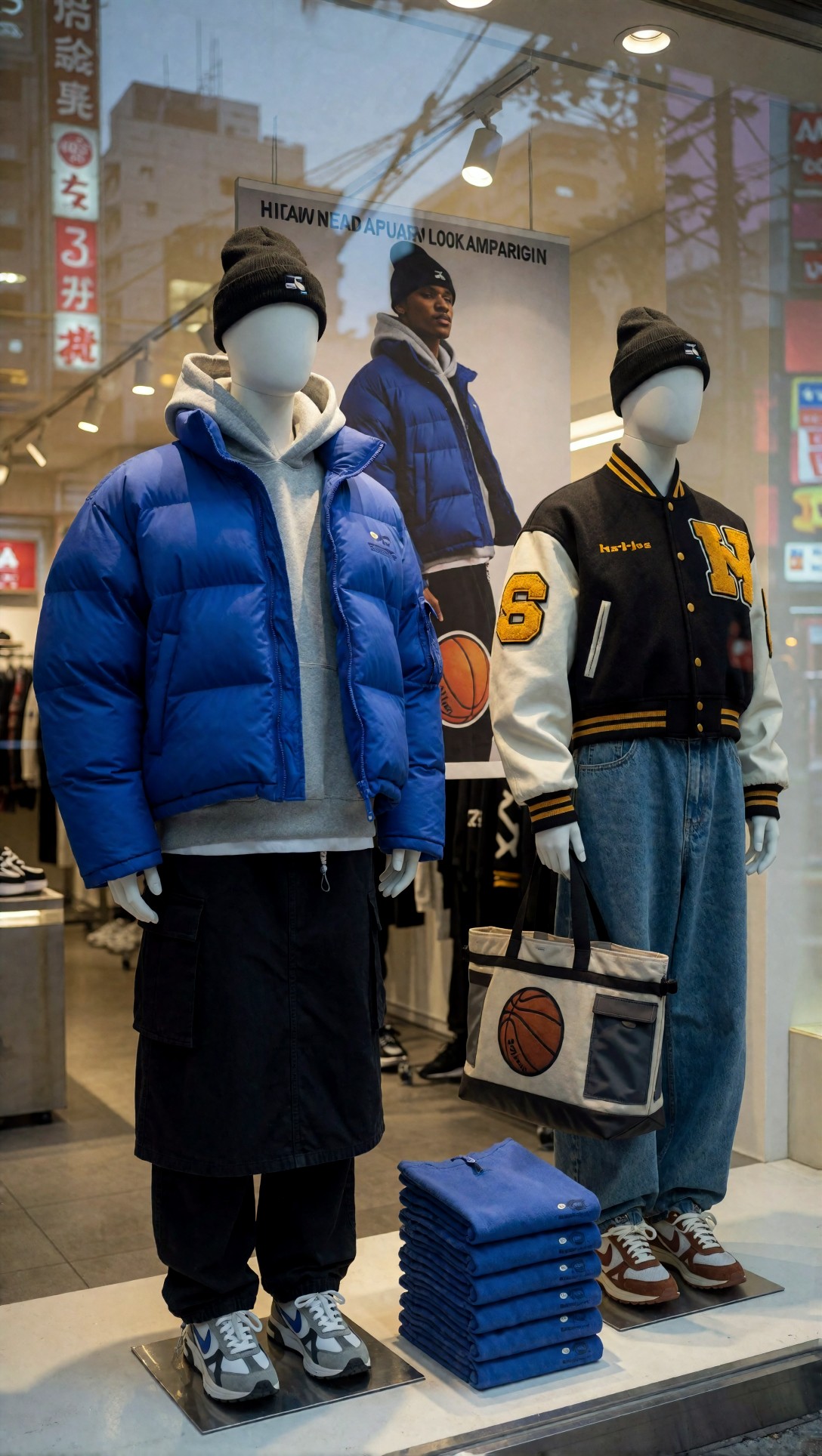
Check whether the mannequins maintain believable proportions and whether the display supports the clothing instead of becoming generic luxury retail. Strong outputs gave clear launch direction beyond image generation alone.
What I would change next when results are weak
When a generation looked trendy but unusable, the fix was usually one of these:
1. Reduce mood words by 20 to 30 percent. Too much atmosphere causes wardrobe improvisation. 2. Name the footwear type clearly. "retro runner," "skate sneaker," or "gum sole lifestyle sneaker" worked better than just "cool sneakers." 3. Describe the outfit from outer layer to shoes. That improved full-body styling retention. 4. Call out texture directly. Washed denim, ripstop nylon, brushed fleece, pebbled leather, mesh underlay. 5. Specify body framing. Full body, three-quarter, top-down, storefront-wide. This reduced composition drift.
More prompt examples for campaign detail control
The next two prompts were especially useful for checking whether editorial fashion AI could preserve the campaign language in close detail without losing the broader streetwear identity.
Test 8: garment detail macro for material truth
This prompt checks texture honesty: denim grain, seam finishing, zipper teeth, and fabric contrast.
Topic: Technical streetwear garment detail macro
Genre: Fashion Detail Study
Camera: Sony A1
Lens: 85mm f/2
Lighting: Directional soft side light with negative fill
Location: Neutral studio corner with soft grey backdrop
Style: High-end fashion materials study
Final Prompt: garment detail macro focused on streetwear material construction, close crop of oversized technical shell layered over heavyweight hoodie, visible matte ripstop weave, taped seam detail, brushed fleece edge, metal zipper teeth, cord lock, reinforced cuff stitching, part of wide trouser waistband and sling bag strap entering frame, premium monochrome palette, controlled editorial composition, tactile fashion detail, Sony A1 precision, 85mm close study, luxury materials campaign aesthetic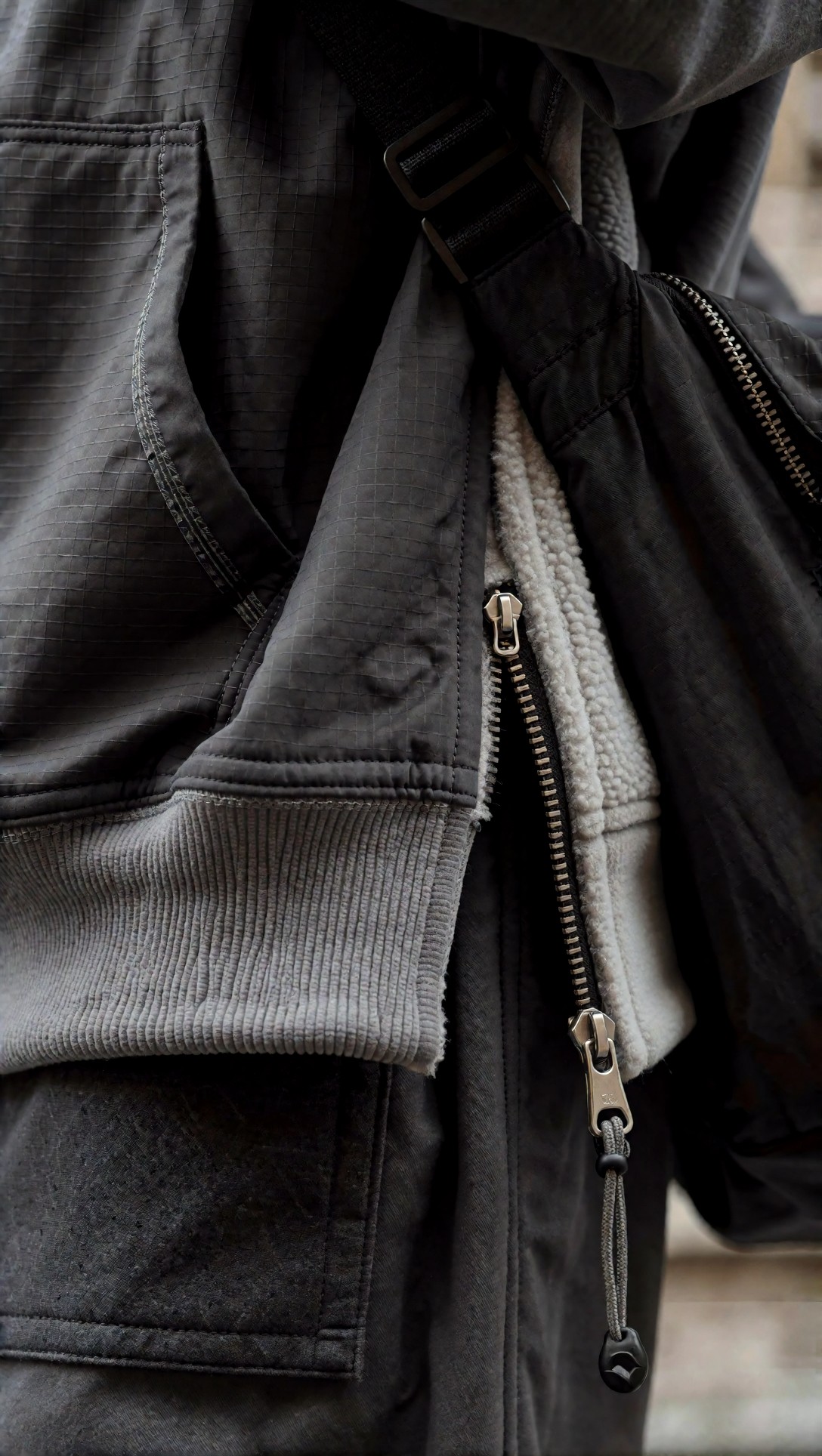
Inspect whether the image separates nylon from fleece cleanly and whether the hardware looks engineered rather than decorative. This is where weak models often fake texture with noise.
Test 9: accessories close-up for bags and hardware
This test checks bag geometry and whether small accessories still feel part of the same styling system.
Topic: Streetwear accessories close-up with bag and sneaker connection
Genre: Accessories Editorial
Camera: Canon EOS R3
Lens: 70mm f/3.2
Lighting: Soft window light with subtle flash lift
Location: New York studio loft near raw plaster wall and chrome clothing rack
Style: Contemporary accessories campaign
Final Prompt: accessories close-up editorial showing a black technical crossbody bag worn over layered streetwear outfit, partial torso and lower body visible, cropped bomber hem, heavyweight tee, pleated trouser waistband, silver carabiner, stacked bracelets, sneaker toe and sidewall entering lower frame to connect accessories with full look, black nylon, brushed cotton, silver hardware, muted stone and chrome color palette, sharp bag structure, premium editorial composition, Canon EOS R3 clarity, 70mm controlled fashion crop
Check the bag structure, zipper direction, and whether the hardware is plausible. Good outputs treated the bag as a product, not just as set dressing.
Best choice by use case
For sneaker drops
Use Option B first. Sneaker campaigns fail quickly when proportions drift. Start with clean product visibility, then adapt one successful prompt into a moodier city frame.
For city editorials and teaser posters
Use Option A first. It gives stronger immediate atmosphere and trend relevance. Just do not assume the first great image can anchor the entire campaign without rewrites.
For full lookbook photography
Use Option B. The consistency gain is worth the slightly less spontaneous first pass.
For runway outfit ideas and trend scouting
Use Option A for direction, then Option B for refinement. This combination worked best when translating editorial fashion AI mood into a usable garment system.
Practical checklist before you export a campaign set
- Is the full silhouette readable from outerwear to shoes?
- Does the same sneaker shape survive across multiple shots?
- Are key accessories visible and physically plausible?
- Does the palette feel like one collection, not random styling?
- Can at least one image work as a clean crop for social or retail?
- If upscaled, do denim, mesh, suede, and nylon stay distinct?
If not, go back to the prompt and tighten the outfit order, body framing, and product language before generating more variations.
FAQ
What are the best streetwear campaign ideas trending now for AI image generation?
The most effective ideas right now are city-editorial hero shots, clean head-to-toe lookbooks, sneaker-led styling frames, storefront launch concepts, and material detail crops. The trend is not just mood. It is mood plus usable garment visibility.
How do I make AI fashion photography look more like a real streetwear campaign?
Use named shot types, clear outfit hierarchy, specific city context, and concrete textiles. Prompt from outerwear to shoes, and describe the scene as a fashion brief instead of a generic image request.
What is the biggest prompt mistake in streetwear campaigns?
Overwriting atmosphere and under-specifying the outfit. If the prompt says "cool urban streetwear" but does not define silhouette, layering, and shoe type, the model fills the gaps inconsistently.
Are lookbook prompts better than editorial prompts for drops?
For production, yes. For instant mood, no. Editorial prompts are better for attention-grabbing concept frames, while lookbook prompts are better for consistency and product truth.
Can I use one prompt for hero shots, lookbooks, and product pages?
Usually not. In this test, one broad prompt rarely handled all three well. A modular workflow produced stronger results because each shot type had its own framing and product priorities.
Conclusion
My conclusion is simple: if you need streetwear campaign ideas trending now that actually hold up in image generation, do not rely on a single dramatic prompt. Use a two-step system. Start with editorial energy to find the campaign mood. Then move to a structured lookbook-style prompt for consistency, sneaker accuracy, and retail usefulness.
Who should use this workflow: fashion founders, content teams, stylists, and creators building drops, sneaker launches, or city editorials with multiple asset needs.
Who should avoid the pure editorial route: anyone who needs strict product accuracy, repeatable outfit continuity, or clean e-commerce support.
The setting that mattered most in this test was not a secret model parameter. It was prompt discipline: named shot type, full styling hierarchy, and explicit fabric and footwear language. That is what turned flashy AI images into a usable campaign system.
For more workflow testing, compare prompt structures in [zview Articles](/articles) or build your own iteration set with [zview Tools](/tools).