US Street Style Trends Today: Tested Outfit Formulas From NYC, LA, and Online Search Demand 한국어 요약
이 페이지는 ZView Space의 영어 원문을 한국어 검색 사용자도 이해할 수 있도록 정리한 SEO 요약입니다. 핵심은 단순한 얼굴 중심 이미지가 아니라 패션 에디토리얼, 룩북, 아웃핏, 프롬프트 테스트, 이미지 생성 워크플로우를 실제로 어떻게 구성할지입니다.
핵심 요약
- 원문 주제: US Street Style Trends Today: Tested Outfit Formulas From NYC, LA, and Online Search Demand
- 목적: AI 이미지 생성에서 outfit, silhouette, fabric, pose, location, camera framing을 더 명확하게 설계합니다.
- 활용 범위: Z-Image Turbo, Krea2 Turbo, Qwen Image, Anima, SeedVR2 같은 이미지 생성 및 업스케일 워크플로우에 적용할 수 있습니다.
- SEO 관점: 제목, 설명, 이미지 alt, 프롬프트 예시가 실제 검색 의도와 맞아야 색인 가능성이 높아집니다.
한국어 사용자를 위한 체크포인트
1. 프롬프트가 얼굴 묘사에만 머물지 않고 전체 스타일과 의상 구성을 설명하는지 확인합니다. 2. 패션 이미지라면 상의, 하의, 아우터, 신발, 액세서리, 소재감, 촬영 장소를 분리해서 씁니다. 3. 생성 결과는 바로 게시하지 말고 디테일, 손, 의상 형태, 배경 일관성, 이미지 품질을 비교합니다. 4. 글 본문에는 실제 테스트 기준과 실패를 줄이는 방법이 들어가야 검색엔진에서 얇은 콘텐츠로 보일 가능성이 줄어듭니다.
원문 미리보기
I approached this as a styling test, not a trend list. The goal was to answer US street style trends today with image generation evidence: which outfit formulas read as current right away, which ones drifted into outdated “Pinterest streetwear,” and which prom
---
I approached this as a styling test, not a trend list. The goal was to answer US street style trends today with image-generation evidence: which outfit formulas read as current right away, which ones drifted into outdated “Pinterest streetwear,” and which prompt details actually kept NYC, LA, and broader American streetwear references distinct.
Instead of guessing from a single aesthetic, I tested repeated outfit structures across city cues, search-driven trend phrases, and fashion shot types. The strongest results came from prompts that described silhouette, footwear, bag choice, layering logic, and location together. The weakest results were vague prompts like “cool streetwear outfit” that produced generic oversized hoodies with no regional identity.
What to know first
- NYC prompts worked best when the outfit had structure: long coat, blazer, wide trousers, leather shoe or fashion sneaker, practical bag, fast-walking sidewalk energy.
- LA prompts looked current when the palette relaxed: washed denim, tanks, oversized shirts, sporty layers, sunglasses, low-profile sneakers, sun-faded neutrals.
- Online trend demand translated into a few repeated formulas: baggy denim, barn or work jackets, retro sneakers, maxi skirts with sneakers, athletic-prep layering, and visible accessories.
- If your result looks “2019 hypebeast,” the prompt usually needs less logo language and more silhouette language.
- For beginners, the easiest fix is to specify full outfit logic from outerwear to shoes instead of naming an aesthetic only.
Test setup
In this test, I generated fashion-style scenes built around current US trend signals rather than runway looks. I used multiple shot types so the styling would stay visible: full-body street style, lookbook, storefront display, accessories close-up, flat lay, and detail macro.
What I tested:
- NYC street style 2026 direction versus LA street style trends
- Search-led outfit formulas from terms like “american streetwear,” “streetwear outfit ideas,” and “viral street style outfits”
- Whether prompts stayed fashion-focused instead of turning into beauty portraits
- Which prompt ingredients improved garment realism, layering, and accessory coherence
For prompt drafting and iteration, a workflow like [Prompt Lab](/promptlab) helps because small wording changes matter a lot in fashion shots. For comparing output consistency across variants, I would keep a contact-sheet style review in [Gallery](/gallery).
What looked current immediately in US street style trends
The strongest result across the set was not one single trend, but a cluster of repeatable formulas. These read as “fashion trends today USA” much faster than trend words alone.
NYC: tailored streetwear with movement
NYC outputs looked right when they mixed polish with utility. The formula that worked most often was:
- oversized wool coat or leather jacket
- fine knit, tee, or button-down underlayer
- wide-leg trousers or dark relaxed denim
- slim tote, shoulder bag, or crossbody
- retro runner or hard-bottom leather shoe
What made it feel current was restraint. Too many logos pushed the image into old streetwear stereotypes. Better prompts used terms like charcoal, espresso, slate, commuter styling, layered neutrals, and full-body walking pose.
This first test checks whether the model can produce a modern NYC silhouette without collapsing into either officewear or skaterwear.
Topic: NYC tailored streetwear trend with long coat and wide trousers
Genre: Street Style
Camera: Canon EOS R5
Lens: 40mm f/2.8
Lighting: Overcast diffusion
Location: Lower Manhattan sidewalk with crosswalk, cast-iron storefronts, light traffic, early fall city atmosphere
Style: Fashion week street-style realism
Final Prompt: street-style full body fashion image of a current NYC outfit, long charcoal wool coat layered over a soft gray knit top, wide-leg black trousers with a fluid drape, retro silver running sneakers, structured black shoulder bag, slim sunglasses, subtle jewelry, clean layered silhouette, visible garment texture, model walking across a Lower Manhattan crosswalk, outfit shown head to toe, practical city posture, neutral palette with espresso and slate accents, documentary editorial framing, Canon EOS R5 look, 40mm lens realism, overcast light for true fabric color, fashion-week street-style energy, background kept secondary to styling system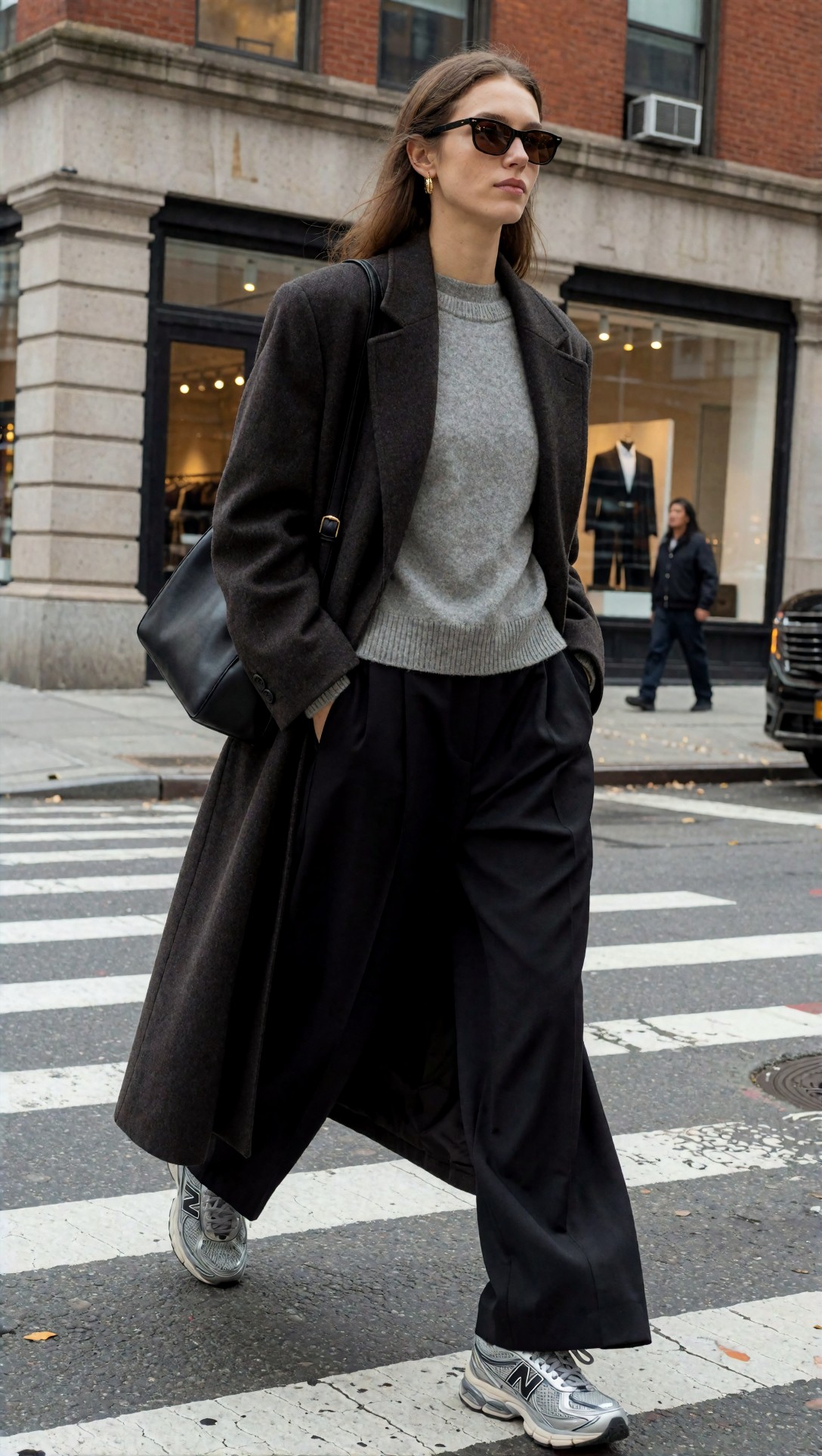
Inspect whether the coat hangs cleanly over the trousers and whether the shoe shape reads current. The weak point here is often the bag scale: if it becomes tiny or oversized, the whole styling logic feels less credible.
LA: relaxed athletic-prep and sun-faded layering
LA results improved when I stopped asking for “edgy” and started asking for relaxed proportion plus bright natural light. The common formula was:
- oversized striped or neutral button-down
- rib tank, baby tee, or cropped knit
- loose denim, track pant, or long short
- low-profile sneaker or sporty sandal
- baseball cap, wire sunglasses, nylon tote
The strongest result had enough polish to look intentional but enough looseness to avoid feeling overstyled.
This test checks whether a model can show relaxed LA street style without turning the outfit into beachwear or festival wear.
Topic: LA street style trend with relaxed denim and sporty layers
Genre: Fashion Editorial
Camera: Sony A7R V
Lens: 35mm f/2
Lighting: Bright late-morning sun with soft bounce
Location: Silver Lake side street with low retail facades, parked cars, faded walls, palm shadows
Style: West Coast contemporary editorial
Final Prompt: street-style full body fashion scene showing current LA street style trends, oversized pale blue striped shirt worn open over a white rib tank, loose faded denim with long straight leg, slim retro sneakers in off-white and gum sole, nylon shoulder tote, baseball cap, narrow sunglasses, layered silver jewelry, relaxed posture on a Silver Lake sidewalk, warm sun, dry pavement, sun-faded neutral palette with denim blue and cream, outfit logic fully visible from top layer to shoes, editorial but casual, Sony A7R V crisp detail, 35mm documentary framing, styling-first composition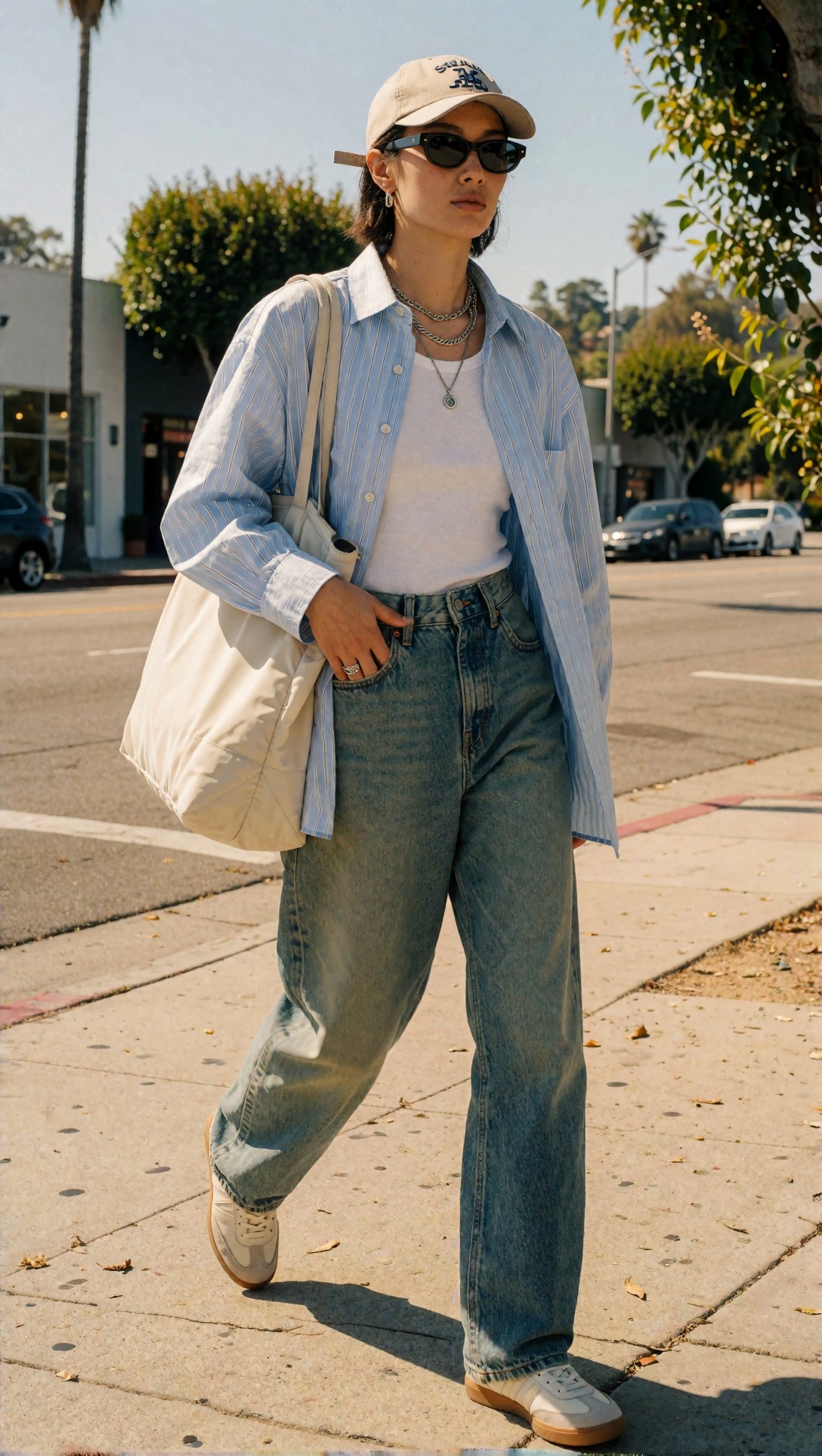
Check whether the denim volume is believable and whether the shirt-tank layering reads intentional. Failures usually show up as random crop lengths or oddly formal shoes.
What needed correction
A lot of early outputs technically looked good but did not read as US street style trends today. The issue was not rendering quality. It was trend accuracy.
Failure pattern 1: generic “streetwear” became old hype visuals
When I used broad labels like “american streetwear,” many models defaulted to:
- giant graphic hoodies
- stacked sneakers with exaggerated soles
- random luxury logos
- chaotic accessories
- no clear seasonal context
That still produces an image, but not a useful one if the searcher wants current outfit direction.
Failure pattern 2: city names alone were not enough
“NYC street style 2026” without garment guidance often returned black-on-black looks with no detail. “LA street style trends” often drifted into influencer vacation outfits.
Failure pattern 3: fashion prompts became portrait prompts
If the shot type was not named, the model cropped too close. That removed the shoes, trouser shape, and bag placement, which are exactly the clues needed to judge trend relevance.
Here I tested a head-to-toe lookbook format to force clearer outfit reading. This is useful when street scenes keep distracting the model.
Topic: US street style trend lookbook with baggy denim and barn jacket
Genre: Lookbook
Camera: Nikon Z7 II
Lens: 50mm f/4
Lighting: Soft studio daylight simulation
Location: Minimal concrete studio with off-white wall and matte floor
Style: Clean commercial fashion lookbook
Final Prompt: head-to-toe lookbook image focused on current US street style trends today, deep olive barn jacket with corduroy collar, white crewneck tee, baggy medium-wash denim with clean break at the shoe, dark brown leather belt, retro runner sneakers, medium black tote bag, baseball cap in washed navy, model standing straight in a neutral studio, full outfit fully visible, emphasis on silhouette, hem length, fabric weight, and layering clarity, clean commercial lookbook styling, Nikon Z7 II precision, 50mm balanced perspective, soft daylight for true color and textile detail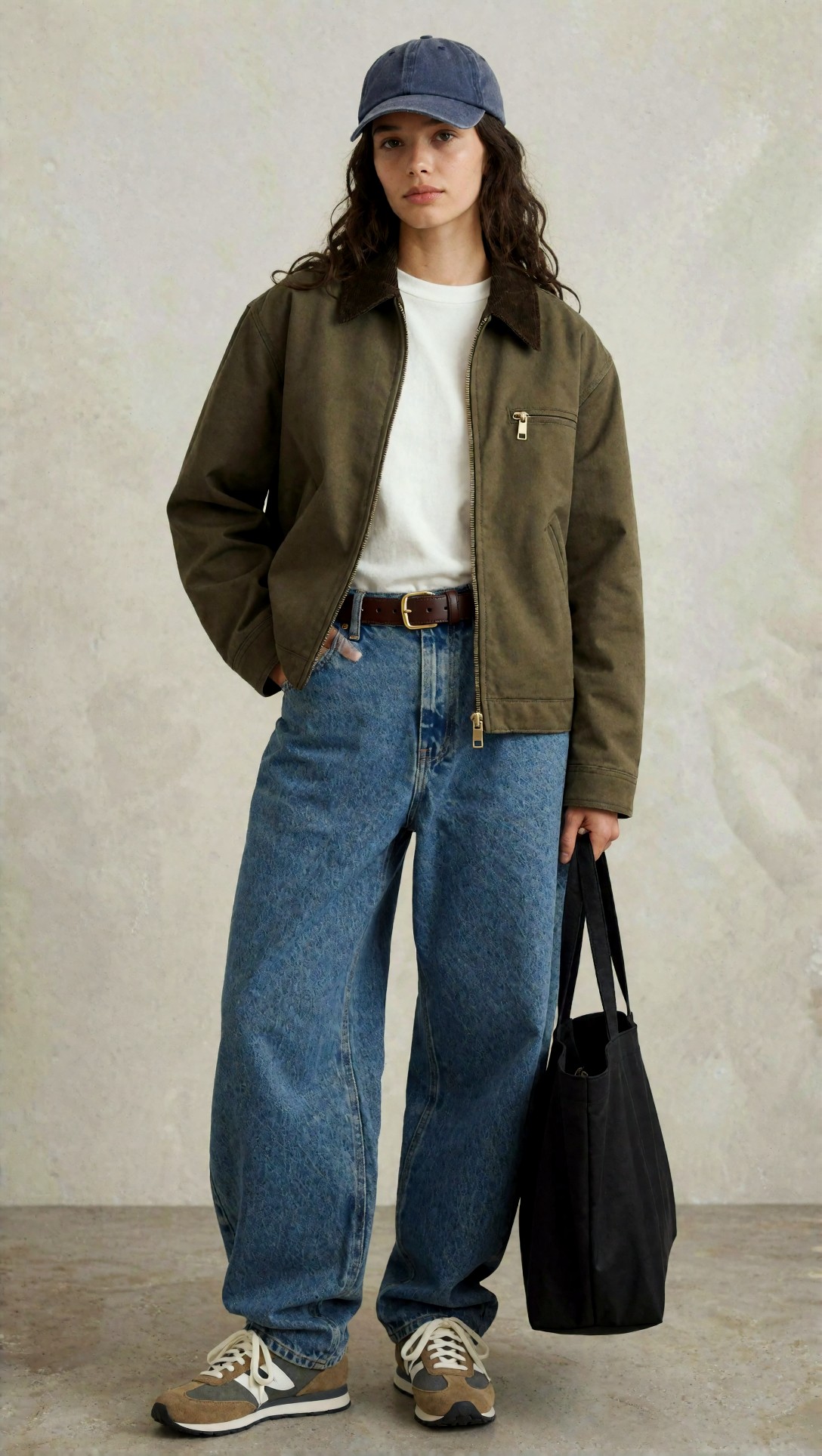
Inspect pant break, jacket collar texture, and whether the barn jacket reads like a current fashion item rather than literal workwear. If the model adds random patches or distressing, the prompt needs stricter wording around “clean” and “minimal branding.”
The prompt ingredients that changed the result
The biggest gain came from treating the prompt like a fashion editor’s shot brief. These were the exact ingredients that improved output quality.
1. Named shot type
Terms like street-style full body, three-quarter outfit editorial, and head-to-toe lookbook gave the model a framing job. This prevented portrait crops.
2. Silhouette before aesthetic label
“Wide-leg trousers, cropped bomber, slim shoulder bag, retro runner” worked better than “cool downtown streetwear.”
3. City-specific environment cues
A Lower Manhattan crosswalk creates different styling assumptions than a Silver Lake side street. That helped separate NYC from LA without overexplaining.
4. Accessories with function
Bag type, sunglasses shape, cap style, and jewelry scale all helped date the outfit correctly.
5. Fabric and texture terms
Words like washed denim, crisp poplin, wool coating, corduroy collar, nylon tote, and suede sneaker moved images away from flat synthetic clothing.
This prompt tests a three-quarter editorial crop, which is a good middle ground when you want outfit logic plus a bit more mood.
Topic: Viral street style outfit with maxi skirt and sneakers
Genre: Fashion Editorial
Camera: Fujifilm GFX100S
Lens: 45mm f/2.8
Lighting: Soft cloudy daylight
Location: SoHo side street with gallery facade, concrete sidewalk, muted storefront reflections
Style: Modern magazine editorial
Final Prompt: three-quarter outfit editorial image capturing a current viral street style outfit, structured black leather jacket over a white fitted tee, fluid ankle-length gray maxi skirt with movement, low-profile retro sneakers, compact underarm bag, slim oval sunglasses, mixed-metal earrings, styling balanced between polished and casual, SoHo fashion context, body framed to keep jacket, skirt shape, bag placement, and shoes readable, cool gray palette with black and white contrast, Fujifilm GFX100S medium-format detail, soft cloudy light, modern magazine composition with styling as the main subject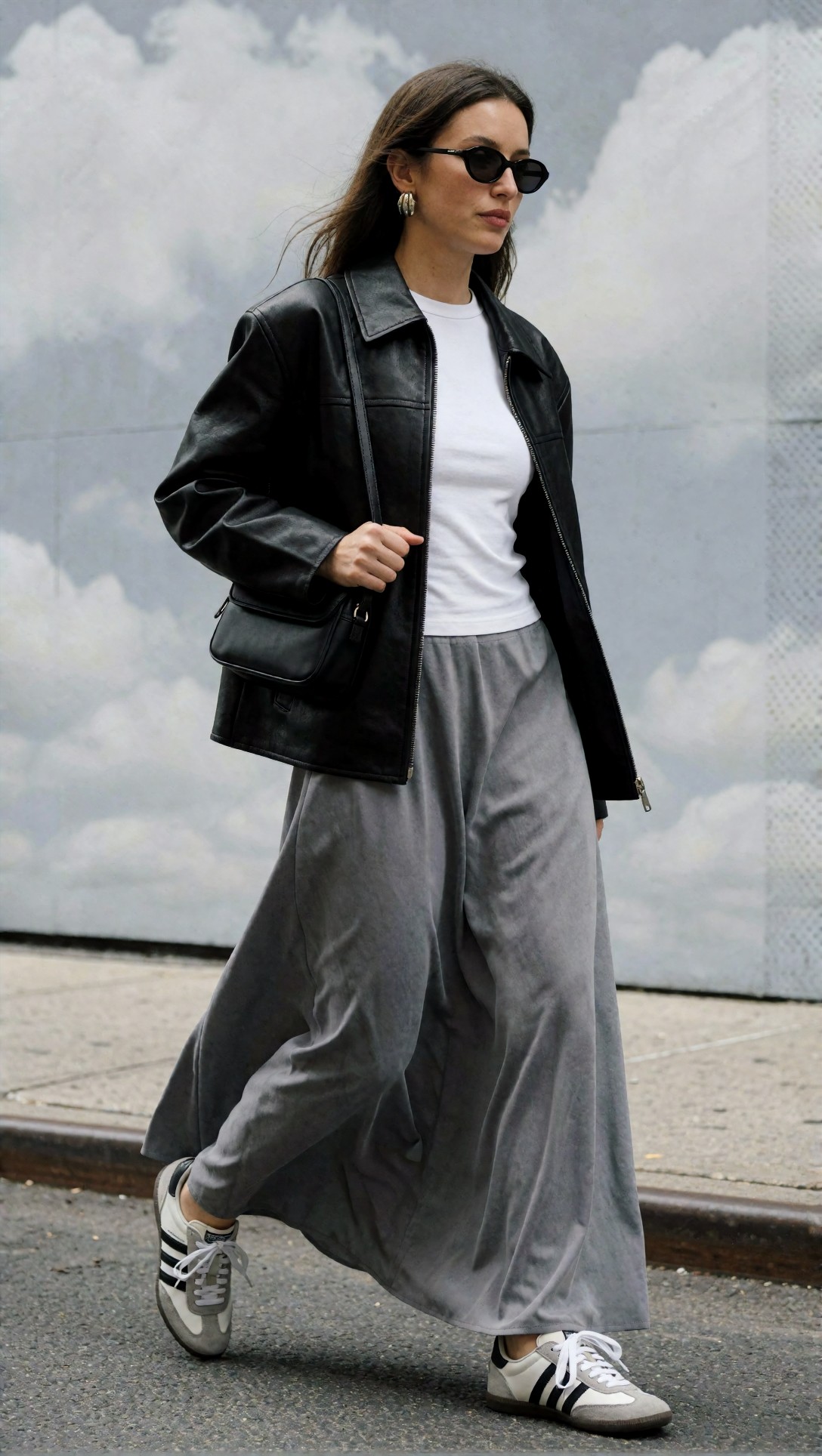
Look at the skirt volume and sneaker scale together. The image works when the sneakers feel intentionally understated; it fails when the model adds a formal heel or makes the skirt bodycon.
A practical checklist: trend formulas that tested best
| Outfit formula | Best for | Why it read current | Common failure risk | |---|---|---|---| | Long coat + knit + wide trousers + retro runners | NYC street style | Clean silhouette, commuter polish, easy layering | Looks corporate if shoes are too formal | | Open striped shirt + tank + loose denim + slim sneakers | LA street style | Relaxed proportion, warm-weather layering | Turns beachy if styling gets too bare | | Barn jacket + tee + baggy denim + tote | Search-driven american streetwear | Strong trend signal without logo overload | Can become literal workwear costume | | Leather jacket + maxi skirt + sneakers | Viral street style outfits | High-low mix feels current and wearable | Skirt shape often renders incorrectly | | Rugby or zip knit + shorts or track pant + cap | Sporty prep | Matches current casual US fashion signals | Easily drifts into college catalog styling | | Matching neutral set + technical outer layer + runners | Clean modern streetwear | Safe beginner formula for AI prompting | Too minimal if textures are missing |
Example prompts and image inspection notes
Search trend test: sporty prep without looking like a school uniform
One trend that kept appearing in search-led references was a prep-sport mix: rugby shirts, caps, athletic socks, track influence, but styled with fashion proportions. This test was meant to see if the model could hold that balance.
Topic: American streetwear sporty-prep outfit with rugby layer and relaxed shorts
Genre: Street Style
Camera: Leica SL2
Lens: 50mm f/2
Lighting: Clear afternoon sunlight with soft shadow definition
Location: Brooklyn neighborhood block with brownstone stoops and corner deli signage
Style: Contemporary American fashion editorial
Final Prompt: street-style full body image of a current American streetwear outfit, oversized rugby shirt in forest green and cream stripes layered over a white tee, relaxed tailored knee-length shorts, crew socks, low-profile leather sneakers, washed baseball cap, crossbody nylon bag, thin chain necklace, outfit shown in full on a Brooklyn sidewalk, sporty-prep styling with modern proportions, clean but lived-in textures, sunlight revealing knit and cotton detail, Leica SL2 realism, 50mm editorial framing, styling-first composition with stoops and city background kept secondary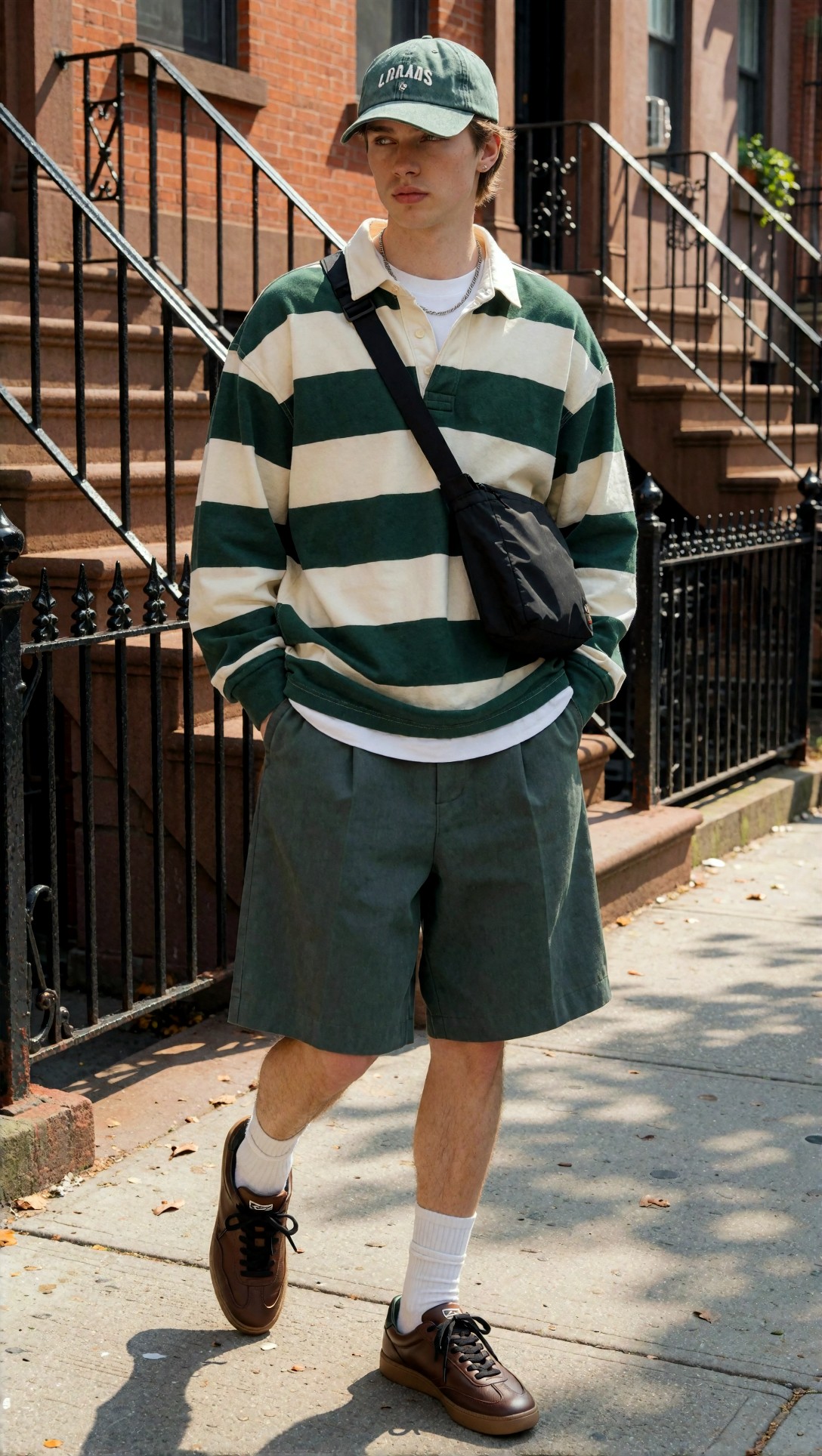
Inspect the short length and sock styling. The strongest result shows deliberate proportion; the weak result looks like generic menswear catalog styling with no fashion tension.
Online demand test: baggy denim and graphic restraint
Many beginners ask for “viral street style outfits” and accidentally push the image toward logo-heavy hype imagery. This test intentionally keeps the denim dominant and graphics secondary.
Topic: Viral baggy denim streetwear with minimal graphics
Genre: Fashion Campaign
Camera: Canon EOS R3
Lens: 35mm f/1.8
Lighting: Late afternoon urban bounce light
Location: Downtown parking structure roof with skyline distance and concrete texture
Style: Youth fashion campaign realism
Final Prompt: street-style full body fashion campaign image based on current viral streetwear outfit ideas, oversized faded black bomber jacket, washed white graphic tee with very minimal small-scale print, exaggerated but believable baggy blue denim, slim black belt, retro skate-inspired low sneakers, soft slouch shoulder bag, silver rings, rooftop urban context, relaxed stance with full silhouette visible, contemporary youth fashion without loud branding, concrete neutrals with denim blue and washed black, Canon EOS R3 dynamic detail, 35mm perspective, late afternoon bounce light, texture-rich but controlled styling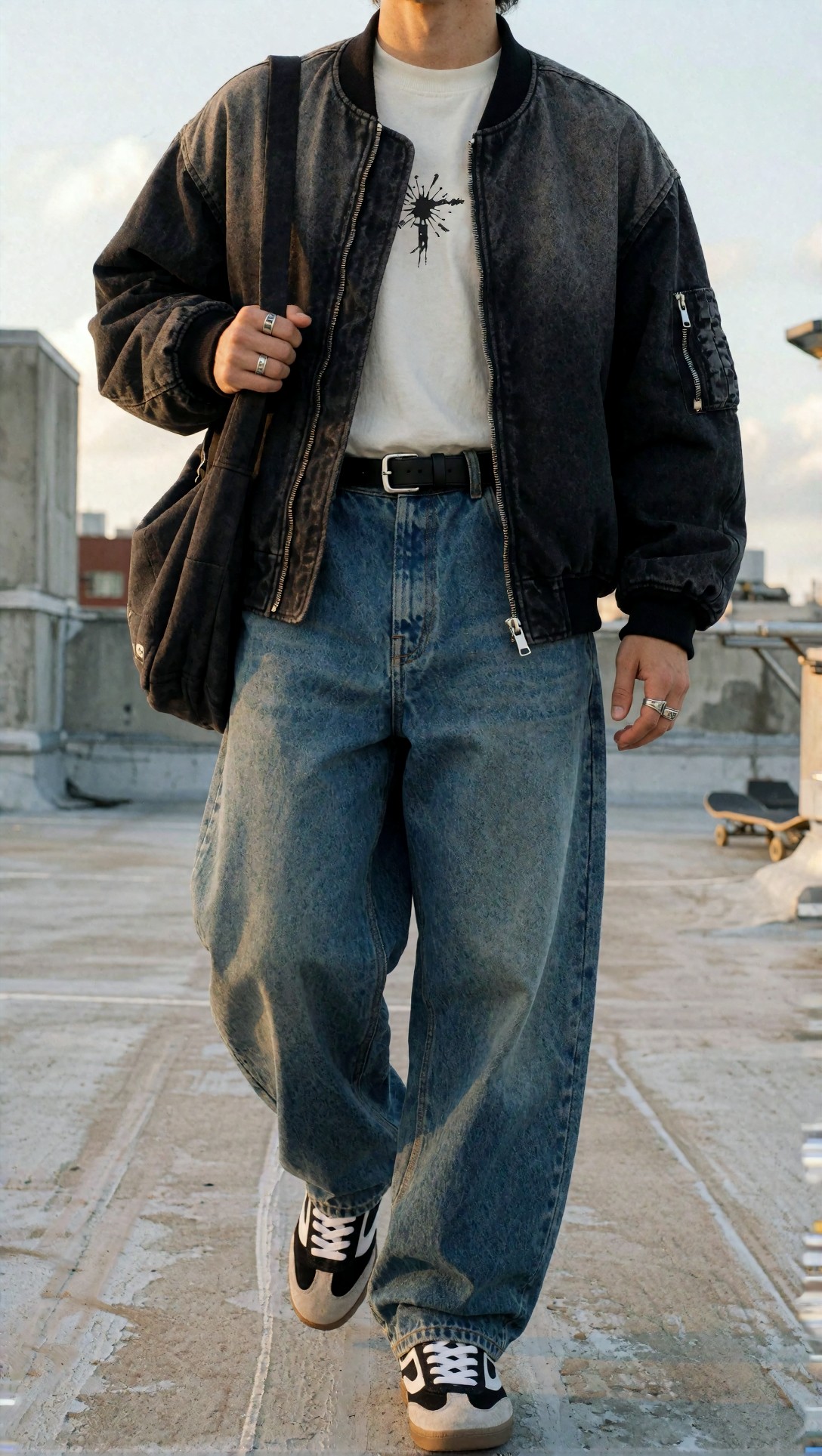
Check whether the graphic tee stays subtle. The model often wants to invent large text or logos, and that usually makes the image feel less current and less usable.
Retail-context test: what trends look strongest in a storefront display
This test helps when you want trend clarity without body-generation issues. Storefront displays are useful for trend boards, thumbnails, and merchandising concepts.
Topic: LA and NYC trend mix shown as a storefront display
Genre: Product Editorial
Camera: Panasonic Lumix S1R
Lens: 24-70mm at 45mm f/5.6
Lighting: Soft window light with controlled interior practicals
Location: contemporary boutique window in SoHo with mannequins and layered accessories
Style: Fashion retail visual merchandising
Final Prompt: storefront display image showing current US street style trends today through styled mannequins, one mannequin in charcoal long coat, gray knit, wide black trousers and retro runners, second mannequin in oversized striped shirt, white tank, loose faded denim and slim sneakers, coordinated bags, caps, sunglasses, folded knits, clean signage-free boutique window, visual merchandising focused on silhouette contrast between NYC polish and LA ease, realistic fabric drape, muted premium palette, Panasonic Lumix S1R commercial sharpness, 45mm storefront framing, soft window light, polished retail editorial feel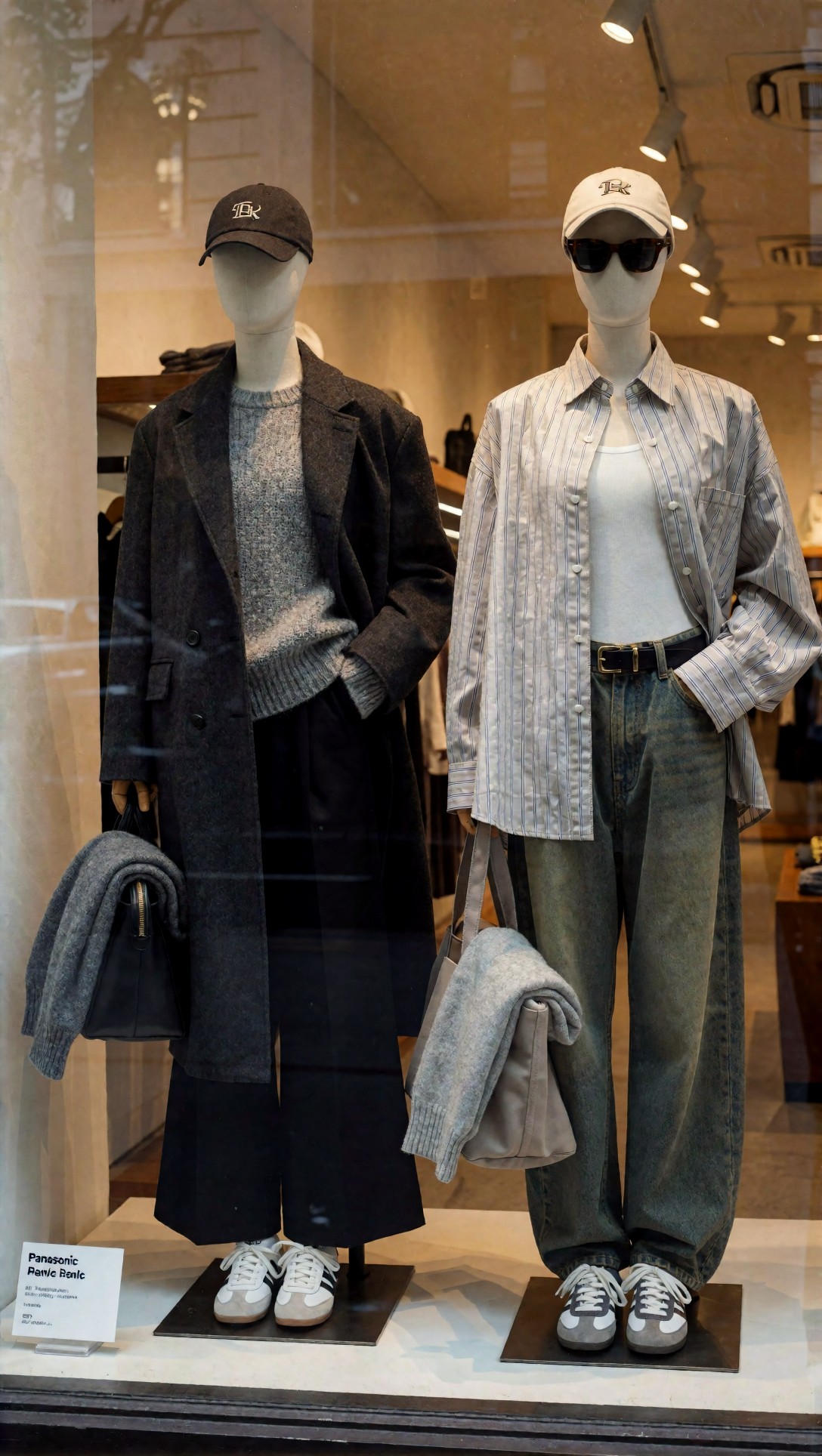
Inspect mannequin proportions, shoe pairing, and whether the window tells a coherent trend story at a glance. This setup avoids hand issues and is often more reliable for fashion articles than person-led scenes.
Product logic test: flat lay for streetwear outfit ideas
When the model struggled with body fit, I switched to a flat lay. This is not as editorial, but it is very good for checking whether the outfit formula itself makes sense.
Topic: US street style trend flat lay with barn jacket and retro sneaker
Genre: Product Editorial
Camera: Hasselblad X2D 100C
Lens: 55mm f/4
Lighting: Overhead diffused softbox
Location: neutral warm-gray tabletop studio setup
Style: Clean commercial product styling
Final Prompt: product flat lay of a current US street style outfit formula, olive barn jacket with corduroy collar, white heavyweight tee, medium-wash baggy denim, brown leather belt, retro running sneakers in silver and cream, black shoulder tote, navy cap, oval sunglasses, silver jewelry arranged cleanly on warm-gray backdrop, fashion-editor styling board feel, garments placed to show silhouette and layering order, texture-rich cotton, denim, suede and leather detail, Hasselblad X2D crisp commercial rendering, overhead diffused light, clean commercial product editorial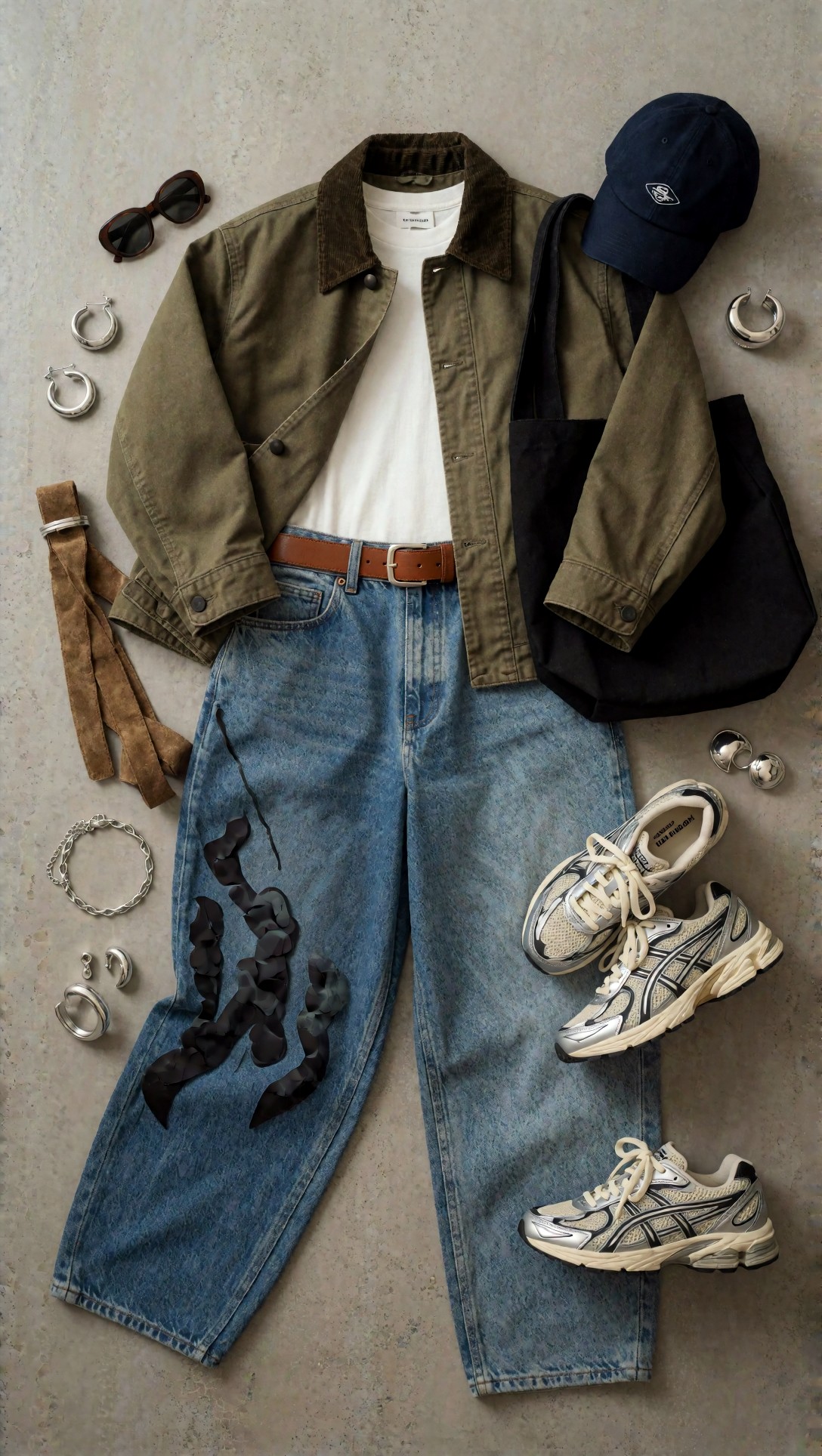
Inspect whether the pieces look like they belong to one styling system. If the shoe color or bag shape clashes, the trend signal weakens even if each item looks good on its own.
Detail test: accessories that date the outfit correctly
A lot of current street style lives or dies on accessories. This test isolates that layer, especially sunglasses, bag hardware, and sneaker materials.
Topic: Street style accessories close-up for current US trends
Genre: Luxury Campaign
Camera: Sony A1
Lens: 85mm f/2
Lighting: Soft directional window light with gentle shadow falloff
Location: café table near a city window, marble surface, blurred sidewalk outside
Style: Refined accessories editorial
Final Prompt: accessories close-up image showing the details that make current US street style trends feel updated, compact black underarm bag with subtle hardware, slim oval sunglasses, mixed-metal rings, silver hoop earrings, retro sneaker toe and sole entering frame, folded striped shirt and leather jacket edge visible, coffee cup and city window context, editorial composition focused on materials, hardware, stitching and texture, understated luxury mood, Sony A1 detail, 85mm controlled close-up, soft directional daylight, styling-led fashion accessory campaign look
Inspect material realism and scale. The best image should make it obvious why the accessories modernize the outfit; the weak one will feel random or overly luxury-coded.
When to switch models or settings
This was the most useful operational takeaway from the session.
Stay with your current model when:
- silhouette is correct
- garments layer cleanly
- accessories are coherent
- fabric textures look believable
- the scene supports the styling instead of competing with it
Switch models or settings when:
- full-body shots keep cropping at the knees
- trouser hems melt into shoes
- hands distort around bags or pockets
- logos or text appear unprompted
- the image looks polished but trend-blind
For stubborn outfit visibility issues, I would move from a busy street-style scene to a controlled lookbook or storefront display. For weak fabric detail, increase prompt specificity around material and use a cleaner lighting setup. For outputs that are compositionally right but soft, run the selected image through an [Upscaler](/upscaler) rather than overcomplicating the original prompt.
If you are building a larger set, generate your first round in [Create](/create), then keep only the formulas that hold up across two or three location variations.
What I would change next when a result misses
In this test, the most common corrections were small and practical:
- Replace “streetwear” with the actual garment stack
- Add head-to-toe or full-body to preserve shoes and hem lines
- Specify one dominant trend item only, not five competing ones
- Remove giant logos unless the image is explicitly about branded hype fashion
- Use one city cue plus one trend cue, not a list of cities
- Add bag type and shoe type every time
This final prompt checks whether a mood-board collage can summarize trend direction for planning before committing to a full campaign set.
Topic: Mood-board collage of US street style trends today across NYC and LA
Genre: Fashion Editorial
Camera: Mixed editorial capture aesthetic
Lens: Mixed 35mm and 50mm fashion documentary framing
Lighting: Blend of overcast city light, bright California sun, and clean studio fill
Location: collage panels combining Lower Manhattan sidewalks, Silver Lake streets, lookbook studio, accessories table, and storefront window
Style: Trend forecast fashion mood board
Final Prompt: mood-board collage summarizing current US street style trends today, multiple coordinated panels showing NYC tailored streetwear with long coat and wide trousers, LA relaxed denim and tank layering, barn jacket with baggy denim, leather jacket with maxi skirt and sneakers, accessory close-ups with slim sunglasses and compact bags, storefront merchandising view, flat lay styling board, muted editorial layout with cohesive gray, olive, denim blue, cream and black palette, trend-led but realistic American fashion direction, mixed documentary and commercial fashion imagery, magazine planning board aesthetic, textures and silhouette emphasized over faces
Inspect whether the collage tells a clear trend story without repeating the same outfit. This is the fastest way to see if your prompt direction is broad enough for an article but tight enough to stay current.
Strengths and weak points of this workflow
Strengths
- Good for beginners because trend formulas are easier to control than abstract aesthetics
- Works across multiple fashion shot types
- Helps separate NYC and LA styling without stereotypes
- Gives useful image evidence for informational search intent
Weak points
- Trends move quickly, so “current” depends on prompt maintenance
- Vague city references easily produce clichés
- Models often over-prioritize faces unless framing is explicit
- Complex layered garments can still break at cuffs, hems, or bag straps
FAQ
What are the biggest US street style trends today?
In this test, the clearest recurring signals were baggy or wide-leg denim, barn/work jackets, relaxed tailoring, maxi skirts with sneakers, slim retro sneakers, sporty-prep layers, and compact accessories with cleaner silhouettes.
How is NYC street style different from LA street style right now?
NYC reads more structured and layered: coats, leather, tailoring, darker neutrals, and commuter-ready bags. LA reads more relaxed and sun-faded: open shirts, tanks, loose denim, sporty accessories, and lighter warm-weather palettes.
What prompt detail matters most for fashion image generation?
Shot type plus full outfit logic. If you do not specify full-body framing and the complete garment stack, the model often hides the most important trend details.
Why do AI images of streetwear often look outdated?
Because “streetwear” alone triggers old defaults: oversized hoodies, loud graphics, and generic sneaker culture references. More specific silhouette, accessory, and fabric cues produce more current results.
Should I use street scenes or studio lookbooks for trend testing?
Start with lookbooks if you need clean outfit evaluation. Use street scenes once the formula is working and you want stronger editorial context.
Practical closing advice
If you want a fast answer to US street style trends today, focus on outfit formulas rather than trend buzzwords. In this test, the strongest setup was a named fashion shot type plus one regional context plus one clear silhouette anchor. That combination kept images current more reliably than broad labels like “american streetwear.”
Who should use this workflow: beginners building fashion prompts, editors comparing trend directions, and creators who need visual proof instead of generic trend summaries.
Who should avoid it: anyone needing exact real-time market reporting or exact retail best-seller claims. This is a visual trend-translation workflow, not a live commerce dashboard.
If I had to keep only one rule from the session, it would be this: always prompt the full styling system from outerwear to shoes, then lock the framing so the entire outfit stays visible. That single detail changed more results than any camera or lighting tweak.